
Freight Cost Management: Rate Negotiation Gets You Halfway There

February 4, 2026
•
14
mins
Most enterprises treat freight cost management as a procurement problem. Negotiate better rates, consolidate carriers, run a tighter RFP. Each initiative produces a projected savings figure at award.
Then the contract is signed, invoices start arriving, and the freight cost line in the ERP doesn't move the way the procurement team expected.
The negotiated savings exist on paper. Whether they show up in actual freight cost depends on whether the invoice compliance layer is enforcing the contracted rates, and most enterprises haven't built that layer.
Key Takeaways
- Freight cost management has two failure points: the contracting gap, where negotiated rates don't reflect the market, and the compliance gap, where contracted rates aren't enforced at invoice level. Most enterprises invest in the first and neglect the second.
- The savings realization problem is structural: a rate reduction negotiated at RFP and not enforced at invoice level produces a fraction of the projected savings, not because the carrier didn't honor the contract, but because no one compared invoices to the contracted rate before payment cleared.
- Fuel surcharges and accessorials are the highest-error-rate line items in freight invoices and the hardest to catch manually. A freight cost management program that validates base rates but not surcharge tiers misses the majority of billing errors by dollar volume.
- Unified freight spend visibility requires contracted rates, invoiced actuals, and market benchmarks in the same layer. Without all three, spend reporting shows what was paid, not whether it was correctly billed or competitively priced.
What is freight cost management?
Freight cost management is the end-to-end process of controlling what an enterprise actually pays for freight across its carrier portfolio, covering rate negotiation, invoice compliance, spend visibility, and continuous benchmarking against market rates.
Rate negotiation determines what the contract says freight should cost. Freight cost management determines whether that is what freight actually costs, by running invoice validation against contracted rates and tracking spend against market benchmarks throughout the contract period, not just at renewal.
Most enterprises have strong rate negotiation capability and weak cost enforcement:
- The RFP process is structured, benchmarked, and documented
- The invoice validation process is manual, incomplete, and running against rate cards that may or may not reflect the current contract
The gap between the two is where freight cost leaks.
What drives freight cost in an enterprise carrier portfolio?
Freight cost in an enterprise carrier portfolio is driven by three components requiring separate management: contracted rate structure, carrier mix and mode selection, and billing compliance.
Contracted rate structure
Base lane rates, fuel surcharge schedules, and accessorial fee tables collectively form the contracted rate structure. Each component has different cost management implications:
- Base rates are negotiated once per contract cycle and are relatively stable
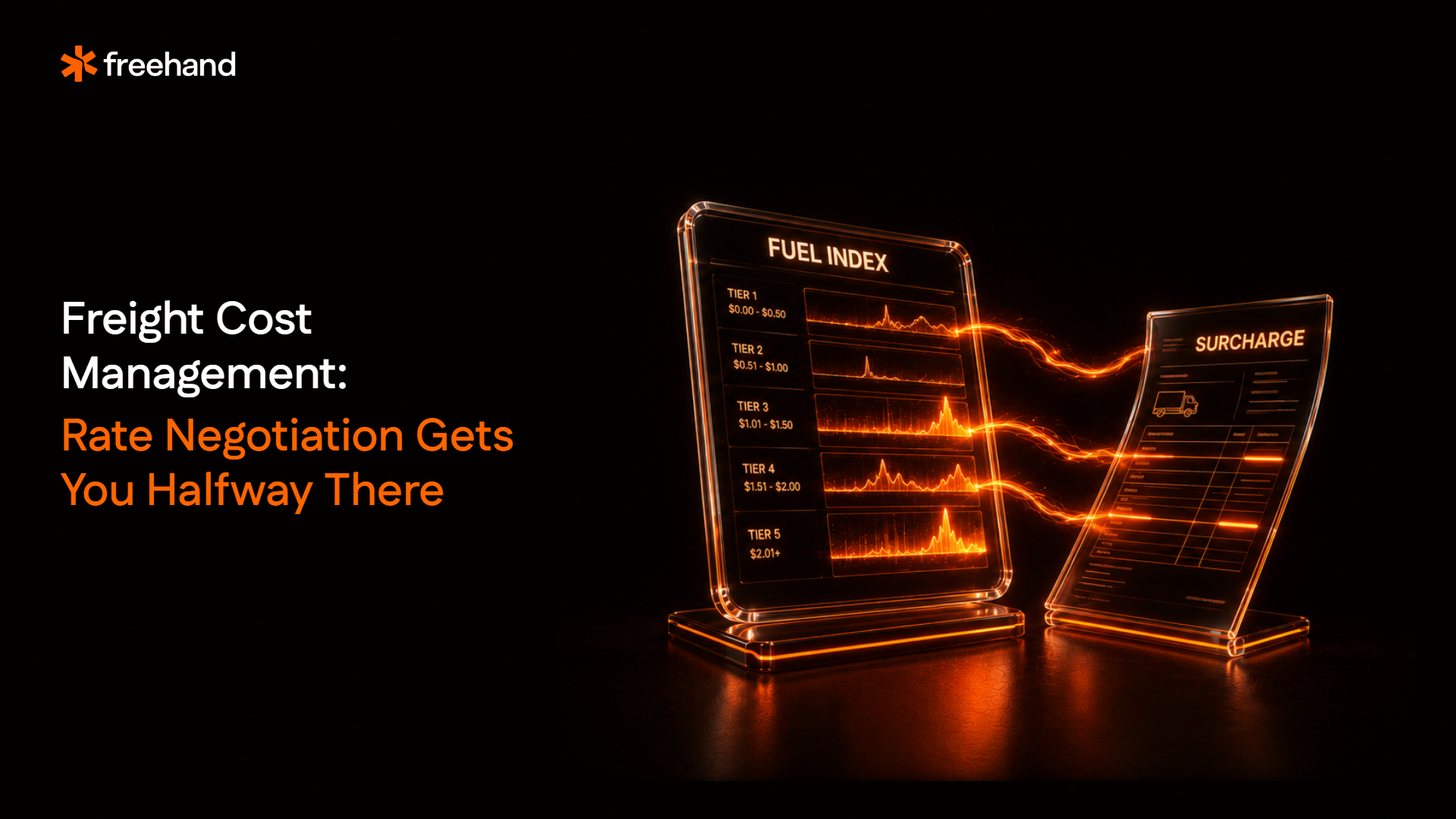
- Fuel surcharges fluctuate weekly by index and represent 15 to 25% of the freight invoice for many modes, making them the single largest variable in total freight cost from week to week
- Accessorials are billed conditionally but can inflate per-shipment cost significantly when applied incorrectly or without contract basis
The contracted rate structure only controls freight cost if the invoice validation layer is enforcing it. A base rate renegotiated down 6% midcycle controls nothing if the AP system is still validating against the original rate.
Carrier mix and mode optimization
Mode selection affects base rate, transit time, and accessorial exposure simultaneously:
- Truckload versus intermodal: intermodal typically produces lower base rates on long hauls where transit time variance is acceptable
- LTL consolidation: reduces cost per unit on shipments below full truckload threshold but introduces freight classification complexity that generates higher billing error rates
Mode optimization decisions made at the carrier sourcing stage determine the cost floor the enterprise operates from. Freight cost management can recover billing errors against that floor, but it cannot compensate for a carrier mix that was poorly optimized at sourcing.
Billing compliance
Billing compliance is the cost driver that doesn't appear separately in freight spend reports. Carrier invoices carry a 1.5 to 2.5% error rate across the average enterprise portfolio:
- Fuel surcharges billed above the contracted tier
- Accessorials applied without contract basis
- Rate misapplication where an outdated rate card drives the invoice
Those errors don't appear in the ERP as errors. They appear as freight cost. A freight spend report showing $28M in annual freight expense includes, embedded in that figure, somewhere between $420,000 and $700,000 in billing errors that cleared AP without being compared to the contract.
Where does freight cost management break down?
Freight cost management breaks down at two structural points: the contracting gap, where negotiated rates don't reflect current market conditions, and the compliance gap, where contracted rates aren't enforced at invoice level.
The contracting gap
The contracting gap is the spread between the contracted rate and the current market rate for the same lane. It opens when markets move after a contract is signed and the enterprise doesn't have a mechanism to detect the drift or act on it between RFP cycles.
A contract signed when truckload capacity was tight can be 10 to 15% above the market rate within six months if capacity loosens. By the time the next RFP arrives, the question isn't just what current market rates are. It's how much did above-market rates cost in the months the spread was running undetected.
The compliance gap
The compliance gap is the spread between the contracted rate and the rate actually applied on carrier invoices. It opens when the invoice validation layer doesn't have the current contracted rate, because an amendment wasn't propagated, the rate card in the AP system is outdated, or the validation layer doesn't exist at all.
The invoices where billing errors concentrate aren't the ones that trigger AP exceptions. They're the invoices that look correct, in standard format at plausible amounts, and clear without review because there's nothing comparing each line item to the contracted rate.
Both gaps compound over time:
- A contracting gap running for six months on a $3M lane represents $150,000 to $225,000 in above-market spend
- A compliance gap at 2% of freight spend represents $560,000 per year on a $28M portfolio that clears AP every billing cycle without recovery
What does freight cost reduction require beyond carrier negotiation?
Freight cost reduction requires four capabilities running in sequence: market benchmarking, invoice audit, spend visibility, and continuous monitoring.
Most freight cost reduction programs are procurement-heavy and compliance-light. The RFP gets attention because it has a defined timeline and a projected savings output. Invoice compliance gets treated as an AP workflow problem rather than a cost management function.
The sequence matters:
Market benchmarking
Validates that contracted rates reflect what other shippers are paying for comparable lanes. The contracting gap check that runs at RFP and, in a continuous program, between RFP cycles when rate drift can be detected and acted on before the next renewal.
Invoice audit
Enforces contracted rates by comparing every line item on every carrier invoice to the contracted rate before payment clears. The compliance gap check that recovers billing errors and ensures negotiated savings appear in actual freight cost.
Spend visibility
Aggregates validated invoice data across carriers, modes, and lanes. Shows where freight cost is concentrated, which carriers are generating the most billing exceptions, and how total cost is trending against contracted benchmarks.
Continuous monitoring
Tracks the contracted-to-market spread on active lanes throughout the contract period. Only produces freight cost savings when the monitoring data drives a renegotiation decision rather than just a periodic report.
How does unified freight spend visibility support cost management?
Unified freight spend visibility connects contracted rates, invoiced actuals, and market benchmarks in the same data layer, showing where freight cost stands relative to what was contracted and whether the contracted rate is competitive with the current market.
Most enterprise freight spend reporting pulls from the ERP: what invoices cleared AP, what was paid, what was accrued. That view is accurate in the sense that it reflects what was paid. It doesn't answer whether what was paid was correct relative to the contract, or whether the contracted rate was competitive relative to the market.
When all three are in the same layer, the spend view shows not just what freight costs but why: because the contracted rate was above market, or because the invoice didn't match the contract, or both.
The savings realization question becomes answerable. A rate reduction negotiated at the last RFP should show up as a reduction in actual freight cost per unit moved on those lanes. If it doesn't, the spend visibility layer identifies the specific carrier and lane where the contracted rate isn't being applied at invoice level.
How do enterprise teams measure freight cost management effectiveness?
Five metrics separate a managed freight cost program from a reported one.
.png)
Your freight cost shows what cleared AP. Does it show what should have?
The freight cost line in your ERP reflects what cleared AP. Whether that matches what was contracted depends on whether the invoice compliance layer compared every line item to the contracted rate before payment. For most enterprises, it didn't.
A procurement team that negotiated $1.4M in freight savings across a carrier portfolio should be able to confirm those savings are appearing in actual freight cost. In most cases, it can't. The savings exist in the signed contracts. Whether they appear in the ERP as lower freight costs depends on whether:
- Rate amendments reached the AP validation layer before invoices arrived
- Fuel surcharge tiers are being validated against the contracted formula rather than the carrier's published table
- Accessorials are being checked against the contract before they clear
The freight cost management gap isn't visible in spend reports because billing errors are indistinguishable from correctly billed spend. It becomes visible only when the invoiced rate is compared to the contracted rate at line-item level, across every invoice, before payment.
Freehand's freight audit platform automates the invoice-to-contract comparison across base rates, fuel surcharges, and accessorials, connecting the carrier contract rate to the AP validation layer and feeding validated freight cost data into the spend intelligence layer so the freight cost line in your ERP reflects what was contracted, not what cleared because no one was checking.
Frequently Asked Questions
What is freight cost management?
The end-to-end process of controlling what an enterprise pays for freight, covering rate negotiation, invoice audit against contracted rates, market benchmarking, and spend visibility across the carrier portfolio. It validates whether what was paid was correct, not just what was paid.
What are the two main failure points in freight cost management?
The contracting gap: spread between contracted rates and current market rates, opening when markets move after a contract is signed. The compliance gap: spread between contracted rates and what carriers actually invoice, opening when the AP validation layer doesn't have the current contracted rate.
Why don't freight savings from RFP negotiations show up in actual freight costs?
When the invoice compliance layer isn't enforcing new rates, invoices at the old rate clear as correct. The savings exist in the contract but are never realized in cost.
What is the savings realization rate in freight cost management?
Actual freight cost reduction as a percentage of savings projected at the last RFP or contract amendment. Below 80% indicates the compliance layer isn't enforcing contracted rates at invoice level.
What is freight spend under management?
The percentage of total carrier spend validated against contracted rates before payment. Spend that clears AP without contract validation isn't under management. At enterprises without a freight audit layer, this is often below 50%.
How do fuel surcharges affect freight cost management?
Fuel surcharges represent 15 to 25% of the total freight invoice on many modes and fluctuate weekly by index. Because the carrier's published surcharge table and the contractually specified formula often differ, surcharge errors are among the most common sources of billing overcharges.
How often should freight costs be reviewed for billing compliance?
Before each payment, not in periodic audits. Post-payment audits recover some overcharges but miss the claim window on many and allow billing errors to accumulate across multiple cycles before detection.
What data does a freight cost management program require?
Three data sources: contracted rate cards covering base rates, fuel surcharge formulas, and accessorial schedules; TMS shipment records confirming operational details needed to validate each charge; and market benchmarking data by lane and mode.