
Four-Way Matching: Why the Third and Fourth Dimensions Change Everything

June 10, 2026
•
6
mins
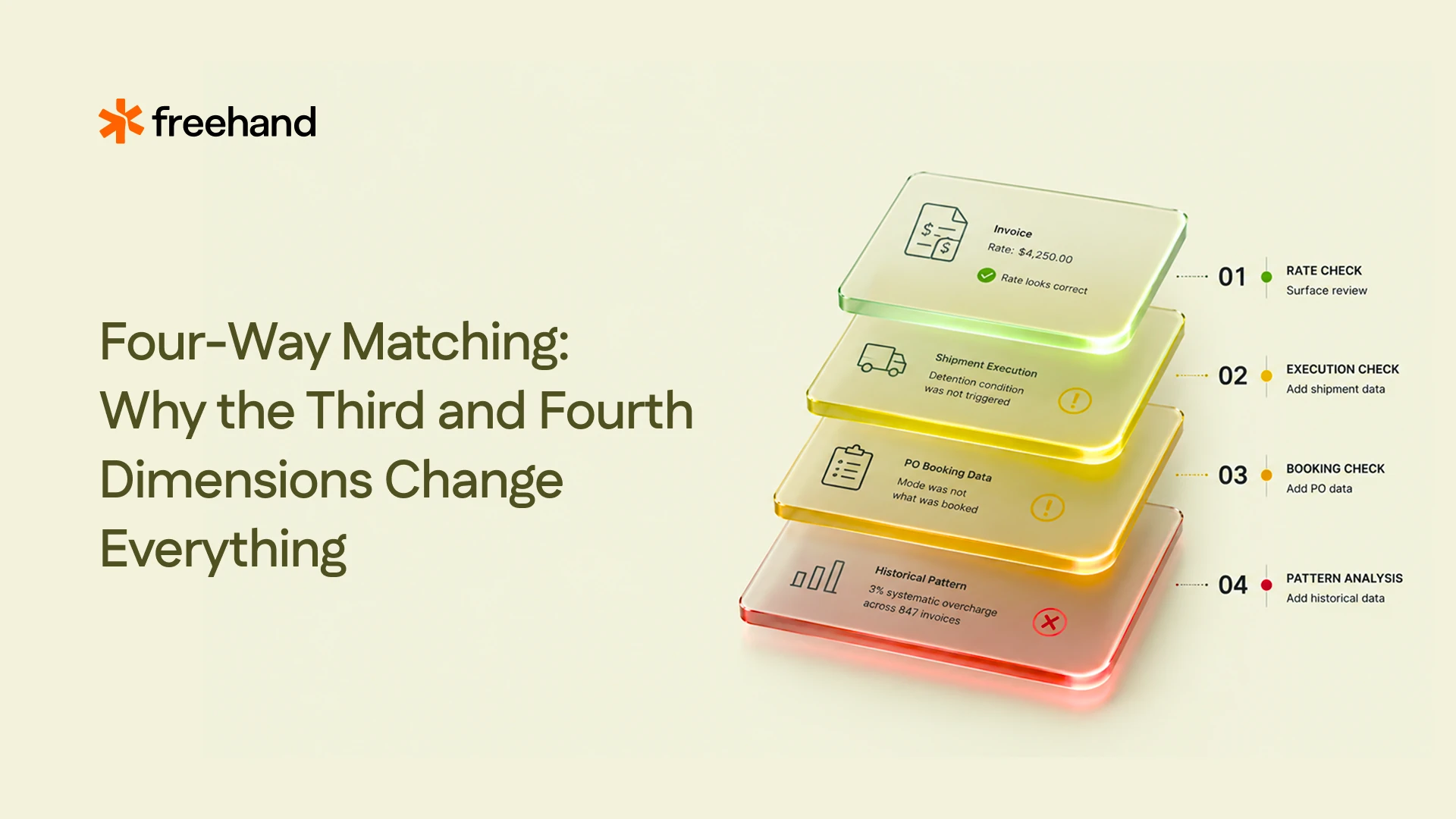
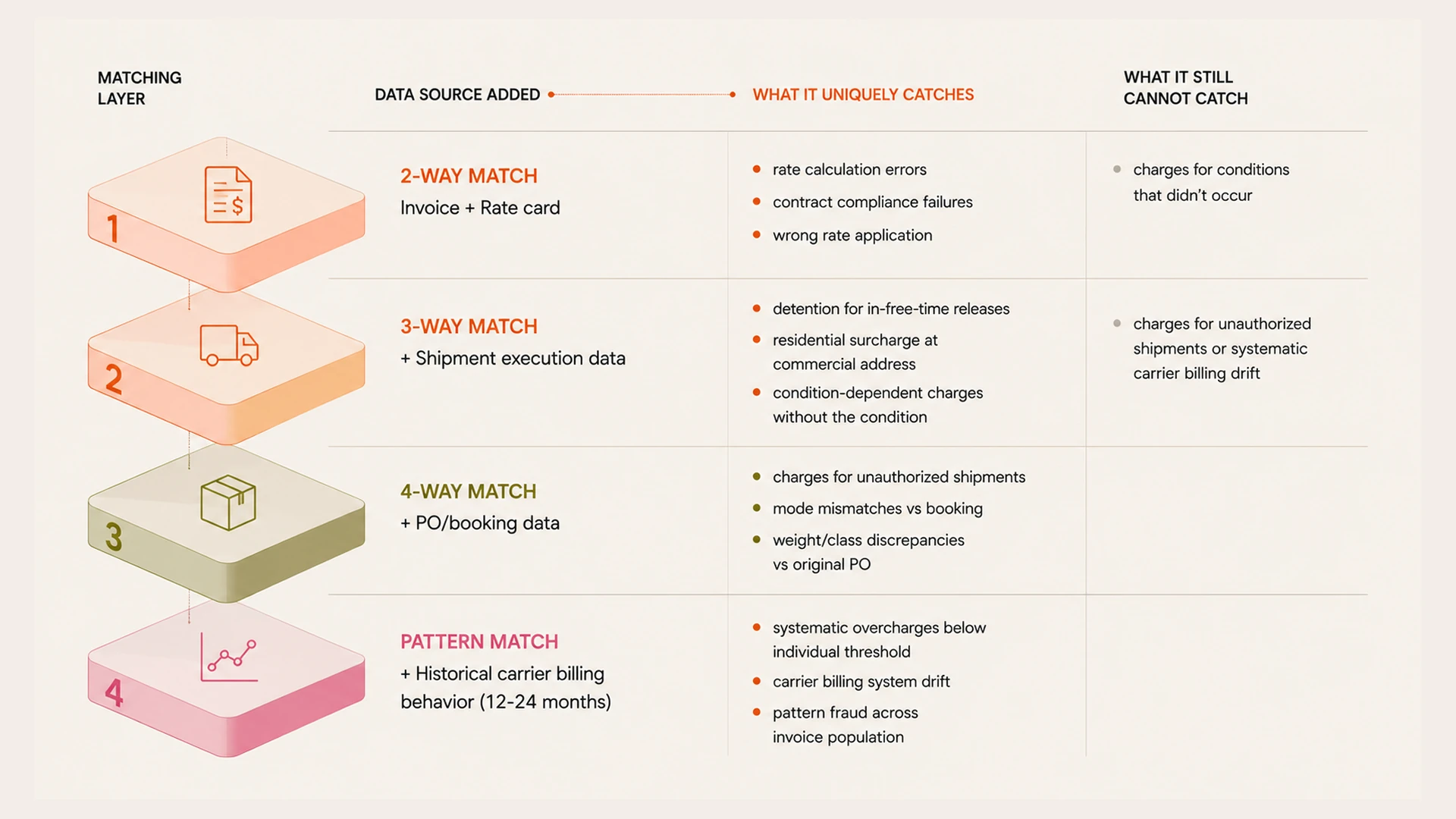
A 2-way match tells you if the rate is right. The third and fourth dimensions tell you if the charge was earned.
Two-way matching is the foundation of most enterprise freight audit programs. Compare the invoiced rate to the contracted rate. If they match, approve. If they don't, flag. This catches rate miscalculations, incorrect fuel surcharge application, and contract compliance failures. It is necessary and insufficient.
The category of billing errors that 2-way matching cannot detect is large and financially material: charges where the rate is correct but the condition that triggered the charge did not occur. A detention charge calculated at the correct contracted rate, applied to a shipment where the driver was released in one hour and forty minutes — twelve minutes before the two-hour free-time threshold. A residential delivery surcharge at the correct contracted rate, applied to a commercial address. A fuel surcharge calculated correctly, applied to an invoice where the contracted exemption window applied. The rate is right. The charge is not owed. A 2-way match approves every one of them.
What the third dimension adds
Three-way matching adds the shipment execution record to the invoice and rate card comparison. The third dimension answers the question that the rate card cannot: did the condition that triggered this charge actually occur? For detention, the execution record provides the timestamps — the driver's actual arrival and release time according to the carrier's tracking system, cross-referenced against the shipper's facility records. If the timestamps show the driver was released at one hour and forty minutes, the detention charge is disputed with the timestamps as evidence.
For address-dependent charges — residential delivery surcharges, limited access fees, inside delivery — the execution record provides the delivery address classification against the carrier's own delivery data. For condition-dependent accessorials — fuel surcharges in exemption windows, hazmat fees for non-hazmat freight, temperature surcharges for ambient shipments — the execution record provides the shipment attributes that determine whether the condition applied.
The fourth dimension: pattern matching across the invoice population
The fourth matching dimension is the most powerful and the least commonly implemented. Historical carrier billing behavior — the record of how this carrier has billed on this lane for this service type over the past 12 to 24 months — provides a statistical baseline against which current invoices can be compared. An individual invoice that is within threshold on every check but is systematically 3% above the carrier's own historical billing pattern on this lane is a pattern anomaly that warrants investigation.
This is the dimension that catches the carrier whose billing system was reconfigured after an internal update — not by an amount that triggers any individual threshold, but by a consistent small amount across every invoice since the update. Each invoice passes all three prior matching dimensions. The pattern dimension detects that the carrier's billing behavior changed at a specific date and has been consistently higher since that date on a specific charge type. The investigation surfaces the configuration error. The carrier corrects it. The systematic overcharge stops.
“The fourth dimension is not about any single invoice. It is about what 847 invoices from the same carrier on the same lane tell you that no single invoice can reveal. The signal is invisible at the invoice level. It is unmistakable at the population level.”
What the data requirements mean for implementation
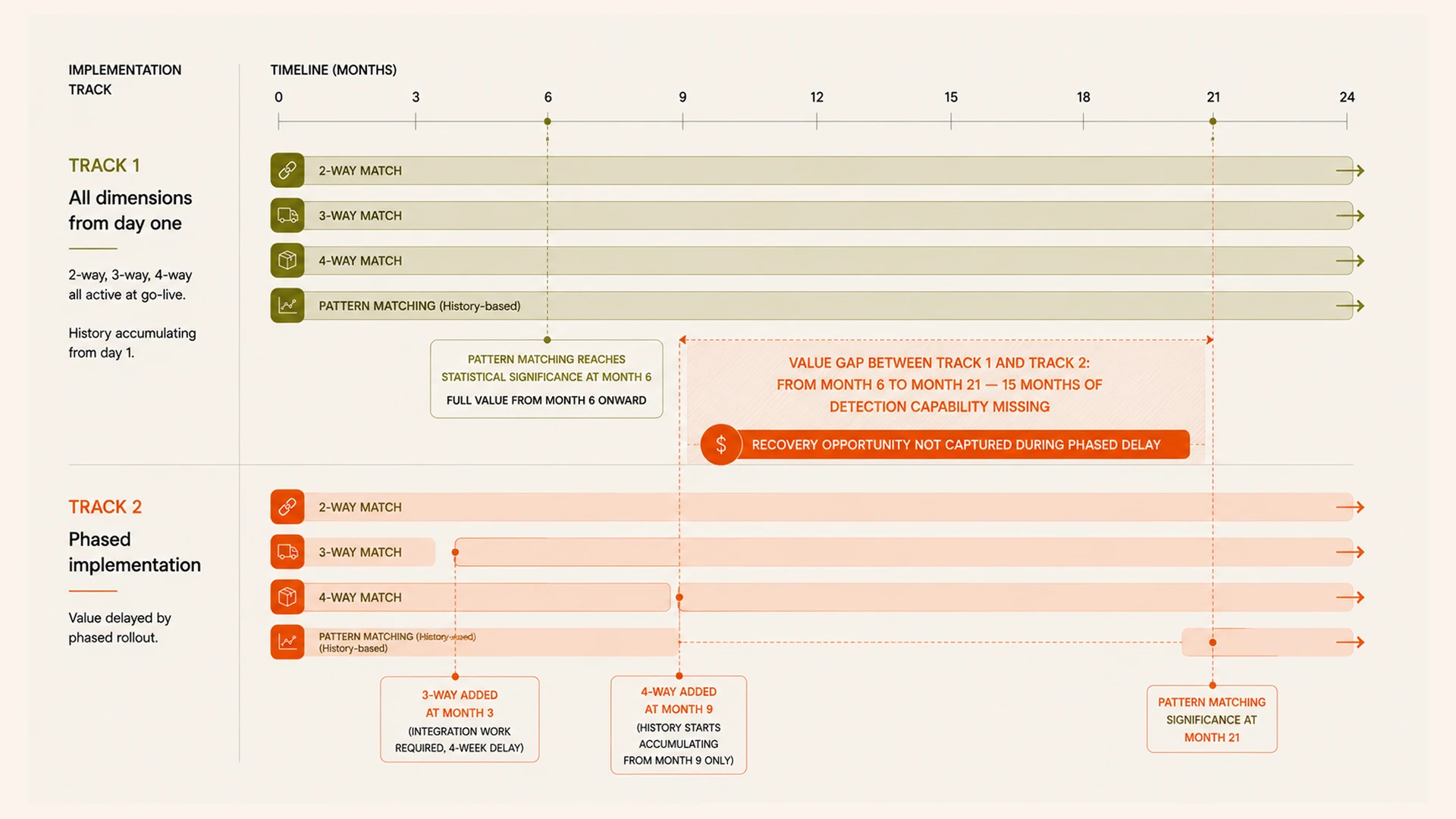
Each matching dimension requires a data source that must be connected. Three-way matching requires shipment execution data — pickup and delivery timestamps, driver detention records, exception events — from carrier tracking systems or the shipper's TMS. This is typically the connection that implementations omit because it adds time to the project scope. Four-way pattern matching requires a persistent invoice history of sufficient depth — 12 to 24 months of invoices from each carrier at adequate transaction volume to produce reliable baselines.
An implementation that starts with 2-way matching and plans to add dimensions later typically finds that 'later' is harder than anticipated. The data connections that would have been straightforward to establish at implementation require integration work when added retroactively. The historical data that would have been accumulating from the first invoice is not there when the pattern matching capability is activated six months after go-live. The dimensions that are most valuable — the third and fourth — produce the most value when they are present from the start.