
How the Logistics Language Model Differs from a General-Purpose LLM

May 20, 2026
•
6
mins
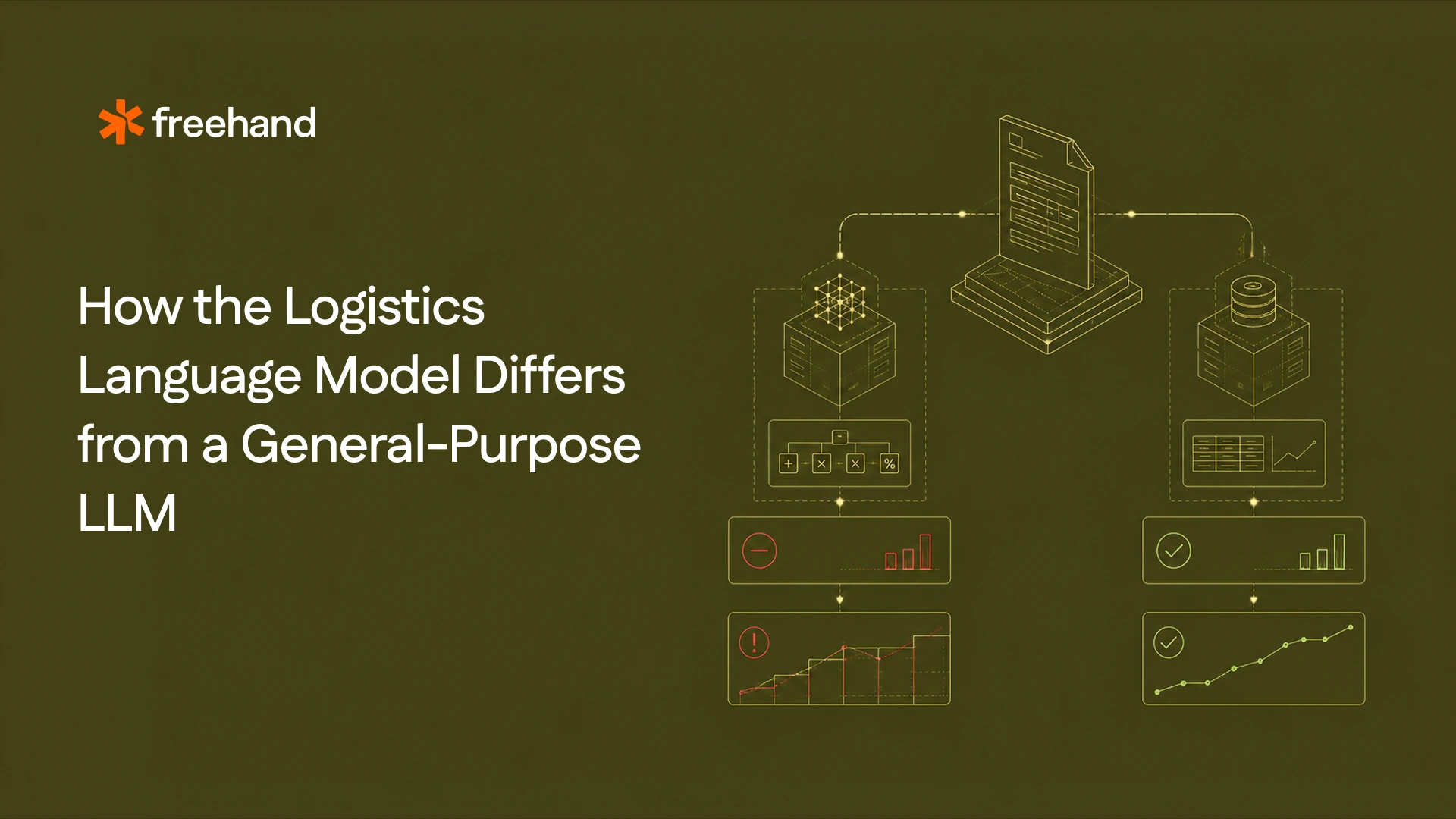
A general-purpose model understands freight. A logistics-specific model knows how your carriers actually bill. The difference is the accuracy gap.
Every LLM vendor in the market will tell you their model understands freight. They are correct. A well-trained general-purpose model has been exposed to carrier tariff documents, NMFC classification guides, freight industry publications, and regulatory filings. It can explain how accessorial charges work. It can describe the difference between LTL and FTL billing. It can draft a dispute letter. This understanding is real and it is useful for a broad range of freight-adjacent tasks.
It is not sufficient for invoice audit. The reason is the gap between how freight is supposed to work — the general framework that any well-trained model has absorbed — and how specific carriers actually bill in practice. That gap is where the billing errors live. A model that applies the general framework to a real invoice from a specific carrier on a specific lane under a specific contract vintage will produce a plausible result. Plausible is not the same as correct.
The stated rule vs observed behavior gap
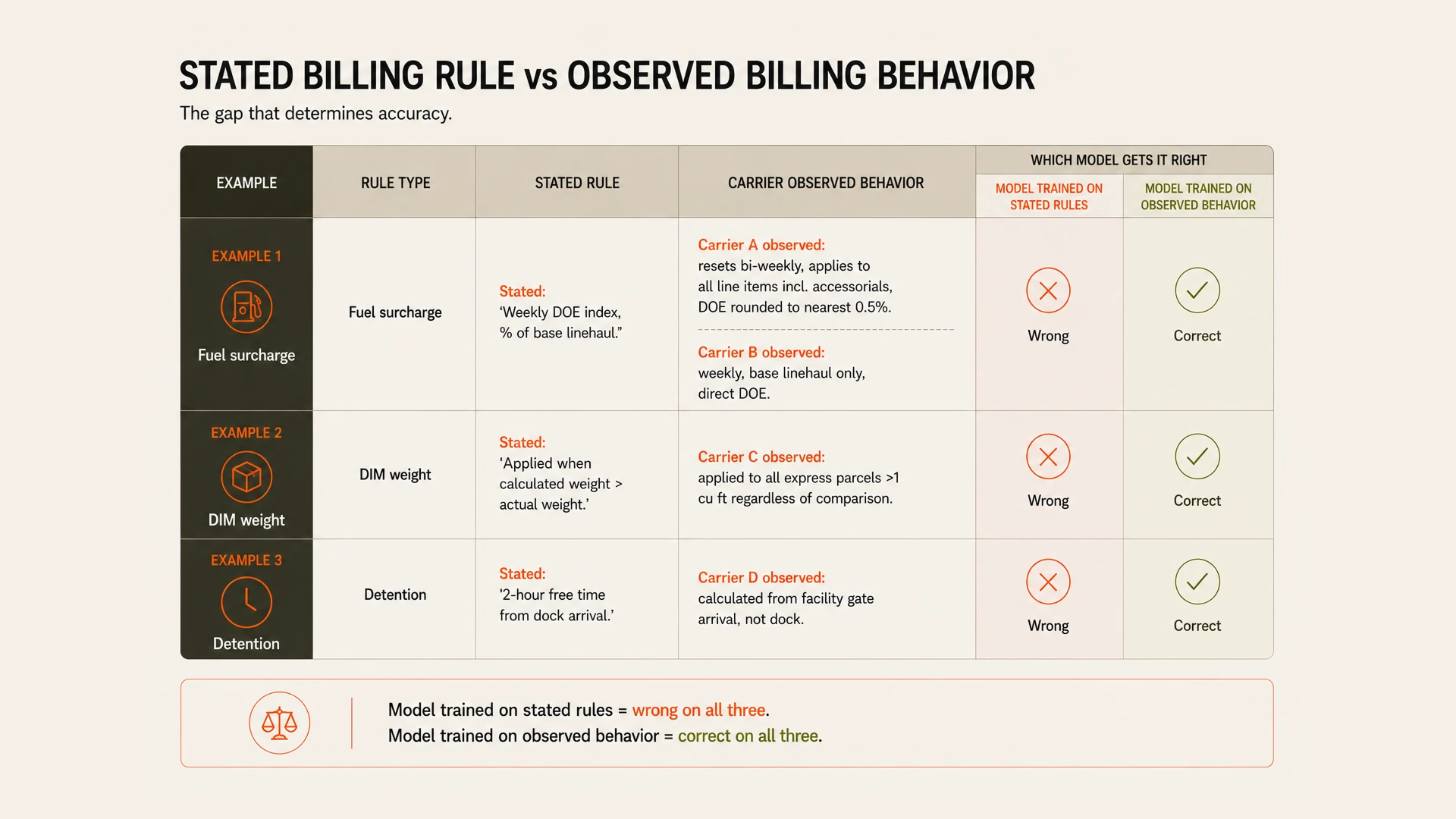
Consider fuel surcharges. The standard framework is clear: the carrier applies a weekly fuel surcharge as a percentage of base freight, indexed to the Department of Energy's weekly diesel price. A well-trained general LLM knows this. What it does not know is that Carrier A resets their fuel surcharge bi-weekly rather than weekly, applies it to all line items including accessorials rather than base freight only, and rounds the DOE index to the nearest 0.5% before applying the percentage. None of these deviations are stated in the carrier's tariff document. They are observable only from the carrier's actual billing behavior across thousands of invoices.
A model trained on the tariff produces wrong predictions for Carrier A's fuel surcharge calculation on a significant fraction of invoices. A model trained on Carrier A's observed billing behavior produces correct predictions. The accuracy difference is not marginal. For a shipper processing 500 invoices per week from Carrier A, incorrect fuel surcharge predictions on 15 to 20% of those invoices means 75 to 100 false exceptions per week — manual review load that should not exist.
What pre-training on observed billing behavior means in practice
The Freehand Logistics Language Model is pre-trained on the actual billing patterns observed from millions of freight invoices across thousands of carrier relationships — not on tariff documents, but on the invoices themselves. What Carrier A actually charges for fuel on LTL shipments from Chicago to the Southeast corridor. How Carrier B calculates detention at retail DC locations versus industrial DC locations. What NMFC classification Carrier C applies to a specific product category for a specific shipper under a specific contract that deviates from the standard classification.
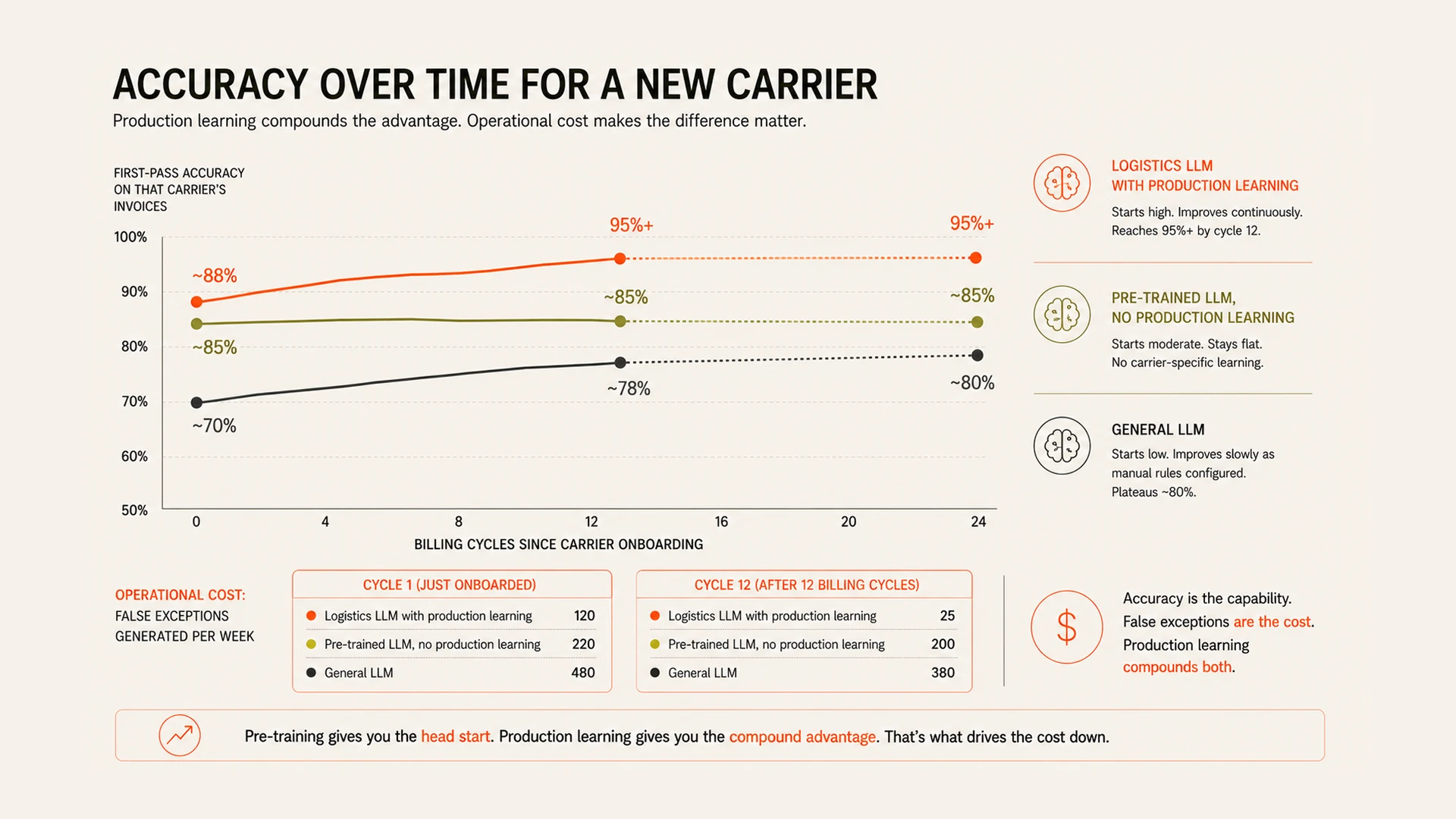
This pre-training means the model arrives with carrier-specific knowledge rather than accumulating it from scratch during the customer's implementation. Day one accuracy on a newly onboarded carrier is significantly higher than a general-purpose model because the carrier's general billing patterns are already in the model. The implementation period is about validating the pre-trained patterns against the customer's specific contract terms, not about teaching the model what freight billing is.
“A general LLM knows how freight billing works. A logistics-specific model knows how each carrier actually bills. The difference shows up as false exception volume — work that should not exist but does because the model is applying the wrong framework to a real invoice.”
Continuous learning from production data
The second distinction from a general-purpose model is continuous learning from production invoice data. As invoices are processed, the model updates its carrier-specific billing patterns based on what is actually observed. When a carrier changes their billing system after an internal update — producing invoices that deviate from their established pattern — the model detects the anomaly in the first billing cycle and flags it for investigation. The detection is not rule-based. It is pattern-based: the model knows what normal looks like for this carrier and surfaces deviation from it.
This continuous learning is what makes the model more accurate over time on every carrier it processes invoices from. At month six, the model has 24 billing cycles of observed behavior for each carrier. At month 18, it has 72. The accuracy improvement that follows is compounding — each billing cycle adds data that makes the next cycle more accurate. A general-purpose model deployed today and a logistics-specific model deployed today will produce significantly different accuracy rates on the same carrier's invoices at the 18-month mark, because only one of them has been learning from every invoice in between.