
Real-Time Accruals vs. Month-End Reconciliation: A Finance Director's View

June 13, 2026
•
7
mins
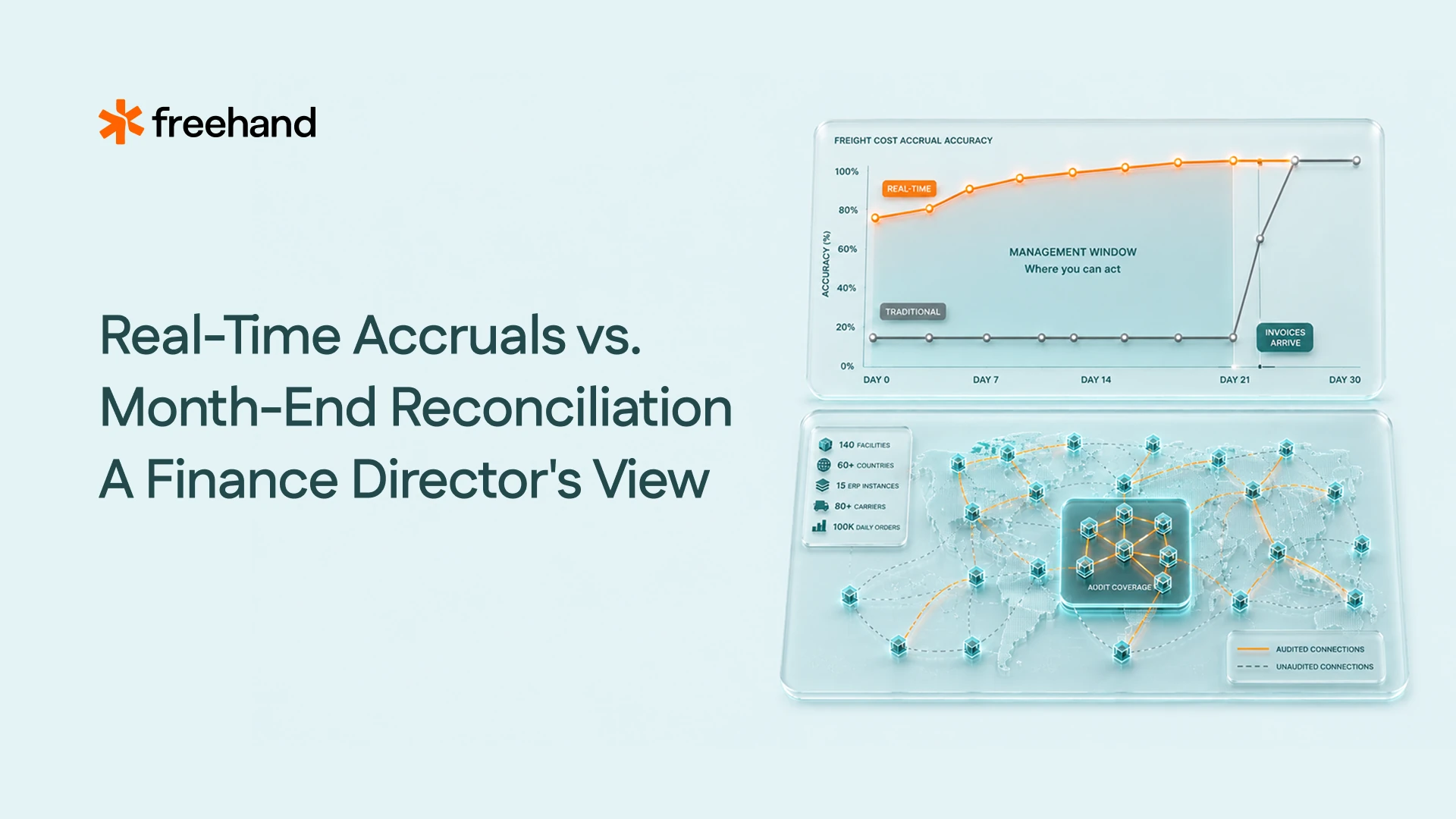
When freight costs accrue in real time, finance can manage the period instead of explaining it.
The month-end close conversation in most logistics finance functions follows a predictable script. The freight accrual from the first three weeks of the period is an estimate. The actual invoice data arrives in the final week. The reconciliation between what was accrued and what was actually invoiced produces a variance. The variance is explained, documented, and reported. The explanation is filed. Next month, the script runs again.
This is not a failure of the finance function. It is the predictable output of a freight cost model where invoices arrive 10 to 21 days after the shipment, where the audit cycle runs batch rather than real-time, and where the GL coding that assigns costs to the correct business units, regions, and cost centers happens at invoice arrival rather than at tender. The finance director is managing an accounting lag. She is not managing freight costs.
What real-time accruals require
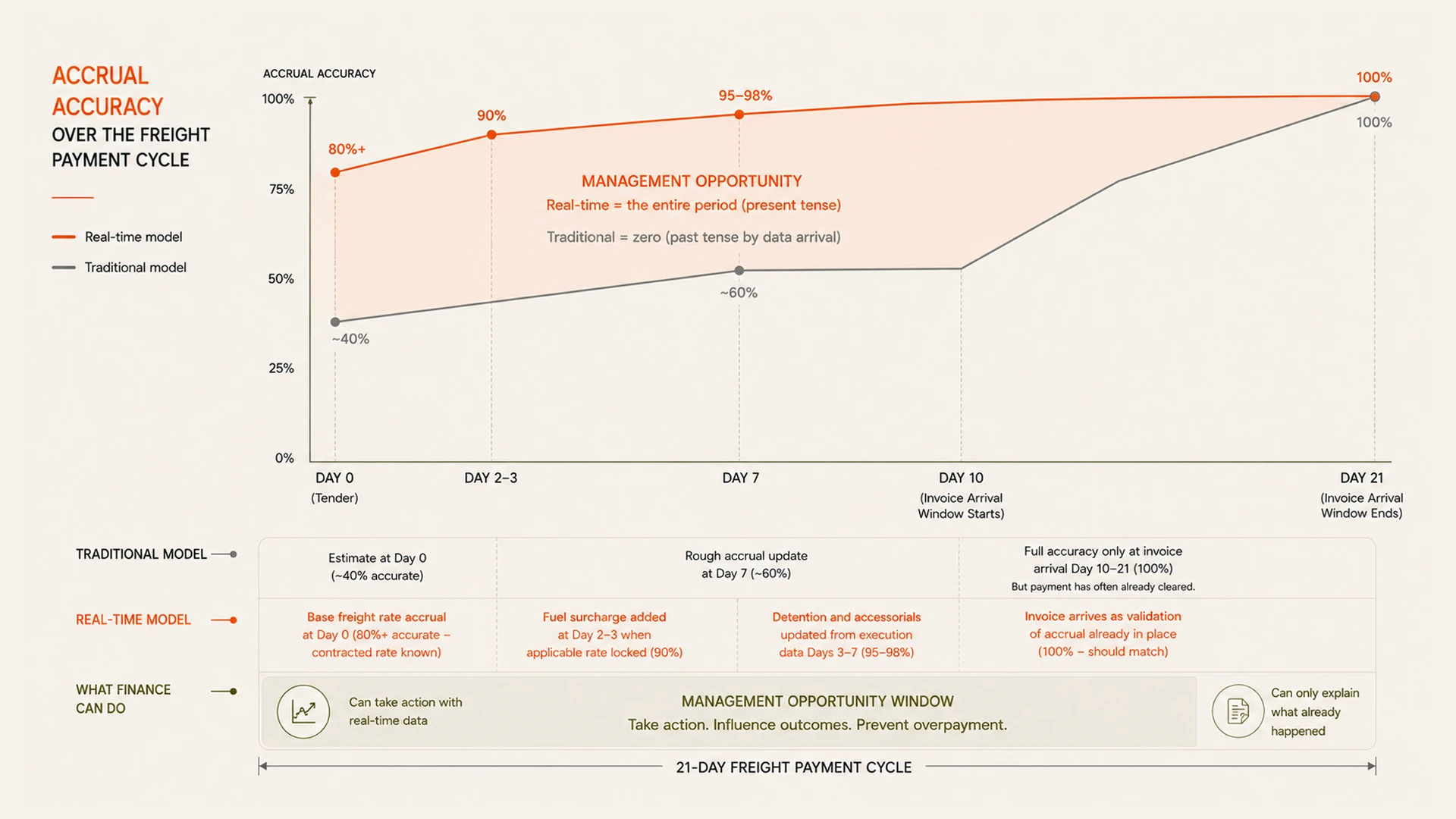
Real-time freight cost accruals require two things that most freight operations have not connected. The first is rate data at the tender moment: when a shipment is dispatched, the contracted rate for that carrier on that lane in that mode is immediately retrievable, and the estimated freight cost is coded to the correct GL account at the moment of tender. Not at invoice arrival. At tender. The accrual starts the moment the shipment starts.
The second requirement is dynamic accrual updates as additional cost elements become known. The base freight rate is known at tender. The fuel surcharge is known when the shipment closes and the applicable weekly fuel table is locked. The detention accrual is estimated at tender and updated when the actual detention time is confirmed from carrier tracking data. The accessorial charges accrue as the shipment moves and the conditions that trigger them are confirmed from execution data. By the time the invoice arrives, the accrual is not an estimate. It is a validated forecast of what the invoice will contain.
What finance can do differently
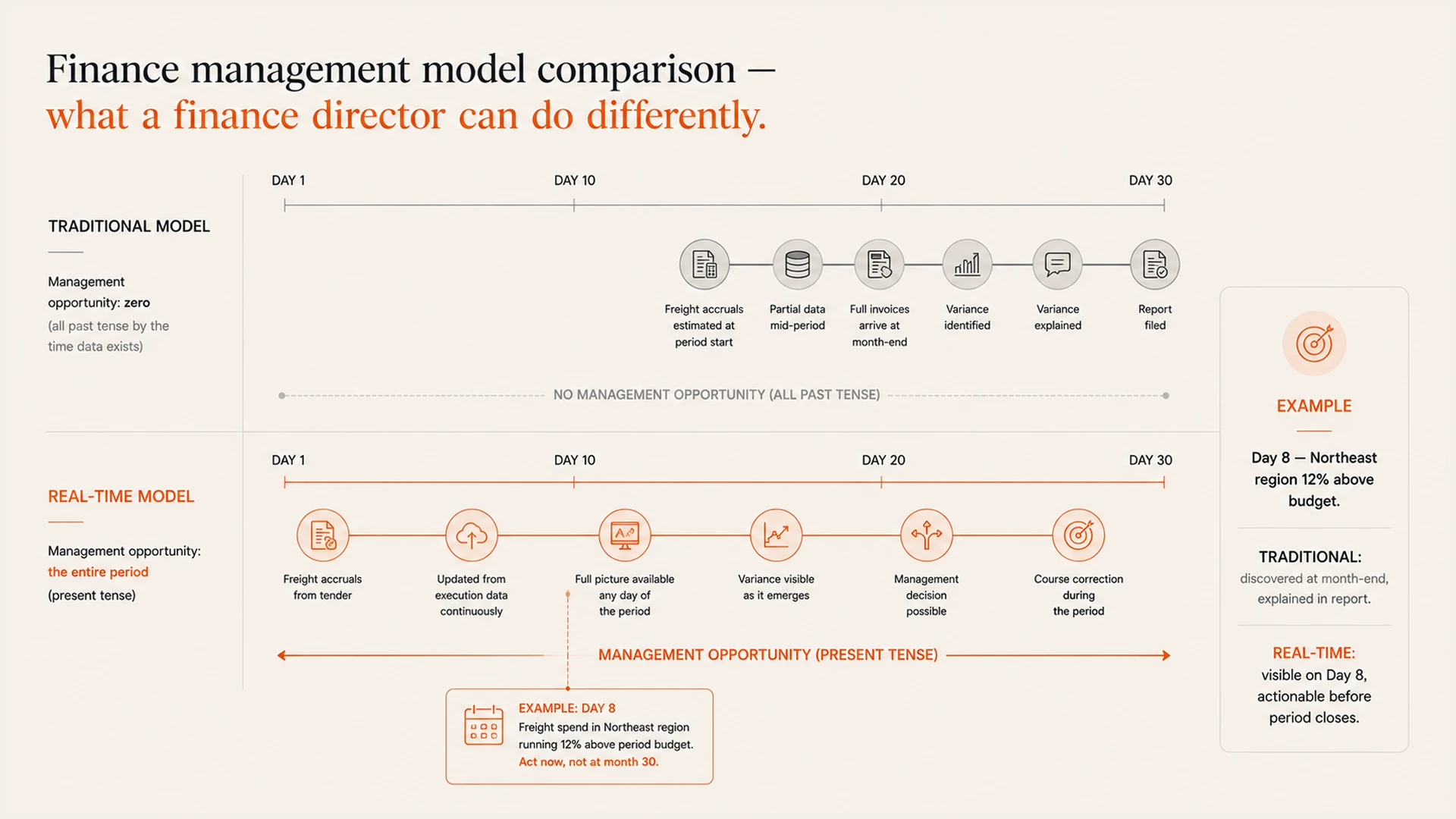
When freight costs accrue in real time at the GL level from the moment of tender, the finance director stops managing a month-end variance and starts managing an operating cost. She can see on Day 8 that freight spend in the Northeast region is running 12% above the period budget — not because she is extrapolating from a partial invoice set, but because the real-time accruals reflect the actual movements that have occurred. She can ask why before the period closes rather than explaining what happened after it closed.
The conversation with business unit leaders changes. Instead of presenting a freight cost variance at the month-end review and attributing it to volume mix or carrier price changes, the finance team can identify on Day 10 that a specific business unit's promotional shipment pattern shifted from LTL to TL for a three-week period — increasing the freight cost per unit by 22% — and raise the flag while there is still time to adjust. The variance becomes visible as a management decision rather than an accounting outcome.
“Real-time freight accruals do not improve month-end close. They eliminate the month-end freight variance as an accounting problem by converting it into a management decision made during the period.”
The GL coding accuracy requirement
Real-time accruals at the business unit or cost center level require GL coding that is correct from the moment of tender — not corrected at invoice arrival or during the month-end close. If the freight cost for a shipment that serves three business units is coded entirely to one business unit at tender and then reallocated at invoice arrival, the real-time accrual has the wrong structure even if the total amount is right. Business unit managers who see incorrect cost allocations during the period will not trust the accruals enough to act on them.
Automated GL coding at tender — where each shipment is assigned to the correct cost center, region, and business unit based on the order it is serving, the product category it is carrying, and the distribution network it is moving through — is the prerequisite for real-time accruals to be operationally useful to finance rather than just technically accurate. The Albert Heijn deployment, which produced an 81% reduction in analyst workload from automated GL coding, was solving exactly this problem: making the cost allocation correct at the moment of tender rather than correcting it manually at month-end.