
The CPG Accessorial Problem Nobody Audits

May 16, 2026
•
6
mins
One global FMCG shipper. 50% of invoices to manual review. Two legacy FAP vendors. Neither solved it.
In CPG logistics, the accessorial charge problem is structural and persistent. A single promotional event — a holiday season SKU push, a new product launch, a seasonal distribution shift — generates thousands of invoices across dozens of carrier relationships, each with accessorial charges that reflect the specific conditions of that movement. Detention at the retailer's DC because the promotional pallet configuration required manual breaking. Residential delivery surcharges because the distribution expanded to direct-to-consumer channels for the first time. Fuel surcharges indexed to a table that the carrier updated mid-promotion without notification.
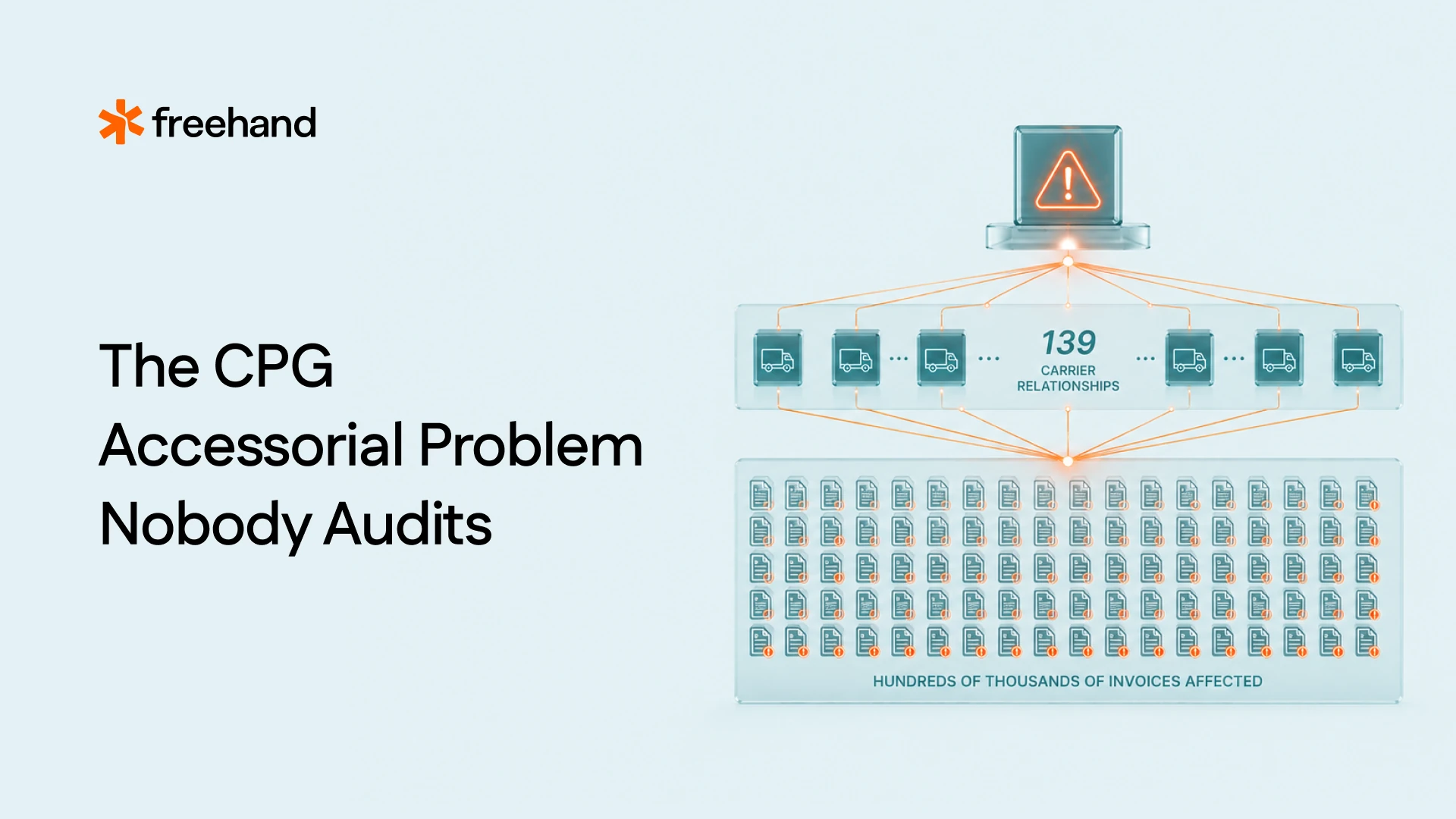
Each of these charges is individually small enough to pass a threshold-based audit. In aggregate, across a carrier base of 139 relationships and a promotional calendar that runs continuously through the year, they represent a material and largely invisible cost that sits outside the scope of standard freight audit.
What 50% manual review actually means
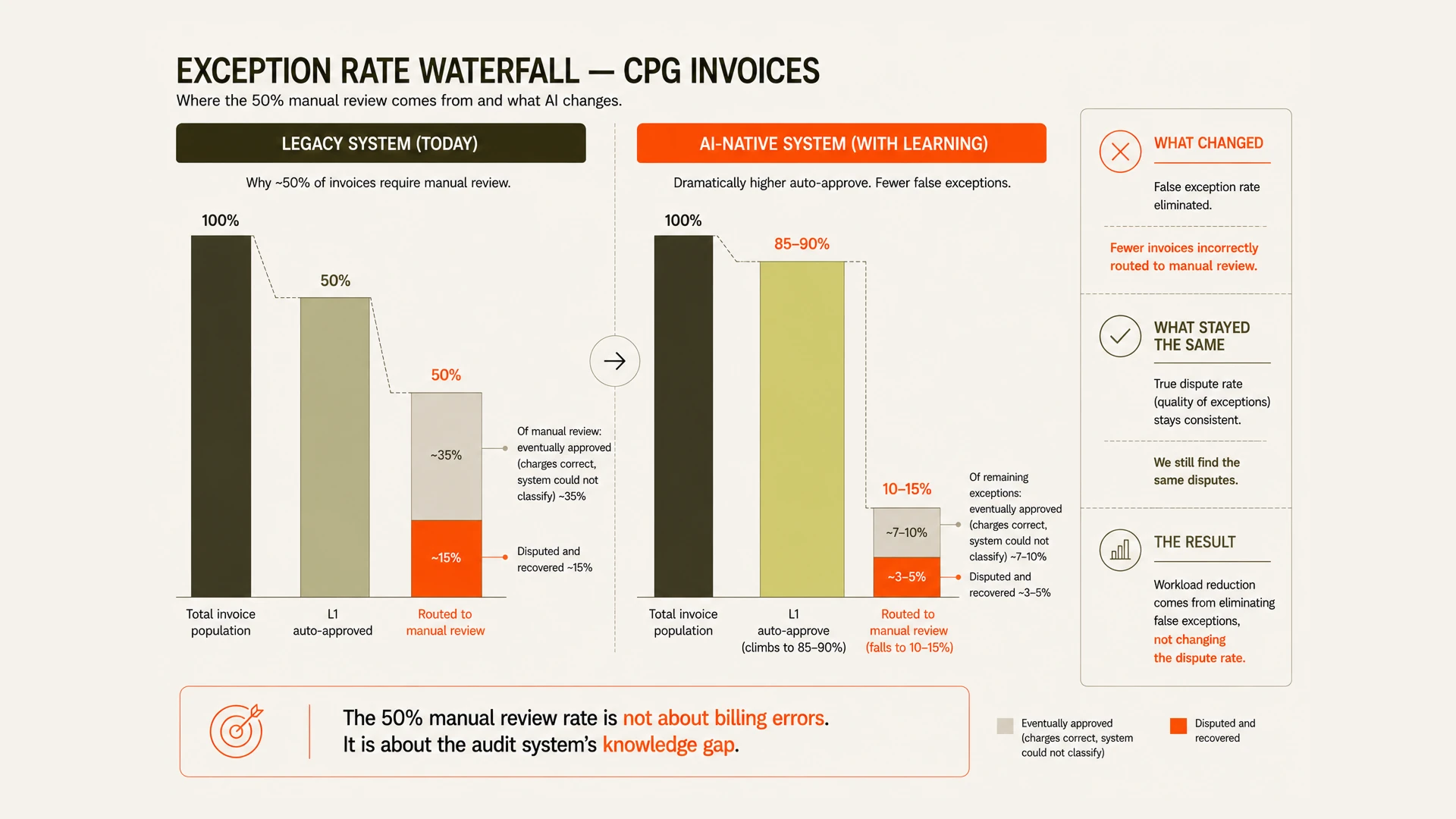
One of the world's largest FMCG companies ran freight audit through two of the largest legacy FAP vendors simultaneously — one for North America, one for Europe. Combined, these two established vendors were routing 50% of the company's invoices to manual review queues every month. Not 50% of exception invoices. 50% of total invoice volume. Every other invoice that arrived required a human to look at it before it could be approved or disputed.
The manual review rate was not caused by a high underlying billing error rate. Most of those 50% of invoices were eventually approved. The problem was that the audit logic built into the legacy systems — rule-based, configured at implementation, updated manually when anyone noticed a gap — could not classify the accessorial charges on CPG promotional freight with enough specificity to auto-approve them. The charges were not wrong. The audit system simply did not know enough about promotional freight billing to distinguish the correct charges from the incorrect ones.
The pattern that made 139 carrier relationships unmanageable
The root cause of the 50% manual review rate was not complexity per se — it was unlearned complexity. Each of the 139 carrier relationships had their own accessorial structure, their own promotional billing behavior, their own history of exceptions and resolutions. A rule-based audit system, configured at implementation and updated only when errors were manually identified, could never keep pace with the rate at which carrier billing behavior evolved across a carrier base of that size.
Promotional freight billing is particularly unstable. Carriers adjust their accessorial structures for promotional periods. Detention calculations change when the retailer DC is under peak-season constraints. Zone-based surcharges shift when new distribution points are added. Each change creates a category of invoices that the audit system has not seen before and cannot classify confidently. The default is manual review.
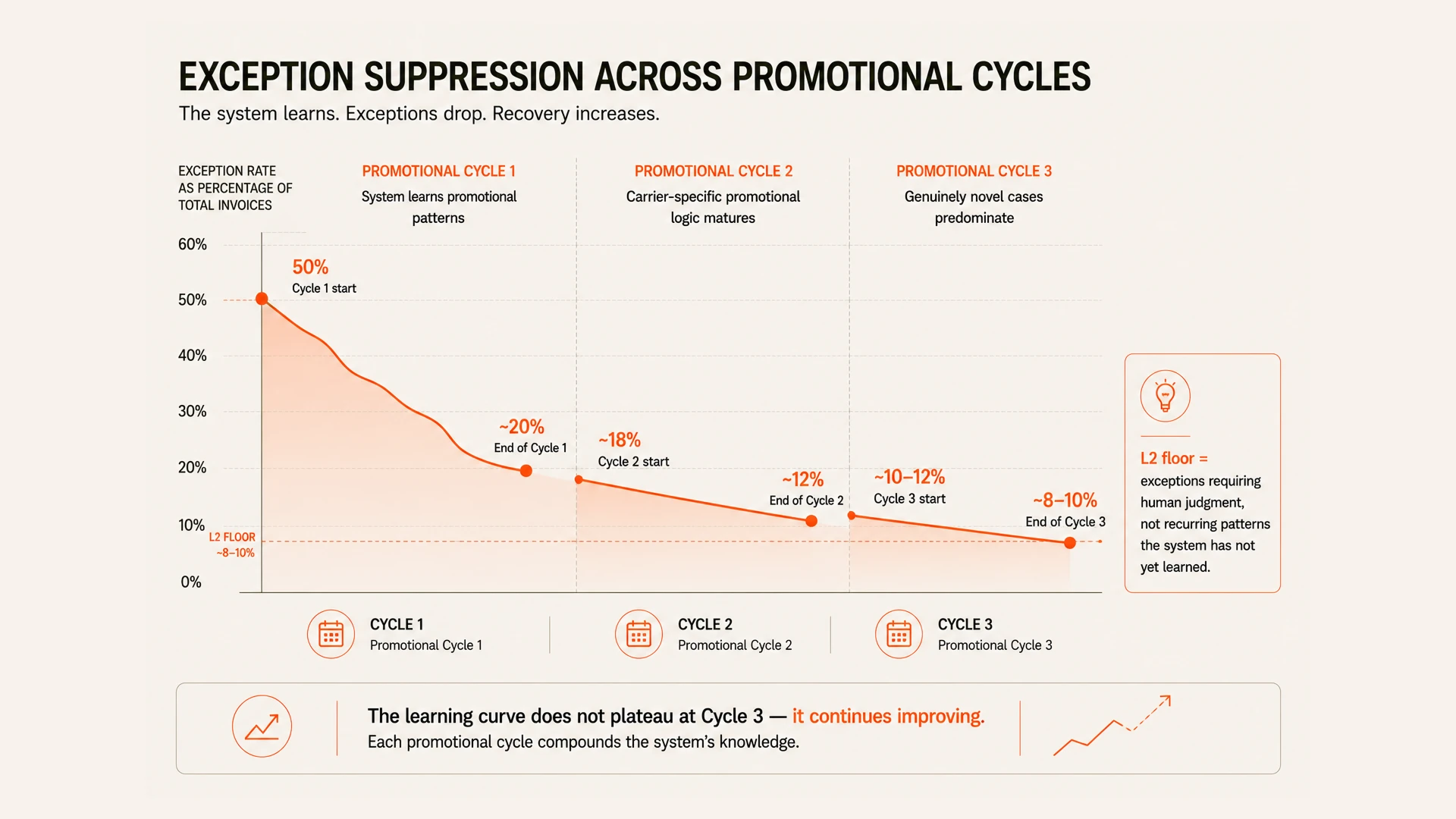
Within 90 days of deploying an AI-native audit system trained on CPG promotional freight patterns, the recurring exception rate dropped by 70%. Not because the carriers changed their billing. Because the system learned enough about each carrier's actual billing behavior — not their stated billing rules, but their observed billing behavior across thousands of promotional invoices — to classify and approve charges that had previously required human review every cycle.
“The 50% manual review rate was not a carrier billing problem. It was an audit system knowledge problem. The carriers were billing consistently. The audit system simply didn't know what consistent looked like for each of them.”
What carrier-specific promotional logic requires
Auditing CPG promotional freight accurately requires a system that has been trained on promotional billing patterns at the carrier level — what each carrier charges during promotional periods, how their accessorial triggers differ from their standard service billing, and how their billing behavior has changed over time. This is not something that can be configured into a rules engine at implementation. It has to be learned from the invoice data.
The 70% exception suppression that follows from this learning is not a one-time improvement. It compounds. As each subsequent promotional cycle is processed, the system's understanding of each carrier's promotional billing behavior becomes more precise. Exception types that survived the first 90 days get suppressed in subsequent cycles as their patterns are identified. The exception queue does not just shrink — it stabilizes at a floor that represents genuinely novel cases, not the same recurring charges that the system has seen hundreds of times.