
When Your 3PL Audits Its Own Invoices

June 17, 2026
•
6
mins
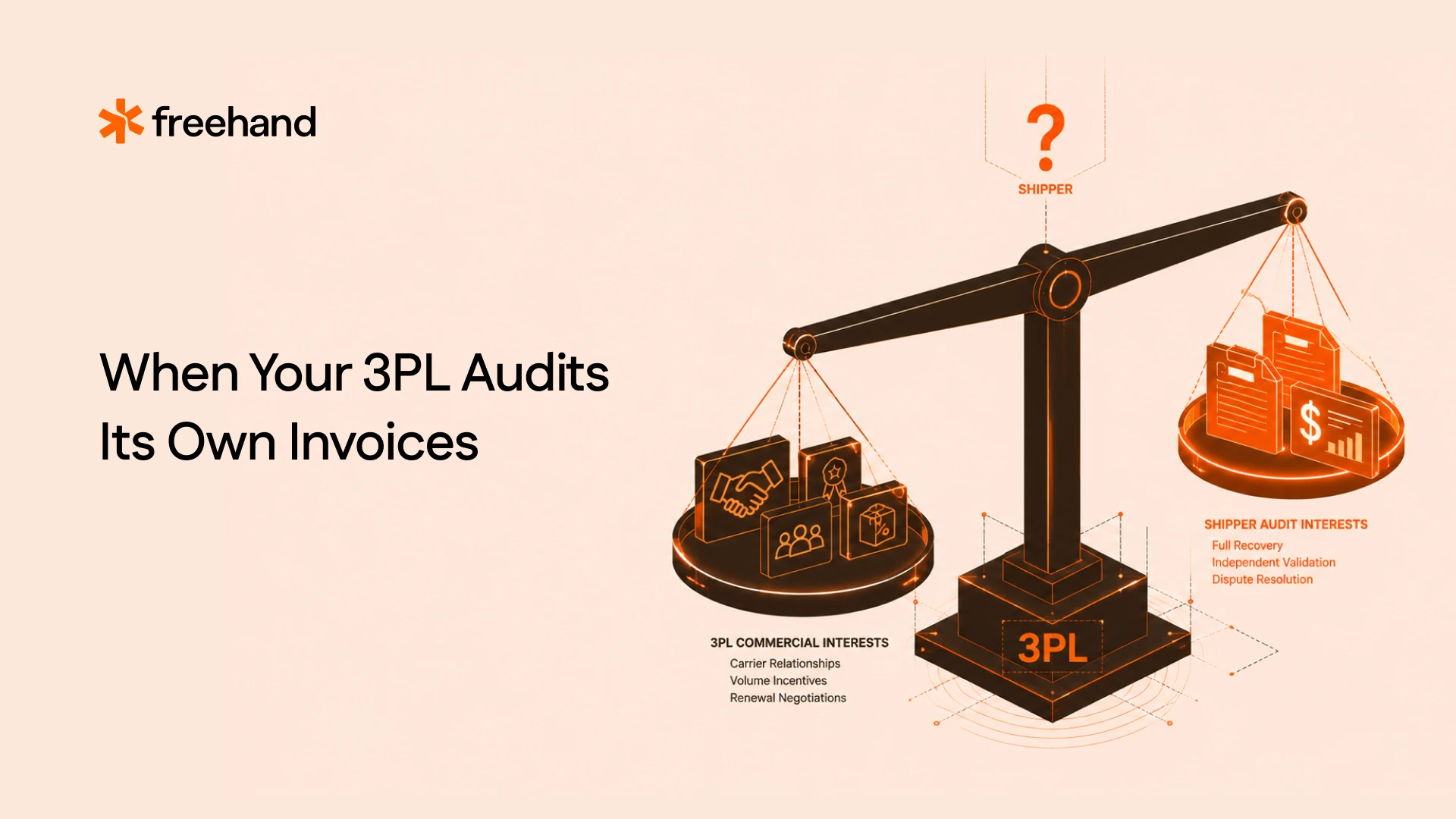
The structural conflict of interest in broker-managed freight audit is not a relationship problem. It is an architecture problem.
Ask your 3PL how they handle billing discrepancies, and most will describe a process that sounds reasonable. They review invoices from their carrier network. They flag charges that appear incorrect. They dispute overcharges on your behalf. The process is internal to the 3PL. The result lands in your monthly report as a recovery credit.
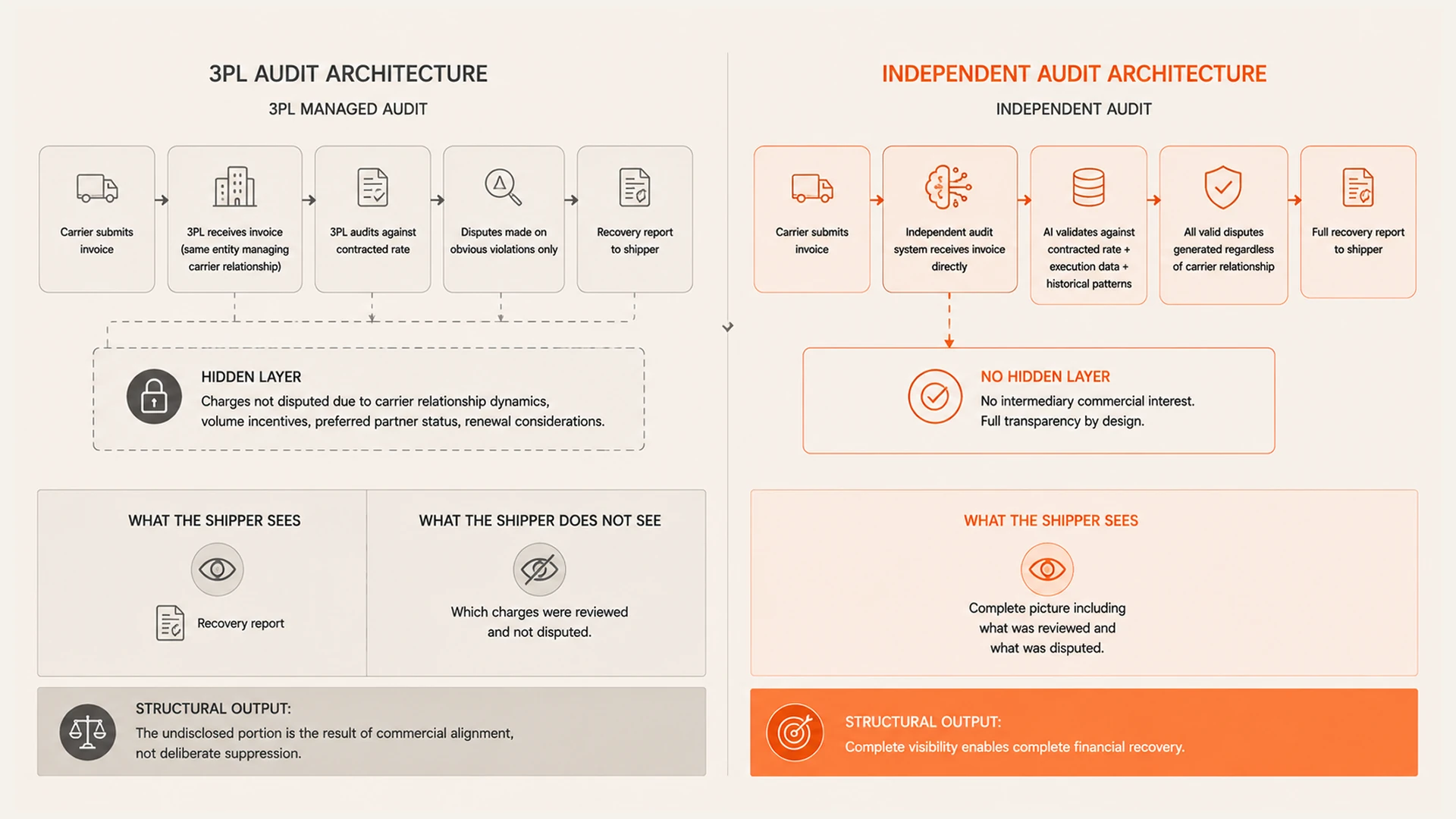
What this description omits is the structural architecture: the 3PL is auditing invoices from carriers in a network they manage, using rates they negotiated, under contracts where they may have commercial relationships that extend well beyond your freight movements. The incentive to find and return overcharges competes with the incentive to maintain carrier relationships. The incentive to surface systematic billing errors from a carrier competes with the incentive to renew that carrier's contract on favorable terms for the 3PL's broader book of business.
How the conflict manifests in practice
The conflict of interest in 3PL-managed audit rarely manifests as deliberate suppression of recoveries. It manifests as systematic incompleteness. The charges that get disputed are the ones with clear contractual violations — wrong rate, wrong lane, obviously incorrect calculation. The charges that do not get disputed are the ones that require the 3PL to challenge a carrier relationship: the systematic detention overcharge from a carrier who handles 20% of the 3PL's volume across multiple client accounts, the fuel surcharge indexing that has been slightly wrong for six months but was never formally raised because the carrier is a preferred partner.
The shipper in this model receives the disputes that were easy to make. The disputes that would have required the 3PL to act against its own relationship interests were never made. The shipper has no visibility into which charges were reviewed and not disputed, because the audit process is internal to the 3PL. The outcome is a recovery report that shows consistent performance but understates the total recoverable pool.
The FTL and dedicated gap
The modes most affected by 3PL audit conflicts are the ones with the highest per-shipment value and the deepest 3PL relationships: FTL, dedicated fleet, and temperature-controlled freight. These modes also happen to be the ones that receive the least rigorous independent audit coverage in most enterprises — not coincidentally. The carriers who operate these modes have the most significant commercial relationships with the 3PLs that manage the freight, and therefore the most protection from aggressive audit.
A food and beverage company with €350 million in annual freight spend found that FTL and dedicated lanes represented over 60% of total freight cost but less than 20% of audited invoice volume. The discrepancy was not an oversight. It was the structural output of an audit architecture that was managed by the same entity that had commercial relationships with the carriers on those lanes.
“The 3PL is not auditing your invoices. The 3PL is auditing invoices from carriers it has relationships with, using a process that it controls, on terms that it sets. That is a different thing.”
What independent audit architecture requires
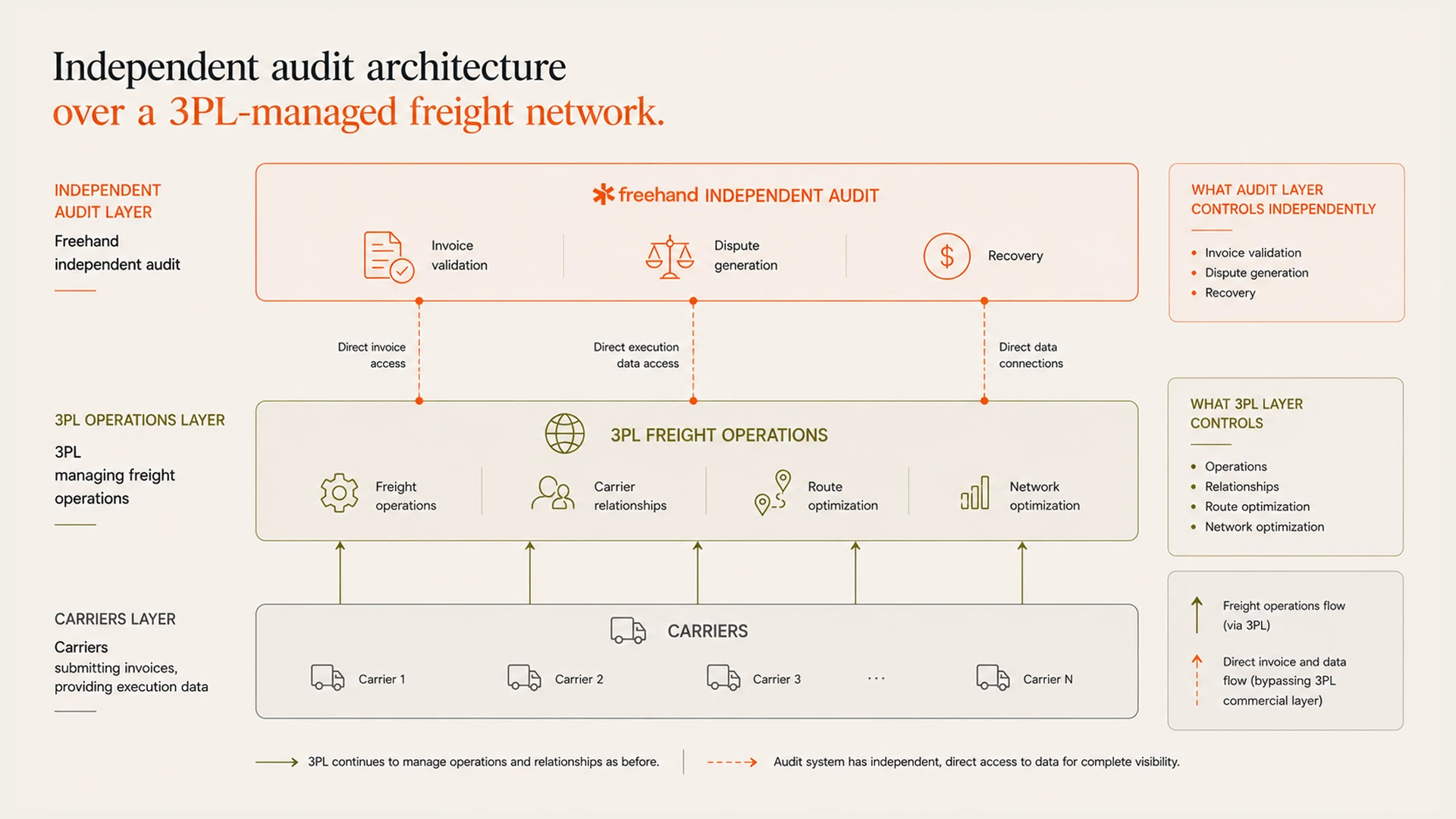
Independent freight audit requires separating the audit function from the carrier management function — not just organizationally but architecturally. The audit system must have direct access to the carrier invoices, not mediated through the 3PL. It must have access to the contracted rates that govern those invoices, not rates that the 3PL has summarized or interpreted. It must have access to the shipment execution data — from the shipper's TMS or from carrier tracking systems directly — not from the 3PL's records of what it told carriers to do.
When Freehand operates as an independent audit layer over a 3PL-managed freight network, the connection is directly to the carrier invoices and carrier data sources, not through the 3PL. The 3PL continues to manage carrier relationships, freight operations, and network optimization. The audit function operates with complete independence from those relationships. The disputes generated are based on the contracted rates and the execution data, not on the 3PL's commercial calculus about which disputes are worth making.