
Why the Freight Audit Market Is Growing at 13.8% CAGR and Nobody Talks About It

May 27, 2026
•
6
mins
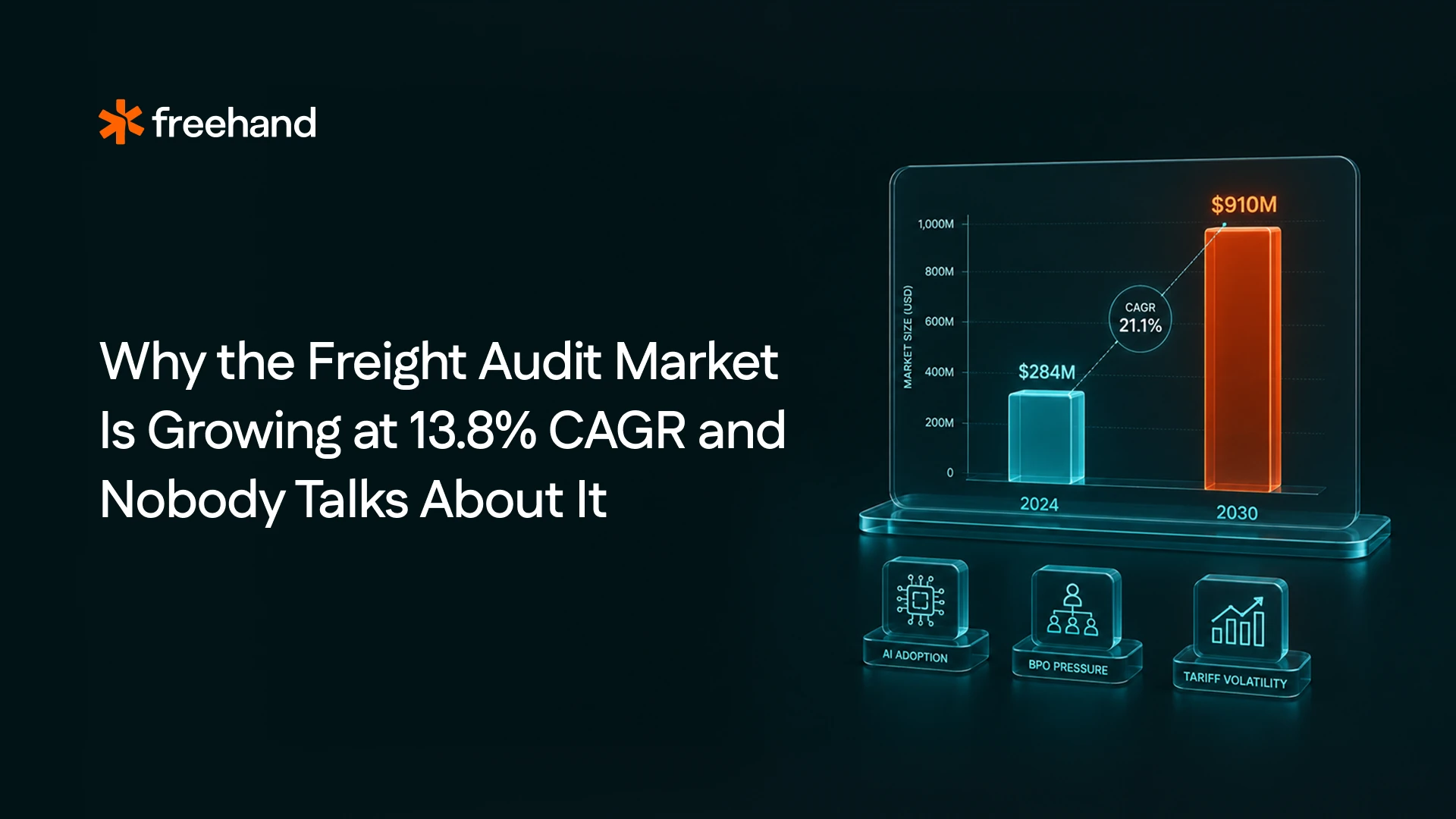
A $284 million market becoming a $910 million market by 2030. The drivers are not what the headline suggests.
The freight audit and payment market is growing at 13.8% annually — from $284 million in 2024 to a projected $910 million by 2030. This is a significant expansion in a category that has historically been treated as a back-office cost center. The growth is not because companies suddenly care more about whether their freight invoices are correct. It is because the cost of getting them wrong has become large enough that it is no longer a compliance consideration. It is a strategic one.
Three forces are driving the expansion simultaneously. The first is AI adoption — the recognition that manual review at enterprise freight volumes is not scalable and that AI-native audit systems can achieve coverage and accuracy rates that human teams cannot. The second is BPO pressure — legacy freight audit providers are operating on sub-10% EBITDA margins with limited capacity to invest in the AI infrastructure required to compete with purpose-built systems. The third is tariff volatility — the persistent uncertainty around trade policy that has made freight cost management a board-level topic rather than a logistics operations concern.
What the AI adoption driver actually looks like
The 13.8% CAGR is not driven by existing freight audit programs getting larger. It is driven by enterprises moving from legacy BPO arrangements to AI-native systems that deliver capabilities the BPO model cannot. The economics of this transition are compelling. A freight audit BPO charges between 10 and 30% of recovered overcharges — a contingency model that creates an incentive to find errors rather than prevent them. An AI-native system charges a fixed platform fee regardless of recovery volume, which changes the economic relationship from one where the provider profits from the persistence of billing errors to one where the provider's value is measured by the operational outcomes it produces.
The transition also delivers capabilities that have no equivalent in the BPO model: real-time audit rather than batch processing, 100% invoice coverage rather than sampling, autonomous exception management rather than manual review queues, and spend intelligence that connects audit outcomes to sourcing decisions. Each of these capabilities represents a structural improvement over what a human review team can produce, regardless of how well-resourced the BPO is.

The tariff volatility contribution
Tariff volatility has changed the nature of freight cost management in a way that makes the traditional BPO model less adequate. When freight contracts were relatively stable and tariff changes were predictable and annual, a batch audit that reviewed invoices monthly against a rate card that was updated annually was adequate for most purposes. The errors it missed were inconvenient but not strategically significant.
When tariff changes can move the landed cost of a product category by 15 to 25% overnight, the period between a tariff event and the audit system's detection of its impact on freight costs becomes a strategic liability. An enterprise whose audit configuration is six weeks behind the current rate environment is not just missing billing errors. It is making sourcing, inventory, and pricing decisions on freight cost data that does not reflect current reality. The audit function is no longer just a recovery mechanism. It is an information infrastructure that feeds into strategic decisions.
“The freight audit market is growing because freight cost management has become too consequential to be managed with tools designed for a more stable world. A batch audit with monthly cycles and 33% coverage was adequate when nothing moved fast. Nothing moves slowly anymore.”
What the regulatory driver adds
The Macy's $154 million delivery-expense fraud case — in which systematic concealment of logistics costs ran for nearly three years before detection — has produced a new category of urgency around freight audit controls. Finance and legal functions that previously treated freight audit as an operational matter are now asking whether the controls around accounts payable for freight spend are auditable and demonstrably effective. The regulatory driver is not a primary growth factor in the same way AI adoption is, but it is accelerating adoption in specific sectors — particularly retail, pharmaceutical, and consumer goods — where the regulatory and brand risk of undetected freight fraud has become material.
The combination of these three forces — AI adoption, BPO displacement pressure, and tariff volatility — explains why the market is growing at the rate it is. Each force is independent, but they reinforce each other. AI adoption makes better audit possible. Tariff volatility makes better audit necessary. BPO pressure makes the switch economically compelling. The 13.8% CAGR is what happens when all three align simultaneously.