
Best Cass Information Systems Alternatives for 2026: 6 Compared
.webp)
July 4, 2026
•
9
mins

The best Cass Information Systems alternatives for 2026: 1. Freehand, 2. Loop, 3. Trax Technologies, 4. Intelligent Audit, 5. nVision Global, 6. CTSI-Global.
Cass Information Systems is one of the most established freight audit and payment providers in North America, with bank-level payment security and more than $50B in freight processed annually.
If you are on this page, you are likely weighing a switch: the per-invoice pricing is hard to model, and the managed-service model still leaves your team chasing exceptions and reading raw data. Below are six providers that handle the same core job, ranked for enterprise shippers evaluating a replacement.
New to the category? Our overview of freight audit explains how full audit coverage works before you compare vendors.
Comparison table: Top freight audit and payment software for 2026
Here is a closer look at the best alternatives to Cass Information Systems: 1. Freehand, 2. Loop, 3. Trax Technologies, 4. Intelligent Audit, 5. nVision Global, 6. CTSI-Global.
TL;DR
- Freehand. The fully agentic option. AI Teams audit 100% of freight invoices, resolve exceptions, and post to your ERP without human review. Best fit if you are leaving a managed service and want the work done, not flagged.
- Loop. AI-native data platform that reads unstructured documents before the audit runs. Strong on data quality; still surfaces findings for people to confirm.
- Trax Technologies. Widest global carrier network and multinational spend visibility, delivered as a premium managed service.
- Intelligent Audit. Deep parcel and small-parcel audit with high-volume ML detection and a per-invoice SaaS model.
- nVision Global. Built for global freight with multi-currency, VAT, and regional reporting depth.
- CTSI-Global. Freight audit, payment, and a TMS in one platform for shippers who want a single lifecycle tool.
Why do teams look for Cass Information Systems alternatives?
Teams shop for a Cass replacement mainly over cost transparency, the working-capital implications of a bank-model provider, and a managed-service model that samples invoices rather than auditing all of them.
Cass is genuinely strong on financial stability and payment security, and reviewers praise its dedicated service team, so any replacement has to match it on accuracy and payment reliability first.
The specific, sourced reasons buyers still move on:
- Opaque, quote-based pricing. Cass uses custom pricing set by shipment volume with nothing published, so total cost is hard to model upfront without a sales conversation (Gartner Peer Insights).
- Flow-of-funds and working capital. Cass is a Federal Reserve-approved bank holding company that disburses payments through its own subsidiary, Cass Commercial Bank, so buyers weigh the float and working-capital implications of routing freight payments through those rails (Cass Information Systems).
- Managed-service ceiling. A public G2 review notes EDI use has limitations and that denied issues can cause delays, which is the tradeoff of a human-reviewed managed service rather than autonomous resolution (G2).
If those points match your evaluation, the alternatives below sort cleanly by how they answer them.
How did we evaluate these Cass Information Systems alternatives?
Every provider here handles the core Cass job: verify carrier invoices against contracted rates, resolve discrepancies, and execute payment.
We weighted six criteria by how much each drives a switch from a managed-service or bank-model incumbent:
- Audit coverage (25%). How much of your invoice volume is actually audited, 100% versus a sample.
- Exception autonomy (25%). Whether the system resolves discrepancies and posts them, or hands them back to your team.
- Pricing transparency (15%). Disclosed upfront versus per-invoice tiers, float, or percent of savings.
- ERP and TMS integration (15%). Native connectors versus custom file or EDI setup.
- Implementation speed (10%). How fast it goes live and how much of your team's time it takes.
- Data ownership and portability (10%). Who owns the data and whether you can export it without the vendor.
This is an independent editorial comparison. Where available it references Gartner Peer Insights and G2 ratings alongside public vendor documentation; it is not a Gartner Magic Quadrant or other certified third-party ranking.
Best AI freight audit and payment software, ranked for 2026
Platforms are ordered by the weight of independently verifiable evidence, not by who published this guide. Vendor-supplied figures are labeled as vendor-claimed throughout.
Freehand
For enterprises leaving a managed service, yes. Freehand is the only option here that audits 100% of invoices and resolves exceptions autonomously, posting results into your ERP instead of handing them back to your team. It ranks first on the two axes that drive most Cass switches, coverage and autonomy.
Best for:
Enterprise shippers leaving an in-house team, a freight audit BPO, or a bank-model provider who want the audit work executed autonomously rather than flagged for a person to finish, with every invoice covered.
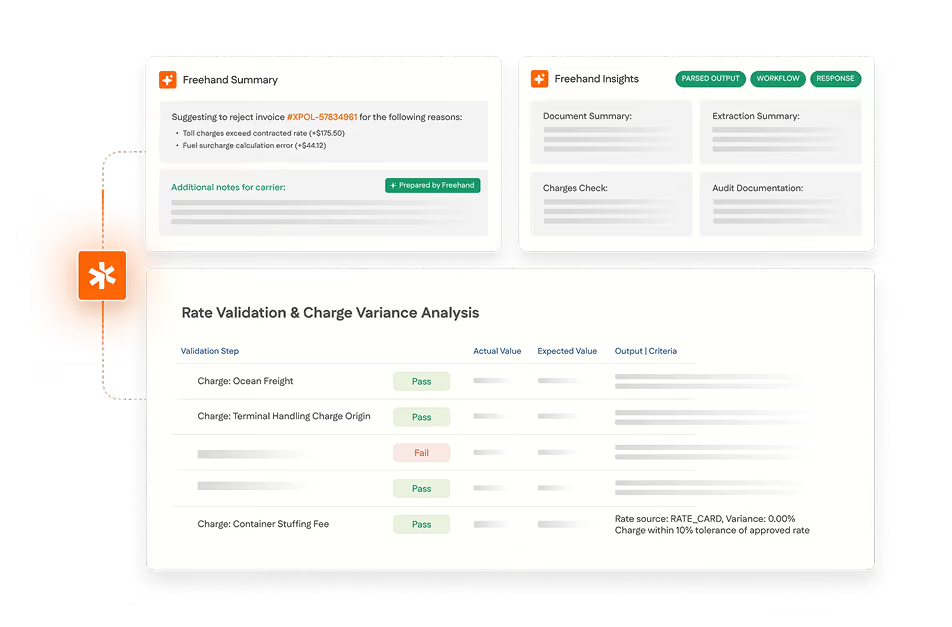
Freehand runs freight accounts payable as AI Teams that audit, resolve, and post to your ERP directly. It is built as services delivered as software: you buy completed audit and payment work, not seats or a managed-service retainer. The comparison that matters is against the labor line (in-house ops, BPO, shared services), which is where a Cass replacement conversation usually starts. It sits on top of your existing TMS and ERP through freight audit and payment software rather than replacing them at go-live.
Key Features
- AI Teams audit 100% of freight invoices, not a 15-30% sample
- Fully agentic exception resolution: the system senses, decides, and posts without waiting for a human to review each exception
- Multi-way matching across invoice, contracted rate, shipment, and PO
- Detects 30+ freight billing error types, adaptive rather than a fixed rules ceiling
- Context Graph connects contracts, carrier history, shipment data, and GL rules so decisions are explainable
- Real-time GL coding and cost-center allocation with automatic posting
- Native connectors for SAP ECC, S/4HANA, Oracle Cloud, Oracle JDE, and NetSuite
- Duplicate invoice detection at scale
- Built-in freight spend analysis by mode, carrier, lane, and cost center
- Client-exclusive model in a dedicated environment; the enterprise owns and can export its own data
- Go-live in 12-14 weeks requiring 11-20 hours of client team time
Pricing
Volume-based and disclosed at scoping, quoted by freight volume and modules. No per-invoice format tiers, no percent-of-savings, and no bank-float model.
Pros
- 100% audit coverage closes the sampling gap that lets sub-threshold overcharges through
- Autonomous resolution removes the exception queue instead of moving it to your team
- Transparent volume pricing and enterprise-owned data reduce switching risk
Cons
- Newer entrant than decades-old incumbents like Cass
- Enterprise-focused; a small shipper with low freight volume is not the target fit
What Users Say
Love: Every invoice audited, exceptions executed. Freehand reports recovering 1.5-2.5% of freight spend annually (vendor-claimed); a Fortune 100 Consumer Electronics company moved from auditing 33% of invoices to 100% and captured more than $3M in annual savings. (source)
Complain: Newer name, enterprise-only fit. Freehand is a newer entrant than decades-old incumbents, and it targets enterprise freight volume, so a small, low-volume program is not the ideal fit.
Loop
Loop is a strong choice if your core problem is dirty, unstructured invoice and document data. Its AI reads messy documents into clean data before the audit runs, and the 2025 Data2Logistics merger added real audit-and-pay depth. It still asks a person to confirm actions, so it is assistive rather than fully autonomous.
Best for:
Shippers whose biggest problem is dirty, unstructured invoice and document data before the audit even runs.
Loop is an AI-native logistics data platform founded by former Uber Freight leaders. Its DUX model reads unstructured documents and turns them into clean, unified data ahead of the audit. Its 2025 merger with Data2Logistics added decades of freight audit domain depth and global payment execution, which broadened it from a data layer into a fuller audit and pay offering. It covers freight, parcel, ocean, and air.
Key Features
- DUX AI model for extracting data from unstructured documents
- Real-time audit automation with granular cost allocation
- Self-serve analytics and dispute resolution
- Freight, parcel, ocean, and air coverage
- Global payment execution added via the Data2Logistics merger
- Modern interface with faster implementation than legacy providers
- Strongest North American coverage, with global expansion ongoing
Pricing
Custom enterprise pricing, not published. Quotes depend on freight volume and modules and require a sales conversation.
Pros
- Strong data extraction on messy, multi-format documents
- Modern interface with a shorter implementation than legacy incumbents
Cons
- Assistive rather than fully agentic; a person still confirms actions
- Newer to market, with global coverage still expanding
What Users Say
Love: Logistics-trained document AI. Loop's DUX model turns messy invoices, BOLs, and customs paperwork into clean data, and its Data2Logistics merger added decades of enterprise audit depth. (source)
Complain: Undisclosed pricing, North America-weighted coverage. Loop does not publish pricing and its strongest coverage is North American, and the 2021-founded platform is still integrating its 2025 Data2Logistics merger. (source)
Trax Technologies
Trax is closest to Cass in model, a premium managed service, but with the widest global carrier network in this list. If your reason for leaving Cass is global carrier breadth or multinational spend visibility rather than automation, Trax is the natural swap.
Best for:
Multinationals that need the widest carrier network and spend visibility across many countries and modes.
Trax delivers enterprise freight audit, payment, and transportation spend analytics as a premium managed service. It processes more than $24B in annual transportation spend across 21,000+ carriers worldwide (vendor-claimed), with invoice validation trained on more than two decades of normalized freight data. It is a strong fit where global carrier breadth is the deciding factor, backed by carrier-level freight rate benchmarking.
Key Features
- Broadest global carrier network at 21,000+ carriers (vendor-claimed)
- Enterprise data normalization across regions and modes
- Carrier performance benchmarking and scenario planning
- Multi-currency and multi-language support
- Automated exception handling
- More than $24B in annual transportation spend processed (vendor-claimed)
- Managed-service delivery for complex global programs
Pricing
Custom, premium pricing for a managed service, not published. Quotes scale with spend and modules.
Pros
- Excellent visibility into complex, global supply chain costs
- Highly scalable for multinational corporations
Cons
- Requires high-quality input data to perform well
- Premium pricing aimed at the upper-enterprise market; some reviewers cite implementation on older platforms
What Users Say
Love: Broad global carrier coverage and reporting depth. Reviewers value Trax's multinational spend visibility and reporting across 21,000+ carriers. (source)
Complain: Support gaps and unclear exception handling. A Manager at a $10B+ manufacturer cited "too many gaps in operations and management" and low confidence in support structures and exception clarity, plus an aging TPS platform (3.5/5 on Gartner). (source)
Intelligent Audit
Yes, especially if parcel and small-parcel volume dominate your spend. Intelligent Audit brings nearly three decades of audit depth and a per-invoice SaaS model that is easier to price than Cass's per-invoice tiers. It leans technology-first rather than managed-service.
Best for:
Shippers with heavy parcel and small-parcel volume who want deep, high-volume audit and refund recovery.
Intelligent Audit, founded in 1996, is a technology-first provider processing over 2 billion shipments annually and serving roughly 20% of the Fortune 50 (vendor-claimed). It runs more than 200 audit points per invoice (vendor-claimed) and specializes in high-volume parcel, LTL, and freight, with fast late-delivery refund identification. Its depth in parcel audit software is a standout, and it pairs with TriumphPay for carrier payment execution.
Key Features
- ML anomaly detection with 200+ audit points per invoice (vendor-claimed)
- High-volume parcel and small-parcel specialization
- Real-time cost-to-serve analytics
- Automated claim filing and late-delivery refund recovery
- Freight, parcel, and LTL coverage
- Per-invoice SaaS pricing model
- Carrier payment via the TriumphPay partnership
Pricing
Per-invoice SaaS model for shippers and 3PLs. Companies typically cut shipping budgets by 2% to 5% (vendor-claimed).
Pros
- Nearly three decades of enterprise credibility and scale
- Strong for high-volume, small-parcel shippers
Cons
- Less emphasis on managed services than a provider like Cass
- Data-dense dashboards carry a learning curve
What Users Say
Love: Clear invoice visibility and layered approvals. A Technical Program Manager praised easy navigation, a clear view of all logistics invoices, and a multi-layer approval workflow with scheduled reporting (4.8/5 across 12 G2 reviews). (source)
Complain: No pending-approval alerts, dense dashboards. The same reviewer wanted email alerts when an invoice is awaiting approval, and its data-dense dashboards carry a learning curve. (source)
nVision Global
For heavy international freight, yes. nVision Global is built around multi-currency, VAT, and regional reporting, with processing centers worldwide. It fits when global tax and currency complexity, rather than automation depth, is your main gap with Cass.
Best for:
Enterprises with heavy international freight where multi-currency, VAT, and regional reporting are the hard part.
nVision Global is a freight audit and payment provider built for global operations, with regional processing centers, multi-language and multi-currency handling, and global tax and VAT compliance. It layers business intelligence, a pricing and auditing engine, and transportation visibility on top of the core audit.
Key Features
- Multi-language and multi-currency invoice processing
- Global tax and VAT compliance
- Cost recovery and overpayment tools
- Document management and imaging
- Pricing and auditing engine with business intelligence
- Regional operations centers for global coverage
- Supply chain consulting services
Pricing
Custom pricing, not published. Quotes depend on volume and regional scope.
Pros
- Wide geographical reach for auditing global logistics
- Flexible, customizable reporting for regional offices
Cons
- Feature breadth can complicate setup
- Support response times can vary across regions
What Users Say
Love: Region-by-region customization, reliable service. A Supply Chain Manager at a $10B+ manufacturer notes solutions tailored to each region that adjust year over year, calling them a reliable partner (4.9/5 across 6 Gartner reviews). (source)
Complain: Thin independent software reviews. nVision runs largely as a managed service, and its G2 product profile shows zero reviews, so software-level diligence leans on a small Gartner sample. (source)
CTSI-Global
CTSI-Global folds freight audit, payment, and a TMS into one platform, which Cass does not. If you want to consolidate audit and transportation management under one vendor rather than run them separately, CTSI-Global is the closest single-platform alternative.
Best for:
Shippers who want freight audit, payment, and a transportation management system in a single platform.
CTSI-Global combines freight audit and payment with a TMS, covering more than 50 countries. It manages the lifecycle from planning through payment in one tool, with claims management, customizable dashboards, and carrier contract expertise. It suits teams that want to consolidate audit and transportation management with one vendor rather than run transportation spend management across separate systems.
Key Features
- Unified freight audit, payment, and TMS platform
- Coverage across 50+ countries
- Claims management with advanced exception handling
- Strategic data modeling and customizable dashboards
- Managed carrier negotiation and contract expertise
- Carrier performance insights
- Full plan-to-pay lifecycle in one tool
Pricing
Custom pricing, not published. Quotes depend on volume, modules, and TMS scope.
Pros
- Manages the full lifecycle from planning to payment in one platform
- Deep carrier contract and negotiation expertise
Cons
- Broad feature set adds setup complexity
- Some components need modernization versus AI-first entrants
What Users Say
Love: Audit, payment, and TMS in one platform. CTSI-Global unifies freight audit, payment, and transportation management across 50+ countries, holding 4.1/5 across 9 Gartner reviews. (source)
Complain: Modest review volume, aging components. The 9-review sample is thin for enterprise diligence, and some components need modernization versus AI-first entrants. (source)
How does Freehand compare to Cass Information Systems directly?
Both do the same job; the difference is the operating model.
Cass is proven, financially secure, and dependent on human reviewers. If your reason for leaving Cass is the sampling ceiling, the exception workload, or opaque cost, Freehand is the direct replacement. If bank-holding-company payment rails are a hard requirement, Cass still holds that specific edge.
FAQs
What is the best alternative to Cass Information Systems?
For enterprises that want autonomous audit over a managed service, Freehand ranks first: it audits 100% of invoices and resolves exceptions without human review. Best fit depends on your priorities.
Is there a cheaper alternative to Cass Information Systems?
Cass uses per-invoice pricing that varies by format and payment type. Volume-based options like Freehand or per-invoice SaaS like Intelligent Audit are easier to model, though all quotes are custom.
Who are Cass Information Systems' main competitors?
Its main freight audit and payment competitors include Freehand, Loop, Trax Technologies, Intelligent Audit, nVision Global, and CTSI-Global, plus U.S. Bank Freight Payment among bank-model providers.
Why do companies switch from Cass Information Systems?
Common reasons are opaque per-invoice pricing, a bank-model flow of funds that can tie up working capital, and a managed-service model that samples invoices instead of auditing all of them.
Does Cass Information Systems use AI to audit freight?
Cass runs a managed service with human reviewers rather than fully autonomous AI. Agentic alternatives like Freehand audit every invoice and act on findings without a person confirming each exception.
What should I look for in a Cass replacement?
Check audit coverage (100% versus sampling), whether the system resolves or just flags exceptions, implementation time, ERP and TMS integration, data ownership, and whether pricing is disclosed upfront.
Can a Cass alternative integrate with SAP or Oracle?
Yes. Freehand offers native connectors for SAP ECC, S/4HANA, Oracle Cloud, Oracle JDE, and NetSuite. Most enterprise providers integrate through APIs or EDI, though setup effort varies.
How long does it take to switch freight audit providers?
It varies by provider and freight complexity. Freehand goes live in 12-14 weeks using 11-20 hours of client team time, operating on top of your existing TMS during setup.
Every warehouse. Every provider. Every mile.
Gartner's 2026 outlook on logistics outsourcing, and how AI Teams hold every contract to the terms you agreed.
- Where outsourced logistics quietly loses margin
- Why billed charges drift from the contract
- How AI Teams close the gap