

Freight Spend Analysis: What the Data Reveals When It's Been Validated First
Freight spend analysis, also called freight cost analytics, only works if the data behind it is validated first. See how to segment it, what it reveals, and where most programs skip a step.
.webp)
February 4, 2026
•
15
mins
Every enterprise with a freight program has freight spend data. It lives in the ERP: invoices paid, carriers used, amounts cleared.
What most enterprises don't have is freight spend intelligence: the analytical picture that shows where freight costs are concentrated, which carriers are generating systematic billing compliance problems, and where contracted rates have drifted above the market.
The difference between freight spend data and freight spend intelligence isn't the analytical tools. It's whether the data being analyzed reflects actual contracted costs or a mix of contracted costs and billing errors that cleared AP unreviewed.
Key Takeaways
- Validated data is the prerequisite. Analysis built on raw AP data reports on what cleared AP, including billing errors that were never compared to the contracted rate. The output accurately describes what was paid but is misleading as a guide to what freight should cost.
- Segment before you analyze. Freight spend data should be segmented by mode, carrier, lane, and charge type. Aggregated totals hide the carrier-level and lane-level patterns that identify specific cost reduction opportunities.
- The most actionable output isn't total spend or year-over-year variance. It's the carrier-level billing compliance pattern: which carriers have systematic accessorial misapplication, which lanes have the highest rate-to-market spread, and which charge types are generating the most exceptions.
- Analysis only creates value when it drives decisions. Which lanes are mini-bid candidates, which carrier relationships need compliance escalation, and which charge-type patterns require carrier-level correction.
What is freight spend analysis?
Freight spend analysis, also called freight cost analytics or freight analytics, is the process of examining validated freight cost data by mode, carrier, lane, and charge type to identify cost concentration, billing compliance patterns, and rate competitiveness across the carrier portfolio.
Spend reporting aggregates what cleared AP by carrier, mode, or business unit: an accurate record of what was paid.
Freight spend analysis asks different questions:
- Does what was paid reflect the contracted rate?
- Which segments of the portfolio are driving cost?
- Which carriers and lanes represent the most significant optimization opportunities?
The "validated" qualifier matters. Spend analysis run on raw AP data includes billing errors in the cost base. A carrier with a 2% billing error rate on a $5M spend relationship appears in the analysis as $5M in correctly billed freight cost. The $100,000 in recoverable overcharges is invisible until the data was validated before it was analyzed.
How should freight spend data be structured for analysis?
Freight spend data should be structured in three analytical layers before synthesis: mode and carrier segmentation, lane and corridor analysis, and charge type breakdown.
Mode and carrier segmentation
Different freight modes have different cost structures, billing complexity, and compliance patterns:
- Truckload: driven primarily by lane rates and fuel surcharges, with relatively low accessorial rates
- LTL: driven by freight classification, minimum charges, and a higher accessorial rate than truckload
- Parcel: driven by zone tables, DIM weight factors, and layered surcharge stacks
- Ocean: driven by trade lane rates and a surcharge portfolio covering BAF, PSS, and terminal handling charges
Analyzing freight spend without mode segmentation produces totals that mix incompatible cost structures. A 5% year-over-year increase in total freight spend could reflect:
- A shift from truckload to LTL (mode mix change requiring a network analysis response)
- Increased accessorial billing on parcel (a compliance problem requiring carrier escalation)
- A rate increase on ocean (a market change requiring benchmarking and procurement action)
Each has a different response. None is visible without mode-level segmentation.
Carrier segmentation within each mode identifies performance patterns at the relationship level:
- Which carriers have the highest billing compliance rates
- Which generate the most exception volume
- Which are delivering contracted rates consistently across billing cycles
Lane and corridor analysis
Lane-level analysis shows where freight costs concentrate within the carrier portfolio. A Pareto analysis of lanes by spend typically shows that 20% of lanes account for 70 to 80% of freight cost.
Corridor analysis aggregates lanes by origin or destination geography to identify network patterns:
- Which production locations generate the most outbound freight cost
- Which distribution centers have the highest inbound accessorial rates
- Which trade corridors have the most rate volatility between contract cycles
Two priority cases emerge:
- High-spend lanes with high compliance exception rates: the largest dollar impact from billing correction and the strongest business case for carrier escalation or early renegotiation
- High-spend lanes with above-market contracted rates: priority cases for the next procurement event
Charge type breakdown
Disaggregating freight spend by charge type (base rate versus fuel surcharge versus accessorial) is where compliance analysis begins.
Accessorial spend running above 20 to 25% of total freight cost on a carrier relationship indicates either:
- High accessorial activity: a network design question about delivery conditions and service patterns
- Systematic accessorial misapplication: a compliance question about whether charges have a contract basis and triggering event
Charge type breakdown also identifies which components of freight cost are most variable:
- Base rates change with contract cycles
- Fuel surcharges change weekly by index
- Accessorials are conditional and carrier-discretionary
An enterprise that sees total freight cost increasing but doesn't know whether the increase is in base rates, fuel, or accessorials cannot identify the correct corrective action.
Analysis only pays off if it feeds a process that acts on it. Our guide to transportation spend management picks up where the numbers end, covering how to turn the findings into recovered dollars and tighter carrier control.
Freight cost allocation
Charge type breakdown shows what you're paying for. Freight cost allocation is the separate question of who should be paying for it: splitting a shipment's cost across the business units, departments, or cost centers that actually generated it, based on origin, destination, or product line. A consolidated shipment carrying goods for two business units needs its freight cost split proportionally, not booked entirely to whichever unit's PO happened to trigger the shipment. Allocation accuracy depends on the same validated invoice data charge type breakdown does. A cost that's misallocated to the wrong business unit is still wrong even if the total invoice amount is correct.
{{blue-cta}}
What does freight spend analysis reveal?
Freight spend analysis reveals three things that spend reports can't: cost concentration, compliance patterns, and rate competitiveness signals.
Cost concentration
Identifies the 15 to 20% of lane-carrier combinations that account for the majority of freight spend. A 2% billing error rate is immaterial on a $50,000-per-year lane and significant on a $3M-per-year lane. Cost concentration analysis determines where compliance investment produces the most recovery.
Compliance patterns
Distinguishes between:
- Random billing errors: one-off invoice mistakes that resolve under individual dispute
- Systematic errors: recurring misapplication of the same charge type, indicating an underlying rate card or carrier process problem
A carrier that overcharges on fuel surcharges once per quarter requires individual dispute management. A carrier that overcharges on 12% of invoices requires carrier escalation and root cause correction. Spend analysis that disaggregates by charge type and carrier makes that distinction visible.
Rate competitiveness signals
Tracks contracted rates at the lane level against the current market index, showing which lanes have drifted above market since the last contract cycle. Without lane-level rate-to-market tracking, those above-market lanes don't announce themselves in the spend data.
A lot of what analysis surfaces traces back to how rates and accessorials were set in the first place. If you want to work the root cause, our breakdown of freight shipping costs explains where the charges come from and which ones you can push back on.
Why does data quality determine analysis quality?
Freight spend analysis built on unvalidated AP data produces outputs that accurately describe what was paid but cannot separate correctly billed freight cost from overcharges that cleared without comparison to the contract.
The freight invoices that contain billing errors aren't the ones that trigger AP exceptions. They're the ones that look correct and clear because there's no automated comparison to the contracted rate running at payment.
This creates a specific problem for cost reduction analyses. Consider:
- A carrier's spend total is $5M, including $100,000 in systematic accessorial misapplication
- The analysis sees $5M in apparently correctly billed freight cost
- A 10% reduction target requires negotiating $500,000 in rate savings
If the $100,000 in billing errors were corrected first through invoice audit:
- The real contracted spend base is $4.9M
- The target drops accordingly
- The enterprise enters the negotiation with a lower baseline and evidence of carrier billing performance that strengthens the negotiating position
The correct sequence is audit before analysis, not analysis before audit.
How does freight spend analysis connect to procurement action?
Freight spend analysis connects to action when the outputs map to specific decisions.
Most freight spend reporting stops at the summary: a record of what happened rather than a signal of what to do next. Freight spend analysis that produces a report without feeding a specific procurement or audit decision is information, not intelligence.
The actionable outputs of a working freight spend analysis program:
- Mini-bid candidates: Lanes where the contracted rate has drifted above the market index beyond a defined threshold, ranked by dollar savings potential. These are the lanes to take to the spot market or a bilateral renegotiation before the annual RFP cycle.
- Compliance escalation targets: Carrier relationships where the billing error rate by charge type is above the systematic threshold, indicating a carrier-level process or rate card problem requiring formal escalation rather than individual invoice dispute management.
- Charge type corrections: Specific accessorial categories where the billing pattern indicates systemic misapplication, for example, residential delivery fees applied at a rate that doesn't match the contracted category, or fuel surcharges consistently one tier above the contracted formula output.
- Spot supplement opportunities: Lanes where the current spot market rate is materially below the contracted rate, making spot market supplementation cost-effective for overflow or discretionary volume during the current contract period.
How do enterprise teams measure freight spend analysis effectiveness?
Five metrics distinguish a working freight spend analysis program from periodic reporting.
| Metric | What it measures |
|---|---|
| Analytical coverage | % of freight spend with validated data at carrier, mode, lane, and charge type level. Missing charge type = totals without diagnostic value. |
| Insight-to-action rate | % of cost reduction opportunities actioned within 60 days. Past that window, analysis competes with the next data refresh. |
| Data freshness | Lag from invoice date to spend analysis layer. 60-day-old data misses rate drift already compounding. |
| Spend variance explained rate | % of spend variance attributed to a specific cause. Unexplained variance is invisible to corrective action. |
| Cost reduction initiatives from analysis | Cost actions from spend analysis vs. annual RFP cycle. High share from analysis = continuous cost management, not periodic. |
Your spend data shows what you paid. Does it show what you should have paid?
Freight spend data shows what cleared AP. Freight spend analysis shows whether what cleared was correctly billed, where it was concentrated, and where the next cost reduction opportunity is.
Most enterprises have access to quarterly freight spend reports showing total cost by carrier, mode, or business unit. What those reports can't show:
- Where billing errors are embedded in the totals
- Which lanes have drifted above market since the last RFP
- Which carrier relationships have systematic compliance problems that won't resolve without escalation
At 1.5 to 2.5% of freight spend in billing errors that clear AP unvalidated, a $30M freight portfolio carries $450,000 to $750,000 per year in costs that appear as legitimate freight expense in every spend report. That amount is invisible to spend analysis built on raw AP data and visible only when the invoice validation layer runs before the analysis layer.
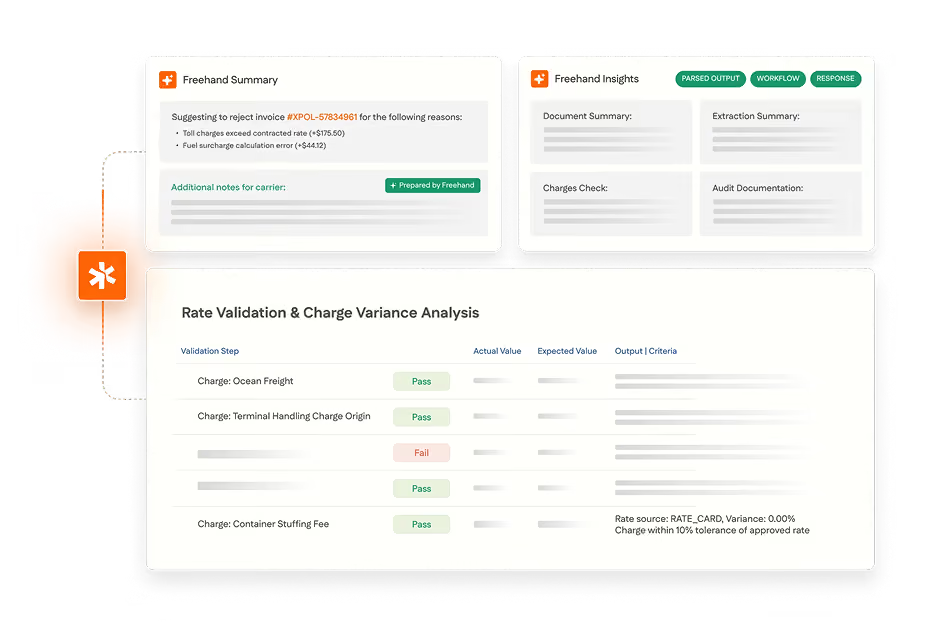
Freehand's logistics spend platform connects validated freight invoice data, carrier benchmarking, and contracted rate cards in a unified spend intelligence layer, generating lane-level rate-to-market spreads, carrier billing compliance rates, and cost concentration analysis that feed procurement and audit decisions rather than quarterly cost summaries.
{{brown-cta}}
Frequently Asked Questions
What is freight spend analysis?
The examination of validated freight cost data by mode, carrier, lane, and charge type to identify cost concentration, billing compliance patterns, and rate competitiveness. It differs from spend reporting in that it asks whether the data reflects contracted costs, not just what cleared AP.
Why does freight spend analysis require validated invoice data?
Analysis built on raw AP data includes billing errors that cleared without contract comparison. A carrier with a 2% billing error rate appears as $5M in correctly billed cost rather than $4.9M in contracted cost plus $100,000 in recoverable overcharges.
How should freight spend data be segmented for analysis?
By mode, by carrier within each mode, by lane or corridor, and by charge type: base rate, fuel surcharge, and accessorial. Each segment has different cost drivers, compliance patterns, and optimization levers. Aggregated totals obscure the patterns that identify cost reduction opportunities.
What does a lane-level Pareto analysis of freight spend show?
That 20% of lanes typically account for 70 to 80% of freight cost. Identifying high-spend lanes enables targeted benchmarking, compliance review, and procurement effort focused on where the dollar impact of improvements is largest.
How does freight spend analysis connect to procurement decisions?
It identifies mini-bid candidates (lanes above the rate-to-market threshold), compliance escalation targets (carriers with systematic billing error patterns), charge type correction needs, and spot supplement opportunities. These outputs feed procurement and audit actions rather than periodic summaries.
How often should freight spend analysis be refreshed?
Continuously, with validated invoice data feeding the analysis layer in near real-time. Quarterly analysis misses rate drift that compounds across billing cycles and identifies compliance patterns only after multiple cycles of errors have cleared.
What is the insight-to-action rate in freight spend analysis?
The percentage of cost reduction opportunities identified in spend analysis that result in a procurement or compliance action within 60 days. A low rate indicates the analysis produces observations but not decisions.
What is the difference between cost concentration and billing compliance in freight spend analysis?
Cost concentration identifies which lanes, carriers, and modes drive the most spend. Billing compliance identifies how much of that spend was correctly billed versus overbilled. A high-spend carrier with a 3% billing error rate has both a procurement opportunity and a compliance problem in the same spend line.
Freehand Validates the Data Before It Becomes Your Analysis.
Freehand's AI Teams check every invoice against contracted rates first, so your freight spend analysis reflects what you actually owed, not what carriers happened to bill.
Your Spend Data Shows What Cleared AP. Not What Should Have.
Analysis built on unvalidated data reports on billing errors right alongside legitimate charges, with no way to tell them apart.
Every warehouse. Every provider. Every mile.
Gartner's 2026 outlook on logistics outsourcing, and how AI Teams hold every contract to the terms you agreed.
- Where outsourced logistics quietly loses margin
- Why billed charges drift from the contract
- How AI Teams close the gap