



AI in Procurement: How It Works, Use Cases, and Benefits
.webp)
June 23, 2026
•
13
mins
AI in procurement is the application of machine learning, natural language processing, and autonomous agents to automate and enhance purchasing processes across the source-to-pay cycle.
It gives procurement teams the ability to analyze spend at full coverage, identify supplier risks before they surface as disruptions, review contracts faster, and validate invoices against contracted terms before payment clears.
According to McKinsey's 2025 Procurement Organization of the Future research, 55% of procurement leaders reported flat or shrinking budgets while savings targets increased, and spend managed per full-time employee is now 50% higher than five years ago. AI is how procurement teams close that gap.
Key Takeaways
- AI in procurement is the use of machine learning, NLP, and autonomous agents to automate and enhance sourcing, spend analysis, supplier management, contract review, and invoice validation across the source-to-pay cycle.
- An April 2025 study by Ardent Partners of nearly 400 procurement leaders found 62% believing the impact of AI on procurement in the next two to three years will be transformational or significant.
- The highest-value AI procurement applications are not in process automation alone. They are in the financial control layer: spend analytics at full coverage, contract compliance enforcement, and invoice validation against contracted rates.
- According to Gartner, 60% of procurement functions will have fully integrated AI-driven analytics by 2026, generating 20% higher cost savings compared to traditional methods.
What Is AI in Procurement?
AI in procurement is the application of machine learning, natural language processing, and intelligent automation to the processes that govern how an organization sources goods and services, manages suppliers, enforces contracts, and validates payments.
It is not a single tool or platform. It is a capability layer that applies across the entire source-to-pay cycle, from the moment a purchase need is identified to the moment a validated invoice clears AP.
What makes it distinct from earlier automation is that AI systems learn, adapt, and act.
- Rule-based automation applies fixed logic: if invoice amount exceeds PO amount by more than 5%, flag for review.
- AI-driven procurement applies learned patterns: a supplier whose invoices consistently fail validation is flagged as a systematic billing risk — not just as individual exceptions.
The shift in operational terms: procurement moves from reactive to predictive. Rather than discovering that a supplier has financial difficulties when a delivery fails, AI surfaces the risk signal weeks earlier from financial health monitoring. Rather than finding out a contract rate was not enforced after the quarterly spend review, AI catches the deviation on the first invoice after the contract takes effect.
According to the Art of Procurement's 2026 State of AI in Procurement research, 80% of global CPOs plan to deploy generative AI in some capacity over the next three years. Currently only 36% of procurement organizations have meaningful implementations. The gap between intent and execution is where most procurement teams are today.
How Does AI Work in Procurement?
AI works in procurement by ingesting structured and unstructured data from across the source-to-pay cycle, identifying patterns and anomalies humans cannot process at scale, and either generating recommendations for procurement teams or taking autonomous action within defined guardrails.
Four underlying technologies combine to deliver this:
Machine learning
ML models train on historical procurement data: purchase orders, invoices, supplier performance records, contract terms, and market pricing.
They surface patterns that inform decisions, including spend categorization, supplier scoring, demand forecasting, and anomaly detection in invoice data.
ML is also what makes spend analytics reliable at scale. Classifying spend manually across thousands of transactions, multiple ERPs, and dozens of cost centers produces inconsistent results. ML classification achieves approximately 97% accuracy and improves as more data flows through the model.
Natural language processing
NLP reads and interprets unstructured documents. Contracts, RFP responses, supplier communications, and invoice line items all contain critical procurement information locked in formats that standard systems cannot parse. NLP extracts obligation clauses, payment terms, pricing commitments, and risk language from documents that previously required manual review.
For procurement teams managing hundreds of active contracts, NLP is what makes contract compliance monitoring operationally feasible. A contract that commits a supplier to specific delivery terms across 200 lane-level appendices cannot be monitored manually at every invoice cycle. NLP reads it continuously.
Generative AI
Generative AI in procurement accelerates content-intensive work.
- RFP drafting and sourcing event structuring
- Supplier communication and contract clause generation
- First-draft documents that category managers review and refine
The Hackett Group's research identifies purchase order processing, spend analytics, and contract management as the areas where generative AI is making the most immediate impact.
Agentic AI
Agentic AI takes action rather than generating recommendations. An AI agent that monitors supplier financial health alerts the procurement team when a threshold is crossed, issues an RFQ to alternative suppliers, scores the responses against weighted criteria, and delivers a shortlist for human approval, all without waiting for a category manager to initiate each step.
McKinsey's 2025 research estimates agentic AI could make procurement 25 to 40% more efficient by shifting transactional work away from procurement teams and freeing capacity for strategic decisions.
What Are the Key Use Cases of AI in Procurement?
AI in procurement delivers measurable value across six use cases: spend analytics, supplier risk management, strategic sourcing, contract management, purchase order processing, and invoice validation. Each addresses a different failure mode of traditional procurement, and each compounds on the others when they share a connected data foundation.
Spend analytics
Advanced spend analysis is the most widely adopted AI use case in procurement, cited by 78% of organizations that have implemented AI, according to APQC research.
AI spend analytics classifies transactions across every cost center and ERP simultaneously, identifies off-contract purchasing, surfaces vendor consolidation opportunities, and flags maverick spending patterns by department and category. The output is a complete, categorized picture of organizational spend in real time rather than a monthly report built from incomplete data exports.
For logistics-heavy enterprises, spend analytics applied to freight and carrier spend specifically identifies lane-level cost variances, carrier performance gaps, and accessorial charge patterns that would take weeks of manual analysis to surface. This feeds directly into the next sourcing cycle.
Supplier risk management
AI supplier risk monitoring ingests financial health data, geopolitical exposure indicators, ESG compliance scores, and news signals simultaneously, continuously, and across hundreds of suppliers at once.
A category manager monitoring 50 suppliers manually reviews each periodically. An AI risk monitoring layer reviews all 50 continuously, flags deteriorating financial signals before a delivery failure, and proposes alternative sourcing routes before the risk becomes operational.
94.5% of senior procurement leaders plan to shift their supplier base within the next 18 months, according to Gartner, with AI-powered risk prediction identified as the primary driver. The volatility of global supply chains since 2020 has made reactive supplier management operationally unacceptable at enterprise scale.
Strategic sourcing and RFQ management
AI sourcing tools analyze historical supplier performance, market pricing benchmarks, and category-specific risk factors to recommend optimal sourcing strategies. Practically, this means:
- Automated early-stage supplier discovery
- RFP documents structured from a brief
- Supplier responses compared on a normalized basis
- Bid analysis that surfaces trade-offs category managers would otherwise miss
The practical impact is significant. McKinsey reports that AI-driven procurement can accelerate supplier selection by approximately 30%, compressing sourcing cycles that previously ran for months.
Contract management
AI contract management extracts key terms, flags non-standard clauses, monitors obligation compliance, and identifies upcoming renewal dates across an entire contract portfolio. NLP reads contracts at document level, surfacing price escalation clauses, volume commitment requirements, and termination terms that manual review on a 200-page master service agreement routinely misses.
The enforcement layer matters as much as the extraction. A contract that commits a carrier to specific fuel surcharge formulas needs to be checked against every invoice in every billing cycle, not sampled quarterly. AI contract management connected to the invoice validation layer converts contract terms into a continuous enforcement mechanism rather than a document in a shared drive.
Purchase order processing
AI PO processing automates the requisition-to-order workflow:
- Suggests approved suppliers and catalog items at the point of purchase
- Enforces policy thresholds automatically
- Routes approvals without manual intervention on standard transactions
This is where guided buying reduces maverick spending at the source rather than catching it in AP after the fact.
Invoice validation and payment
Invoice validation is where AI procurement delivers its fastest measurable return on investment.
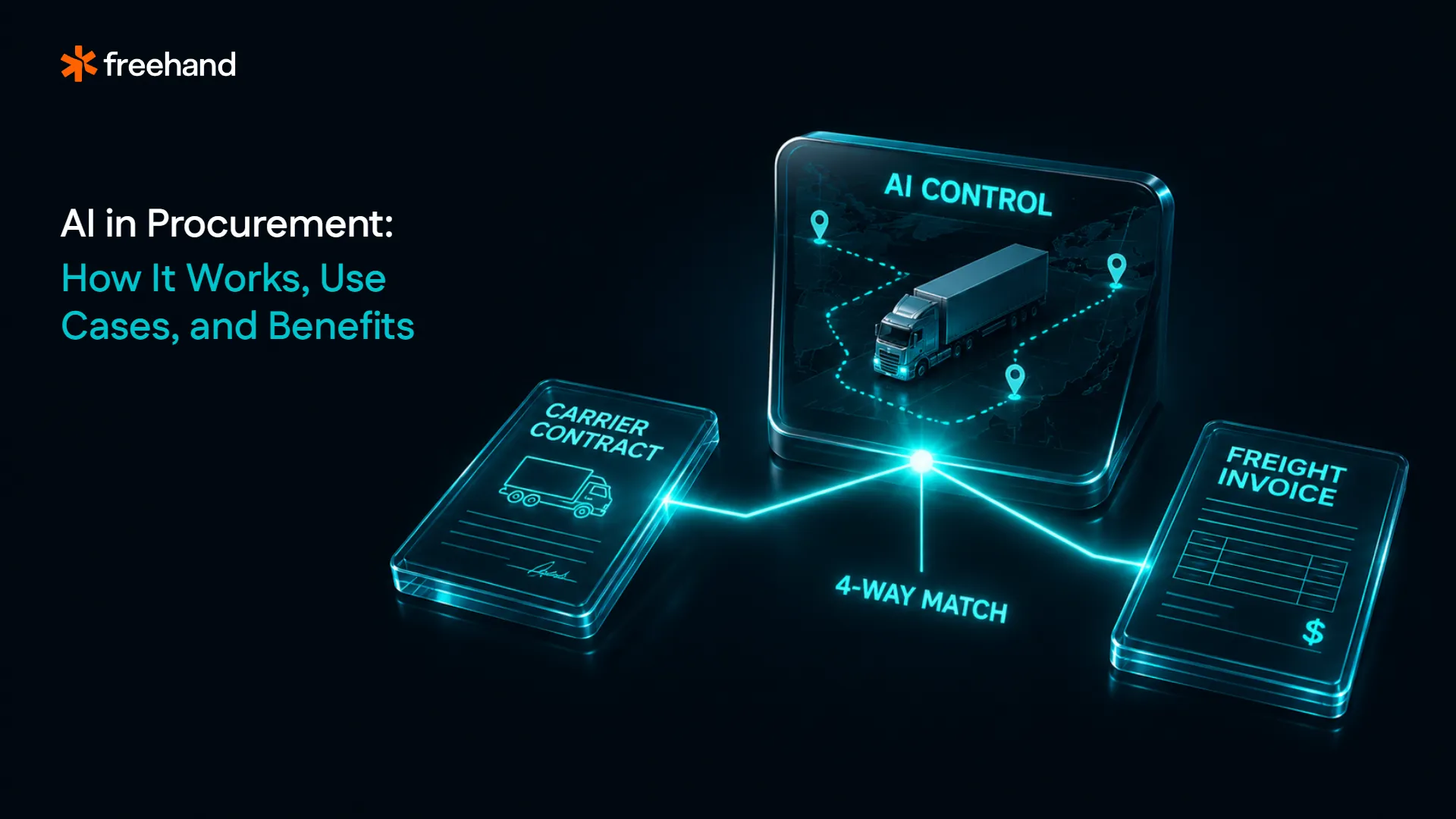
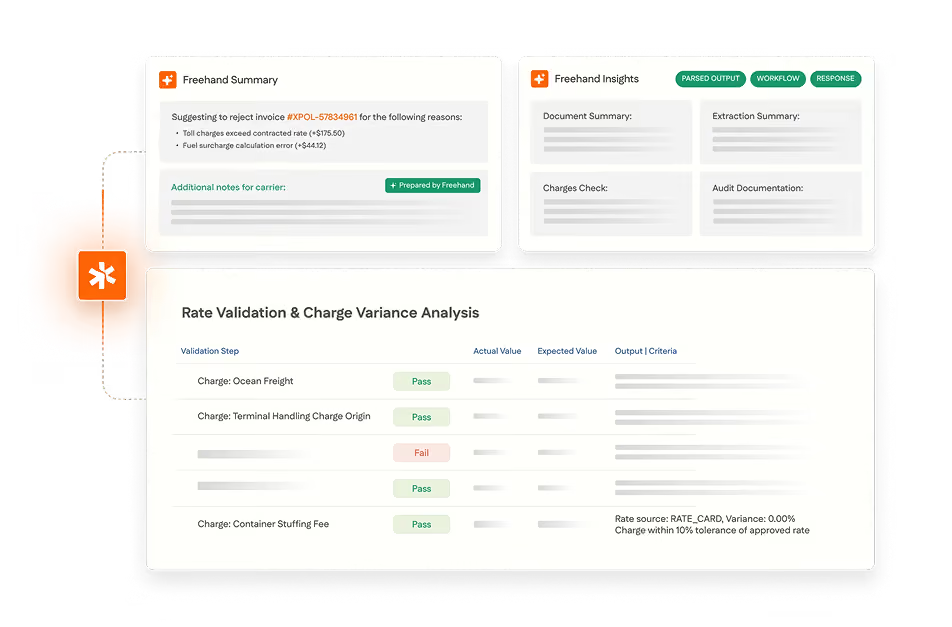
AI invoice processing extracts charge data from every invoice format, validates each line item against contracted rates and shipment records, and either clears the invoice for payment or flags the discrepancy with the evidence pre-compiled. For freight invoice automation, this means 4-way matching against carrier contracts, TMS shipment data, and fuel surcharge indices before payment clears.
At 1.5 to 2.5% of freight spend recovered through systematic overcharge detection, this is the AI procurement application with the shortest payback period in most logistics-intensive enterprises.
{{blue-cta}}
How Does AI Procurement Compare to Traditional Procurement?
AI procurement differs from traditional procurement across every operational dimension: coverage, speed, accuracy, and what the procurement team's time is spent on. The distinction is not automation vs. manual. It is predictive and continuous vs. periodic and reactive.
The bottom line is not that AI replaces procurement expertise. It removes the data assembly and routine processing that prevents procurement professionals from doing the work that requires expertise: supplier strategy, negotiation, category development, and risk response.
What Are the Benefits of AI in Procurement?
The benefits of AI in procurement compound across cost reduction, risk mitigation, speed, and spend visibility. The organizations generating the most value are not using AI for individual task automation. They are connecting AI across the full source-to-pay cycle so each application feeds the next.
Cost reduction
McKinsey's research on AI in procurement operations quantifies reductions of 5 to 15% in procurement spend and 5 to 20% in logistics costs for organizations with mature AI implementations.
The savings come from two distinct sources:
- Sourcing-layer savings from better market intelligence, faster RFQ cycles, and stronger negotiating positions
- Financial-layer savings from invoice validation — catching charges that clear AP in traditional procurement because no one is comparing every invoice line to the contracted rate
The savings come from two distinct sources. Sourcing-layer savings come from better
Risk reduction
Continuous supplier monitoring surfaces financial, geopolitical, and compliance risks before they materialize as delivery failures or contract breaches. For enterprises managing global supply chains across hundreds of tier-1 and tier-2 suppliers, the risk reduction benefit alone often justifies the AI investment.
Speed
Sourcing events that previously ran for eight to twelve weeks compress to four to six when AI handles supplier discovery, RFP structuring, and bid normalization. Invoice validation that previously took 30 days compresses to three when automated matching replaces manual review.
For finance, that cycle time reduction has a direct impact on month-end close accuracy. When invoices clear validation in under three days, finance books actuals at month-end rather than estimates.
Spend visibility
AI spend analytics gives procurement a complete, categorized view of organizational spend in real time. Category managers who previously built monthly spend reports from incomplete data exports now work from live dashboards that show exactly where money is going, which contracts are being honored, and where leakage is occurring. Carrier spend management at the logistics level gives operations and finance a lane-level view of freight costs that traditional reporting cannot produce.
What Are the Challenges of Implementing AI in Procurement?
The most consistently cited implementation challenge is not technology. It is data. AI models are only as reliable as the data they run on, and most enterprise procurement data is fragmented across ERP systems, contract repositories, supplier portals, and spreadsheets that were not designed to connect.
Gartner's research finds that 74% of procurement leaders say their data is not AI-ready. This does not mean AI implementation should wait for perfect data. It means the sequencing of implementation should start with the use cases that require the most data-ready inputs and build from there.
Data fragmentation
Multiple ERPs, inconsistent supplier master data, and contract terms stored in PDFs rather than structured databases are the three most common data barriers. Resolving them requires integration work that is unglamorous and time-consuming, but it is the prerequisite for reliable AI output regardless of which use case is prioritized.
Siloed functions
Deloitte's 2025 Global CPO Survey identifies siloed working as the top barrier to AI value delivery, cited by 57% of CPOs. Procurement AI delivers compounding value when sourcing, contracts, AP, and logistics data are connected. When they operate in separate systems with separate teams, each AI application works in isolation and the cross-functional benefits do not materialize.
Change management
Procurement teams built expertise over years of working within specific processes. AI changes those processes, and natural resistance follows. The organizations that succeed treat AI adoption as a change management project rather than a technology deployment. They identify where AI augments existing roles, not only where it replaces steps, and they invest in training alongside implementation.
Scope creep
Broad AI transformation projects stall in production more often than narrow, well-scoped ones. Starting with a high-value, data-ready use case with measurable KPIs, such as spend classification accuracy or invoice exception rates, produces faster evidence of value than attempting end-to-end source-to-pay transformation from the start.
What Is the Future of AI in Procurement?
The future of AI in procurement is agentic: systems that do not just analyze and recommend but act within defined guardrails, continuously, across every transaction in every category. The transition from AI as a reporting tool to AI as an operating participant is underway now.
According to Gartner, by 2028, 90% of B2B buying will be AI agent-intermediated, pushing over $15 trillion in B2B spend through AI agent exchanges. That is not a distant forecast. The procurement organizations investing in agentic infrastructure now are building the capability they will need to compete in three years.
The defining transition is from generative AI to agentic AI:
- Generative AI assists: drafts an RFP, summarizes a contract, produces a bid analysis
- Agentic AI executes: issues the RFP, scores responses, flags non-compliant clauses, submits a dispute when an invoice fails validation — without waiting for a team member to initiate each step
BCG research reported by Dataiku shows agentic systems already accounted for 17% of total AI value in supply chain in 2025 and are projected to reach 29% by 2028.
In the logistics and freight procurement layer specifically, agentic AI is already delivering operational returns. AI Teams that validate freight invoices, enforce carrier contracts, recover overcharges, and manage dispute resolution continuously represent the shift from periodic procurement control to continuous enforcement.
How Does Freehand Apply AI Across Procurement in Logistics?
Procurement in logistics has a financial control problem that standard procurement AI was not built to solve.
Most procurement AI focuses on the sourcing layer: better RFPs, smarter supplier scoring, faster bid analysis. Those capabilities matter. They do not address what happens after the contract is signed and the first invoice arrives: whether what the carrier billed actually matches what procurement negotiated.
Carrier spend management at full coverage requires a procurement AI that connects sourcing outcomes to invoice validation. The contract rate that procurement negotiated needs to be enforced on every invoice in every billing cycle, not sampled quarterly or reviewed when a variance report flags an anomaly.
Freehand's AI Teams apply AI across the logistics procurement financial layer.
- Freight Audit and Payment validates every carrier invoice against contracted rates, TMS shipment data, and fuel surcharge indices before payment clears
- The same contract intelligence that informed the sourcing cycle enforces compliance at the invoice level
For enterprises managing $15M or more in annual freight spend, Freehand recovers 1.5 to 2.5% of freight spend annually through systematic overcharge detection at full invoice coverage. Not through renegotiation. Through enforcing the contracts procurement already put in place.
If you are managing freight spend with standard AP controls and periodic audit sampling, the financial gap between what was contracted and what is clearing AP is running every billing cycle.
To see which platforms apply this in practice, compare our ranking of the best procurement software.
{{brown-cta}}
Frequently Asked Questions
What is AI in procurement?
The use of machine learning, NLP, and autonomous agents to automate and enhance sourcing, spend analysis, supplier risk management, contract review, and invoice validation across the source-to-pay cycle.
What are the most common AI use cases in procurement?
Spend analytics is the most widely adopted use case, followed by supplier risk monitoring, strategic sourcing, contract management, PO processing, and invoice validation. Each use case compounds on the others when connected data infrastructure is in place.
How much can AI reduce procurement costs?
McKinsey research documents 5 to 15% reductions in procurement spend and 5 to 20% in logistics costs for organizations with mature AI implementations. In the financial control layer, invoice validation at full coverage recovers 1.5 to 2.5% of freight spend annually through overcharge detection.
What is the biggest challenge in implementing AI for procurement?
Data readiness. Gartner finds 74% of procurement leaders say their data is not AI-ready. Fragmented ERP systems, inconsistent supplier master data, and contracts stored as unstructured documents prevent AI from running reliably regardless of model quality.
What is agentic AI in procurement?
AI systems that take autonomous action within defined guardrails rather than generating recommendations for humans to act on. Agentic procurement AI issues RFQs, scores supplier responses, monitors contract compliance, and submits invoice disputes without waiting for a procurement team member to initiate each step.
Freehand Applies AI to the Validation Layer Procurement Tools Skip.
Freehand's AI Teams check every freight and logistics invoice against contracted rates before payment clears, the layer most procurement AI stops short of.
AI Analyzes Your Spend. Does It Validate What You Actually Paid?
Spend analysis tells you where money went. It doesn't confirm whether each invoice matched the contract.
Every warehouse. Every provider. Every mile.
Gartner's 2026 outlook on logistics outsourcing, and how AI Teams hold every contract to the terms you agreed.
- Where outsourced logistics quietly loses margin
- Why billed charges drift from the contract
- How AI Teams close the gap

.png)