
Best Tariff Monitoring Software in 2026: 8 Compared
.webp)
July 10, 2026
•
12
mins

Comparing the top tariff monitoring software options for 2026: 1. Freehand, 2. Descartes, 3. Thomson Reuters ONESOURCE Global Trade, 4. Gaia Dynamics, 5. GingerControl, 6. KYG Trade, 7. SAP Global Trade Services, 8. Quickcode.
Tariffs now move week to week: new duties, retaliatory measures, anti-dumping and countervailing actions, and administrative updates land faster than any team can track by hand. Miss one and you overpay duty, underpay and trigger penalties, or lose margin you priced in.
Tariff monitoring software tracks every duty and rule change against your product mix and models the landed-cost impact before it hits. This comparison is sized for trade, procurement, and finance teams managing tariff exposure across many countries.
TL;DR
- Freehand: Agentic tariff monitoring that re-classifies products, recalculates duty, and models landed-cost impact when schedules shift, rather than only alerting.
- Descartes: The deepest commercial duty and tariff database, with real-time rate updates across 175+ countries.
- Thomson Reuters ONESOURCE Global Trade: Deep trade content and landed-cost determination for Fortune 1000 importers on the Thomson Reuters stack.
- Gaia Dynamics: An AI tariff audit engine that scans historical declarations against new rulings for errors and refund opportunities.
- GingerControl: AI tariff engineering and policy-change tracking, newer and mid-market.
- KYG Trade: Duty optimization and tariff finance, for teams focused on lowering duty under volatility.
- SAP Global Trade Services: Native SAP tariff and duty monitoring for enterprises standardized on SAP.
- Quickcode: Focused AI tariff and classification monitoring for lean trade teams.
What is tariff monitoring software?
Tariff monitoring software continuously tracks changes to customs duties, trade remedies, and preferential programs, then flags or acts on how each change affects the landed cost of your goods. It typically:
- Tracks duty and rule changes across jurisdictions, pulling from government sources
- Maps changes to your active product mix and HS codes
- Alerts trade, procurement, and finance teams before effective dates
- Models landed-cost impact and supplier-relocation scenarios
- Re-validates classification and duty when schedules shift
- Reports duty exposure and recovery opportunities
The dividing line is response: most tools alert, while agentic systems re-classify and recalculate duty automatically. It is one function within trade compliance software; for the full customs picture, see the broader global trade compliance software comparison.
How We Evaluated Tariff Monitoring Software
We weighted six criteria by what decides a tariff monitoring choice for a team managing duty exposure under volatility, then judged every platform on the same basis using vendor documentation, Gartner Peer Insights, and G2. Tracking, agentic response, and impact modeling carry the most weight, because they decide whether a tariff change is caught, understood, and acted on before it costs money.
- Tariff-change tracking and alerts (20%): Continuous, multi-jurisdiction monitoring of duty and rule changes against your product mix.
- Agentic response (20%): Does the system act on a change (re-classify, recalculate duty) or only alert a person.
- Landed-cost impact and scenario modeling (20%): Duty exposure, cost simulation, and supplier-relocation modeling before decisions.
- Tariff content depth and coverage (15%): Breadth and freshness of country tariff schedules and duty data.
- ERP and trade-content integration (15%): Native SAP, Oracle, and NetSuite connectors plus current tariff content.
- Pricing transparency (10%): Disclosed and structured versus quote-only enterprise licensing.
This is an independent editorial comparison referencing Gartner and G2 alongside vendor documentation; it is not a certified third-party ranking.
Best tariff monitoring software, ranked for 2026
The agentic platforms lead on acting when tariffs change; the deep-content and specialist tools follow on tracking breadth and impact modeling.
Overall is our weighted editorial score on the criteria below, not a third-party rating.
Here is a detailed comparison of the best tariff monitoring software: 1. Freehand, 2. Descartes, 3. Thomson Reuters ONESOURCE Global Trade, 4. Gaia Dynamics, 5. GingerControl, 6. KYG Trade, 7. SAP Global Trade Services, 8. Quickcode.
{{blue-cta}}
Freehand
Best for
Trade and finance teams that want tariff changes acted on, not just flagged. If a schedule shift means your team re-classifies products and re-runs duty by hand, Freehand does that work automatically.
Freehand is an AI-native platform whose AI Teams monitor tariff and rule changes against your active product mix, then act: re-evaluating classification, recalculating duty, and modeling the landed-cost impact before effective dates. Where most tools send an alert for an analyst to chase, Freehand's agents update the classification and duty on a Context Graph grounded in your product and shipment data.
Key Features
- Continuous tariff monitoring that tracks schedule and rule changes against your product mix
- Automatic re-classification and duty calculation when tariffs shift
- Landed-cost impact modeling per shipment before effective dates
- Autonomous HS classification across 100% of shipments
- Denied party screening and FTA qualification alongside tariff logic
- Native SAP, Oracle, and NetSuite connectors
- Full audit trail with immutable decision logs
- Client-exclusive model trained on your data
Pricing
Volume-based pricing quoted per engagement, aligned to trade volume rather than per-seat licenses. No opaque tiers.
Pros
- Acts on tariff changes autonomously, re-classifying and recalculating duty
- Models landed-cost impact per shipment, not just a rate alert
- Full coverage across shipments rather than sampled checks
Cons
- A newer entrant than the decades-old tariff-content incumbents
- Not a standalone raw tariff-content library; it acts on changes within a trade compliance flow
What Users Say
- Love: Recognized by analysts before the review sites caught up. Freehand was named in the 2026 Gartner Market Guide for Freight Audit and Payment Providers and featured in TIME Best Inventions 2025. (source)
- Complain: No independent tariff-software review profile yet. As a newer entrant, Freehand has no G2 or Gartner review presence for tariff monitoring, so buyers validate it through reference calls. (source)
Descartes
Best for
Customs and trade teams that treat duty and tariff data quality as the deciding factor, with real-time rate updates across many countries.
Descartes builds its duty and tariff data around what many consider the deepest commercial tariff database, spanning 175+ countries, with real-time regulation and rate updates through CustomsInfo. It is the content leader for teams that want authoritative duty data feeding their monitoring and landed-cost work.
Key Features
- The deepest commercial tariff and duty database, 175+ countries
- Real-time tariff and regulation validation updates
- Duty rate lookup and landed-cost inputs
- Classification validation
- Restricted party screening across global lists
- Document archive and statement processing
- Integration with the broader Descartes logistics portfolio
Pricing
Modular, quoted by function. You license the tariff and duty data components you need.
Pros
- Best-in-class tariff content and real-time regulatory updates
- Authoritative duty data trusted at high entry volume
- Connects to a wider customs and logistics ecosystem
Cons
- Interface feels dated, and experienced users hit workflow friction
- Assistive rather than agentic, so changes still need human sign-off
What Users Say
- Love: A dependable, consolidated customs workflow. A verified logistics reviewer calls it a reliable, all-in-one platform that combines multiple customs and compliance functions in a single ecosystem. (source)
- Complain: The experience shows its age. The same reviewer notes "some parts of the user experience feel dated compared to modern software solutions," with extra clicks that slow experienced users. Descartes holds 4.4/5 across 93 G2 reviews. (source)
Thomson Reuters ONESOURCE Global Trade
Best for
Fortune 1000 importers on a Thomson Reuters tax and content stack that want tariff monitoring and landed-cost determination on one platform.
ONESOURCE Global Trade pairs one of the deepest trade content libraries in the market with duty determination and landed-cost tools, updated as rules change. For enterprises where content depth and classification accuracy drive tariff decisions, it is a recognized leader.
Key Features
- Deep proprietary trade content feeding tariff updates
- Duty and landed-cost determination across jurisdictions
- HS classification backed by trade content
- Free trade agreement and preference management
- Restricted party screening
- Native SAP S/4HANA integration
- Global trade reporting and audit support
Pricing
Enterprise licensing, quoted, typically tied to the broader Thomson Reuters content stack. Not publicly disclosed.
Pros
- Deep, well-maintained trade content for accurate duty determination
- Strong fit for organizations already on Thomson Reuters tax products
- Mature landed-cost and reporting coverage
Cons
- Assistive by design, so tariff decisions still route to analysts
- Enterprise pricing tied to the wider Thomson Reuters stack
What Users Say
- Love: Content depth that anchors accurate duty determination. ONESOURCE is widely recognized as an end-to-end, ERP-integrated trade platform whose classification and duty content is trusted by Fortune 1000 importers. (source)
- Complain: Thin independent review signal. ONESOURCE Global Trade carries no G2 review volume, so day-to-day usability is hard to validate outside analyst positioning. (source)
Gaia Dynamics
Best for
Importers and customs brokers that want an AI tariff audit engine to catch classification errors and recover overpaid duty as rules change.
Gaia Dynamics launched a Tariff Audit engine that scans historical customs declarations against new customs rulings to spot classification errors and retroactive refund opportunities. It targets SMB and broker buyers with an AI-first approach to tariff auditing and monitoring rather than a full GTM suite.
Key Features
- AI tariff audit engine scanning past declarations
- Classification error detection against new rulings
- Retroactive refund opportunity identification
- Duty exposure analysis
- Tariff-change tracking
- API-first integration
- Reporting on recovery opportunities
Pricing
Subscription, positioned for SMB and broker budgets. Contact for a quote.
Pros
- AI-first tariff audit and refund detection
- Accessible to smaller import programs and brokers
Cons
- Narrower than enterprise GTM suites on country content
- Newer platform with a thin independent review footprint
What Users Say
- Love: AI tariff audit that finds refunds. Gaia Dynamics is recognized for an AI engine that scans historical declarations against new rulings to surface classification errors and retroactive refunds. (source)
- Complain: Early-stage validation. As a newer entrant, it has limited independent review volume, so buyers should validate through references and a pilot. (source)
GingerControl
Best for
Importers and brokers that want AI tariff engineering and policy-change tracking without a heavy enterprise deployment.
GingerControl is AI trade compliance infrastructure that helps teams classify products, engineer optimal tariff positions, calculate duties, and track policy changes. Its tariff-monitoring value is modern, AI-first tracking and duty modeling for the mid-market.
Key Features
- AI policy and tariff-change tracking
- Tariff engineering to model optimal duty positions
- AI product classification
- Duty calculation and landed-cost estimates
- Restricted party screening
- API-first integration
- Reporting on duty exposure
Pricing
Subscription with usage-based API pricing. Not fully published.
Pros
- AI-first tariff engineering and policy tracking
- Faster to adopt than legacy GTM suites
Cons
- Newer platform with a thin independent review footprint
- Narrower country content than the deep-content incumbents
What Users Say
- Love: AI tariff engineering and policy tracking. GingerControl is positioned as AI infrastructure for classifying products, engineering tariff positions, and tracking policy changes. (source)
- Complain: Early-stage validation. As a newer entrant, it has limited independent review volume, so buyers should validate through references. (source)
KYG Trade
Best for
Finance and trade teams focused on optimizing duty and managing tariff exposure under volatility.
KYG Trade offers tariff management and duty optimization tooling aimed at the finance side of trade, helping teams model and lower duty exposure as tariffs shift. It centers on the cost and finance angle of tariff monitoring rather than customs filing.
Key Features
- Duty and tariff tracking
- Duty optimization modeling
- Tariff exposure analysis
- Classification support
- Trade data integration
- Reporting for finance teams
- Scenario analysis on duty cost
Pricing
Custom, by volume and modules. Contact for a quote.
Pros
- Finance-focused duty optimization
- Models tariff exposure and cost scenarios
Cons
- Narrower than full GTM suites on customs execution
- Limited independent review presence
What Users Say
- Love: Duty optimization for finance teams. KYG Trade is positioned for tariff management and duty optimization, helping finance teams model and lower duty exposure. (source)
- Complain: Thin independent review signal. Its software review footprint is limited, so buyers validate through references and a pilot. (source)
SAP Global Trade Services
Best for
Large enterprises standardized on SAP that want tariff and duty monitoring living natively inside the ERP.
SAP Global Trade Services includes classification, duty, and customs management inside the SAP stack, so tariff updates and landed-cost feed directly from core SAP processes. For an SAP S/4HANA shop, that native integration is the argument.
Key Features
- Classification and duty management inside SAP
- Tariff schedule updates and preference management
- Sanctioned and denied party screening
- Customs declaration management
- Landed-cost within SAP finance
- Deep SAP logistics and finance integration
- Global trade reporting
Pricing
Enterprise licensing, quoted through SAP or a partner. Not publicly disclosed.
Pros
- Native SAP integration pulls tariff and duty data from the ERP
- Mature customs and duty coverage at high volume
Cons
- Long, resource-heavy implementation with few qualified partners
- Flags changes for review rather than acting on them
What Users Say
- Love: Screening and controls that build confidence. A verified reviewer notes the screening feature works very well, with export declarations easier because the system pulls documents from the ERP. (source)
- Complain: Setup runs long. The same reviewer notes initial setup "can be complex and slow, sometimes taking several months to a year," with a lack of qualified partners. SAP GTS holds 4.3/5 across 58 G2 reviews. (source)
Quickcode
Best for
Lean trade teams that want focused AI tariff and classification monitoring without an enterprise suite.
Quickcode provides AI-driven tariff and HS classification monitoring, tracking changes and duty impact by code. It suits teams that want a focused, modern monitoring tool rather than a broad GTM platform.
Key Features
- Continuous AI tariff and classification monitoring
- Duty impact by HS code
- Classification automation
- Tariff-change alerts
- Trade data integration
- API access
- Reporting on exposure
Pricing
Subscription, by volume. Contact for a quote.
Pros
- Focused, modern AI monitoring
- Faster to adopt than enterprise suites
Cons
- Narrower scope than full GTM platforms
- Limited independent review presence
What Users Say
- Love: Focused AI tariff monitoring. Quickcode is positioned for continuous AI tariff and classification monitoring with duty impact by HS code. (source)
- Complain: Early-stage validation. As a newer, focused tool, it has limited independent review volume, so buyers validate through references. (source)
Best Tariff Monitoring Software Alternatives to Descartes
If Descartes' tariff data is right but its dated interface or assistive model is a drawback, consider these.
Freehand
Agentic monitoring that re-classifies and recalculates duty when tariffs change, rather than alerting an analyst to do it.
Thomson Reuters ONESOURCE Global Trade
A comparable deep-content platform with native SAP S/4HANA integration.
Best Tariff Monitoring Software Alternatives to SAP Global Trade Services
When SAP GTS fits your ERP but not your timeline or appetite for manual review, these fit differently.
Freehand
Acts on tariff changes autonomously and goes live in weeks rather than the months-to-a-year SAP deployment.
Gaia Dynamics
An AI tariff audit alternative that surfaces classification errors and refund opportunities from past declarations.
{{brown-cta}}
How to choose the right tariff monitoring software
Match the tool to how much of the tariff response you want automated, and how deep your country content needs run.
- Act on changes, not just track them: Freehand re-classifies and recalculates duty when tariffs shift, covering every shipment rather than a sample.
- Deepest duty and tariff content: Descartes and Thomson Reuters ONESOURCE lead on authoritative tariff data across many countries.
- AI-first, mid-market monitoring: Gaia Dynamics, GingerControl, KYG Trade, and Quickcode offer focused, faster-to-adopt tariff intelligence.
Decide whether you need raw tariff content, automated response, or impact modeling first, then match the tool.
Other tariff tools trade and finance teams consider
These come up in tariff evaluations but cover only part of a monitoring program.
- Suplari: a spend intelligence tool with tariff-impact modeling, useful for procurement teams sizing exposure.
- Camtom: an AI tariff classification tool focused on assigning correct HTS codes.
- AEB: a customs and trade compliance suite strong in the EU, with tariff and duty modules.
Our recommendation
Freehand leads this list for teams that want tariff changes acted on: re-classification, duty recalculation, and landed-cost impact modeling across every shipment, not just an alert. Descartes and Thomson Reuters ONESOURCE are the strongest on raw tariff content and duty data when authoritative multi-country coverage is the priority. Gaia Dynamics, GingerControl, KYG Trade, and Quickcode bring AI-first, mid-market monitoring, and SAP Global Trade Services fits SAP-native shops.
The decision comes down to response versus content: how much of the tariff reaction you want automated versus how deep your country data needs to be.
FAQs
What is tariff monitoring software?
Software that continuously tracks changes to customs duties, trade remedies, and preferential programs, then alerts on or acts on how each change affects the landed cost of your goods.
How does tariff monitoring software work?
It pulls duty and rule changes from government and trade-content sources, maps them to your product mix and HS codes, alerts teams before effective dates, and models the landed-cost impact.
What is the best tariff monitoring software?
It depends on need. Freehand leads on acting on changes automatically, Descartes and Thomson Reuters lead on tariff content depth, and Gaia Dynamics and GingerControl offer AI-first mid-market monitoring.
How much does tariff monitoring software cost?
Enterprise GTM suites use quoted licensing that can run into six figures. AI-native and specialist tools use subscription or usage-based pricing, more accessible for mid-market teams.
Can tariff monitoring software model landed-cost impact?
Yes. Strong tools simulate duty exposure across HS codes, model supplier-relocation scenarios, and forecast tariff-driven cost increases before procurement decisions are finalized.
How is tariff monitoring different from trade compliance software?
Tariff monitoring is the continuous tracking and impact-modeling of duty changes. Trade compliance software is broader, adding classification, screening, licensing, and customs filing as core functions.
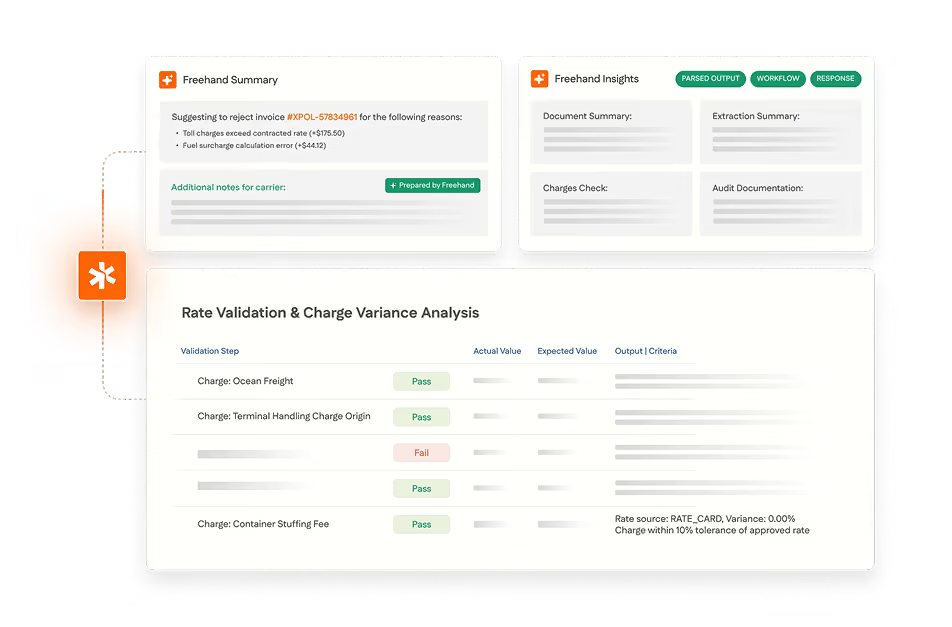
Rate Changes Enforced at the Invoice, Not Just Tracked.
Freehand checks every freight invoice against current contract terms, catching charges that don't reflect the rate they should.
Tariff Monitoring Tracks the Rate Change. Someone Still Has to Check the Invoice.
Knowing a tariff changed is only useful if it actually gets reflected correctly on the bill you're paying.
Every warehouse. Every provider. Every mile.
Gartner's 2026 outlook on logistics outsourcing, and how AI Teams hold every contract to the terms you agreed.
- Where outsourced logistics quietly loses margin
- Why billed charges drift from the contract
- How AI Teams close the gap