
S2P Automation: What It Is, How It Works, and Key Benefits
.webp)
June 25, 2026
•
12
mins
S2P automation is the application of technology to the source-to-pay process: the end-to-end procurement lifecycle from supplier identification and contract negotiation through purchasing, invoice validation, and payment.
It replaces manual handoffs between disconnected systems with a connected workflow where each stage feeds the next, spend data is visible in real time, and contract terms enforced at sourcing are still enforced at the invoice level months later.
McKinsey estimates that digitizing the source-to-pay cycle can cut operational procurement costs by 30 to 50% and automate up to 60% of manual tasks across S2P workflows.
Key Takeaways
- S2P automation is the use of technology to connect and automate the full procurement lifecycle from strategic sourcing and supplier management through contract execution, purchasing, invoice validation, and payment, eliminating manual handoffs between disconnected systems.
- S2P is broader than P2P. Procure-to-pay starts after suppliers are selected. Source-to-pay starts at supplier identification and adds strategic sourcing, supplier assessment, and contract negotiation upstream of the P2P workflow.
- Organizations that invest aggressively in procurement technology achieve their cost savings targets 96% of the time versus 80% for those that do not, according to Deloitte's 2025 Global CPO Survey.
- In logistics, the S2P cycle has a specific enforcement gap: carrier contracts negotiated at sourcing are frequently not enforced at the invoice level. Closing that gap is where the financial return from S2P automation concentrates in freight-intensive enterprises.
What Is S2P Automation?
S2P automation is the use of integrated technology to manage the source-to-pay cycle as a connected workflow, from the first identification of a procurement need through supplier selection, contract execution, purchase ordering, invoice validation, and payment, without manual handoffs between each stage.
The value proposition is continuity. In most organizations, sourcing, contracting, purchasing, and AP operate as functionally separate teams using separate systems.
A supplier relationship negotiated in the sourcing system does not automatically carry its contracted rates into the AP validation layer. A contract amendment agreed in the contract management platform does not automatically update the rate cards used to validate invoices two weeks later. Each handoff is a gap where contracted value leaks.
S2P automation closes those gaps by connecting each stage to the next through shared data, automated workflows, and a single source of truth for supplier relationships, contract terms, and spend activity.
The result is not just faster processing. It is enforced continuity: the terms procurement negotiated at the beginning of the supplier lifecycle are still the terms that govern what gets paid at the end of it.
What Is the Difference Between S2P and P2P?
P2P is a subset of S2P. Procure-to-pay begins after suppliers are selected and covers the transactional execution of procurement: requisitions, purchase orders, invoice matching, and payment. S2P starts earlier, adding strategic sourcing, supplier evaluation, and contract negotiation as upstream stages that shape what P2P transacts against.
The distinction matters because P2P automation optimizes transaction execution. S2P automation optimizes the decisions that transactions execute against.
An organization with excellent P2P automation processes invoices efficiently against contracts and rates that were determined upstream. An organization with S2P automation determines those contracts and rates through a structured, data-informed sourcing process, and then enforces them through the same connected system all the way to payment.
When P2P is sufficient
If the challenge is invoice processing speed, approval routing delays, or payment accuracy on an established supplier base, P2P automation addresses those problems directly. Organizations with stable supplier relationships and well-negotiated contracts primarily need transactional execution to improve.
When S2P is required
If the challenge is supplier quality, contract leakage, maverick spending across categories, or spend visibility before commitments are made, P2P alone cannot help because the problem originates upstream of where P2P begins. S2P automation is required when procurement needs to govern decisions, not just process transactions.
What Are the Stages of the S2P Process?
The S2P process runs across seven stages: spend analysis, strategic sourcing, supplier onboarding, contract management, purchase requisition and ordering, invoice validation and matching, and payment and reconciliation. The first three are upstream stages that P2P does not include.
Stage 1: Spend analysis
Before any sourcing activity begins, S2P starts with understanding what the organization currently buys, from whom, at what price, and under what terms. Spend analysis classifies historical purchasing data across categories, identifies consolidation opportunities, flags maverick purchasing patterns, and surfaces the categories where sourcing investment will generate the highest return.
This upstream visibility is what separates S2P from P2P: the decision about which suppliers to engage and on what terms is informed by data rather than habit.
Stage 2: Strategic sourcing
With spend data as the foundation, the sourcing team identifies potential suppliers, issues RFPs or RFQs, evaluates responses against price, quality, delivery performance, financial health, and compliance criteria, and selects the supplier or carrier that best meets the organization's requirements.
McKinsey's research on AI-driven procurement documents a 30% acceleration in supplier selection cycles for organizations using AI-assisted sourcing. In logistics and freight, this stage produces the carrier contracts that the rest of the S2P cycle enforces.
Stage 3: Supplier onboarding
Selected suppliers are onboarded into the S2P system: contact information, payment terms, tax documentation, compliance certifications, and performance SLAs are recorded in a central supplier master. This record becomes the reference point for every transaction that follows.
Poor supplier master data quality is consistently among the top three barriers to S2P automation ROI.
Suppliers with incorrect bank details, outdated compliance certifications, or missing tax documentation generate exceptions at every downstream stage.
Stage 4: Contract management
The negotiated terms are formalized into a contract, executed, and loaded into the contract management layer. Rate cards, surcharge formulas, volume tiers, service level commitments, and amendment histories are stored and made queryable.
This stage is the bridge between strategic sourcing and operational execution. The value of every negotiated term depends on whether it is accessible to the invoice validation layer when the first billing cycle runs.
A carrier contract that is filed but not loaded into the payment validation system generates zero enforcement value regardless of how well it was negotiated.
See how procurement contract management addresses this specifically at the enforcement layer.
Stage 5: Purchase requisition and ordering
With suppliers contracted and onboarded, procurement operates against the established supplier base. Employees submit purchase requisitions, approved requisitions convert to purchase orders, and POs route to suppliers through the connected system.
Guided buying at this stage directs employees toward approved suppliers at contracted rates, reducing maverick spending at the point of purchase rather than catching it in AP after the fact. The PO that is created here becomes one of the validation inputs when the invoice arrives.
Stage 6: Invoice validation and matching
When the supplier invoice arrives, the S2P platform compares it against the contracted rate, the purchase order, and the goods receipt or delivery confirmation. This is where S2P automation provides enforcement continuity: the contract terms negotiated in stage 4 are still the terms compared against the invoice in stage 6, within the same connected system.
For freight, this stage requires a fourth validation layer beyond standard three-way matching: contract-rate comparison against TMS shipment data, fuel surcharge indices, and accessorial triggering conditions. Standard S2P platforms do not include this layer. Freight invoice automation built specifically for carrier billing is required.
{{blue-cta}}
Stage 7: Payment and reconciliation
Validated invoices are scheduled for payment according to contracted terms. Payments are executed, posted to the ERP, and reconciled against the AP subledger. The full transaction record, from the original spend analysis through the final payment, is available in a single audit trail.
What Does S2P Automation Look Like in Practice?
A consumer goods manufacturer sources packaging materials across 15 suppliers in three regions. Before S2P automation, the process looks like this:
Procurement discovers a need for a new packaging specification. A category manager emails three known suppliers for quotes. Responses come back in different formats over ten days. The category manager selects one based on price and relationship familiarity. A contract is drafted in Word, negotiated over email, signed via DocuSign, and filed in a shared drive. The supplier is added to the ERP manually by someone in finance.
Six months later, when the supplier updates its surcharge structure, nobody updates the contract record. Invoices arrive with the new surcharge applied. AP processes them because the rate looks plausible. The overcharge accumulates across 400 invoices before a quarterly review catches it.
With S2P automation, the same cycle runs differently. The need triggers a spend analysis that identifies two existing approved suppliers already contracted for similar specifications, at better rates than the quote from the unfamiliar supplier.
A structured RFQ goes to four approved suppliers through the platform. Responses normalize automatically for comparison. The contract is generated from a pre-approved template, executed digitally, and loaded into the rate validation layer on the effective date. When the supplier attempts to update its surcharge structure, the invoice validation layer compares each invoice against the contracted formula and flags the deviation before payment.
The overcharge never clears. The quarterly review finds nothing to correct.
What Are the Benefits of S2P Automation?
The benefits of S2P automation compound across cost reduction, compliance improvement, risk visibility, and procurement speed. Organizations that connect the full S2P cycle generate returns that isolated P2P or sourcing automation cannot produce, because the value comes from continuity across stages rather than efficiency within any single stage.
Cost reduction through upstream and downstream connection
McKinsey estimates that digitizing the source-to-pay cycle can cut operational procurement costs by 30 to 50%. The savings come from both ends: better sourcing decisions that produce better contracts, and systematic enforcement of those contracts at the invoice level.
Deloitte's 2025 Global CPO Survey documents that S2P innovators achieve 56.4% more savings than their peers. That gap is not attributable to better negotiators. It is attributable to organizations whose contracted terms are consistently enforced rather than negotiated and then leaked.
Maverick spend reduction
Guided buying within the S2P workflow directs employees toward approved suppliers and contracted catalog items at the point of purchase. When the compliant path is the easiest path, off-contract purchasing concentrates only in categories with genuine coverage gaps rather than in every category where employees find workarounds.
Risk visibility before spend is committed
S2P automation surfaces supplier financial health, compliance status, and performance history before a purchase commitment is made. Organizations that identify a supplier's deteriorating financial position during the sourcing stage avoid the operational disruption of a mid-contract supplier failure.
Procurement cycle time compression
APQC's Sourcing and Procurement Blueprint data shows top performers generate a purchase order in approximately five hours. Bottom performers take up to 48 hours. That gap is almost entirely a workflow automation problem: approval chains, document retrieval, and supplier communication that automated S2P workflows resolve in minutes rather than days.
Audit readiness and compliance
Every stage of the S2P cycle creates a documented record: the sourcing decision rationale, the contract terms agreed, the purchase authorization, the delivery confirmation, and the payment record. When those records exist in a connected system rather than scattered across emails and shared drives, compliance reviews and audits are straightforward.
What Are the Challenges of S2P Automation Implementation?
The most consistently cited barrier to S2P automation ROI is not technology selection. It is data quality and system integration. An S2P platform connected to fragmented, inconsistent data produces fragmented, inconsistent outputs regardless of platform capability.
Ivalua's research on S2P adoption identifies the three biggest issues limiting S2P investment ROI as poor data quality and limited data access (48%), lack of integration between S2P solution and other systems (34%), and lack of integration across S2P processes (33%).
Supplier master data quality
The supplier master record is the foundation of every S2P transaction. Suppliers with incorrect bank details, outdated compliance certifications, duplicate records across regions, or missing tax information generate exceptions at every stage from onboarding through payment. Data remediation before S2P implementation is time-consuming but structurally required.
ERP and TMS integration
S2P platforms need to connect to the systems that hold the data they need: ERP for financial records and PO history, TMS for shipment execution data, and contract repositories for rate information.
Without those integrations, the connected workflow that defines S2P automation is replaced by a series of manual data transfers between systems, which recreates the handoff gaps the automation was intended to eliminate.
Cross-functional alignment
S2P spans procurement, legal, finance, and operations. Each function has different priorities and different definitions of success. 73% of CFOs and finance leaders are never fully aligned with their CIO on strategic priorities, according to Deloitte.
Without a shared implementation vision across functions, S2P projects stall as departments negotiate competing requirements.
Scope management
Broad S2P transformation programs that attempt to automate every stage simultaneously consistently take longer and deliver less than programs that start with a high-value, data-ready use case and build from there.
Accounts payable automation or spend classification are common starting points: high volume, measurable impact, and data requirements that most organizations can meet without full data remediation.
What Are the Best Practices for S2P Automation?
The best practices for S2P automation address the same failure modes: data quality problems that undermine platform output, integration gaps that recreate manual handoffs, and scope decisions that attempt full transformation before the foundation is ready.
Start with a connected data foundation, not a platform selection
The sequence that produces the fastest S2P automation ROI is: consolidate and clean the supplier master, connect ERP and contract data, then deploy automation against clean, integrated inputs. Organizations that select a platform before resolving data quality issues encounter the same exceptions in the new system that they had in the old one, only faster.
Design the contract enforcement layer before going live
The value of S2P automation is that sourcing-stage terms are enforced at the payment stage. That enforcement requires contracted rates to be loaded into the invoice validation layer on the contract effective date, not as a manual follow-on task.
Building amendment governance into the contract workflow, so that rate updates propagate to the validation layer as part of the change process, is the design decision that determines whether S2P automation delivers continuity or just faster siloed execution.
Apply freight-specific validation in logistics categories
Standard S2P platforms validate invoices against PO terms and delivery records.
Freight carrier invoices require a different validation architecture: contract-rate comparison against TMS shipment data, fuel surcharge index verification, and accessorial triggering condition confirmation.
These inputs are not held in a general S2P platform. They require freight-specific invoice validation infrastructure connected to the carrier contract layer and the TMS.
Measure compliance metrics, not just efficiency metrics
Processing time and cost per invoice are efficiency metrics. Contract compliance rate, maverick spend percentage, and invoice error rate by supplier are compliance metrics.
S2P automation generates value from both, but the compliance metrics are where the structural financial returns are generated.
An AP team that processes invoices 70% faster but at the same 8% overcharge rate has improved efficiency without improving financial control.
Build supplier performance data as a negotiating asset
Every billing cycle produces data that informs the next contract negotiation: invoice accuracy by carrier, SLA compliance by supplier, and on-time delivery rate by lane. Organizations that systematically collect and retain that data enter renewal negotiations with documented evidence rather than impressions, and the contract outcomes reflect that difference.
How Does Freehand Complete the S2P Cycle for Freight and Logistics?
Standard S2P platforms cover strategic sourcing, contract management, and general AP well. They do not cover the financial control layer of freight and logistics, which requires a different validation architecture than general procurement.
The gap is structural. Carrier invoices carry no PO reference. The rate authority is the carrier contract, covering hundreds of lanes, multiple surcharge matrices, and accessorial schedules that reset weekly by index.
Standard S2P invoice validation compares the invoice to the PO. In freight, the comparison needs to run against the contracted rate for the specific lane, the fuel surcharge index for the departure week, and TMS shipment data confirming that each accessorial charge's triggering condition occurred.
No general S2P platform holds those inputs. The freight S2P cycle has an enforcement gap at the invoice validation stage that compounds through every billing cycle it goes unresolved.
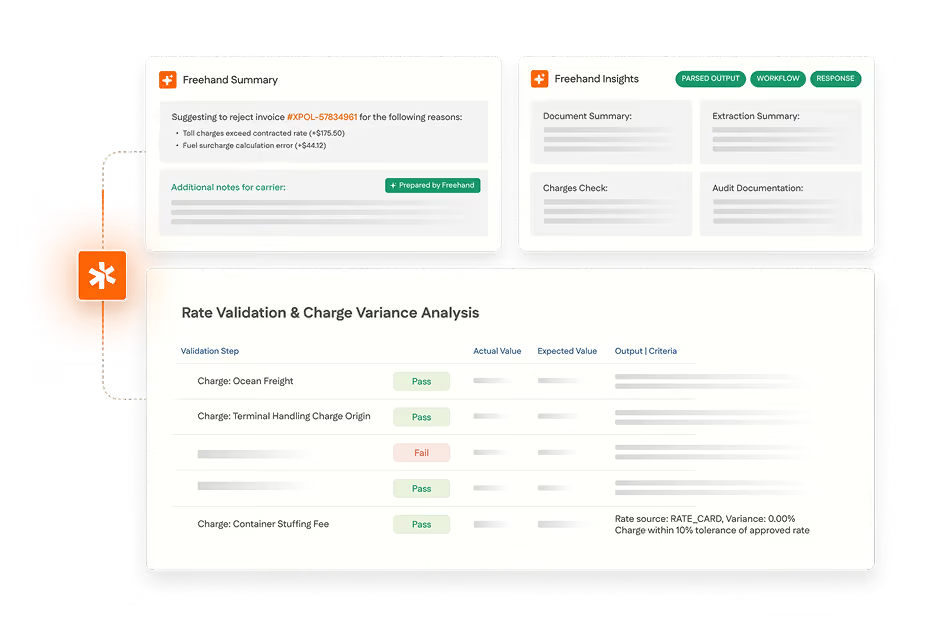
Freehand's freight audit and logistics finance platform closes that gap. It connects carrier contracts, TMS shipment data, fuel surcharge indices, and the AP system to run 4-way matching on every carrier invoice before payment clears. Contracted rates from the sourcing stage are enforced at the invoice stage in the same cycle. Amendments propagate to the validation layer on the effective date. Dispute packets are compiled and submitted autonomously when a charge fails validation.
For enterprises managing $15M or more in annual freight spend, Freehand recovers 1.5 to 2.5% of freight spend annually through systematic contract-rate enforcement at full invoice coverage. That is the S2P enforcement gap converted into recovered margin.
Request a demo to see how the freight S2P enforcement layer works alongside your existing procurement infrastructure.
{{brown-cta}}
Frequently Asked Questions
What is S2P automation?
The use of technology to connect and automate the full source-to-pay lifecycle from spend analysis and supplier selection through contract management, purchasing, invoice validation, and payment, eliminating manual handoffs between disconnected systems.
What is the difference between S2P and P2P?
P2P starts after suppliers are selected and covers transactional execution: requisitions, purchase orders, invoice matching, and payment. S2P starts earlier, adding supplier discovery, strategic sourcing, and contract negotiation as upstream stages that determine what P2P transacts against.
What are the main stages of the S2P process?
Spend analysis, strategic sourcing, supplier onboarding, contract management, purchase requisition and ordering, invoice validation and matching, and payment and reconciliation. The first three stages are upstream activities that P2P does not include.
What is the biggest challenge in S2P automation implementation?
Data quality and system integration. Poor supplier master data and disconnected ERP, TMS, and contract systems recreate the manual handoffs S2P automation is designed to eliminate, regardless of platform capability.
Why does freight require additional S2P enforcement beyond standard platforms?
Freight carrier invoices carry no PO reference and require validation against contracted rates, fuel surcharge indices, and TMS shipment data. Standard S2P platforms validate invoices against PO terms. Freight validation requires a fourth data layer that general S2P platforms do not hold.
Freehand Keeps Contract Terms Enforced All the Way to Payment.
Freehand's AI Teams validate freight invoices against the same contracted terms your sourcing team negotiated, no matter how much later the invoice arrives.
The Rate You Negotiated Isn't the Rate That Gets Billed.
Contract terms enforced at sourcing often go unchecked by the time an invoice actually clears AP months later.
Every warehouse. Every provider. Every mile.
Gartner's 2026 outlook on logistics outsourcing, and how AI Teams hold every contract to the terms you agreed.
- Where outsourced logistics quietly loses margin
- Why billed charges drift from the contract
- How AI Teams close the gap
.png)