



What Is AI in Logistics? Use Cases, Benefits, and Financial Impact
.webp)
June 23, 2026
•
12
mins

Your TMS routes shipments, your WMS manages inventory, and your ERP books the entries.
And yet, somewhere between all three:
- A carrier charged you for a load that didn't move
- A fuel surcharge matrix expired eight months ago
- A customs broker billed a duty rate you're not sure anyone verified
AI in logistics is supposed to fix that. Most implementations stop well short of it.
Key Takeaways
- AI in logistics cuts freight spend by 1.5 to 2.5% through overcharge detection that manual audit processes can't deliver at full invoice volume, translating to $450,000 to $750,000 per year on $30M in freight spend.
- The most underused AI layer in logistics is the financial one: freight invoice auditing, carrier contract enforcement, trade compliance, and logistics AR, where most enterprises still rely on manual review.
- Most logistics teams deploy AI for routing and demand forecasting but leave the billing and spend layer on manual process, where errors accumulate unchecked across every invoice cycle.
- Measuring AI ROI in logistics means tracking invoice cycle time, recoverable overcharge per period, and back-office workload reduction, not just operational efficiency metrics.
What is AI in logistics?
AI in logistics is the application of machine learning, natural language processing, and autonomous agents to logistics operations and commercial processes, from route planning and demand forecasting to invoice auditing, carrier contract compliance, and trade classification.
Logistics AI operates across two layers:
- Operational layer: routing, warehouse management, demand forecasting
- Commercial layer: billing, contracts, spend management, trade compliance
Most enterprises have invested in the first. The second, where recoverable margin lives, is still largely manual at most organizations.
The operational layer is visible. A route that's optimized shows up in fuel savings. A warehouse running AI-driven slotting shows up in pick rates. The commercial layer is harder to see: a carrier that overbilled $47,000 last quarter on an expired fuel surcharge matrix, a duty classification that cost 8% more than it should have, an AP team processing 30,000 invoices a month with no capacity to audit every line.
AI in logistics closes both layers.
Logistics is one slice of a much wider picture. If you want to see how these same capabilities extend from freight into planning, sourcing, and finance, our overview of AI in supply chain management maps where the decisions actually get made.
What are the most common use cases of AI in logistics?
The most common AI use cases in logistics are route optimization, demand forecasting, warehouse automation, and carrier performance management.
Route optimization and demand forecasting
When a carrier runs 500 trucks across 200 lanes, the number of possible routing combinations isn't something a planning team can evaluate manually. Machine learning models trained on historical shipment data, seasonal demand signals, weather patterns, and carrier capacity handle that evaluation continuously.
Demand forecasting works the same way. Instead of pulling last year's order data and applying a growth percentage, AI models ingest point-of-sale data, supplier lead times, inventory positions, and market signals to generate rolling forecasts by SKU, lane, and distribution center.
Warehouse operations and inventory management
A distribution center running 15,000 picks per day has a labor planning problem and a slotting problem. AI addresses both:
- Predictive models recommend which SKUs to slot near the pick face based on forward demand
- Workforce planning tools adjust staffing based on inbound volume forecasts
- Pick error rates drop when the system guides the path rather than relying on picker memory
Inventory management extends this to the replenishment cycle. AI models flag when safety stock thresholds need adjustment given current lead times, carrier reliability scores, and seasonal variance.
Carrier management and last-mile delivery
AI changes the inputs that factor into carrier scoring:
- Invoice accuracy history across all lanes and modes
- On-time performance broken down by lane, not averaged across the network
- Dispute frequency and resolution rate
- Benchmark rates from live market data
The result: you're not just picking the cheapest bid. You're picking the carrier whose real cost, including billing errors and service failures, is lowest.
{{blue-cta}}
Where does AI have the biggest impact on logistics costs?
The largest recoverable cost pool in logistics isn't in routing or warehouse labor. It's in billing errors, contract non-compliance, and trade overpayments that accumulate across every invoice cycle, every carrier, and every cross-border shipment.
The pattern is heaviest in freight-intensive sectors such as automotive and oil and gas.
Freight invoice auditing and overcharge recovery
Carriers bill incorrectly. That's a structural reality of a billing environment where rate tables are complex, accessorial charges are discretionary, and invoice volumes make manual line-item review impractical.
Four billing errors show up most consistently across enterprise invoice volumes:
- Duplicate charges processed without flag across a high-volume parcel batch
- Fuel surcharge matrices billing past their contract expiration date
- TONU charges on loads that actually moved, buried in monthly carrier invoices
- LTL class reclassifications added post-delivery without a contract basis
At 1.5 to 2.5% of freight spend, the average enterprise leaves $750,000 to $1.25M on the table annually for every $50M in freight.
AI freight audit covers 100% of invoices across every mode by running 4-way matching: contracted rates, shipment data, purchase orders, and carrier performance history, at a speed and scale that makes manual spot-checking look like the workaround it is.
Carrier contract compliance enforcement
Your procurement team spent months negotiating a carrier contract. The discount tiers, lane rates, and accessorial caps are documented. Whether the carrier is honoring them at invoice level is a different question, and it's one most logistics teams don't have the bandwidth to verify continuously.
AI contract compliance enforcement:
- Runs every invoice against the contracted rate structure
- Flags deviations automatically
- Generates dispute packets with the evidence needed to recover the overcharge
The enforcement happens continuously, not during a quarterly carrier review when the window for recovery may have already closed.
Trade, duty, and cross-border cost leakage
For companies with international freight, the cost leakage extends beyond carrier invoices into:
- Customs broker fees
- HS classification errors
- Missed FTA qualification
An incorrect tariff classification on a high-volume SKU doesn't get caught until someone reviews the entry, which often means it doesn't get caught at all. Duty drawback recovery goes unfiled because nobody has the bandwidth to manage the claims process at scale.
What types of AI are used in logistics systems?
The four primary AI types deployed in logistics are machine learning, natural language processing, semantic knowledge graphs, and autonomous agents.
| AI type | What it does in logistics | Example application |
|---|---|---|
| Machine learning | Detects patterns in historical data and makes predictions. | Demand forecasting, invoice anomaly detection, carrier scoring. |
| Natural language processing | Reads and interprets unstructured documents. | Invoice ingestion from PDFs, email, and EDI; contract clause extraction. |
| Semantic knowledge graph | Maps relationships between freight entities across systems. | Spend query interface, cross-system data reconciliation. |
| Autonomous agents | Takes action without waiting for human approval at each step. | Dispute packet compilation, carrier submission, duty protest filing. |
The distinction between AI that classifies and AI that acts is the one most enterprises underestimate.
A system that flags an invoice anomaly and waits for a human to approve the dispute hasn't reduced workload.
A system that compiles the evidence, drafts the dispute packet, and submits it to the carrier has.
What challenges do logistics teams face with AI adoption?
The biggest barriers to AI adoption in logistics are data fragmentation across ERP, TMS, and WMS systems, carrier invoice format variability, and the gap between pilots that succeed on clean sample data and production environments handling full invoice volume.
Three blockers account for most failed or stalled deployments:
Cross-system data fragmentation
A logistics operation running SAP for financials, a third-party TMS for transportation execution, and a separate WMS has three data environments that weren't designed to share structured data in real time.
AI that can't ingest from all three consistently produces unreliable outputs because it's working from an incomplete picture of what moved, what was contracted, and what was billed.
Carrier invoice format variability
Carriers don't invoice in a standard format. One sends EDI 210, another sends PDFs with line items in varying column positions, and a third sends CSV exports from a proprietary system.
An AI audit system that only processes structured inputs misses the invoices arriving in every other format, which in a real-world AP environment is a large share of volume.
Coverage gaps between pilot and production
Lots of logistics AI pilots succeed on a sample: the test dataset is clean, the carrier is cooperative, and the rate table is current.
Production breaks that assumption immediately. The question isn't whether AI works in a demo.
It's whether it covers 100% of your invoice volume across all modes, all carriers, and all ingestion formats, or whether it covers 80% and leaves the rest for your team to reconcile manually.
How do logistics leaders measure ROI from AI?
ROI from AI in logistics is measured across three dimensions: recovered overcharges as a percentage of freight spend, reduction in invoice processing cycle time, and reclaim of manual back-office workload.
| Metric | What it measures |
|---|---|
| 1.5–2.5% of freight spend recovered | Overcharge detection and recovery. On $30M in freight spend, this equates to approximately $450K–$750K recovered annually. |
| 80–90% reduction in invoice cycle time | 30+ day manual processes collapse to under 3 days, eliminating month-end accrual estimation. |
| 60–70% reclaim of back-office workload | Autonomous reconciliation shifts staff capacity from data entry to higher-value, judgment-required work. |
| 90% reduction in manual spend reporting time | Natural language queries replace two-day weekly reporting cycles. |
Freight spend recovery is the most direct measure. It's not a cost avoidance estimate. It's money that was billed incorrectly and is now being disputed and recovered.
Is your logistics AI covering the financial layer, or just the operational one?
Most logistics AI deployments cover routing, demand, and warehouse. That's the visible layer, the one with clear dashboards and easy KPIs.
The financial layer is different:
- Carrier billing errors accumulate
- Contract rates don't get enforced at invoice level
- Trade compliance overpayments go unrecovered
Even at companies with sophisticated TMS and ERP infrastructure.
That's not a technology gap. It's a coverage gap. Your systems know what was contracted and what shipped. The question is whether anything is comparing the two at 100% invoice volume, or whether that comparison only happens when someone on your team has time to check.
If your freight audit is running below full invoice coverage, the 1.5 to 2.5% of spend you're losing to billing errors isn't a future risk. It's a current line item.
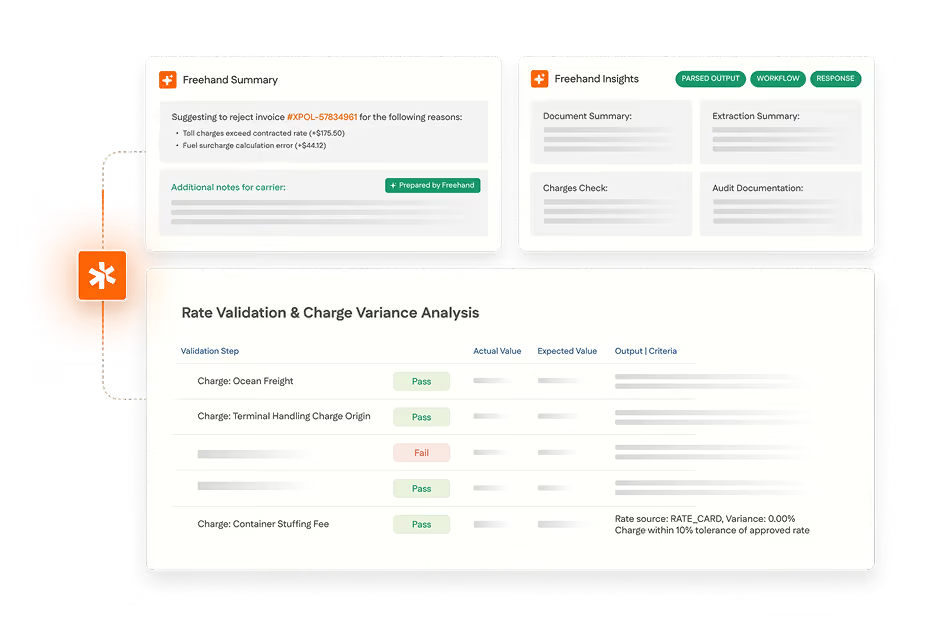
Freehand's freight audit platform covers every invoice across every mode, runs 4-way matching autonomously, and handles dispute submission without adding to your team's queue.
{{brown-cta}}
Frequently Asked Questions
What is AI in logistics?
The use of machine learning, NLP, and autonomous agents to automate operations and commercial processes, including route planning, invoice auditing, carrier contract compliance, demand forecasting, and trade classification, without requiring manual review at each step.
How does AI reduce logistics costs?
By catching carrier overcharges, enforcing contracted rates at invoice level, eliminating manual AP workload, and recovering duties that would otherwise go unfiled. Most enterprises recover 1.5 to 2.5% of freight spend through invoice-level audit alone.
What's the difference between AI and automation in logistics?
Automation executes a fixed process repeatedly. AI learns from data, adapts to new inputs, and handles variability, like a carrier invoice arriving in a format it hasn't seen before. Autonomous agents go further: they act on problems without waiting for human approval.
How does AI catch freight invoice errors?
By comparing every invoice against contracted rates, shipment data, purchase orders, and carrier history simultaneously. It flags rate mismatches, duplicate charges, unearned accessorials, and expired surcharge matrices, then compiles the dispute evidence automatically.
What ROI can logistics teams expect from AI?
Confirmed outcomes include 1.5 to 2.5% of freight spend recovered via overcharge detection, 80 to 90% reduction in invoice processing cycle time, and 60 to 70% reclaim of manual back-office workload, measurable within the first 90 days of deployment.
Which logistics teams benefit most from AI?
AP and logistics finance teams managing high invoice volume, procurement directors running RFP cycles manually, and supply chain executives at enterprises where freight spend exceeds $15M annually see the fastest ROI from AI deployment.
Freehand Puts AI on the Financial Layer Logistics AI Usually Skips.
Freehand's AI Teams audit every freight invoice against your contract, the layer most logistics AI deployments leave to manual review.
Your TMS Routes Shipments. It Doesn't Catch the Overcharge.
A fuel surcharge matrix that expired eight months ago keeps generating invoices your operational systems have no way to flag.
Every warehouse. Every provider. Every mile.
Gartner's 2026 outlook on logistics outsourcing, and how AI Teams hold every contract to the terms you agreed.
- Where outsourced logistics quietly loses margin
- Why billed charges drift from the contract
- How AI Teams close the gap


.png)