



AI in Supply Chain Management: How It Works and Key Use Cases
.webp)
June 22, 2026
•
14
mins

AI in supply chain management is the application of machine learning, natural language processing, computer vision, and autonomous agents to plan, execute, and optimize the flow of goods, data, and money across a supply network. It replaces manual processes with systems that learn and improve continuously.
According to McKinsey, enterprises with mature AI supply chain implementations achieve reductions of 20 to 30% in inventory, 5 to 20% in logistics costs, and 5 to 15% in procurement spend.
Key Takeaways
- AI in supply chain management applies machine learning, predictive analytics, and autonomous agents to functions across procurement, logistics, inventory, and finance, replacing manual processes with systems that learn and improve over time.
- McKinsey research found reductions of 20 to 30% in inventory, 5 to 20% in logistics costs, and 5 to 15% in procurement spend at enterprises with mature AI implementations.
- The highest-value AI applications in supply chain are not in robotics or routing. They are in the financial layer: invoice validation, contract enforcement, spend management, and freight cost recovery.
- Gartner forecasts that supply chain management software with agentic AI will grow from less than $2 billion in 2025 to $53 billion by 2030, with 60% of enterprises adopting agentic AI features by 2030, up from 5% in 2025.
What Is AI in Supply Chain Management?
AI in supply chain management is the application of machine learning, NLP, computer vision, and autonomous agents to plan, execute, and optimize the flow of goods, data, and money across a supply network. It is not a single technology. It is a layer of intelligence applied across multiple supply chain functions simultaneously.
The system operates across three distinct layers:
- Planning — AI analyzes historical patterns, external signals, and market conditions to forecast demand more accurately than rule-based models
- Execution — it routes shipments, validates invoices, flags exceptions, and manages supplier performance in real time
- Financial control — AI validates what carriers and vendors actually billed against what they were contracted to bill, which is where a significant portion of recoverable cost sits in most enterprise supply chains
Most enterprises are least mature at the financial layer. That is also where the gap between what AI can recover and what is currently running tends to be widest.
The common thread across all three: AI systems learn from data, improve with exposure, and act on findings without waiting for a human to initiate each step.
How Does AI Work in Supply Chain Management?
AI works in supply chain management by ingesting data from across a supply network, identifying patterns humans cannot process at scale, generating predictions or recommendations, and increasingly taking autonomous action within defined rules. The underlying technologies work together rather than in isolation.
Machine learning
Trains on historical data, shipment records, supplier performance, and market signals to generate predictions. Demand forecasting, carrier scoring, and anomaly detection in invoice data all run on ML models that improve as more data flows through them.
Natural language processing
Reads and interprets unstructured documents. Purchase orders, contracts, freight invoices, customs declarations, and supplier communications all contain critical information locked in formats that traditional systems cannot parse. NLP extracts it.
Computer vision
Reads physical environments. In warehouses, it powers automated receiving, quality inspection, and inventory counting without manual scanning. In freight, it reads shipping labels, BOLs, and damage documentation from camera feeds.
Agentic AI
It goes further than any of the above. Rather than generating a recommendation for a human to act on, AI agents take the action directly. They file a dispute with a carrier, update a rate card, flag a supplier for review, or reroute a shipment, all within guardrails set by the enterprise. This is where supply chain AI is heading fastest, and where the operational gap between early adopters and late movers is widening.
The foundation beneath all of these is data integration. AI systems that cannot access clean, connected data from ERP, TMS, WMS, and carrier systems produce unreliable outputs regardless of model sophistication. Data readiness is consistently the real constraint, not model capability.
What Are the Key Applications of AI in Supply Chain Management?
AI is delivering measurable value across six supply chain functions. Each represents a distinct use case with its own data requirements and ROI profile.
Demand forecasting and planning
Traditional demand forecasting uses historical sales data and seasonal patterns. AI models ingest far more: social media signals, economic indicators, weather patterns, competitor pricing, and real-time point-of-sale data.
AI-driven demand forecasting reduces forecast errors by up to 50% compared to traditional statistical methods. For manufacturers and retailers operating across multiple geographies and SKUs, that accuracy improvement translates directly into lower carrying costs and fewer service failures.
Inventory optimization
Carrying too much inventory ties up working capital. Carrying too little creates service failures.
AI continuously recalibrates safety stock thresholds, reorder points, and distribution allocations based on current lead times, supplier reliability scores, and demand signals. It does this across every SKU and every location simultaneously, something no planning team can replicate manually at scale.
Procurement and sourcing
AI changes how procurement teams assess suppliers, structure bids, and enforce contract terms across three areas:
- Supplier scoring — ML models evaluate price, reliability, financial health, and compliance history simultaneously
- Bid normalization — AI structures carrier and vendor proposals into comparable formats so teams evaluate true all-in cost rather than headline rates
- Contract compliance — AI validates invoices against contracted terms at full volume, catching rate deviations and unauthorized charges that manual review misses
Logistics and transportation management
Route optimization is the most visible AI application in logistics. Real-time models adjust routing based on traffic, weather, carrier capacity, and cost, continuously rather than at dispatch.
The financial layer of logistics is where AI generates the most recoverable value. Carrier billing errors, fuel surcharge mismatches, and accessorial charges applied without a contract basis represent 1.5 to 2.5% of freight spend at most enterprises. AI validates every invoice line before payment clears.
See how freight shipping costs accumulate at the invoice level when this validation layer is absent.
Warehouse and fulfillment operations
AI-enabled warehouse automation coordinates robotics for picking, sorting, and packing, reducing fulfillment errors and accelerating throughput at high-velocity distribution centers.
Beyond robotics, AI manages labor planning, slotting optimization, and inbound receiving. Predictive maintenance models monitor equipment health and schedule service before failures occur, eliminating unplanned downtime across facilities running continuous operations.
Supply chain finance and spend management
This is the application most enterprises underinvest in, and where AI delivers some of the fastest ROI.
AI in supply chain finance:
- Validates 3PL billing against WMS operational records
- Catches duty overpayments from HS misclassification
- Manages freight audit at full invoice coverage
- Surfaces cost variances before they compound through multiple billing cycles
For enterprises with significant freight and logistics spend, the financial control layer is where AI investment pays back fastest. This is the domain Freehand was built specifically to address.
{{blue-cta}}
What Are the Benefits of AI in Supply Chain Management?
The benefits fall across cost reduction, visibility, resilience, and speed. They compound: better forecasting reduces inventory, which reduces carrying costs, which improves working capital, which funds further investment in AI capability.
Cost reduction across the supply network
McKinsey's research quantified the cost impact across three areas:
- 20 to 30% reduction in inventory
- 5 to 20% reduction in logistics costs
- 5 to 15% reduction in procurement spend
These reflect documented outcomes from enterprises that connected AI models to clean, integrated supply chain data and ran them at full coverage. The logistics cost reduction deserves specific attention. Most of it does not come from route optimization. It comes from systematic invoice validation: catching the carrier billing errors, accessorial overcharges, and surcharge mismatches that clear AP unreviewed in manual processes.
Improved supply chain visibility
AI gives supply chain leaders a live picture of what is happening across the network, not a report on what happened last week. Real-time visibility into shipment location, inventory positions, supplier status, and financial exposure allows teams to intervene before exceptions become crises.
It also enables accurate financial reporting at month-end. When invoices clear validation in under three days, finance books actuals rather than estimates.
Greater resilience and risk management
AI continuously monitors supplier financial health, geopolitical events, and compliance signals to forecast supply chain risks ahead of time. Generative AI models simulate complex supply chain scenarios, supporting contingency planning and strengthening resilience across networks.
The supply chain disruptions of the last five years made resilience a board-level priority. AI is the infrastructure that converts resilience from an aspiration into an operational capability.
Faster, better decisions
AI does not replace supply chain judgment. It eliminates the time spent assembling data before a decision can be made.
Two examples of what that looks like in practice:
- A procurement team that previously spent two weeks normalizing carrier bids across 20 spreadsheets can now scenario-model award allocations in hours
- A finance team waiting 30 days for freight invoices to clear can now close with actuals after three days
The decisions remain human. The data assembly that precedes them becomes automated.
What Are the Challenges of Implementing AI in Supply Chain?
The most common reason AI supply chain projects fail to deliver sustained ROI is not model quality. It is data readiness. Fragmented systems, siloed data, and undocumented workflows prevent AI from operating reliably, regardless of how sophisticated the underlying models are.
Gartner research finds that 74% of procurement leaders say their data is not AI-ready, and that organizations which skip data integration work before AI deployment consistently discover the gap mid-pilot rather than in planning.
Data quality and integration
AI models are only as reliable as the data they run on. Most enterprise supply chains operate across ERP, TMS, WMS, and carrier systems that were not designed to share data in real time. Before meaningful AI can run on supply chain data, those systems need to connect. That integration work is unglamorous and time-consuming, but it is the prerequisite for everything else.
Legacy system constraints
McKinsey estimates an average of 2.8 years and 55 to 100 million euros to fully implement a new supply chain system. Most enterprises cannot replace legacy ERP and TMS infrastructure on that timeline.
The practical path is layering AI above existing systems through integration, not replacing them wholesale. That requires selecting AI platforms that integrate with what exists rather than requiring migration as a condition of value.
Organizational resistance and skills gaps
Supply chain teams built expertise over years of working within specific processes. AI changes those processes, which creates natural resistance.
The organizations that succeed treat AI adoption as a change management project, not just a technology deployment. They:
- Identify where AI augments existing roles rather than replaces them
- Invest in training alongside implementation
- Measure adoption as rigorously as they measure output
Scope creep and pilot failure
Many AI supply chain pilots succeed on clean sample data and controlled conditions, then stall in production. The gap is usually between the curated dataset used in the pilot and the messy, inconsistent data in the actual system.
Starting with a narrow, high-value use case with clearly defined data inputs, documented workflows, and measurable KPIs is consistently more effective than attempting broad transformation from the start.
How Is AI Being Used Across Supply Chain Industries?
AI supply chain applications look different by industry because cost structures, compliance requirements, and operational cadences differ. The common thread: AI delivers the most value where data volume is highest and where manual processes have the least capacity to keep up.
It shows up most in complex, multi-tier supply chains such as OEM manufacturing and chemical manufacturing.
Manufacturing
In manufacturing, AI manages demand-driven production scheduling, predictive maintenance across plant equipment, and inbound freight validation at scale.
A multi-plant manufacturer shipping across 30 active carrier relationships faces a specific problem: billing errors that are individually small but systematically applied across every invoice in a billing cycle never surface in manual review at volume. AI running at full invoice coverage catches the pattern on the first cycle rather than in a quarterly audit six months after the overcharges cleared.
Retail and consumer goods
Retail AI applications concentrate in demand forecasting, inventory positioning, and last-mile logistics. The SKU complexity and seasonal volatility of retail make it one of the highest-value environments for ML-based planning.
When inventory rebalancing runs on current sell-through data rather than prior-week reports, the carrying cost reduction materializes in the same period as the forecast improvement.
Pharmaceutical and healthcare
Pharmaceutical supply chains carry regulatory requirements and product sensitivity that make visibility and traceability non-negotiable. AI tracks cold-chain compliance, monitors expiry dates across distribution networks, and validates import duties and HS classifications on pharmaceutical components.
The cost of a classification error in pharma is not just a billing dispute. It is a customs hold that delays product reaching patients, with downstream consequences that far exceed the original duty amount.
Logistics and 3PL providers
For logistics providers and 3PLs, AI applications concentrate in two areas:
- Operational efficiency — route optimization, warehouse automation, carrier capacity management
- Financial management — billing validation, dispute automation, invoice accuracy
3PL invoice accuracy is a persistent challenge on both sides of the relationship. Providers that automate their own billing validation reduce dispute rates and improve cash flow. Enterprises that validate 3PL invoices with AI before payment reduce the billing errors that compound across weekly billing cycles. See how the logistics finance platform layer runs these validations continuously rather than in periodic audit batches.
Global trade and import/export
Cross-border supply chains carry duty classification, FTA qualification, and customs compliance obligations that generate significant cost exposure when managed manually. AI validates HS classifications, identifies duty drawback opportunities, monitors tariff changes, and flags compliance risks before entries are filed.
For enterprises with significant import volumes, the duty recovery alone often justifies the AI investment.
What Is the Future of AI in Supply Chain Management?
The future of AI in supply chain management is agentic: systems that do not just recommend actions but take them autonomously within guardrails defined by the enterprise. The transition from AI as a reporting tool to AI as an operating participant is already underway.
Gartner predicts that by 2030:
- 60% of enterprises using SCM software will have adopted agentic AI features, up from 5% in 2025
- Supply chain management software with agentic AI capabilities will grow from less than $2 billion to $53 billion
That growth is not speculative. It reflects enterprises that have already moved past dashboards and reporting into systems that take action.
From recommendations to autonomous execution
The distinction matters more than it first appears. A system that shows a procurement team which lanes have drifted above market is useful. A system that initiates a mini-bid on those lanes, scores the responses, and presents a shortlist for approval is operational leverage. The first requires a person to decide and act. The second requires a person only to approve.
In the supply chain financial layer, the same distinction applies. An AI system that flags a fuel surcharge misapplication is better than nothing. An AI system that compiles the dispute evidence, generates the carrier-formatted dispute packet, and submits it autonomously converts the finding into recovered margin without adding to the AP team's workload.
The human-plus-machine model
The supply chain leaders gaining ground are not replacing human judgment with AI. They are using AI to eliminate the data assembly and routine decision-making that prevents human judgment from focusing on what actually requires it: strategy, exception management, and supplier relationships.
Spend managed per full-time employee in leading procurement organizations is now approximately 50% higher than five years ago, with AI absorbing the transaction volume that would otherwise require proportional headcount growth.
Agentic AI in the financial layer
The financial control layer of supply chain operations is where agentic AI is delivering the fastest measurable return. AI Teams that validate freight invoices, file disputes, enforce carrier contracts, recover duty drawback, and manage 3PL billing compliance operate:
- Continuously, not in periodic batches
- At full invoice volume, not sampled coverage
- Without the scaling constraints of a human AP team
Every invoice cycle, every carrier, every billing period. The margin recovered compounds as long as the system runs. This is the shift from supply chain AI as an operational tool to supply chain AI as a financial control mechanism.
AI in Supply Chain Management and Freehand
Supply chain AI is a broad category. Most of the attention goes to the operational layer: routing algorithms, warehouse robots, demand sensing. Those applications are real and valuable.
The financial layer gets less attention. That is where the recoverable margin concentrates.
Every enterprise with significant freight and logistics spend has three problems running in parallel:
- Billing errors clearing AP unreviewed
- Carrier contracts not enforced at invoice level
- Duty overpayments sitting in entries that nobody audited before the protest window closed
The data to catch all of it exists. The comparison between what was contracted and what was billed just is not running automatically.
How we solve this
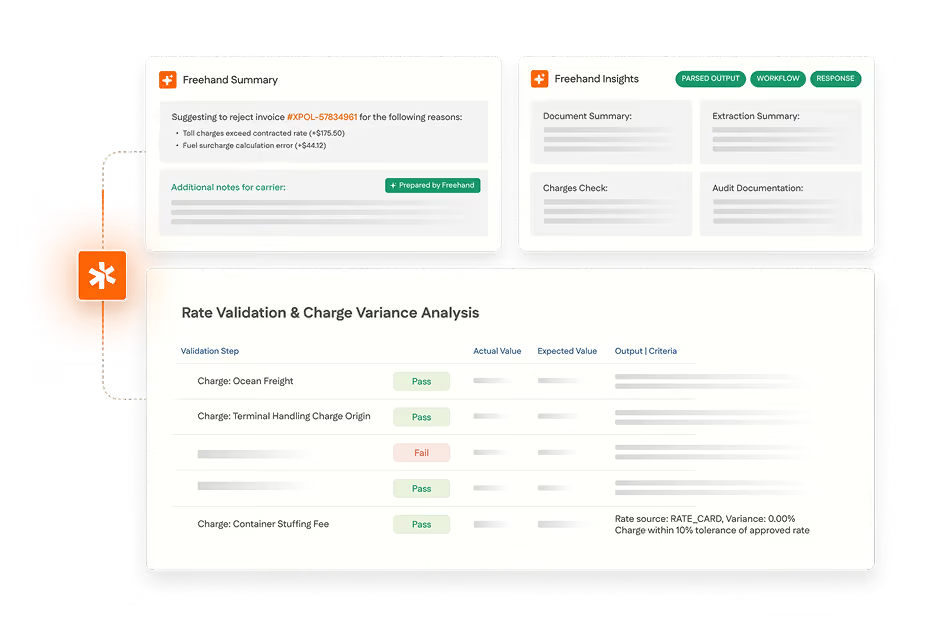
Freehand's AI Teams audit freight invoices, enforce 3PL contracts, validate trade compliance, and manage logistics accounts receivable across the supply chain financial layer, autonomously, with outcomes posted back to the ERP and a full audit trace on every resolved line.
For enterprises where freight and logistics represent $15M or more in annual spend, the financial layer of supply chain AI is where the investment pays back fastest, and where most enterprise AI programs have the widest gap between what is possible and what is currently running.
Request a demo to see what autonomous supply chain spend management looks like against your current carrier portfolio.
Sourcing is where a lot of the savings get decided long before an invoice ever lands. If your team is looking at where automation pays off on the buy side, our guide to AI in procurement covers RFQ handling, contract enforcement, and the rate work that spills straight into AP.
{{brown-cta}}
Frequently Asked Questions
What is AI in supply chain management?
The application of machine learning, NLP, computer vision, and autonomous agents to plan, execute, and optimize the flow of goods, data, and money across a supply network, replacing manual processes with systems that learn and improve over time.
How does AI improve supply chain forecasting?
AI models ingest demand signals, economic indicators, weather data, and real-time sales alongside historical patterns. Forecast errors drop by up to 50% compared to traditional statistical methods, reducing both stockouts and excess inventory.
What are the biggest challenges of implementing AI in supply chain?
Data readiness is the primary constraint, not model sophistication. Fragmented ERP, TMS, and WMS systems that do not share clean data prevent AI from operating reliably, regardless of model quality. Gartner finds 74% of procurement leaders say their data is not AI-ready.
What is agentic AI in supply chain management?
AI systems that take autonomous actions within defined guardrails rather than generating recommendations for humans to act on. In supply chains, agents file carrier disputes, update rate cards, reroute shipments, and flag compliance risks without waiting for human initiation at each step.
How much can AI reduce supply chain costs?
McKinsey research documents reductions of 20 to 30% in inventory costs, 5 to 20% in logistics costs, and 5 to 15% in procurement spend for enterprises with mature implementations. In the financial layer, invoice validation recovers 1.5 to 2.5% of freight spend annually.
Freehand Brings AI to the Financial Layer of Your Supply Chain.
Freehand's AI Teams validate freight and logistics invoices against contracted rates, the financial control most AI supply chain rollouts still leave manual.
AI Optimizes the Flow of Goods. Who's Validating the Flow of Money?
Most AI supply chain deployments focus on inventory and routing, leaving invoice validation to manual review.
Every warehouse. Every provider. Every mile.
Gartner's 2026 outlook on logistics outsourcing, and how AI Teams hold every contract to the terms you agreed.
- Where outsourced logistics quietly loses margin
- Why billed charges drift from the contract
- How AI Teams close the gap

.png)