
Freight Invoice Automation: What It Covers, What It Recovers, and How to Evaluate It
.webp)
June 30, 2026
•
8
mins
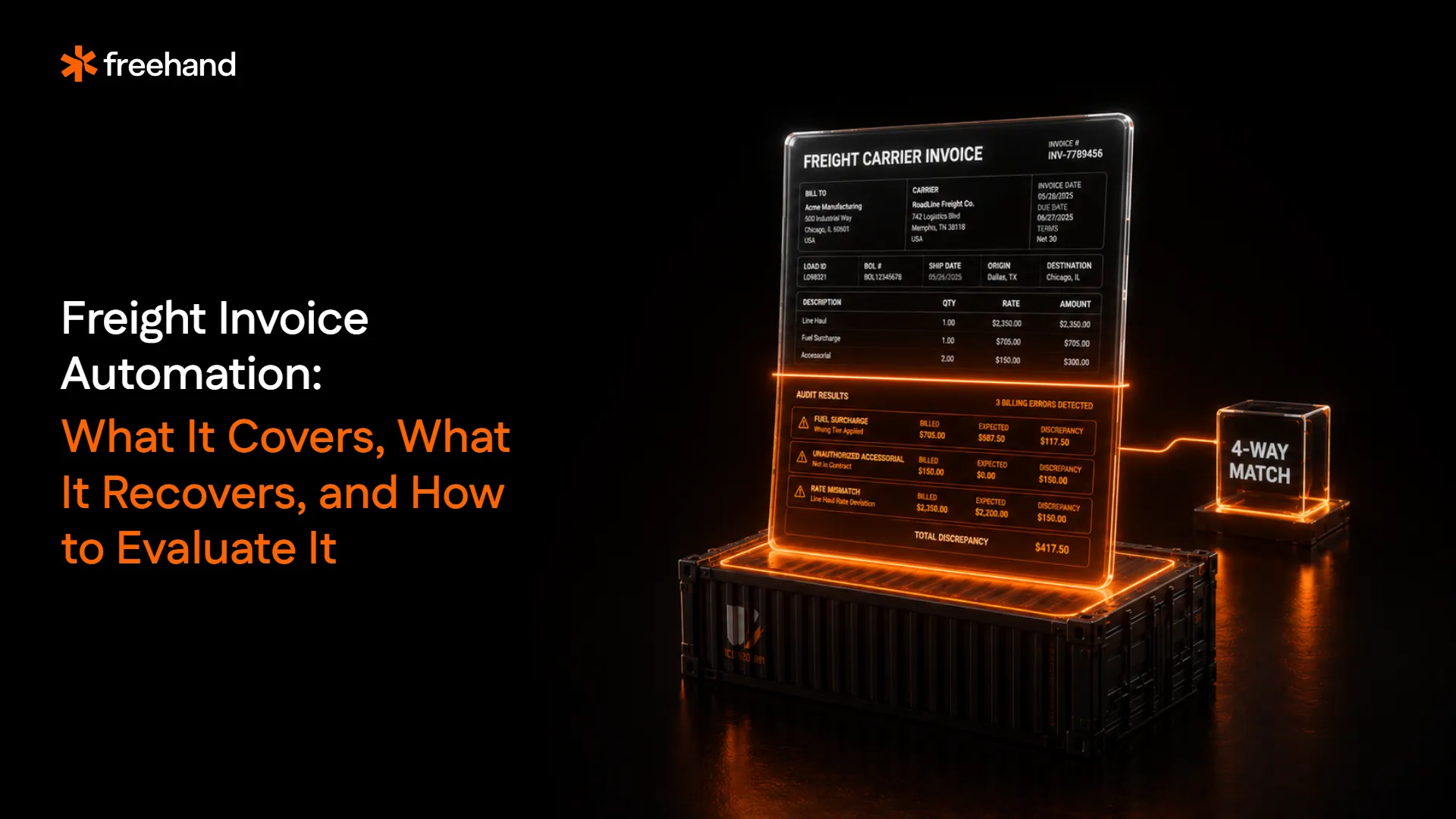
An AP team processing 18,000 freight invoices per month has usually automated the easy part: invoices arrive, data gets extracted, entries land in the ERP.
What hasn't been automated is the question that matters: is every charge on every invoice what the carrier contracted to bill?
At a carrier billing error rate of 1.5 to 2.5% of freight spend, the gap between extracting invoice data and validating it against contracted rates is where several hundred thousand dollars in annual overcharges quietly accumulates.
Key Takeaways
- The difference between freight invoice capture and freight invoice audit determines whether your automation recovers overcharges or just files invoices faster. Only the audit step produces the 1.5 to 2.5% of freight spend most enterprise AP teams are leaving on the table.
- Freight invoices require specialized automation because format variability across carriers, accessorial charge complexity, and multi-system validation requirements make general AP automation tools insufficient at carrier billing volumes.
- Most freight invoice automation platforms handle ingestion and data extraction but stop short of 4-way matching against contracted rates, purchase orders, and shipment confirmations, the step where overcharge recovery actually happens.
- Full freight invoice automation covers 100% of invoice volume across every format and carrier, runs 4-way matching autonomously, and submits dispute packets without adding to the AP team's review queue.
What is freight invoice automation?
Freight invoice automation is the end-to-end process of ingesting carrier invoices in any format, extracting charge-level data, and validating each line against contracted rates, purchase orders, and shipment records. It covers two distinct layers: invoice capture and invoice audit. Most tools cover the first. Full automation covers both.
Invoice capture handles the intake:
- Receiving invoices from EDI feeds, email attachments, carrier portals, and PDF uploads
- Extracting structured data from each
- Routing entries into the ERP or AP system
This layer replaces manual data entry and eliminates transcription errors.
Invoice audit handles the validation:
- Comparing extracted charge data against the contracted rate for the specific lane, mode, and carrier
- Checking for accessorial charges that lack a contract basis
- Verifying that each billed service matches confirmed shipment activity
This is where overcharges get caught.
The distinction matters because most enterprises have the capture layer in place and believe the automation problem is solved. The 1.5 to 2.5% of freight spend sitting in billing errors isn't a capture failure. The invoice data is in the system. It's a validation failure: the data was captured but never compared against what the carrier was supposed to charge.
Why do freight invoices require a different automation approach than standard AP invoices?
Freight invoices are harder to automate than standard AP invoices because they arrive in multiple formats with no standardization, carry discretionary accessorial charges that change by lane and date, require validation data from three separate systems, and arrive in volumes that make manual exception review impractical at enterprise scale.
Standard AP automation works on supplier invoices because they follow a predictable structure: a vendor, a line item, a price, a PO number. Freight invoices don't work that way.
Four features make them a fundamentally different automation problem:
Format variability
A single enterprise with 30 active carriers receives invoices in EDI 210, PDF in a dozen different carrier-specific layouts, CSV, Excel, and carrier web portal exports. Template-based extraction breaks when a carrier changes its PDF format or sends a supplemental invoice outside a standard layout. Coverage gaps mean the invoices most likely to contain errors are the ones least likely to be reviewed.
Accessorial charge complexity
- Ocean freight carries BAF, EBS, and CAF surcharges indexed to fuel prices that change weekly
- Parcel carries residential delivery, address correction, and DIM weight fees that apply conditionally
- LTL carries fuel surcharges, reweigh fees, and reclassification charges that require contract reference to validate
Standard AP automation can capture the charge but has no mechanism for determining whether it was valid under the carrier agreement.
Multi-system validation
Validating a freight invoice line item requires data from three sources that aren't co-located:
- The carrier contract (rate, accessorial schedule, applicable surcharges)
- The shipment record (departure date, actual weight, delivery address, mode)
- The purchase order (origin, destination, authorized shipment)
General AP automation validates against the PO only.
Invoice volume
An enterprise with $30M in annual freight spend processes between 8,000 and 25,000 invoices per month. At that volume, any manual exception review process covers a sample. Billing errors distributed across the full invoice population accumulate unchecked.
What does freight invoice automation actually do?
Full freight invoice automation handles three functions in sequence: ingesting and normalizing invoices, validating each extracted charge against contracted rates and shipment data, and acting on validation failures autonomously.
Invoice ingestion and data extraction
The ingestion layer receives invoices from every channel a carrier uses: EDI 210 feeds, email attachments in PDF/CSV/Excel, carrier portal APIs, and manual uploads. It normalizes heterogeneous inputs into a structured data format that the validation layer can process consistently.
Two key capability distinctions:
Format coverage.
Some platforms handle structured EDI reliably but struggle with PDF invoices from carriers that don't transmit electronically. Full coverage means the platform handles every format every carrier sends without creating a residual manual queue.
Normalization.
One carrier labels a charge "OHC," another calls it "origin handling," a third bundles it into the base rate. The extraction layer maps these variations to a consistent charge taxonomy before validation can run.
Rate validation and 4-way matching
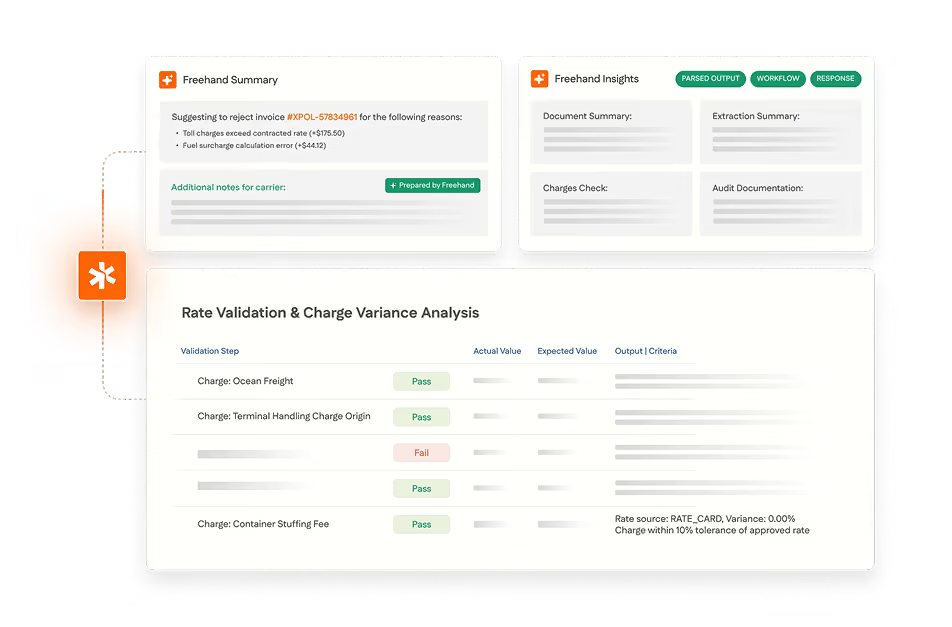
This is the step that separates freight invoice capture from freight invoice audit. The validation layer compares each charge against four data sources simultaneously:
- The contracted rate for that carrier, lane, and charge type
- The applicable fuel surcharge tier for the week of shipment
- The confirmed shipment record including weight, dimensions, delivery address, and departure date
- The purchase order authorizing the movement
Validation failures that are invisible from the invoice alone:
- A fuel surcharge applied at the wrong tier for the week of shipment
- A residential delivery fee that maps to a commercial address in the shipment record
- A TONU charge on a load the TMS confirms actually moved
Exception handling and autonomous dispute resolution
When a charge fails validation, a platform has two options: flag it for human review, or act on it autonomously.
Most platforms do the first. They surface an exception in a dashboard and wait for an AP analyst to decide whether to dispute. That model reduces data entry labor but doesn't reduce the human review burden for exceptions. It redirects workload from invoice reading to exception queue management.
Autonomous dispute resolution compiles the evidence, generates a dispute packet in the format the carrier's claims process requires, and submits it. The AP team reviews a summary of what was disputed and recovered, not each individual exception before it moves.
What is the difference between freight invoice capture and freight invoice audit?
Freight invoice capture extracts charge data from invoices and loads it into a system. Freight invoice audit compares that extracted data against contracted rates and shipment records to determine whether each charge is valid.
The distinction determines what the platform recovers:
- A capture-only platform speeds up invoice processing and eliminates data entry labor, typically a 25 to 40% reduction in per-invoice processing cost. But it doesn't catch the fuel surcharge billed at the wrong tier, the accessorial applied without a contract basis, or the TONU on a load that moved.
- A platform validating at 80% coverage leaves the hardest-to-process invoices in a manual queue where no one is checking them against the contract. The invoices a platform can't handle cleanly are often the ones with the most irregular charge structures.
Full-coverage audit automation means 100% of invoices, 100% of line items, validated against contracted rates and shipment data before payment clears, regardless of carrier format, charge type, or invoice volume.
The 1.5 to 2.5% of freight spend in billing errors isn't concentrated in the invoices that are easy to process. It's distributed across the full population, which is why coverage percentage matters more than accuracy rate on the subset a platform does handle.
This validation step is what a freight invoice auditor would traditionally do by hand: checking rate, weight, and accessorial charges line by line. Automated freight invoice auditing runs the same checks on every invoice instead of a sampled few, which is why invoice audits that used to take a person hours run in seconds at full coverage.
{{blue-cta}}
What does freight invoice automation recover at enterprise scale?
Full-coverage freight invoice automation recovers 1.5 to 2.5% of total freight spend, reduces invoice processing cycle time by 80 to 90%, and reclaims 60 to 70% of manual AP back-office workload.
| Metric | Before automation | After full automation |
|---|---|---|
| Overcharge recovery | Minimal: errors clear on 2-way match. | 1.5% to 2.5% of freight spend recovered. |
| Invoice cycle time | 30+ days. | Under 3 days. |
| Manual back-office workload | Full AP team exposure. | 60% to 70% reclaimed. |
The recovery math is straightforward. An enterprise managing $30M in annual freight spend recovers $450,000 to $750,000 per year through systematic overcharge detection.
The cycle time reduction eliminates the month-end accrual estimation problem. Instead of booking estimated freight costs because invoices haven't cleared, the team books actuals.
The back-office metric matters most for headcount justification. When 60 to 70% of manual reconciliation work runs autonomously, AP team capacity doesn't need to scale linearly with freight volume growth.
What should enterprise AP teams look for in a freight invoice automation platform?
Enterprise AP teams should verify four capabilities: multi-format invoice ingestion, 4-way matching against contracted rates, autonomous dispute action, and ERP and TMS integration.
Multi-format ingestion coverage
Does the platform handle EDI 210, PDF across carrier-specific layouts, CSV, and carrier portal exports without a residual manual queue? Non-EDI formats run 30 to 60% of most enterprise freight portfolios. Partial coverage means partial recovery.
Validation depth beyond capture
Does the platform compare extracted charges against contracted rate tables, accessorial schedules, and surcharge matrices for the specific lane and date, or does it classify charges into GL categories and flag statistical outliers?
GL classification catches gross anomalies. Contract-rate validation catches systematic errors: the fuel surcharge billed at the wrong tier on 300 invoices, the accessorial applied repeatedly above the contracted cap.
Autonomous dispute action
When a validation failure is identified, does the platform compile the dispute packet and submit it to the carrier, or does it queue the exception for an AP analyst to review before anything moves?
One model reclaims analyst time for higher-value work. The other redirects it from invoice reading to exception management.
ERP and TMS integration
Full 4-way matching requires contracted rate data, purchase order data from the ERP, and shipment confirmation data from the TMS or carrier EDI. Platforms that integrate with the ERP alone run 2-way matching. The additional integrations are what make rate-level and shipment-level validation possible.
Your AP team is processing freight invoices. Is the automation auditing them or just filing them?
Processing freight invoices means invoices are captured, coded, and paid.
Auditing them means every charge is validated against the contracted rate, the shipment record, and the purchase order before payment clears.
Most freight invoice automation platforms do the first. The 1.5 to 2.5% of freight spend sitting in billing errors is the cost of the gap between the two.
The validation step isn't a secondary feature of freight invoice automation. It's where the financial return is generated:
- Capture eliminates data entry labor, a real saving that applies once
- Audit recovers overcharges on a continuous basis: every invoice cycle, every carrier, every line item that shouldn't have cleared
At $30M in freight spend, the difference between capture-only automation and full 4-way matching audit runs $450,000 to $750,000 per year, not in one year, but in every year the validation is running.
That's the number the evaluation should start from, not the per-invoice processing cost reduction.
Freehand's freight audit platform runs full 4-way matching across every invoice across every mode, ingesting from EDI, PDF, and email, validating against contracted rates and shipment data, and submitting dispute packets autonomously, without adding to your AP team's review queue.
See which platforms automate this end to end in our guide to the best freight invoice processing software.
{{brown-cta}}
Frequently Asked Questions
What is freight invoice automation?
Two layers: invoice ingestion and data extraction, and validation of extracted charges against contracted rates, purchase orders, and shipment records. Capture makes invoices processable. Audit determines whether charges are valid. Full automation handles both without manual review at each step.
What is the difference between freight invoice capture and freight invoice audit?
Capture extracts charge data from invoices and loads it into a system. Audit compares that data against contracted rates and shipment records. Most automation tools do capture. Full audit, where overcharge recovery happens, requires 4-way matching that few platforms run at 100% invoice coverage.
How much freight spend does invoice automation recover?
Full-coverage freight invoice automation recovers 1.5 to 2.5% of total freight spend. On $30M in annual freight spend, that's $450,000 to $750,000 per year in charges that were billed without a contract basis and cleared AP because validation wasn't running.
What is 4-way matching in freight invoice automation?
Validates every invoice line against four data sources: the contracted carrier rate, the applicable surcharge tier for the week of shipment, the confirmed shipment record, and the authorizing purchase order. Each source closes a different validation gap that contract-only or PO-only matching misses.
How fast does freight invoice automation process invoices?
Full freight invoice automation reduces processing cycle time from 30 or more days to under three days, eliminating the month-end accrual estimation problem. AP teams book actual freight costs rather than estimates because invoices clear validation before the close cycle ends.
What is autonomous dispute resolution in freight invoice automation?
The platform compiles dispute evidence, generates a carrier-formatted dispute packet, and submits it when a charge fails validation, without waiting for an AP analyst to act on each exception. It converts audit findings into recovered amounts rather than a queue of flagged items.
How does freight invoice automation handle different carrier formats?
Full freight invoice automation ingests EDI 210, PDF, CSV, and carrier portal exports, normalizing each into structured charge data regardless of carrier-specific layout. Platforms that only process structured formats route non-EDI invoices to a manual queue, producing partial coverage and partial recovery.
How does freight invoice automation integrate with ERP and TMS systems?
The platform integrates with the ERP for purchase order data and GL coding, and with the TMS or carrier EDI for shipment confirmation data. Both integrations are required for 4-way matching. Platforms connected only to the ERP run 2-way matching, which misses rate-level and shipment-level validation failures.
What is freight invoice audit?
Freight invoice audit is the verification step inside invoice automation: matching each charge on the invoice to the contracted rate and shipment record before the invoice is approved for payment.
Freehand Automates the Audit Step, Not Just the Filing.
Freehand's AI Teams check every freight invoice against your contracted rates before it posts, closing the gap between capture and validation.
Extracting the Data Isn't the Same as Validating the Charge.
Automation can get an invoice into your ERP fast and still let a billing error clear right alongside it.
Every warehouse. Every provider. Every mile.
Gartner's 2026 outlook on logistics outsourcing, and how AI Teams hold every contract to the terms you agreed.
- Where outsourced logistics quietly loses margin
- Why billed charges drift from the contract
- How AI Teams close the gap