
6 Best GEP SMART Alternatives for 2026 (Compared)
.webp)
July 22, 2026
•
15
mins
The best GEP SMART alternatives for 2026: 1. Freehand, 2. Coupa, 3. SAP Ariba, 4. Ivalua, 5. Jaggaer, 6. Zycus.
GEP SMART is a unified, cloud-native source-to-pay suite that covers sourcing, contracts, supplier management, and procure-to-pay in one platform. It is a capable procurement system.
If you are here, you are likely weighing a long, premium-priced rollout, uneven P2P depth, or the fact that a general S2P suite still leaves freight and logistics AP leakage on the table, where your sourcing team negotiates rates your audit team never fully enforces.
This page compares the alternatives that do the same core job, plus the layer that closes that gap.
TL;DR
GEP SMART is a strong source-to-pay suite, but reviewers cite slowness at high data volume, uneven P2P depth, cluttered reporting, and premium pricing, and no general S2P suite closes freight and logistics AP leakage. The six alternatives, ranked for enterprises with heavy freight spend:
- Freehand (4.6/5). Runs freight procurement, invoice audit, and payment as one autonomous loop, validating 100% of invoices. It does not replace sourcing or contracts; it closes the AP leakage a suite leaves open.
- Coupa (3.5/5). Broad spend management and P2P with community spend intelligence, best for horizontal indirect spend.
- SAP Ariba (3.4/5). Deep SAP-native procurement and the largest supplier network, for SAP-standardized enterprises.
- Ivalua (3.3/5). Highly configurable source-to-pay for teams that want to tailor every workflow.
- Jaggaer (3.2/5). Strong sourcing and supplier management depth across source-to-settle.
- Zycus (3.1/5). AI-forward S2P suite with a broad module set.
Pick by what you actually need: a full S2P suite (Coupa, SAP Ariba, Ivalua, Jaggaer, Zycus) or the freight and logistics AP-execution layer those suites underdeliver (Freehand).
Why teams look for GEP SMART alternatives
GEP SMART earns its place. It is a cloud-native, unified S2P platform with 24-7 support, and reviewers call it one of the better suites to use and integrate. The reasons buyers evaluate alternatives are about depth, cost, and one structural gap.
- It slows down at high data volume. A reviewer notes it "is slow when we dump in lot of data," a concern for large, transaction-heavy enterprises. (source)
- P2P depth is uneven. The same reviewer says it "doesn't have good P2P features," and others find reporting "not intuitive, dashboards cluttered."
- Customization is limited and pricing is premium. Reviewers cite "limitations in customizing the platform" and that "it cost higher premium as compared to the other in competition," with a learning curve for new users.
- It does not close freight AP leakage. Like every general S2P suite, GEP SMART negotiates and contracts well, but carrier invoices with accessorials, fuel surcharges, and contracted rates need freight-specific audit that a procurement suite does not run, so overcharges get paid.
If suite depth is fine but freight and logistics AP leakage, cost, or P2P gaps are pushing you to look, the alternatives below either offer a different S2P suite or, in Freehand's case, run the freight audit-to-pay layer the suites leave open.
How did we evaluate these GEP SMART alternatives?
We scored every provider on the same six criteria, weighted for an enterprise with heavy freight and logistics spend evaluating source-to-pay. Weights sum to 100%, and the Overall score in the table is the weighted result. For the category baseline, see source to pay software.
- Freight and logistics AP execution (20%). Does it audit and pay carrier invoices, including accessorials and contracted rates, or leave that to a separate process?
- Autonomy (20%). Does it resolve exceptions and run the work, or automate a workflow your team operates?
- Closed-loop sourcing to payment (15%). How tightly do negotiated rates flow through to what actually gets paid?
- Spend coverage (15%). Breadth across direct, indirect, sourcing, contracts, and suppliers.
- ERP integration (15%). Pre-built connectors to SAP, Oracle, NetSuite, and Dynamics.
- Pricing transparency (15%). Predictable, disclosed pricing versus premium enterprise contracts.
This is an independent editorial comparison, not a Gartner Magic Quadrant or a paid ranking. A team consolidating broad indirect spend would weight spend coverage and closed-loop S2P highest; a freight-heavy enterprise would weight AP execution and autonomy highest.
GEP Smart Alternatives Comparison table
Here is a detailed comparison of the best GEP SMART alternatives for 2026.
{{blue-cta}}
Freehand
Best for: Enterprises with heavy freight and logistics spend that want the invoice audit and payment layer their source-to-pay suite leaves open, run for them as software.
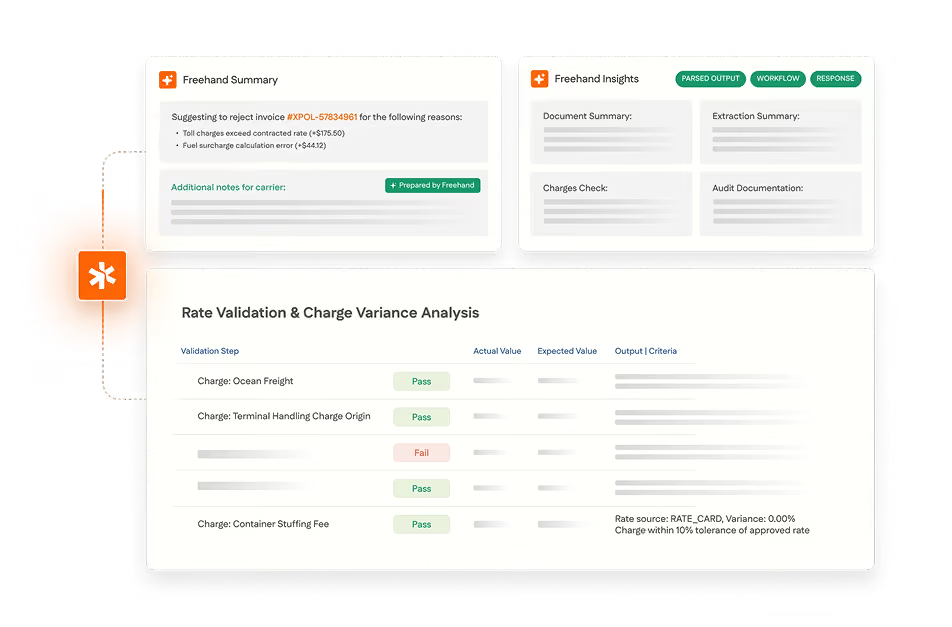
Freehand is AI Teams that run freight procurement, invoice audit, and payment as one autonomous loop. It is not a source-to-pay suite and does not replace your sourcing or contract tools. It closes the gap those suites leave: carrier invoices get validated against negotiated rates, exceptions get resolved, and clean charges post to the GL, so the savings your procurement team negotiated actually reach the invoice. For freight and logistics spend, that leakage is where the money hides.
Key features
- Validates and audits 100% of freight and vendor invoices against contracted rates, with no sampling
- Agentic AP Teams that audit, resolve exceptions, code, and pay end to end
- Freight rate and accessorial audit that general S2P suites do not perform
- Context Graph that learns carriers, lanes, contracts, and GL rules
- Freehand Studio for full visibility into every decision and recovered dollar
- Closed loop from negotiated rate to paid invoice
- Automated GL coding, cost-center allocation, and three-way matching
- Pre-built integrations with SAP, Oracle, NetSuite, and Dynamics 365
- Payment execution and reconciliation inside the same flow
- Scales without added headcount, enterprise data ownership
Pricing
Volume-based and delivered as software, so cost tracks work done rather than seats or a premium suite license. Request a quote for your freight and AP volumes.
Pros
- Only option here that runs freight audit-to-pay autonomously
- Closes the freight AP leakage a source-to-pay suite leaves open
- Complements, rather than rips out, your existing sourcing and contract tools
Cons
- Not a source-to-pay suite; it does not do sourcing, contracts, or supplier management
- Focused on freight and logistics AP, less relevant to teams whose spend is purely indirect
What users say
Love: Closes the leakage suites leave open: Freehand runs freight procurement, invoice audit, and payment as one autonomous loop, enforcing negotiated rates on every carrier invoice rather than only in the contract. (source)
Complain: A layer, not a full S2P suite: Teams looking to replace sourcing and contracts wholesale will still run a procurement suite alongside Freehand. (source)
See how the sourcing and audit sides connect in our guide to freight procurement.
Coupa
Best for: Enterprises consolidating broad indirect spend and P2P in one platform.
Coupa is a leading spend management and source-to-pay suite, strong on procure-to-pay, expenses, and community-sourced spend intelligence. It suits organizations standardizing horizontal indirect spend. It is workflow software your team configures and operates.
Key features
- Broad spend management and procure-to-pay
- Community spend intelligence and benchmarks
- Sourcing, contracts, and supplier management
- Expenses and invoicing
- Approval workflows and controls
- ERP integrations
- Large partner ecosystem
Pricing
Enterprise subscription, negotiated; not publicly listed.
Pros
- Broad, mature spend coverage
- Community spend intelligence
- Large ecosystem and integrations
Cons
- Workflow suite your team operates, not autonomous
- Reviewers cite tedious PO receiving and edit errors
- No freight-specific rate or accessorial audit
What users say
Love: Intuitive POs and easy setup: A reviewer likes "the simple and intuitive management of purchase orders," the search history, Slack and email notifications, and says "the initial setup was very simple." (source)
Complain: PO receiving and edits are clunky: A reviewer notes "receiving purchase orders is a bit tedious," and that "modifying the amounts and quantities of a purchase order generates an error that completely invalidates that order." (source)
For the buyer's-guide view, see procurement management software.
SAP Ariba
Best for: SAP-standardized enterprises that want native procurement and the largest supplier network.
SAP Ariba is a deep, enterprise-grade S2P platform with the widest supplier network and strong compliance and risk tooling. It fits organizations already committed to SAP. Reviewers value the depth while flagging complexity and long rollouts.
Key features
- Full source-to-pay across direct and indirect
- Largest global supplier network (Ariba Network)
- Supplier risk and compliance management
- Sourcing, contracts, and procurement
- Native SAP integration
- Guided buying
- Global scale
Pricing
Enterprise subscription plus implementation; not publicly listed.
Pros
- Deep, enterprise-grade procurement
- Largest supplier network
- Strong for SAP-native organizations
Cons
- Complex interface and long implementations
- Integration with non-SAP systems is time-consuming
- No freight-specific rate or accessorial audit
What users say
Love: Scale, compliance, and supplier risk: A reviewer says Ariba "provides transparency and scalability into compliance, supplier risk and sustainability management," and is "easy to use both from end-user and admin point of view." (source)
Complain: Complex and multi-step: A reviewer notes "the interface can feel complex and not very intuitive, which can slow adoption," with workflows that "require several steps" and time-consuming integrations. (source)
Compare where invoices actually get paid in procure to pay software.
Ivalua
Best for: Teams that want a single, highly configurable source-to-pay platform tailored to their processes.
Ivalua is a flexible, unified S2P platform known for configurability across sourcing, contracts, and procurement. It suits organizations with specific process needs and the resources to configure them. Reviewers praise flexibility while noting setup can be difficult.
Key features
- Unified, configurable source-to-pay
- Sourcing, contracts, and supplier management
- Intake and quality planning modules
- Spend analysis and reporting
- Workflow and scoring configurability
- ERP integrations
- Direct and indirect spend
Pricing
Enterprise subscription, negotiated; not publicly listed.
Pros
- Highly configurable across the S2P lifecycle
- Strong sourcing and supplier flexibility
- Solid independent review rating
Cons
- Configurability adds setup complexity
- Reviewers cite difficult partner-led implementations
- No freight-specific rate or accessorial audit
What users say
Love: Flexible sourcing and evaluation: A reviewer highlights "flexibility in sourcing modules for supplier's invitations, selection of suppliers," and item-specific supplier selection. (source)
Complain: Rocky partner-led setup: A reviewer says "the initial setup was difficult and badly done, as it was implemented via a partner." (source)
For the analytics angle, compare spend analytics software.
Jaggaer
Best for: Organizations that prioritize sourcing and supplier management depth across source-to-settle.
Jaggaer is an established source-to-settle platform with particular strength in sourcing and supplier management, used across direct and indirect procurement. It suits sourcing-led teams. Its independent review volume is thinner than the largest suites.
Key features
- Source-to-settle procurement
- Deep sourcing and supplier management
- Contracts and spend analytics
- Category management
- Supplier network
- ERP integrations
- Direct and indirect spend
Pricing
Enterprise subscription, negotiated; not publicly listed.
Pros
- Strong sourcing and supplier management
- Broad source-to-settle coverage
- Established enterprise vendor
Cons
- Thinner, less recent independent review volume
- Workflow suite your team operates, not autonomous
- No freight-specific rate or accessorial audit
What users say
Love: Supplier and stakeholder collaboration: A reviewer values "the possibility to collaborate in different aspect with your supplier and also enable collaboration within your company with other stakeholders." (source)
Complain: UX driven by the system, not the task: A reviewer says "the user experience should be shaped more around user needs and real business tasks, rather than being driven primarily by system capabilities," with "room for improvement in the data flows." (source)
If you are weighing sourcing tools, see our Jaggaer alternatives guide.
Zycus
Best for: Teams that want an AI-forward source-to-pay suite with a broad module set.
Zycus is a full S2P suite that has leaned into AI across sourcing, contracts, procurement, and payments. It suits organizations wanting one AI-forward suite. Its independent review depth is more modest than Coupa or Ariba.
Key features
- Full source-to-pay suite
- AI modules across the lifecycle
- Sourcing, contracts, and supplier management
- Procure-to-pay and invoicing
- Spend analytics
- ERP integrations
- Direct and indirect spend
Pricing
Enterprise subscription, negotiated; not publicly listed.
Pros
- Broad S2P module coverage
- AI-forward roadmap
- Single-vendor suite
Cons
- Modest independent review depth versus Coupa and Ariba
- Workflow suite your team operates, not autonomous
- No freight-specific rate or accessorial audit
What users say
Love: Automated, simplified workflow: A reviewer highlights an "automated and simplified workflow, high-speed and straightforward solution, and helpful tools and features." (source)
Complain: Reporting and module readiness: A reviewer says "reporting is very hit and miss," and that the "iManage module needs a lot of work to make it ready for business use." (source)
For the transport-spend angle, see transportation spend management.
GEP SMART vs Freehand
These two are not the same kind of product, and that is the point. GEP SMART is a source-to-pay suite: it sources, contracts, and runs P2P across your spend. Freehand is the agentic layer that audits and pays freight and logistics invoices against the rates procurement negotiated.
If your gap is sourcing or contract management, keep a suite. If your gap is freight AP leakage, the overcharges, accessorials, and off-contract rates that get paid because no one audits every carrier invoice, that is what Freehand resolves autonomously. Many enterprises run both: the suite for sourcing, Freehand for freight audit-to-pay. The decision is not either-or; it is whether you are leaving freight savings on the table today.
{{brown-cta}}
How to choose a GEP SMART alternative
Answer a few questions to narrow the shortlist fast:
- How big is your organization? These source-to-pay suites (Coupa, SAP Ariba, Ivalua, Jaggaer, Zycus) target large enterprises, with SAP Ariba and Coupa scaling the highest. Freehand fits $1B+ enterprises with heavy freight and logistics spend that want the AP-execution layer run for them.
- What industry are you in? Freight-intensive sectors like manufacturing, retail, CPG, food and beverage, and automotive lose the most to unaudited carrier invoices, which is where Freehand adds the most. Indirect-spend-heavy sectors like professional services and technology lean on the suites' procurement breadth.
- Are you replacing the whole S2P suite, or specific modules? For a full rip-and-replace, weigh Coupa, SAP Ariba, Ivalua, Jaggaer, or Zycus. For sourcing depth specifically, Jaggaer and Ivalua stand out; for contract management, Ivalua and the broad suites. For the freight invoice-audit and payment piece a suite underdelivers, add Freehand alongside what you keep.
- What is your ERP? SAP-standardized enterprises lean SAP Ariba; broad indirect spend leans Coupa; highly configurable needs lean Ivalua. Freehand offers pre-built connectors to SAP, Oracle, NetSuite, and Dynamics for the freight audit-to-pay layer.
Weight freight AP execution and autonomy highest if logistics is a major line of spend. A source-to-pay suite negotiates the rate; it does not enforce it on every invoice.
Fit by scenario
FAQ
Who are GEP SMART's main competitors?
In source-to-pay, the main alternatives are Coupa, SAP Ariba, Ivalua, Jaggaer, and Zycus, plus Freehand for the freight and logistics AP-execution layer.
What is the best GEP SMART alternative?
For enterprises with heavy freight spend, Freehand ranks first because it runs freight audit and payment autonomously, closing the AP leakage that a source-to-pay suite like GEP SMART leaves open.
Does Freehand replace GEP SMART?
No. Freehand does not do sourcing or contracts. It complements a source-to-pay suite by auditing and paying freight and vendor invoices against negotiated rates.
Why do companies look beyond GEP SMART?
Reviewers cite slowness at high data volume, uneven P2P depth, cluttered reporting, premium pricing, and the fact that no general S2P suite audits freight invoices.
Which GEP SMART alternative is best for SAP shops?
SAP Ariba fits SAP-standardized enterprises with native integration and the largest supplier network, though reviewers note complexity and long implementations.
Which GEP SMART alternative is most configurable?
Ivalua is known for configurability across the source-to-pay lifecycle, though that flexibility adds setup effort and often needs partner implementation.
Which alternative closes freight AP leakage?
Freehand audits 100% of carrier invoices against contracted rates and resolves exceptions autonomously, catching accessorial and off-contract overcharges that procurement suites do not audit.
Can I run Freehand alongside a source-to-pay suite?
Yes. Many enterprises keep their suite for sourcing and contracts and add Freehand for freight audit-to-pay, so negotiated savings reach the invoice.
The Layer That Actually Audits the Freight Bill.
Freehand checks every freight invoice against the carrier contract before it's paid, filling the gap a general procurement suite leaves on freight.
GEP SMART Unifies Procurement. Freight Still Gets Treated Like Office Supplies.
A unified procurement and supply chain platform covers a lot of ground. Carrier rate enforcement at the invoice isn't part of that ground.
Every warehouse. Every provider. Every mile.
Gartner's 2026 outlook on logistics outsourcing, and how AI Teams hold every contract to the terms you agreed.
- Where outsourced logistics quietly loses margin
- Why billed charges drift from the contract
- How AI Teams close the gap