
Your Sourcing Team Is Negotiating. Your Audit Team Is Paying the Wrong Rates.

March 27, 2026
•
6
mins

When sourcing and audit run on different rate data, the efficiency gains from good procurement disappear in billing.
Every few months, your freight procurement team runs a sourcing event. Carriers are invited to bid. Rates are negotiated. Contracts are signed. The team documents the agreed rates, updates the contract system, and moves on to the next sourcing cycle. This is the process working as designed.
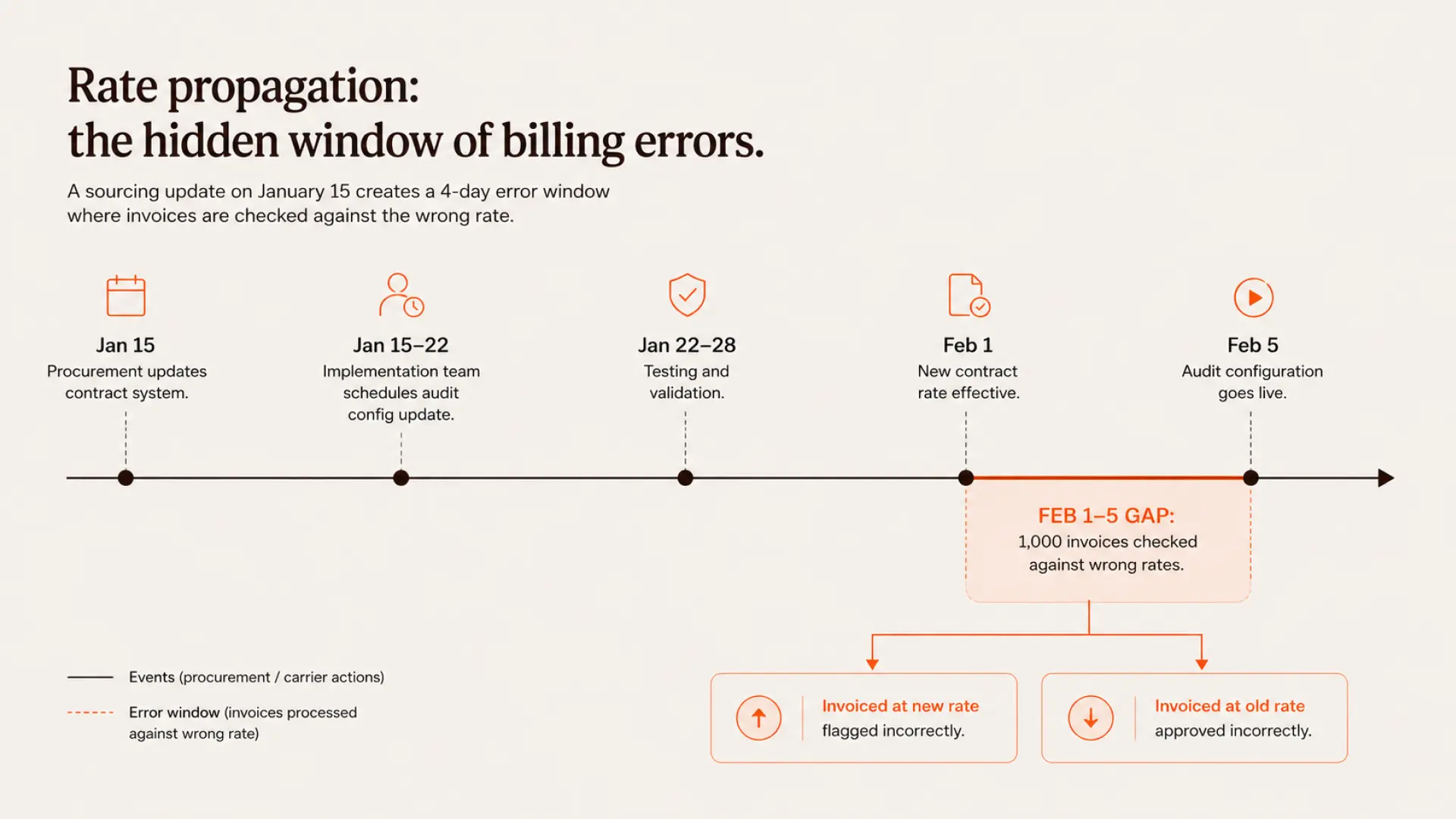
Meanwhile, in the audit system, the rate cards that invoices are checked against may be running anywhere from two weeks to six months behind the current contracted rates. A sourcing event completed in January may not be fully reflected in the audit configuration until March. In a volatile rate environment, the gap between what was negotiated and what the audit system is checking against is not a minor calibration issue. It is the systematic reason why invoices that should be disputed are approved and invoices that are compliant get flagged.
The rate propagation gap
The gap between sourcing and audit is an infrastructure problem, not a process problem. Most enterprises have two separate systems handling these functions: a procurement or contract management system where rates are negotiated and stored, and a freight audit platform where invoices are validated. The rate data that lives in the first system has to be manually imported, configured, or re-keyed into the second. That handoff is where the lag accumulates.
For annual contract cycles in a stable rate environment, the lag is manageable. The rates change once a year. The audit configuration gets updated during the transition period. By the time significant invoice volume runs under the new contract, the audit system is reasonably current. In a tariff-volatile environment, where rates change mid-cycle and carriers apply surcharges on short notice, the annual-update model produces systematic errors every time the market moves.
Two directions of error
A stale audit rate card produces errors in both directions. In the period after a new contract takes effect but before the audit configuration is updated, invoices billed under the new (lower) rate will appear to mismatch the old (higher) rate card, generating false exceptions. The audit team reviews them, determines they are correct, and approves them — spending time on a problem that the system created rather than a problem the carrier created.
In the period after a carrier changes their surcharge table but before the audit configuration catches up, invoices billed under the new (higher) surcharge will match the carrier's current billing rules but exceed the contracted limit. The audit system, checking against a rate card that predates the change, may approve them — particularly if the variance falls within the auto-approval threshold. The overcharge passes undetected.
“Sourcing recovered 8% on a carrier renegotiation. Audit was still checking against rates from the prior contract for six weeks. The savings were invisible until the audit configuration caught up.”
What a shared live rate repository changes
The architectural fix is to eliminate the handoff entirely. When sourcing and audit run on the same live rate repository — one data source that holds the current contracted rates for all carriers, updated in real time as negotiations complete and as carriers publish surcharge changes — the propagation lag disappears. A rate negotiated on a Tuesday afternoon is available to the audit engine for invoices processed on Wednesday morning.
This is not just an efficiency improvement. It changes the nature of the audit function. An audit system that always has current rates is not just catching billing errors against what was contracted last cycle. It is enforcing the current commercial relationship in real time. When a carrier tests the edges of a contract by applying a higher fuel surcharge than agreed, the detection is immediate — not discovered six weeks later when someone finally gets around to updating the audit configuration.