

Freight Procurement: Strategy, Process, and Where Savings Are Lost
Learn how freight procurement works from carrier sourcing to invoice enforcement, and where savings negotiated at RFP actually disappear.
.webp)
June 16, 2026
•
22
mins
The freight procurement cycle at most enterprises ends at contract award. The RFP goes out, carriers submit bids, rates are negotiated, and the contract is signed.
The procurement team records the projected savings. And somewhere between the signed contract and the first twelve months of invoices, a portion of those negotiated savings quietly disappears.
Not because the procurement team did anything wrong, but because there is no systematic mechanism verifying that what was contracted is what is actually being billed.
Key Takeaways
- Freight procurement covers the full lifecycle from carrier identification and tender through contract management, invoice validation, and payment. The post-contract half of that lifecycle is where most enterprises have the weakest controls.
- The freight procurement savings recorded at contract award are projections. The savings actually realized depend on whether contracted rates are being enforced at invoice level, a verification step most procurement strategies do not address.
- Fuel surcharge drift, accessorial creep, and rate misapplication consistently erode 1.5 to 2.5% of freight spend annually. These amounts accumulate after contract signature and are invisible without systematic invoice validation.
- Connecting the front end of freight procurement (sourcing, contracting) to the back end (invoice validation, payment compliance) is what separates procurement strategies that generate paper savings from strategies that generate realized ones.
- Mini-bids and dynamic procurement models reduce full truckload freight spend by an estimated 2 to 3% when supported by continuous rate benchmarking and real-time market data.
What Is Freight Procurement?
Freight procurement, also called freight sourcing, is the end-to-end process of sourcing, negotiating, and managing transportation services: identifying carrier capacity, running competitive tenders, awarding contracts, maintaining rate cards, validating invoices, and ensuring payment reflects what was contracted.
Most definitions stop at contract award. The RFP, the carrier selection, the negotiated lane rates: this is the part of freight procurement that gets attention, dedicated software categories, and the metrics procurement teams report to leadership.
But whether the savings negotiated in the RFP cycle actually reduce the freight spend line on the P&L depends entirely on what happens after the contract is signed. The post-contract phase covers managing carrier compliance against contracted rates, validating invoices against contract terms, and recovering overcharges before payment clears.
Most enterprises manage this phase poorly, not because they lack intent but because it requires connecting procurement data (contracted rates) to financial data (invoices) to operational data (shipment records) in a way that most procurement technology stacks do not support natively.
Freight is one line in a larger buying function. For the wider view across modes, carriers, and services, our guide to logistics procurement covers sourcing and contract management beyond a single freight lane.
What Are the Types of Freight Procurement?
Freight procurement operates across three models: contract procurement, spot procurement, and dynamic procurement. Most enterprise shippers use all three simultaneously, with the mix determined by lane volume, market conditions, and carrier portfolio strategy.
| Type | How it works | Best suited for | Risk |
|---|---|---|---|
| Contract procurement | Negotiated lane rates fixed for a defined period through a formal RFP. | High-volume, predictable lanes with stable carrier relationships. | Rate locked above market if capacity softens after award. |
| Spot procurement | Individual loads sourced at current market rates through load boards or direct carrier outreach. | Low-volume lanes, overflow capacity, market-rate lanes. | No rate predictability; exposure to market spikes. |
| Dynamic procurement | Shorter contract windows, frequent mini-bids, continuous lane repricing against live market data. | Volatile lanes, seasonal freight, lanes where the market has moved materially since the last RFP. | Higher procurement overhead; requires continuous rate management. |
Real-time analytics and predictive tools have become essential for dynamic procurement, allowing shippers to use strategies like mini-bids and lane rebalancing backed by current rate and capacity data.
The procurement model that works for a stable domestic truckload lane does not work for an ocean corridor that moved 30% in six months.
The compliance implication differs by type:
- Contract procurement has a rate card to validate against.
- Spot procurement validates against the confirmed spot rate.
- Dynamic procurement requires the most rigorous rate card management because the rate reference changes more frequently than under annual contract cycles.
{{blue-cta}}
How Does the Freight Procurement Lifecycle Actually Work?
The freight procurement lifecycle runs across three phases: carrier sourcing and tender, contract and rate card management, and execution and invoice compliance. Each phase produces inputs the next requires. The savings gap opens between phase two and phase three.
Phase 1: Carrier Sourcing and Tender
The sourcing phase begins with a market engagement: identifying which carriers have capacity on the lanes you need, at service levels your operations require, and at rates that reflect current market conditions.
For enterprise shippers, this typically runs through a formal RFP: a structured bid solicitation that collects carrier proposals, normalizes them for comparison, and drives competitive rate discovery.
The RFP has two outputs: a contracted rate structure covering lane-level rates, accessorial schedules, fuel surcharge formulas, and service terms, and projected savings expressed as the difference between the previous rate structure and the new contracted rates.
The projected savings are a procurement assumption. They become realized savings only if the contracted rates are applied correctly across every shipment that moves during the contract period.
Phase 2: Contract and Rate Card Management
The carrier contract is the rate authority for the entire post-signature period. Every invoice the carrier issues should be validated against it. That validation requires the contract to be structured, current, and accessible to the invoice processing layer, not a signed PDF in a contract management system.
This is the phase most enterprises underinvest in relative to the RFP cycle. The RFP gets dedicated time, technology, and procurement resources. Contract maintenance, including updating rate cards when amendments are negotiated, tracking surcharge schedule changes, and maintaining accessorial fee structures, often runs on spreadsheets or manual contract review.
This creates a gap between what the contract says and what the invoice processing layer uses for validation. That gap widens over time.
A carrier contract signed in Q1 may have accessorial schedule amendments by Q3. If those amendments are not updated in the rate reference the AP team uses for validation, invoices validate against outdated rates, producing both false positives and false negatives.
Phase 3: Execution and Invoice Compliance
The execution phase covers the operational movement of freight: shipments tendered to carriers, loads executed, deliveries confirmed.
The data generated here is the operational ground truth that invoice validation depends on: departure dates, confirmed weights, dimensions, delivery address classifications, and container release times.
Post-execution, the compliance phase runs: carrier invoices received, each line item validated against the contracted rate for the lane and date, applicable surcharge tiers confirmed against the shipment departure week, and accessorial charges verified against the conditions that warrant them.
This is the phase that converts the contracted rate structure into actual spend outcomes. Most freight procurement strategies have a detailed playbook for phases one and two.
Phase three runs on AP manual review, sampling, or exception-based flagging, producing partial coverage and systematic leakage.
What Are the Carrier Selection Criteria in Freight Procurement?
Carrier selection in freight procurement covers six criteria: rate competitiveness, service level, capacity reliability, operational fit, financial stability, and billing accuracy history. Most enterprise RFPs score the first four. The last two are the ones that most reliably predict total carrier cost over the contract period.
| Criterion | What to evaluate | Why it matters |
|---|---|---|
| Rate competitiveness | Normalized all-in cost including base rate, fuel surcharge methodology, and accessorial schedule. | The most visible criterion; also the most incomplete predictor of actual spend. |
| Service level | On-time delivery rate, tender acceptance rate, claims frequency. | Operational reliability drives routing guide compliance. |
| Capacity reliability | Coverage of contracted lanes at committed volumes, backup capacity availability. | A carrier that cannot cover committed lanes forces spot market exposure. |
| Operational fit | EDI 210 capability, invoicing format, systems integration. | A carrier without EDI creates AP processing costs that do not appear in the rate comparison. |
| Financial stability | Credit rating, insurance coverage, authority status. | Carrier financial failure mid-contract creates service disruption and re-sourcing cost. |
| Billing accuracy history | Historical billing error rate, accessorial application frequency, dispute resolution rate. | The most predictive criterion for total carrier cost; consistently excluded from RFP scoring. |
Billing accuracy history is where most carrier evaluations leave the most money on the table.
A carrier with a 3% historical billing error rate on a $2M lane commitment costs $60,000 per year more than its contracted rate implies.
Those overcharges arrive one invoice at a time, distributed across a billing cycle that makes the pattern invisible without systematic validation.
Where Do Freight Procurement Savings Get Lost?
Contracted savings erode after signature through three mechanisms: fuel surcharge drift above the contracted formula, accessorial creep where new or higher fees appear without contract basis, and rate misapplication where invoices use an expired or incorrect rate card.
Together these represent 1.5 to 2.5% of freight spend annually, amounts that accumulate invisibly because most enterprises have no systematic mechanism comparing invoiced amounts to contracted amounts at the line-item level.
| Mechanism | How it happens | Typical cost |
|---|---|---|
| Fuel surcharge drift | Surcharge applied at a higher tier than the index warrants for the departure week. | $30 to $80 per shipment. |
| Accessorial creep | Fees applied without contract basis or without the service event that triggers them. | $15 to $75 per charge. |
| Rate misapplication | Invoices reference an expired or unamended rate card after a mid-cycle renegotiation. | Full lane rate variance on every affected invoice. |
None of these mechanisms appear on a standard freight cost report. The spend line reflects what was paid, not what should have been paid.
#### Worked example: what the savings gap costs
A heavy-industry shipper managing 200+ carrier contracts had a 6-week lag between contract execution and audit system update. Rate cards were updated manually.
During each lag window, invoices arrived at new rates the audit engine did not yet recognize and cleared as valid charges.
After deploying Freehand's Contract Execution Agent, contract-to-audit activation dropped to 48 hours. Rate-based overbilling dropped to near zero within one quarter. Closing the stale-rate gap recovered an additional 3% of freight spend on top of the overcharge recovery already running.
The savings from the prior RFP negotiation existed in the contract. The audit engine was enforcing the old rate.
How Is Freight Market Volatility Changing Procurement Models?
Dynamic procurement models reduce the gap between contracted rates and current market conditions, but they do not reduce the importance of invoice compliance.
When rates are changing more frequently and the carrier portfolio is broader, the gap between contracted rates and applied rates is harder to monitor and more costly when it goes undetected.
Dynamic procurement with mini-bids and continuous lane repricing reduces freight spend by 2 to 3% when supported by live benchmarking data. The compliance infrastructure that enforces those rates at invoice level matters more, not less, when the rate reference is changing quarterly instead of annually.
What Are the Best Practices for Freight Procurement?
The best practices that move the needle in freight procurement are not in the RFP itself. They are in the decisions made before the RFP goes out, the specifications built into the bid solicitation, and the infrastructure connected at contract signing.
Getting any one of them right improves outcomes at the margin. Getting all of them right is what closes the gap between projected savings and realized ones.
Build the Carrier Scorecard Beyond Rate
Include billing accuracy history, accessorial application frequency, and dispute responsiveness in carrier evaluation alongside lane rate. These are the factors that determine total carrier cost over the contract period, not just rate on day one.
Specify Fuel Surcharge Formulas in the RFP
Do not leave the fuel surcharge methodology to carrier discretion. Specify which index applies (EIA national, EIA regional, IATA fuel monitor), the reset day, and the tier table.
A carrier that accepts a base rate reduction while proposing a more aggressive surcharge methodology may produce a higher all-in cost despite the lower headline rate.
Normalize Bids Before Awarding Lanes
A carrier quoting a lower base rate but excluding residential delivery from its accessorial schedule is not quoting the same thing as a carrier that includes both. Normalize every carrier response to the same accessorial scope, the same surcharge formula, and the same volume baseline before scoring.
By streamlining the bid normalization process, shippers can achieve faster time to value with an estimated 2 to 3% reduction in full truckload freight spend.
Close the Compliance Window at Contract Signing
The window between contract signing and rate card update in the AP validation layer is where negotiated savings evaporate. Connecting the procurement platform to the invoice audit engine so awarded rates push to the validation layer at signing eliminates this window entirely.
Use Prior Contract Audit Data as the Primary RFP Input
Billing accuracy history, accessorial application rates, and contract compliance rates from the prior contract period are the most accurate predictors of total carrier cost in the next contract. Entering the next RFP with invoice audit data converts carrier renewal negotiations from assumption-based discussions to evidence-based ones.
Run Continuous Benchmarking Between RFP Cycles
Fewer than 20% of enterprise shippers have continuous rate benchmarking in place between RFP cycles. The other 80% operate on a snapshot that may be 6 to 12 months stale. When a carrier's contracted rate drifts above the current market, the only way to identify it before the next annual RFP is to run continuous lane-level benchmarking.
#### Manage Carrier Relationships as a Procurement Input
Post-award carrier management is not a logistics function. It is a procurement input. Billing accuracy history, dispute resolution rates, and accessorial application frequency generated during the contract period are the primary inputs for the next sourcing cycle.
A carrier that disputes slowly, resolves partially, and bills accessorials at twice the contracted rate is a different counterparty at renewal than the rate comparison alone suggests. Documenting these patterns continuously converts every contract period into evidence for the next negotiation.
What Are the Challenges in Freight Procurement?
Freight procurement challenges concentrate in the same three places across almost every enterprise: the front-end process of comparing carrier bids accurately, the mid-cycle problem of keeping rate references current as contracts change, and the post-award gap between what was negotiated and what gets enforced at invoice level. Each is solvable. Most enterprises solve only the first.
Bid Normalization at Scale
A logistics RFP for 200 lanes across four modes generates carrier responses in carrier-defined formats: different spreadsheet structures, different surcharge conventions, different ways of expressing accessorial schedules. Manual normalization takes two to four weeks and still produces comparison artifacts. Awards made on unnormalized data produce contracts that do not deliver projected savings because the comparison was imprecise.
Rate Card Maintenance Across a Multi-Carrier Portfolio
Managing rate cards across 15 to 20 carrier relationships means maintaining different rate structures, amendment histories, and surcharge formulas for each, and ensuring every change propagates to the invoice validation layer before the next billing cycle.
Ocean carrier surcharge schedules can change monthly. Truckload fuel surcharges reset weekly. Parcel surcharge schedules revise quarterly.
An enterprise managing this manually through PDFs and spreadsheets falls behind within months of each RFP cycle.
The Post-Award Compliance Gap
When a carrier contract is signed and the AP team manually updates rate cards, there is a window during which invoices on the new contract validate against the old rate. Billing errors in that window appear as legitimate freight cost, not as a compliance failure.
The procurement team records the projected savings from the new contract. The realized savings are lower by the amount that cleared during the compliance window.
Market Volatility and Contract Rigidity
Annual contract cycles cannot capture quarterly capacity shifts, index-driven surcharge movements, or carrier network changes that reprice specific lanes mid-cycle. Shippers that lock in annual rates in a tightening market overpay.
Shippers that lock in annual rates in a softening market miss the renegotiation window. Dynamic procurement models address this but require more procurement infrastructure to execute.
How Is AI Changing Freight Procurement?
AI automates the bid normalization, carrier scoring, and rate scenario modeling that consume the majority of manual RFP cycle time. Post-contract, it runs continuous invoice compliance monitoring that manual AP review cannot replicate at enterprise invoice volume.
RFP Cycle Compression
The full carrier response population runs through a consistent normalization model rather than the partial analysis a manual program produces under time pressure. Two to four weeks of normalization work runs in hours.
Scenario analysis, what does the portfolio cost if volume allocation shifts between primary and backup carriers on a lane, runs in real time rather than as a two-week project.
Continuous Market Benchmarking
AI systems compare contracted rates against live market data continuously, surfacing renegotiation opportunities between RFP cycles rather than at the next annual event. A procurement team that enters a carrier renewal knowing which of its lanes are above market has a fundamentally different negotiating position than one relying on last year's RFP data.
Zero-Lag Contract Enforcement
When the procurement platform generates structured rate data and pushes it to the freight audit and payment software at contract signing, the compliance window closes to zero. The rate the procurement team negotiated is the rate the AP team enforces from day one.
How Do Enterprise Teams Measure Whether Freight Procurement Savings Are Being Realized?
Five metrics connect the front end of procurement to the back end of invoice validation. Together they answer the question the RFP scorecard cannot: did the sourcing event produce realized savings, or projected savings that eroded in the billing cycle?
| Metric | What it reveals | Below threshold |
|---|---|---|
| Contracted vs. billed rate variance | Where the contract is being honored and where it is not, by carrier and lane. | Any sustained variance flags systematic billing deviation. |
| Overcharge recovery rate | Whether the compliance process is recapturing identified billing errors. | Low rate: errors are clearing undetected or disputes are not resolving. |
| Savings realization rate | The gap between projected and actual spend reduction. | Below 80%: compliance gaps or normalization errors at award. |
| RFP-to-contract cycle time | Where manual tender management is slowing the sourcing cycle. | Above 6 weeks: normalization is the bottleneck. |
| Carrier contract compliance rate | Which carrier relationships have systemic billing problems. | Below 95% on a high-volume carrier: systematic deviation requiring intervention. |
Most enterprise procurement reporting stops at contract award. Connecting procurement data to AP data to produce these five metrics is the infrastructure investment that makes freight procurement a financial control function rather than a periodic sourcing event.
How Does Freehand Connect Freight Procurement to Invoice Compliance?
The savings your freight procurement strategy generates on paper are only as real as the compliance infrastructure behind them. Without systematic invoice-to-contract validation, the contracted rates your procurement team spent months negotiating erode through fuel surcharge drift, accessorial creep, and rate misapplication, one invoice at a time, across every carrier, across every billing cycle.
At 1.5 to 2.5% of freight spend in annual billing errors, a $30M freight spend portfolio loses $450,000 to $750,000 per year between contract signature and invoice payment. That is not market volatility. It is the cost of running a freight procurement strategy with a strong front end and a weak compliance back end.
Freehand's logistics spend platform connects both ends: automating the RFP and carrier scoring cycle, then running continuous invoice compliance monitoring against every contracted rate across every carrier relationship, and feeding realized savings data back into the next procurement cycle so the gap between projected and realized savings closes.
Freehand is recognized in the 2026 Gartner Market Guide for Freight Audit and Payment Providers. The platform serves industrial manufacturers, FMCG enterprises, retailers, and logistics service providers managing complex multi-carrier, multi-mode freight portfolios.
Our ranking of the best freight procurement software compares the tools that run sourcing end to end.
{{brown-cta}}
Frequently Asked Questions
What is freight procurement?
Sourcing, negotiating, and managing transportation services from carrier identification through contract award, invoice validation, and payment. It covers both establishing contracted rates and enforcing them at invoice level across the full contract period.
What is included in a freight procurement strategy?
A complete strategy includes carrier market analysis, RFP management, carrier selection, contract negotiation, rate card maintenance, invoice compliance monitoring, and post-contract performance management. Most enterprises cover the first three well and underinvest in the last three.
What is the difference between spot and contract freight procurement?
Contract procurement sets negotiated lane rates for a defined period through a formal tender. Spot procurement sources individual loads at current market rates. Most enterprises use both: contracts for core lanes, spot rates for overflow or low-volume lanes where the volume does not justify a contracted relationship.
How do freight procurement savings get lost after contract award?
Through fuel surcharge misapplication, accessorial charges without contract basis, and rate misapplication where invoices reference expired rate cards. Together these represent 1.5 to 2.5% of freight spend annually, invisible without systematic invoice-to-contract validation at the line-item level.
What is bid normalization in freight procurement?
Translating carrier RFP responses into a common structure for accurate cost comparison: same accessorial scope, same surcharge formula, same volume baseline. Without it, the apparent low-bid carrier may have higher all-in costs than a carrier with a higher base rate and lower accessorial exposure.
How is AI changing freight procurement?
AI automates bid normalization, carrier scoring, and rate scenario modeling in the RFP cycle, compressing sourcing timelines from weeks to hours. Post-contract, it runs continuous invoice compliance monitoring, surfacing variances that manual AP review misses and recovering overcharges before payment clears.
What is carrier contract compliance in freight procurement?
The measure of whether carriers invoice at the rates, surcharges, and accessorial schedules defined in the contract. Low compliance means systematic billing deviations that require dispute processes to recover, eroding the savings negotiated at RFP.
How do enterprise teams measure freight procurement savings realization?
By comparing actual freight spend reduction against savings projected at contract award, tracked by carrier and lane. Contracted-versus-billed rate variance and overcharge recovery rate are the two metrics that explain where realized savings fall short of projected ones.
Is logistics considered direct spend or indirect spend?
Logistics usually falls under indirect spend, since it supports getting a finished product to its destination rather than becoming part of the product itself. That classification matters less than the practical reality: freight is high-volume, high-complexity spend regardless of which category it's filed under, and it needs the same rate and contract validation either way.
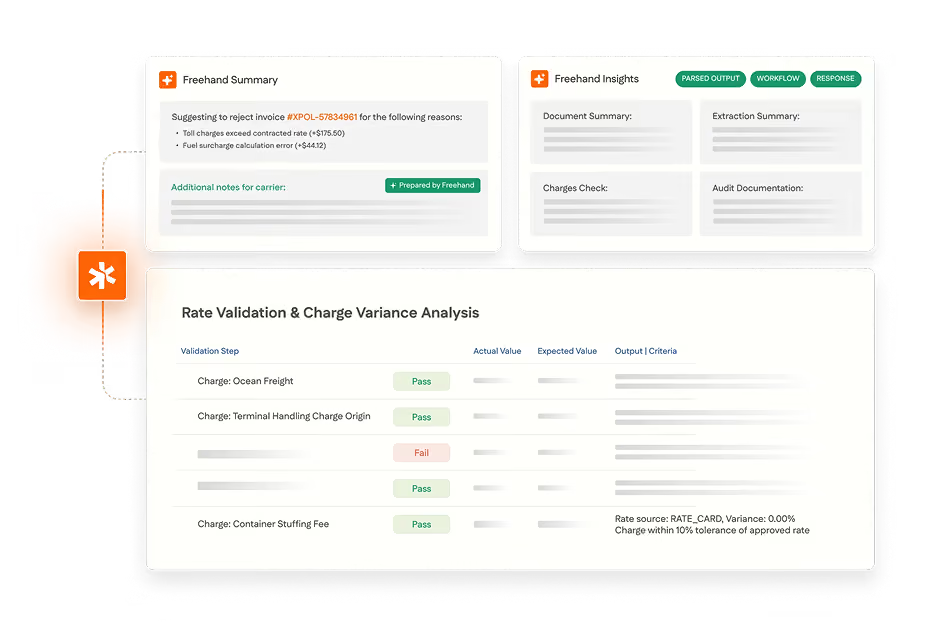
Freehand Verifies Every Invoice Against What You Actually Negotiated.
Freehand's AI Teams enforce your contracted freight rates at the invoice level, so the savings you won in procurement are the savings you actually keep.
The Savings Were Real at Contract Award. They Don't Stay That Way on Their Own.
Without something checking every invoice against the negotiated rate, contracted savings erode one billing cycle at a time.
Every warehouse. Every provider. Every mile.
Gartner's 2026 outlook on logistics outsourcing, and how AI Teams hold every contract to the terms you agreed.
- Where outsourced logistics quietly loses margin
- Why billed charges drift from the contract
- How AI Teams close the gap