

Logistics Procurement: Why the RFP Isn't Where the Savings Are Lost
.webp)
June 17, 2026
•
7
mins
Most logistics procurement programs have a well-defined RFP process. Carriers bid, rates are normalized, awards are made, contracts are signed. Then invoices arrive, and the savings line in the finance report never reaches the projected number. The RFP produced the right contract. The enforcement infrastructure was not ready to execute it. At 1.5 to 2.5% of freight spend in billing errors, the gap between contracted rate and invoiced rate is where projected savings disappear, one billing cycle at a time.
Key Takeaways
- Logistics procurement is the end-to-end process of sourcing, contracting, and managing transportation and logistics service providers across modes, from carrier RFPs through to the invoice compliance layer that determines whether contracted savings are enforced.
- Logistics procurement is structurally different from direct and indirect procurement. The output is a rate framework with variable billing components, not a fixed price against a purchase order. Standard three-way PO matching does not apply.
- The failure mode is not in the RFP. It is in the handoff from contract award to invoice compliance enforcement. Savings projected at award are only realized if the awarded rate structure reaches the AP validation layer before the first invoice arrives.
- Bid normalization is where most logistics RFPs break down operationally. Carrier responses arrive in different formats. Accurate comparison requires translating them into a common structure, a task that is time-intensive manually and introduces comparison errors that compound through the award.
- Procurement AI automates bid normalization, carrier scoring, and the award-to-enforcement handoff, so the rate structure awarded in the RFP pushes directly to the invoice audit engine at contract signing rather than through a manual rate card update step weeks later.
What Is Logistics Procurement?
Logistics procurement is the end-to-end process of sourcing, contracting, and managing transportation and logistics service providers: identifying qualified carriers and 3PLs, running competitive bids, awarding contracts, and connecting the awarded rate structure to the invoice validation layer that enforces it.
That last step is where most programs stop short. Whether the contracted rate produces the projected savings depends entirely on whether the invoice compliance function can enforce what was negotiated. Procurement that does not connect to compliance enforcement produces signed contracts and unrealized savings.
What Types of Providers Does Logistics Procurement Cover?
Logistics procurement covers four provider categories, each with different contract structures, billing complexity, and validation requirements.
| Provider type | What is contracted | Billing complexity | Validation challenge |
|---|---|---|---|
| Carriers (TL, LTL, parcel, ocean, air) | Lane rates, fuel surcharge formula, accessorial schedule | High: variable surcharges, conditional accessorials, weekly index resets | Requires contract, fuel index data, and service event records |
| 3PLs and warehouse providers | Storage rates, handling fees, fulfillment charges | High: activity-based billing against WMS operational records | Requires WMS data AP does not hold |
| Freight forwarders | Multimodal rates, THC, documentation fees, port charges | Very high: multi-party passthrough charges bundled into one invoice | Requires underlying carrier rate and service event confirmation |
| Customs brokers | Entry fees, ISF, exam charges, compliance services | Moderate: fee schedule plus conditional government charges | Requires customs event records to validate exam and inspection fees |
Each provider type generates a structurally different invoice. The validation approach that works for a carrier invoice does not work for a 3PL invoice. Most AP workflows treat all of them the same way: match to the contract and approve. That is where billing errors concentrate.
What Is the Difference Between an RFP, RFI, and RFQ in Logistics?
Most enterprise logistics sourcing events run RFI to RFP to RFQ in sequence. Skipping the RFI increases the normalization burden at bid evaluation because unqualified carrier responses still require review before being set aside.
Why Does Logistics Procurement Fail to Deliver Contracted Savings?
Contracted savings erode at two points: bid normalization, where comparison errors produce inaccurate award decisions, and the contract-to-compliance handoff, where the awarded rate is not live in the AP validation layer before the first invoice arrives.
Both failures are structural. They happen because the tools most enterprises use for logistics procurement were not designed to close them.
The Bid Normalization Problem
A logistics RFP for 200 lanes across four modes generates carrier responses in carrier-defined formats: different spreadsheet structures, different surcharge presentation conventions, different ways of expressing accessorial schedules.
Normalizing those responses manually takes two to four weeks and still produces comparison artifacts. The apparent low-bid carrier may have higher all-in costs than a carrier with a higher base rate but lower accessorial exposure or a more favorable fuel surcharge methodology. Awards made on unnormalized data produce contracts that do not deliver projected savings, not because the negotiation failed, but because the comparison was imprecise. The discrepancy is not visible until the first few billing cycles have cleared.
The Contract-to-Compliance Handoff
When the RFP produces a signed contract and the AP team manually updates rate cards, a compliance window opens. During that window, the AP validation layer validates invoices against the old rate.
Worked example: the cost of a 19-day compliance window
A heavy-industry shipper managing 200+ carrier contracts across FTL, LTL, and intermodal had a chronic 6-week lag between contract execution and audit system update. Rate cards were updated manually. During each lag window, invoices arrived at new rates the audit engine did not yet recognize and cleared as valid charges.
After deploying Freehand's Contract Execution Agent, contract-to-audit activation time dropped to 48 hours. Rate-based overbilling dropped to near zero within one quarter. Closing the stale-rate gap recovered an additional 3% of freight spend on top of the overcharge recovery already running.
The gap this closed was not a negotiation failure. Every one of those billing errors occurred on lanes where rates had already been renegotiated. The contracted savings existed. The audit engine was enforcing the old rate.
How Does Logistics Procurement Differ from Other Procurement Categories?
Logistics procurement differs from direct and indirect procurement because the purchase is a rate framework with variable billing components, not a fixed price against a purchase order. That structural difference is what makes standard three-way PO matching inadequate and creates the compliance gap that erodes contracted savings.
Service Framework vs. Fixed Price
Direct and indirect procurement purchases a physical good or a defined professional service. The invoice is compared to the PO: quantity, unit price, line-item match. The matching logic is straightforward because what was purchased and what was invoiced are both specified in advance.
Carrier procurement purchases a service framework. The contracted rate has three components: a base component, a fuel component that resets weekly by index, and an accessorial component that applies conditionally when specific service events occur. A single shipment invoice can carry six or more line items, each requiring a different validation rule against a different part of the contract. There is no PO specifying what the shipment should cost, because the final cost is not known until the shipment is complete and all service events are recorded.
Mid-Contract Amendment Dynamics
Carrier contracts change during their term in ways most other procurement categories do not. Lanes are added. Rates are renegotiated when volume commitments are exceeded. Fuel surcharge formulas are adjusted when index conditions change.
Each amendment creates a new rate that must propagate from the contract to the invoice validation layer before the next billing cycle. In a 15-carrier portfolio with quarterly amendments, the rate management obligation is continuous. Most indirect and direct procurement categories generate a contract and operate against it unchanged until renewal. Logistics procurement requires ongoing rate management that most procurement tools were not built to support.
How Does the Logistics Procurement Process Work?
The logistics procurement process runs across five stages: spend analysis and lane data preparation, carrier market assessment and RFI, RFP design and issuance, bid normalization and award, and contract execution and the compliance handoff.
Stage 1: Spend Analysis and Lane Data Preparation
The sourcing event begins with pulling historical shipment data: departure frequencies, weight distribution, seasonal patterns, accessorial usage rates, and current carrier performance by lane. Companies that implement a detailed RFP process see 15 to 20% reductions in operational logistics costs, but that outcome depends on the quality of data the shipper provides to carriers at the outset.
A sourcing scope built from actual shipment data generates a more defensible RFP than one built from prior-year spend reports. The lane analysis also identifies which carriers are consistently used as backups outside the routing guide, which lane rates predate the current market by 18 months or more, and where service failures have concentrated.
Stage 2: Carrier Market Assessment and RFI
An RFI issued to a broad carrier pool pre-qualifies participants before the RFP. It gathers capability information (modes covered, geographic footprint, EDI readiness, safety ratings, insurance) without requesting detailed pricing. The output is a shortlist of carriers who meet the qualification threshold and will receive the full RFP.
Skipping the RFI increases the normalization burden at bid evaluation because unqualified carrier responses still require review before being set aside.
Stage 3: Carrier Qualification Criteria
Qualification verifies the conditions that determine whether a carrier can execute the awarded lanes. A carrier that bids competitively but fails on one of these criteria creates operational or AP processing costs that do not appear in the rate comparison.
| Qualification criterion | Why it matters |
|---|---|
| Safety ratings and insurance coverage | Operational and liability baseline. |
| Carrier authority status | Legal requirement to operate. |
| EDI 210 invoicing capability | Without it, invoices route to manual AP processing, adding cost and cycle time. |
| Geographic footprint | Coverage of contracted lanes at committed volumes. |
| Historical on-time delivery rate | Predictor of routing guide compliance. |
| Billing accuracy history | Predictor of total carrier cost beyond the contracted rate. |
Billing accuracy history is the qualification criterion most enterprise shippers do not collect. A carrier with a 3% historical billing error rate on a $2M lane costs $60,000 per year more than its contracted rate implies. That cost does not appear in the RFP scoring matrix.
{{blue-cta}}
Stage 4: RFP Design and Bid Normalization
The RFP translates the lane analysis into a structured bid solicitation. The most commonly missed specification: the fuel surcharge formula. A carrier that accepts a base rate reduction while proposing a more aggressive surcharge methodology may produce a higher all-in cost despite the lower headline rate. The RFP must specify the index (EIA national, EIA regional), reset day, and tier table.
Bid normalization translates carrier responses from carrier-defined formats into a common structure for accurate cost comparison at the lane level, including base rate, fuel surcharge methodology, and accessorial schedule. Without normalization, the apparent low-bid carrier may not be the lowest all-in cost carrier. At enterprise scale, manual normalization takes two to four weeks. Automated normalization runs in hours across the full response population.
Stage 5: Contract Execution and the Routing Guide
Contract award assigns lanes based on the normalized bid comparison, qualification results, and portfolio risk considerations, typically spreading volume across primary and backup carriers to maintain service continuity.
The routing guide translates the lane awards into operational instructions: which carrier to tender first on each lane, which carrier handles backup, and what conditions trigger escalation to the spot market. Enterprises that actively manage routing guide compliance reduce spot market exposure by 10 to 25% and lower total freight cost relative to programs that sign contracts and rely on passive compliance.
The routing guide is only as good as the contracts behind it. And the contracts only deliver savings if the awarded rates are live in the AP validation layer before the first invoice arrives.
What Does the Logistics Procurement Cycle Actually Require?
The full logistics procurement cycle requires four connected capabilities that standard procurement tools do not provide together.
| Capability | What it does | What happens without it |
|---|---|---|
| Market intelligence | Current lane-level rate benchmarks anchoring the RFP. | Negotiating against last year's contracted rates; contracts above market at signing. |
| Bid normalization | Translates carrier responses into a common structure for accurate cost comparison. | Awards made on incomparable base rates; all-in cost misjudged at award. |
| Structured contract output | RFP award produces machine-readable rate data that feeds the audit engine. | Manual re-entry into the AP system; compliance window opens. |
| Sourcing-to-contract sync | Automated handoff from contract award to invoice audit engine. | Billing errors accumulate during the compliance window each cycle. |
The first three capabilities improve the quality of the sourcing decision. The fourth determines whether the sourcing decision produces realized savings or projected savings.
What Are the Best Practices for Logistics Procurement?
Specify Fuel Surcharge Formulas in the RFP
Do not leave the fuel surcharge methodology to the carrier's discretion. The RFP must specify which index applies, what reset day, and what tier table. A carrier that accepts a base rate reduction while embedding a more aggressive surcharge formula may produce a higher all-in cost despite the lower headline rate.
Build the Carrier Scorecard Beyond Rate
Include billing accuracy history, accessorial application frequency, and dispute responsiveness alongside lane rate in carrier evaluation. A carrier with a 3% billing error rate on a $2M lane costs $60,000 per year more than its contracted rate implies. None of this appears in the base rate comparison, but all of it shows up in total invoice cost after twelve months.
Run Multiple Bid Rounds on High-Value Lanes
One round captures a snapshot. Two or three rounds produce shortlisting, best-and-final numbers, and negotiation before award. Multi-round RFPs consistently produce better outcomes on high-volume lanes. On a procurement platform this takes less time than a single manual round used to.
Close the Compliance Window at Contract Signing
The compliance window between contract signing and rate card update is where negotiated savings evaporate. The only way to eliminate it is to connect the procurement platform to the invoice audit engine so awarded rates push to the validation layer at contract signing, not through a manual update step days or weeks later.
Use Prior Contract Audit Data as the Primary RFP Input
Billing accuracy history, accessorial application rates, and contract compliance rates generated during the prior contract period are the most accurate predictors of total carrier cost in the next contract. Entering the next RFP with invoice audit data converts carrier renewal negotiations from assumption-based discussions to evidence-based ones.
How Does Procurement AI Change Logistics Sourcing?
Procurement AI automates the bid normalization, carrier scoring, and award-to-enforcement handoff that manual logistics procurement programs handle slowly and imprecisely.
Faster and More Complete Normalization
The full carrier response population runs through a consistent comparison model rather than the partial analysis a manual program produces under time pressure. Two to four weeks of normalization work runs in hours, and comparison accuracy is consistent across all lanes rather than concentrated on the highest-volume ones.
Scenario Modeling Before Award
What does the total portfolio cost look like under alternative award structures, given carrier capacity constraints and volume commitments? Procurement AI evaluates trade-offs before committing to an award rather than discovering them in the first quarter of execution.
Zero-Lag Enforcement
When the RFP platform generates structured rate data and pushes it to the invoice audit engine at contract signing, the compliance window closes to zero. The rate the procurement team negotiated is the rate the AP team enforces from day one. Freehand's freight audit and payment software connects directly to the procurement layer so awarded rates are live in the validation engine the moment the contract is signed.
How Do Enterprise Teams Measure Logistics Procurement Effectiveness?
Five metrics distinguish a systematic logistics procurement program from a periodic RFP exercise.
| Metric | What it reveals | Below threshold |
|---|---|---|
| RFP cycle time | Days from launch to contract award. | Above 6 weeks: manual normalization is the bottleneck. |
| Bid normalization accuracy | Percentage of awarded lanes where contracted all-in cost matched projected savings. | Low accuracy: awards made on incomparable data. |
| Savings realization rate | Actual cost reduction as a percentage of projected savings. | Below 80%: compliance gaps or normalization errors at award. |
| Contract coverage rate | Percentage of freight spend under an active carrier contract with a rate reference in AP. | Below 90%: uncovered spend validating on plausibility, not contract. |
| Amendment-to-compliance lag | Days from contract amendment to live AP validation. | Any sustained lag: invoices validating against the wrong rate. |
How Does Freehand Connect Logistics Procurement to Invoice Compliance?
The contract was signed. Did the savings make it to AP?
A procurement team that negotiated a 7% rate reduction across a $40M freight portfolio expects that reduction to appear as lower freight costs in the following quarters. What typically happens: the award was made on normalized bid data that captured base rates precisely and accessorial exposure approximately. The contract was signed as a PDF. The AP team updated rate cards two weeks later. The first billing cycle validated against the old rates. The Q1 savings figure was already short of the projection.
That is the logistics procurement problem in its most common form: not a negotiating failure, but an infrastructure failure.
Freehand's logistics spend platform automates the logistics procurement cycle from bid normalization to contract award, and pushes awarded rates directly to the freight audit and payment software at signing. The rate the procurement team negotiated is the rate the AP team enforces from day one, not three weeks later. Enterprises running Freehand recover 1.5 to 2.5% of freight spend annually through systematic invoice compliance, the savings the sourcing event produced but the compliance layer was not enforcing.
Freehand is recognized in the 2026 Gartner Market Guide for Freight Audit and Payment Providers. The platform serves industrial manufacturers, FMCG enterprises, retailers, and logistics service providers managing complex multi-carrier, multi-mode freight portfolios.
To shortlist a platform, compare options in our guide to the best freight procurement software.
{{brown-cta}}
Frequently Asked Questions
What is logistics procurement?
The end-to-end process of sourcing, contracting, and managing transportation and logistics providers across modes, from carrier RFPs through to the invoice compliance layer that determines whether contracted savings are actually enforced.
How is logistics procurement different from other procurement categories?
Logistics procurement purchases a rate framework with variable billing components (base rate, fuel surcharge, conditional accessorials) rather than a fixed price against a PO. Standard three-way PO matching does not apply. Mid-contract amendments require ongoing rate management most procurement tools were not designed to handle.
What is bid normalization in logistics procurement?
Translating carrier RFP responses into a common structure for accurate cost comparison. Without it, the apparent low-bid carrier may have higher all-in costs than a carrier with a higher base rate and lower accessorial exposure, a difference only visible after normalization.
What is the contract-to-compliance handoff in logistics procurement?
The step between signing a carrier contract and having the awarded rate live in the AP validation layer. When manual, invoices on the new contract validate against the old rate for days or weeks. Billing errors in that window appear as legitimate freight cost, not as a handoff problem.
What is sourcing-to-contract sync?
The automated handoff from RFP award to the invoice audit engine. Awarded rates push directly to the validation layer at contract signing rather than through a manual update step, eliminating the compliance window during which invoices validate against the old rate.
Why do logistics procurement savings often not materialize?
The compliance layer is not enforcing the awarded rates. Common causes: delayed rate card updates after contract signing, normalization errors that produced inaccurate award decisions, or mid-cycle amendments that never reached the AP validation layer.
What is contract coverage rate in logistics procurement?
The percentage of total freight spend covered by a current carrier contract with a rate reference in the AP validation layer. Spend outside contracted carriers generates invoices without a rate to validate against, clearing on plausibility rather than contract comparison.
How does Procurement AI improve logistics RFP outcomes?
By automating bid normalization, carrier scoring, and scenario modeling across the full RFP population. It compresses cycle time and pushes awarded rates to the audit engine at contract signing, closing the compliance window between RFP award and invoice enforcement.
Freehand Is the Enforcement Layer Your RFP Was Missing.
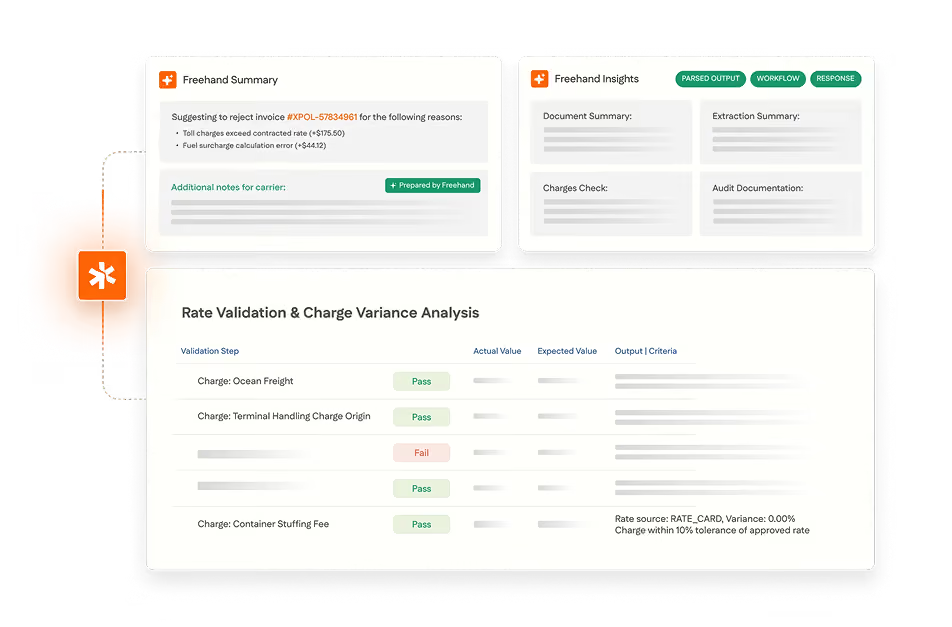
Freehand's AI Teams validate every carrier invoice against the rates your procurement team negotiated, so contracted savings show up in the finance report.
The RFP Got the Rate Right. Nothing Downstream Enforces It.
A well-run carrier RFP still leaves the savings line exposed if no one checks the invoices against the contract that resulted.
Every warehouse. Every provider. Every mile.
Gartner's 2026 outlook on logistics outsourcing, and how AI Teams hold every contract to the terms you agreed.
- Where outsourced logistics quietly loses margin
- Why billed charges drift from the contract
- How AI Teams close the gap