
Best FTA Qualification Software: 8 Tools Compared
.webp)
July 13, 2026
•
12
mins
Comparing the top FTA qualification software options for 2026: 1. Freehand, 2. Thomson Reuters ONESOURCE FTA, 3. MIC Customs Solutions, 4. E2open, 5. Descartes, 6. QAD Precision, 7. SAP GTS, 8. Oracle Global Trade Management.
Free trade agreements are worth money only if you actually qualify the goods and file the paperwork. Most teams leave duty on the table because rules-of-origin analysis is slow, bills of materials change, and supplier declarations never come back in time.
The platforms below take that work on in different ways. Most are qualification engines an analyst drives, with the certificate produced for a human to file. One, Freehand, runs qualification as an autonomous step, evaluating the BOM, flagging eligible items, generating the certificate, and re-checking when inputs change, so the duty savings actually land.
TL;DR: the best FTA qualification software at a glance
- Freehand: the only agentic option here. Its FTA Qualification Agent evaluates the BOM, flags eligible items, generates and files certificates, and connects qualification to duty recovery.
- Thomson Reuters ONESOURCE FTA: automates rules-of-origin determination and certificate of origin across 200+ countries, with the deepest content.
- MIC Customs Solutions: an FTA specialist supporting 300+ agreements, strongest on supplier-declaration solicitation and origin calculation.
- E2open: strong FTA and duty-management logic across complex, multi-country supply chains, inside a broad trade suite.
- Descartes: FTA rules-of-origin checks within an all-in-one customs and compliance ecosystem.
- QAD Precision: a rules-of-origin calculator with top-down, bottom-up, and accumulation methods, best for QAD ERP manufacturers.
- SAP GTS: SAP-native FTA qualification and preferential tariff handling for SAP shops.
- Oracle GTM: Oracle-native FTA compliance and trade management for Oracle Cloud ERP environments.
What is FTA qualification software?
FTA qualification software determines whether a product qualifies for preferential duty treatment under a free trade agreement, by testing its bill of materials against the agreement's rules of origin, then producing the certificate of origin. It typically:
- Applies rules of origin: tariff shift, regional value content, and wholly-obtained tests
- Evaluates multi-level bills of materials and component origins
- Solicits and stores supplier declarations of origin
- Compares standard duty rates against preferential rates
- Generates and files certificates of origin
- Tracks qualification across multiple agreements and countries
Most tools calculate qualification for an analyst to confirm. A smaller set of agentic trade compliance software qualifies items, files the certificate, and re-checks when the BOM or rules change.
How We Evaluated FTA Qualification Software
We judged every platform on the same cross-cutting criteria using vendor documentation, G2, and Gartner Peer Insights. AI autonomy and origin-determination coverage carry the most weight, because a tool that only calculates eligibility leaves the filing and the follow-through on your desk.
- AI autonomy and agentic action (25%): Does the system qualify and file certificates, or only calculate eligibility for a human to act on.
- Origin-determination coverage (20%): Share of the eligible catalog actually qualified, not a sample.
- Rules-of-origin depth (15%): Tariff-shift, regional value content, and accumulation across multi-level bills of materials.
- FTA and country coverage (15%): Breadth of agreements and jurisdictions supported.
- ERP integration and supplier solicitation (15%): Native ERP connectivity plus automated collection of supplier origin declarations.
- Duty savings and time-to-value (10%): Realized duty recovery and speed to go live.
This is an independent editorial comparison referencing Gartner and G2 alongside vendor documentation; it is not a certified third-party ranking.
Best FTA qualification software, ranked for 2026
The content-led platforms lead on the number of agreements and countries they cover. Freehand sits at number one for a different reason: it qualifies every eligible product autonomously and connects the result to the duty you actually recover.
| Tool | Best For | Origin-Determination Coverage | AI Autonomy | Implementation Time | Pricing Model |
|---|---|---|---|---|---|
| Freehand | Autonomous FTA qualification tied to duty recovery | 100% of eligible products | Agentic, qualifies and files | 12–14 weeks | Custom, volume-based |
| Thomson Reuters ONESOURCE FTA | Deepest FTA content and cert of origin | Full catalog | Assistive | Several months | Custom |
| MIC Customs Solutions | FTA specialist with supplier solicitation | Full catalog | Assistive | Weeks to months | Custom |
| E2open | FTA logic inside a broad trade suite | Full catalog | Assistive | Weeks to months | Custom |
| Descartes | FTA checks within the customs suite | Full catalog | Assistive | Weeks to months | Custom |
| QAD Precision | QAD ERP manufacturers | Full catalog | Assistive | Several months | Custom |
| SAP GTS | SAP-native FTA and preferential tariff | Full catalog | Assistive | Several months to a year | Custom |
| Oracle GTM | Oracle-native trade management | Full catalog | Assistive | Several months | Custom |
{{blue-cta}}
Freehand
Best for
Enterprises that want FTA qualification handled as autonomous work, not a calculator an analyst runs product by product, and that want qualification tied to realized duty savings and capture-rate lift. A strong fit for trade compliance, supply chain, and finance leaders at $500M+ importers and manufacturers.
Freehand runs qualification through its FTA Qualification Agent, one of several trade and compliance AI Teams. The agent evaluates product bills of materials, regional value content thresholds, and tariff-shift metrics, flags eligible items for preferential rates, and generates and files certificate documentation systematically. Because it works alongside Freehand's HS Classification, Duty Calculation, and Drawback Recovery agents, qualification becomes the front of a duty-recovery program, not a standalone check.
Key Features
- FTA Qualification Agent that automates rules-of-origin checking end to end
- Multi-level bill-of-materials evaluation for component origin
- Regional value content and tariff-shift qualification logic
- Automatic flagging of eligible items for preferential tariff rates
- Certificate documentation generated and filed systematically
- Re-qualification when the BOM, rules, or schedules change
- Context Graph unifying product data, origin records, and duty tables
- HS Classification and Duty Calculation agents feeding qualification
- Native connectors for SAP, Oracle, and major ERP systems
- Full audit trail on every qualification decision for customs defense
Pricing
Custom, volume-based. No percentage-of-savings fees. Compare the quote against what you pay a trade consultant or in-house origin team, not against a per-seat calculator.
Pros
- Only agentic option here: qualifies, files certificates, and re-checks automatically
- Ties qualification directly to duty savings and capture-rate lift
- 100% coverage with a defensible audit trail on every decision
Cons
- Newer to trade compliance than the 20-to-40-year GTM incumbents
- Does not ship a standalone 300-agreement content library or dedicated supplier-solicitation portal
- Built for enterprise volume, not single-product qualification
What Users Say
- Love: Real capture-rate lift. An automotive parts manufacturer increased its USMCA qualification capture rate from 34% to 79% of eligible multi-mode loads across 8,000 part numbers, driving $4.1M in annual duty savings. (source)
- Complain: No public GTM review profile yet. As a newer entrant focused on agentic execution rather than a content library, Freehand does not carry an established G2 or Gartner trade-management review base, so buyers should validate through reference calls. (source)
Thomson Reuters ONESOURCE FTA
Best for
Large enterprises that want the deepest FTA content and rules-of-origin determination, with certificate-of-origin issuance across many countries, inside a broader global trade and tax stack.
ONESOURCE Global Trade automates rules-of-origin determination, preferential duty calculation, and certificate-of-origin issuance across 200+ countries. Its content is maintained by a large research team, and it integrates with SAP. It suits organizations that treat FTA qualification as part of a wider global trade management program.
Key Features
- Rules-of-origin determination across 200+ countries
- Preferential duty calculation against standard rates
- Certificate-of-origin generation and issuance
- Supplier solicitation for origin declarations
- Deep, regularly maintained FTA content
- Integration with SAP and enterprise ERP systems
- Audit records for qualification decisions
- Part of the wider ONESOURCE global trade suite
Pricing
Custom enterprise pricing, not published, structured within the Thomson Reuters trade and tax stack. Expect a sales process.
Pros
- Broad, well-maintained FTA content across many agreements
- Certificate issuance and origin determination in one platform
Cons
- Enterprise implementation timelines run several months
- Calculates qualification for review rather than filing autonomously
What Users Say
- Love: Deep, current FTA content. ONESOURCE maintains rules-of-origin and preferential-duty content across 200+ countries, which is why enterprises with large, changing catalogs rely on it. (source)
- Complain: Thin independent review signal. The ONESOURCE Global Trade profile carries little public G2 review volume, so buyers lean on analyst positioning and reference calls rather than peer reviews. (source)
MIC Customs Solutions
Best for
Global manufacturers that want a dedicated FTA management specialist, with strong supplier-declaration solicitation and origin calculation across a wide set of agreements.
MIC Global Trade Management is a customs and trade compliance specialist whose FTA Qualifier supports precise qualification, preference management, and certificate-of-origin generation across 300+ agreements. Its supplier web portal automates solicitation and collection of supplier declarations, which is often the slowest part of an origin program.
Key Features
- FTA qualification across 300+ agreements
- Supplier-declaration solicitation via a supplier web portal
- Origin calculation with top-down, bottom-up, and accumulation methods
- Multi-level bill-of-materials analysis
- Certificate-of-origin generation
- Preference management across regions
- Central product classification alongside FTA
- Integration with enterprise ERP systems
Pricing
Custom, not published. Quotes scale with modules, agreements, and regions covered.
Pros
- Deep FTA coverage and mature supplier-solicitation workflow
- Configurable to many markets and country requirements
Cons
- Qualification is analyst-driven rather than autonomous
- Integration to IT and processes takes time to stand up
What Users Say
- Love: Configurable across markets. "One of my favorite things about it is that it has a wide range of solutions that can be changed to fit the needs of different markets and countries all over the world. The software from MIC has everything that is needed to manage and run customs processes efficiently while staying in line with the law." (source)
- Complain: Integration takes time, thin review base. "It takes some time to fully integrate with a company's IT infrastructure and business processes." That review is also the product's only G2 review, so validate on reference calls. (source)
E2open
Best for
Enterprises that want FTA and duty management inside a broad, connected supply chain suite spanning trade compliance, logistics, and execution.
E2open's global trade and duty management capabilities handle FTA qualification, duty calculation, and trade documentation across complex, multi-country supply chains. It suits organizations that want FTA logic alongside broader supply chain and logistics execution in one connected platform.
Key Features
- FTA qualification and duty management across regions
- Rules-of-origin logic for multi-country supply chains
- Duty calculation against preferential rates
- Trade documentation and certificate handling
- Import and export management
- Integration across the E2open supply chain suite
- EDI and ERP connectivity
- Customs filing support
Pricing
Custom, not published. Quotes scale with modules and the wider E2open footprint.
Pros
- Strong FTA and duty logic within a broad trade suite
- Useful when trade compliance sits beside logistics execution
Cons
- Full suite carries a steeper learning curve
- Thin independent review volume for the trade suite specifically
What Users Say
- Love: Handles customs, duty, and trade. A reviewer notes E2open helps with "customs filing, duty management, import and export management" across connected processes. (source)
- Complain: Thin reviews, learning curve. The trade suite carries only 5 G2 reviews (4.6/5), and users note the breadth of the platform brings a steeper learning curve, so scope your rollout carefully. (source)
Descartes
Best for
Importers that want FTA rules-of-origin checks inside a broad customs and compliance ecosystem, especially teams already running other Descartes modules.
Descartes Customs and Trade Compliance provides FTA rules-of-origin checks alongside tariff lookup, duty determination, and restricted-party screening. It works best as part of an existing Descartes footprint, giving teams FTA qualification in the same ecosystem as their other customs workflows.
Key Features
- FTA rules-of-origin compliance checks
- Tariff lookup and duty determination
- Restricted-party screening alongside FTA
- Broad customs content across many countries
- Certificate and documentation support
- All-in-one customs and compliance workflows
- Regular regulatory content updates
- Integration within the Descartes suite
Pricing
Custom, not published. Quotes scale with modules and the wider Descartes deployment.
Pros
- FTA checks inside a broad, all-in-one customs ecosystem
- Strong customs content and country coverage
Cons
- Parts of the user experience feel dated to some reviewers
- Best value comes when already invested in Descartes
What Users Say
- Love: Reliable all-in-one platform. "Reliable, All-in-One Platform for Efficient Customs & Compliance Workflows... it combines multiple customs and compliance functions within a single ecosystem, reducing the need to switch between different platforms." (source)
- Complain: Dated UX in places. "Some parts of the user experience feel dated compared to modern software solutions. There are occasional workflow inefficiencies, extra clicks, and small usability issues that can slow down experienced users." (source)
QAD Precision
Best for
Manufacturers running QAD ERP that want a configurable rules-of-origin calculator qualifying products dynamically across multiple agreements.
QAD Precision, now QAD Global Trade & Transportation Execution, provides a rules-of-origin calculator that qualifies products across multiple FTAs using configurable transformation rules. It applies top-down, bottom-up, and accumulation methods across multi-level bills of materials, and fits large manufacturing enterprises already standardized on QAD.
Key Features
- Rules-of-origin calculator across multiple FTAs
- Top-down, bottom-up, and accumulation qualification methods
- Multi-level bill-of-materials analysis
- Smart product classification alongside FTA
- Documentation generation for qualified goods
- Landed-cost and sourcing comparisons
- Integration with QAD ERP and manufacturing systems
- Compliance alerts and screening
Pricing
Custom enterprise pricing, not published, dependent on the QAD landscape and modules.
Pros
- Strong, configurable rules-of-origin depth for manufacturers
- Tight fit for QAD ERP environments
Cons
- Best value inside a QAD ERP footprint
- No dedicated public review profile for the trade module
What Users Say
- Love: Dynamic rules-of-origin depth. QAD Precision qualifies products dynamically across multiple FTAs using configurable transformation rules and multi-level BOM analysis, a fit for complex manufacturing. (source)
- Complain: No dedicated review profile. The QAD Global Trade & Transportation Execution product has no G2 reviews yet, and the broader QAD G2 rating blends its ERP products, so validate the trade module directly. (source)
SAP GTS
Best for
SAP shops that want FTA qualification and preferential tariff handling native to their ERP, alongside classification, screening, and customs management.
SAP Global Trade Services handles FTA qualification, rules-of-origin verification, and preferential tariff calculation as part of a wider compliance platform. It pulls data from connected SAP ERP systems and centralizes screening and customs management. It fits organizations standardized on SAP that want trade compliance in the same landscape.
Key Features
- FTA qualification and rules-of-origin verification
- Preferential tariff calculation
- Supplier declaration handling
- Sanctioned-party and compliance screening
- Customs management and declaration handling
- Native integration with SAP ERP and S/4HANA
- Content and regulatory updates
- Audit records across compliance workflows
Pricing
Custom enterprise pricing, not published, dependent on the SAP landscape and modules.
Pros
- Deep native fit for SAP-standardized enterprises
- FTA, screening, and customs in one place
Cons
- Implementations can run several months to a year
- Limited pool of qualified implementation partners
What Users Say
- Love: Screening and ERP-driven declarations. "The screening feature works very well, giving us confidence that we are not violating trade regulations... Preparing export declarations is much easier since the system pulls the necessary documents from our ERP systems, cutting down on processing times." (source)
- Complain: Slow, partner-dependent setup. "The initial setup of SAP Global Trade Services can be complex and slow, sometimes taking several months to a year. There's a lack of qualified implementation partners." (source)
Oracle Global Trade Management
Best for
Oracle shops that want FTA compliance and trade management inside Oracle Cloud ERP, with qualification tied to sourcing and transportation data.
Oracle Global Trade Management Cloud automates FTA compliance, classification, and license management for international supply chains. Its tightest fit is for organizations already running Oracle Cloud ERP, where trade qualification connects to sourcing and transportation execution data.
Key Features
- FTA compliance and qualification across agreements
- Trade classification and license management
- Preferential duty determination
- Restricted-party and compliance screening
- Documentation and certificate handling
- Native integration with Oracle Cloud ERP
- Trade content and regulatory updates
- Audit records for compliance decisions
Pricing
Custom enterprise pricing, not published, dependent on the Oracle landscape and modules.
Pros
- Deep native fit for Oracle Cloud ERP environments
- Trade qualification connected to sourcing and transportation data
Cons
- Best value only inside an existing Oracle ecosystem
- Reviewers flag pricing as higher than competitors
What Users Say
- Love: Clean, easy-to-use portal. "Clean and easy to use portal... Even with new users, the training time is reduced due to the entire portal's easy functionality." (source)
- Complain: Priced above competitors. "Cost of the software is higher than the competitors. Would love to see a more cost effective version." (source)
Best FTA Qualification Software Alternatives: Thomson Reuters ONESOURCE
If you are weighing a deep content library, the alternative question is whether qualification stays a manual step or becomes automated.
Freehand
Choose Freehand if the real problem is not finding FTA content but getting every eligible product qualified and the duty recovered. Freehand qualifies autonomously and files certificates, replacing the analyst hours a content tool still requires, and extends into accounts payable automation software once duty is calculated.
MIC Customs Solutions
Choose MIC if supplier-declaration solicitation is your bottleneck and you want a specialist supporting a very wide set of agreements, and you are comfortable qualification stays analyst-driven.
Best FTA Qualification Software Alternatives: SAP GTS
For SAP-native FTA management, the alternative question is speed and autonomy.
Freehand
Choose Freehand if you want FTA qualification live in weeks rather than months and want the system to file certificates, not just calculate eligibility. Freehand connects to SAP without a full GTS implementation, and its duty work extends into procure-to-pay software workflows.
Oracle Global Trade Management
Choose Oracle GTM if you run Oracle Cloud ERP and want FTA compliance native to that landscape, accepting a higher price point and analyst-driven qualification.
{{brown-cta}}
How to choose the right FTA qualification software
Match the tool to the job that is costing you money.
- Autonomous qualification and duty recovery: Freehand fits when the cost is unqualified eligible goods and unrecovered duty, and you want the work done and filed, not just calculated.
- Deep FTA content and coverage: Thomson Reuters ONESOURCE and MIC fit when you need broad agreement coverage and strong supplier solicitation.
- ERP-native fit: SAP GTS suits SAP shops, Oracle GTM suits Oracle Cloud ERP, and QAD Precision suits QAD manufacturers.
- FTA inside a broad trade suite: E2open and Descartes fit teams that want qualification alongside wider trade and logistics workflows.
Shortlist on which job is actually bleeding money, then evaluate each vendor against that job alone. Teams that treat qualification as the front of a duty-savings program often pair it with spend analytics software to size the opportunity first.
Frequently asked questions
What is FTA qualification software?
It is a tool that determines whether a product qualifies for preferential duty under a free trade agreement by testing its bill of materials against rules of origin, then producing the certificate.
How does FTA qualification software work?
It solicits supplier origin declarations, evaluates the multi-level bill of materials against rules of origin, compares standard and preferential duty rates, and generates the certificate of origin.
What are rules of origin?
Rules of origin decide whether goods qualify as originating under an FTA. Common methods are tariff shift, regional value content, and wholly-obtained, applied per product to determine preferential eligibility.
How does FTA qualification software help with USMCA?
It automates the RVC and tariff-shift tests USMCA requires, traces component origin through the bill of materials, and generates the USMCA certificate of origin for qualifying goods.
How much does FTA qualification software cost?
Most enterprise platforms use custom quotes, often starting around $50,000 annually and scaling with agreements, modules, and users. Confirm what qualification, solicitation, and content updates are included.
Does FTA qualification software file certificates of origin automatically?
Most tools generate certificates for a person to file. Agentic tools like Freehand generate and file them automatically and re-qualify when the bill of materials or rules change.
How does FTA software integrate with ERP systems?
Enterprise tools offer native ERP connectors; Freehand, SAP GTS, and Oracle GTM write qualification results into SAP or Oracle, while others integrate through APIs and file transfer.
What documentation should FTA software keep for audit?
Look for the qualification method used, the bill-of-materials analysis, supplier declarations, the preferential rate applied, and a timestamped audit trail to defend the claim during a customs review.
Conflict of interest disclosure:
This guide is published by Freehand, which is included in it. Freehand qualifies goods as one agent inside a wider trade and payment workflow rather than as a standalone FTA content library, so we did not benchmark it feature for feature against the content libraries. We placed it first on autonomy, coverage, and duty recovery, and ranked the content-led tools on their own strengths. Run the same criteria in your own evaluation and score each vendor independently, including us.
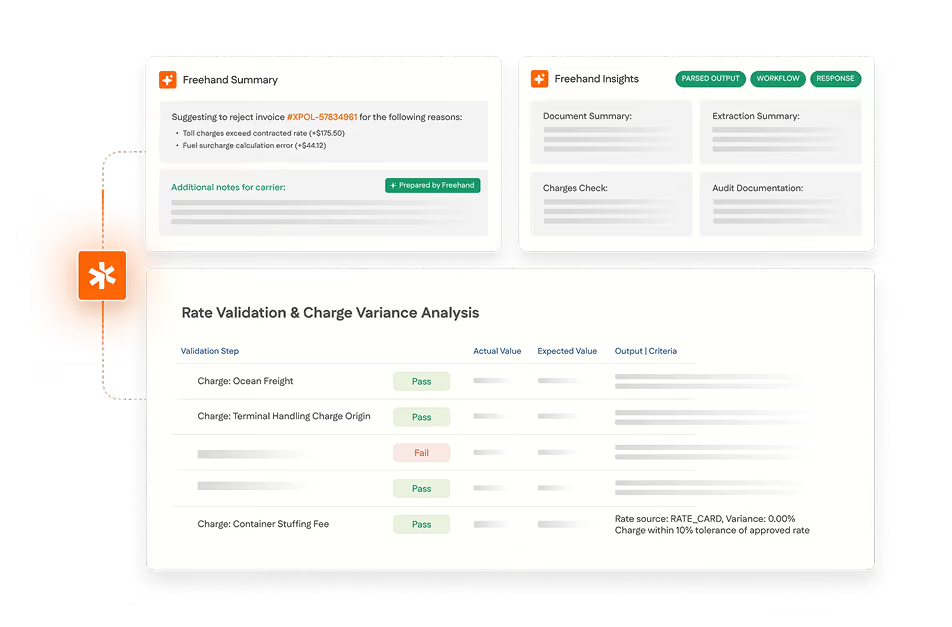
The Freight Invoice Gets Checked Too, Not Just the Trade Eligibility.
Freehand audits every freight invoice against contract terms, a check that runs independently of and alongside FTA qualification.
FTA Qualification Confirms Eligibility. It Doesn't Confirm the Invoice.
Free trade agreement software tells you a shipment qualifies for preferential treatment. It doesn't check whether the freight charges on it are correct.
Every warehouse. Every provider. Every mile.
Gartner's 2026 outlook on logistics outsourcing, and how AI Teams hold every contract to the terms you agreed.
- Where outsourced logistics quietly loses margin
- Why billed charges drift from the contract
- How AI Teams close the gap