



Best Logistics Spend Intelligence Platforms for Enterprise Shippers in 2026: 7 Compared
.webp)
July 14, 2026
•
14
mins
Comparing the best logistics spend intelligence platforms for 2026: 1. Freehand, 2. Coupa, 3. Sievo, 4. Trax Technologies, 5. Intelligent Audit, 6. GoodShip, and 7. Cass Information Systems.
Logistics spend hides in more places than freight. It runs across transportation, warehousing, fulfillment, and last-mile, and most tools see only one slice. An all-category spend suite categorizes the total but cannot decompose the operation; a freight tool goes deep on lanes but stops at the dock. The platform you pick decides how much of your logistics cost base you can actually see and act on.
This is a buyer's guide for logistics and supply chain leaders at enterprise shippers. If logistics is a large, fragmented cost base you cannot fully explain, the comparison below helps you shortlist and book the right demos.
Below, we are going to see a detailed comparison of the best logistics spend intelligence platforms for 2026, one line per platform, before the full breakdown.
TL;DR: the best logistics spend intelligence platforms at a glance
- Freehand: agentic logistics spend intelligence with cost-to-serve across transport, warehousing, and fulfillment, built on audited data.
- Coupa: business spend management that categorizes all-category spend, including logistics, in one suite.
- Sievo: enterprise procurement spend analytics with strong data cleansing and a single spend taxonomy.
- Trax Technologies: enterprise transportation spend management across modes, regions, and currencies.
- Intelligent Audit: freight and parcel analytics with anomaly detection and recovery, down to the SKU.
- GoodShip: transportation spend analytics with lane-level visibility and carrier benchmarking.
- Cass Information Systems: freight spend analytics backed by the Cass Freight Index benchmark.
What is a logistics spend intelligence platform?
A logistics spend intelligence platform collects, normalizes, and analyzes cost data across the logistics network, transportation, warehousing, fulfillment, and last-mile, so shippers can see what drives spend and reduce it. It is broader than freight spend intelligence, which covers only the cost of moving goods, and more operational than an all-category procurement suite, which categorizes logistics as one line.
The core functions it performs:
- Unifies cost data across transportation, warehousing, fulfillment, and parcel into one view.
- Decomposes cost to serve by order, SKU, channel, and customer tier.
- Breaks transportation spend down to lane, carrier, mode, and accessorial.
- Benchmarks rates and performance and detects anomalies before they compound.
- Allocates cost to the right GL, cost center, facility, and SKU.
- Answers spend questions in plain language, without a data team.
The strongest platforms sit on audited data, so the spend they report is accurate rather than estimated. See how network-wide cost-to-serve works on Freehand's spend analytics software page.
How we evaluated these platforms
We judged every platform on the criteria that decide a real enterprise logistics spend program, weighted toward the outcomes that move the P&L. Evidence came from vendor documentation, G2, Gartner Peer Insights, and industry comparisons. Where a capability could not be independently confirmed, we noted it rather than assume a score.
- AI autonomy and agentic action (25%): does the platform act on findings, allocating cost and resolving anomalies, or only visualize spend for a human to interpret.
- Logistics spend coverage and accuracy (20%): how much of the network it covers, transport through last-mile, and whether spend is built on audited data rather than estimated.
- Cost-to-serve decomposition depth (15%): breakdown by order, SKU, channel, and customer, plus lane, mode, and facility.
- Analytics and benchmarking (15%): rate and performance benchmarking, forward-looking insight, and plain-language querying.
- ERP, TMS, and WMS integration (15%): native connectors and normalization across fragmented logistics data.
- Time-to-value and pricing transparency (10%): speed to live and how clearly pricing is structured.
We weighted autonomy and coverage highest because logistics spend you cannot trust across the network, or cannot act on, does not cut cost. This is an independent editorial comparison referencing Gartner and G2 alongside vendor documentation; it is not a certified third-party ranking.
Best logistics spend intelligence platforms, ranked for 2026
Platforms are ordered by autonomy and network coverage, then cost-to-serve depth, benchmarking, and verifiable evidence. The logistics-native tools lead because they decompose the operation. The all-category suites follow for teams that want logistics inside a wider spend platform.
| Platform | Best for | Type | Logistics spend coverage | Pricing model |
|---|---|---|---|---|
| Freehand | Network-wide spend you can act on | AI-native, agentic | Transport, warehouse, fulfillment, final-mile, on audited data | Custom |
| Coupa | All-category spend in one suite | Business spend management | All-category, logistics categorized | Custom enterprise |
| Sievo | Enterprise procurement analytics | Procurement spend analytics | All-category, taxonomy-based | Custom enterprise |
| Trax Technologies | Enterprise multi-modal transportation | Transportation spend management | Transportation, multi-region | Custom, premium |
| Intelligent Audit | Freight and parcel with recovery | Freight and parcel analytics | Transportation and parcel | Custom, per-invoice |
| GoodShip | Lane visibility and benchmarking | Freight-native analytics | Transportation, lane-level | Custom |
| Cass Information Systems | Benchmarking against an index | FAP with analytics | Transportation, carrier-level | Custom, per-invoice |
1. Freehand
Best for:
Logistics and supply chain leaders who want network-wide spend they can act on, decomposed by lane, mode, facility, and SKU, built on data that is audited rather than estimated. A fit for VP of logistics, supply chain, and operations leaders at enterprise shippers.
Freehand is an AI-native platform whose Spend Intelligence builds a real-time, unified view of logistics cost across transportation, warehousing, fulfillment, and final-mile. Because it sits on audited invoice data, the spend it reports is accurate rather than estimated, and it decomposes cost to serve at the order, SKU, channel, and customer level. Its agents act on what they find, allocating cost and flagging anomalies rather than leaving a dashboard to read.
It ranks first here on autonomy and network coverage. The all-category suites cover more non-logistics indirect spend, a tradeoff we state openly.
Key features:
- Real-time unified view of logistics spend across transport, warehouse, and fulfillment
- SKU-level cost-to-serve across order, channel, and customer tier
- Lane, carrier, mode, and accessorial decomposition of transportation spend
- Carrier benchmarking and rate comparison
- Conversational analytics to query spend in plain language, without a data team
- Anomaly detection that flags spend patterns before they compound
- Real-time GL cost allocation to the right facility, cost center, and SKU
- Connects to freight audit and payment software and parcel audit software in one platform
- Native SAP, Oracle, NetSuite, and Dynamics connectors
- Recovers 1.5 to 2.5% of freight spend, live in 12 to 14 weeks
Pricing:
Custom, tied to the broader audit and spend platform. No data connection fees, with a quote after a scoping call.
Pros:
- Network-wide logistics spend decomposed to SKU and facility, on audited data
- Acts on findings, allocating cost and flagging anomalies, rather than only reporting
Cons:
- A newer name than the established spend suites and transportation incumbents
- Deepest in logistics and freight spend, not all-category indirect procurement
What Users Say
- Love: Spend intelligence built on audited data. Freehand's Spend Intelligence decomposes logistics cost to the SKU and facility on audited invoice data, and the company recently debuted its AI supply chain spend management offering to bring that view together (source).
- Complain: No independent review profile yet. As a newer entrant, Freehand has no Gartner or G2 spend-analytics listing, so buyers validate it through reference calls rather than aggregated ratings (source).
2. Coupa
Best for:
Enterprises that want logistics spend inside an all-category business spend management suite, alongside procurement, expenses, and payments.
Coupa is a business spend management platform that centralizes spend across categories, including logistics, in one suite. It automates purchase requests, approvals, and expense submissions, and gives finance broad visibility and control. It categorizes logistics spend well, though it does not decompose the transportation operation the way a logistics-native tool does.
Key features:
- All-category business spend management
- Spend visibility and control across procurement and expenses
- Purchase request and approval automation
- Source-to-pay and invoicing
- Category spend dashboards
- Supplier management
- ERP integration
- Reporting and analytics across categories
Pricing:
Custom enterprise pricing, not published. Scoped to modules and spend volume.
Pros:
- Broadest all-category spend coverage in one suite
- Strong visibility and control across procurement and expenses
Cons:
- Categorizes logistics spend rather than decomposing the transportation operation
- Steep learning curve and reporting that is hard to customize
What Users Say
- Love: One suite for all-category spend. Reviewers credit Coupa with centralizing spend in one platform for full visibility and control, automating purchase requests, approvals, and expense submissions (source).
- Complain: Steep learning curve and rigid reporting. Reviewers cite a "steep learning curve and cumbersome navigation," reporting that is "hard to customize without specialized training," and implementations that "took longer than expected" (source). Coupa holds 4.2/5 across 569 G2 reviews.
3. Sievo
Best for:
Large enterprises that want best-of-breed procurement spend analytics with strong data cleansing and a single spend taxonomy across many ERPs.
Sievo provides enterprise procurement spend analytics for $1B+ companies, combining internal, third-party, and public data into a consolidated taxonomy. It emphasizes data quality and classification accuracy, delivering self-service analytics and savings tracking. Its strength is all-category procurement spend rather than logistics operational decomposition.
Key features:
- Enterprise procurement spend analytics
- Data cleansing, enrichment, and classification
- Consolidated spend taxonomy across multiple ERPs
- Savings tracking and initiative management
- Budgeting and forecasting
- ESG and sustainability reporting
- Benchmarks from cross-customer data
- Self-service dashboards
Pricing:
Custom enterprise pricing, not published. Includes professional services for data work.
Pros:
- High data quality and classification accuracy across many ERPs
- Single source of truth for all-category procurement spend
Cons:
- All-category procurement focus, not logistics operational decomposition
- Large implementations are service-heavy and time-consuming
What Users Say
- Love: A single source of truth across ERPs. Reviewers value Sievo's self-service analytics and its ability to consolidate spend across multiple ERPs into one taxonomy, with strong data quality and support (source).
- Complain: Service-heavy implementations. Reviewers note that "large-scale Sievo implementations can be complex and time-consuming, requiring extensive professional services," and flag gaps in automatic spend reclassification (source).
4. Trax Technologies
Best for:
Global enterprises that want managed transportation spend management across many modes, regions, and currencies, backed by a long-standing incumbent.
Trax Technologies positions itself around transportation spend management, processing more than $24 billion in annual freight spend across 21,000 carriers with AI-assisted document extraction. It audits transportation invoices globally and layers analytics on top, covering the transportation slice of logistics spend at scale.
Key features:
- Global transportation spend management across modes and regions
- 100% transportation invoice audit coverage
- AI-assisted document extraction
- Multi-currency, multi-region reporting
- Carrier and mode-level spend analytics
- Business intelligence dashboards
- ERP and TMS integrations
- Managed-service support model
Pricing:
Custom, premium. Not published, and typically scoped to global freight volume.
Pros:
- Broad multi-modal, multi-region transportation coverage for global shippers
- Established incumbent with high audit coverage
Cons:
- Covers transportation, not the wider warehousing and fulfillment network
- Support and exception clarity draw criticism, and the older platform shows its age
What Users Say
- Love: Established multi-modal audit and reporting. Reviewers value Trax's long-standing coverage of global transportation spend across modes and its reporting depth (source).
- Complain: Support gaps and unclear exception handling. A manager at a $10B+ manufacturer cited "too many gaps in operations and management" and low confidence in "the support structures and clarity in explanations of exception management," alongside an aging platform (source).
5. Intelligent Audit
Best for:
Shippers and 3PLs that want freight and parcel analytics with machine-learning anomaly detection and recovery, extending spend visibility into last-mile.
Intelligent Audit is an AI-driven freight and parcel audit and analytics provider with machine-learning anomaly detection. It pairs recovery with spend analytics, giving shippers SKU and lane-level visibility across transportation and parcel, which reaches into the last-mile portion of logistics spend.
Key features:
- Freight and parcel spend analytics
- Machine-learning anomaly detection
- SKU and lane-level visibility
- Overcharge recovery
- Scheduled reporting, daily, weekly, or monthly
- Multi-layer invoice approval workflows
- Carrier performance reporting
- ERP and TMS integrations
Pricing:
Custom, typically a per-invoice model. Not publicly listed.
Pros:
- Strong anomaly detection spanning freight and parcel
- Clear invoice visibility and layered approval workflows
Cons:
- Focused on transportation and parcel, not warehousing or fulfillment spend
- Lacks some workflow conveniences like pending-approval notifications
What Users Say
- Love: Clear invoice visibility and layered approvals. A technical program manager praised easy navigation, "a clear view of all Invoices" for logistics and transportation, and scheduled reporting on a daily, weekly, or monthly basis (source).
- Complain: No pending-approval notifications. The same reviewer wanted email alerts "as and when the invoice is pending approval," which the tool currently lacks (source). Intelligent Audit holds 4.8/5 across 12 G2 reviews.
6. GoodShip
Best for:
Shippers that want lane-level transportation spend visibility and carrier rate benchmarking to optimize their network and procurement events.
GoodShip unifies transportation data into one source of truth, bridging freight procurement and operations. It provides lane-level spend visibility, automated carrier performance tracking, and rate benchmarking, and it pulls in outside data to strengthen analysis. It goes deep on the transportation layer of logistics spend rather than the full network.
Key features:
- Lane-level transportation spend visibility
- Automated carrier performance tracking and scorecards
- Rate benchmarking across lanes
- Freight procurement and RFP support
- Network monitoring and blindspot detection
- Pulls in external data sources for analysis
- Spend and performance dashboards
- TMS and data integrations
Pricing:
Custom, not published. Quotes depend on freight volume and scope.
Pros:
- Strong lane-level visibility and rate benchmarking
- Purpose-built for transportation analytics and procurement
Cons:
- Covers transportation, not warehousing or fulfillment spend
- Results depend on how carefully your data is set up
What Users Say
- Love: It builds the analysis for you. A transportation manager notes that "instead of spending hours creating pivot tables and graphs, GoodShip does it for you," and that "it also pulls in data from outside sources, which really helps with your analysis" (source).
- Complain: Output is only as good as your data setup. The same reviewer cautions that "missing data could skew the results," and because the platform is "so customizable, the calculations we're currently using might not be best in class" (source).
7. Cass Information Systems
Best for:
Enterprises that want transportation spend analytics and benchmarking from a long-standing freight audit and payment provider, anchored by the Cass Freight Index.
Cass Information Systems is a bank-backed freight audit and payment provider that layers spend analytics, expense management consulting, and carrier benchmarking on top of its audit and payment service. Its Cass Freight Index is a widely cited market benchmark, giving transportation spend analytics a reference point beyond a shipper's own history.
Key features:
- Transportation spend analytics and reporting
- Carrier and mode-level spend visibility
- Benchmarking against the Cass Freight Index
- Freight audit and payment
- Expense management consulting
- Business intelligence dashboards
- GL coding and allocation
- Bank-backed payment reliability
Pricing:
Custom, typically per-invoice. Not published.
Pros:
- Index-based benchmarking for external market context
- Established, bank-backed provider with expense consulting
Cons:
- Focused on transportation spend, not the wider logistics network
- Very thin, dated independent review signal
What Users Say
- Love: A trusted benchmark for cost context. A senior director of transportation calls Cass "a benchmark amongst it's peer group," citing "ease of transition, cost competitiveness and business intelligence" (source).
- Complain: Very thin, dated review signal. Cass shows a single Gartner rating from 2023, so there is little current peer feedback to validate day-to-day experience (source).
Other logistics spend tools to know
These come up in evaluations but sit outside the core seven, as visibility platforms, parcel specialists, or newer entrants.
- SpendHQ: fast-deploying procurement spend classification and visualization, holding 4.4/5 across 57 G2 reviews.
- Loop: an AI-native logistics data platform that normalizes freight and parcel data and automates a high share of audits.
- project44: a real-time transportation visibility platform expanding into decision intelligence, stronger on tracking than spend decomposition.
- Reveel and Sifted: parcel-focused spend intelligence for shippers whose last-mile spend needs its own lens.
Best logistics spend intelligence software alternatives: Coupa
If Coupa fits your all-category spend needs but cannot decompose the logistics operation, these alternatives go deeper on the network.
Freehand
For teams that want logistics spend acted on rather than categorized, Freehand decomposes cost to serve across transport, warehouse, and fulfillment on audited data, live in 12 to 14 weeks.
Trax Technologies
A transportation-deep alternative for global shippers who need managed multi-modal spend management at scale.
Sievo
A best-of-breed procurement analytics alternative with strong data cleansing for all-category spend.
Best supply chain spend analytics software alternatives: Sievo
When Sievo's data quality is attractive but you need logistics operational depth rather than all-category classification, consider these.
Freehand
Pairs network-wide, audited-data spend intelligence with agentic action, so logistics cost is decomposed and acted on, not just classified.
GoodShip
Freight-native analytics with rate benchmarking for teams focused on the transportation layer.
Intelligent Audit
Freight and parcel analytics with recovery, extending visibility into last-mile spend.
How to choose the right logistics spend intelligence platform
The decision comes down to three layers: all-category spend, the transportation slice, and the full logistics network, and how much you want the platform to act rather than report.
If you want logistics inside a wider all-category suite, Coupa and Sievo categorize and analyze total spend, though they do not decompose the operation. If your focus is the transportation layer, Trax, GoodShip, Intelligent Audit, and Cass go deep on freight and parcel. If you want network-wide cost-to-serve you can trust and act on, across transport, warehousing, and fulfillment, Freehand decomposes it on audited data and acts on what it finds.
Match the platform to how much of the logistics network you need to see, and whether you want spend reported or acted on, then book the right demos.
Related: To control and recover spend, not just report it, see logistics spend management software; for the freight-only view, freight spend intelligence platforms.
Frequently asked questions
What is a logistics spend intelligence platform?
Software that collects, normalizes, and analyzes cost data across the logistics network, transportation, warehousing, fulfillment, and last-mile, so shippers can see what drives spend and reduce it.
What is the difference between logistics spend intelligence and freight spend intelligence?
Freight spend intelligence covers the cost of moving goods, by lane and carrier. Logistics spend intelligence is broader, spanning warehousing, fulfillment, and last-mile too.
How is a logistics spend platform different from a procurement spend suite?
A procurement suite categorizes all-category spend, including logistics as one line. A logistics spend platform decomposes the operation, by lane, mode, facility, and SKU.
How much can logistics spend intelligence save?
Spend analytics typically surfaces 3 to 12% of addressable spend in year one, and audited-data platforms recover another 1.5 to 2.5% of freight spend from overcharges.
What data does logistics spend intelligence use?
It normalizes invoice, shipment, warehouse, and contract data across carriers, facilities, and modes. Platforms built on audited data report accurate spend rather than estimates.
How much does logistics spend intelligence software cost?
Most platforms use custom pricing tied to spend volume and scope. All-category suites price by module; transportation tools often price per invoice or by freight volume.
Can these platforms decompose cost to serve by SKU and customer?
Yes, the logistics-native platforms break cost to serve down by order, SKU, channel, and customer tier, on top of lane, mode, and facility-level detail.
Which is the best logistics spend intelligence platform?
It depends on scope. Freehand leads on network-wide, audited-data decomposition and agentic action, Coupa and Sievo on all-category breadth, and Trax on transportation scale.
The bottom line for 2026
If your priority is logistics spend you can trust across the network and act on, Freehand decomposes cost to serve across transport, warehousing, and fulfillment on audited data. If you want logistics inside an all-category suite, Coupa and Sievo carry the breadth. If your focus is transportation, Trax, GoodShip, Intelligent Audit, and Cass go deep on freight and parcel. Match the platform to how much of the network you need, then book the right demos.
Want to see logistics cost to serve decomposed to the SKU and facility on audited data? Book a Freehand demo.
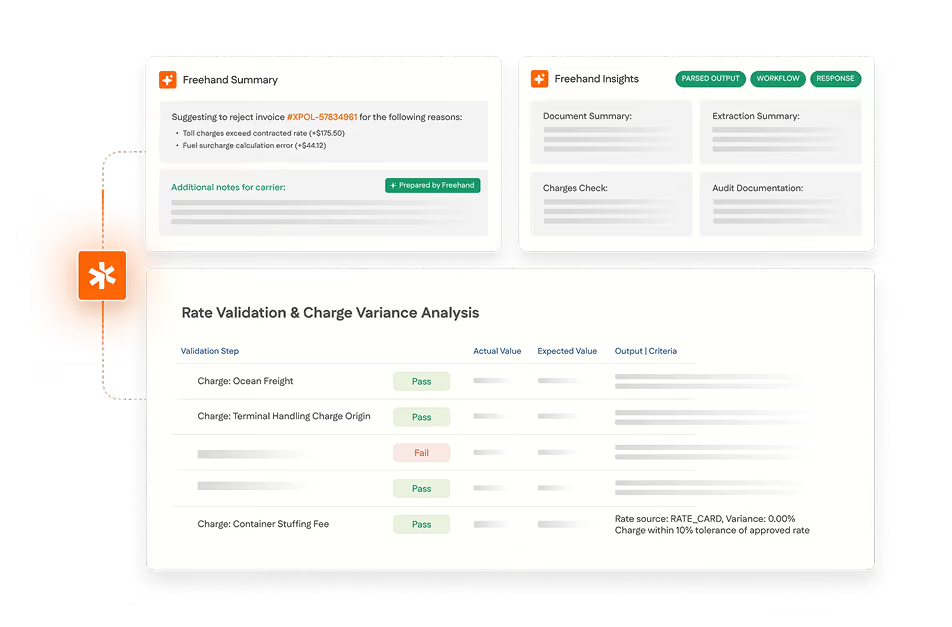
Every warehouse. Every provider. Every mile.
Gartner's 2026 outlook on logistics outsourcing, and how AI Teams hold every contract to the terms you agreed.
- Where outsourced logistics quietly loses margin
- Why billed charges drift from the contract
- How AI Teams close the gap


.png)