
Best Restricted Party Screening Software in 2026: 8 Platforms Compared
.webp)
July 13, 2026
•
12
mins
Comparing the best restricted party screening software for 2026: 1. Freehand, 2. Descartes Visual Compliance, 3. Thomson Reuters ONESOURCE, 4. LexisNexis Bridger Insight, 5. SAP Global Trade Services, 6. Oracle Global Trade Management, 7. Dow Jones Risk & Compliance, and 8. AEB.
One sanctioned counterparty that clears your onboarding check and then transacts is all it takes to trigger an OFAC penalty and a headline. Most screening tools check a name at setup and move on. The gap is what happens between onboarding and the transaction, when ownership changes, a list updates, or a new party joins the order.
This is a buyer's guide for trade compliance, export control, and supply chain leaders. If you move goods across borders and carry real sanctions exposure, the comparison below helps you shortlist and book the right demos.
Below, we are going to see a detailed comparison of the best restricted party screening software for 2026, one line per platform, before the full breakdown.
TL;DR: The best restricted party screening software at a glance
- Freehand: agentic screening that checks every counterparty continuously at the point of transaction and auto-holds matches, not just at onboarding.
- Descartes Visual Compliance: the category leader by G2 volume, screening across 190+ sanctions and denied party lists.
- Thomson Reuters ONESOURCE: deep denied party screening against 750+ lists with rich data elements to cut false positives.
- LexisNexis Bridger Insight: 1,000+ watchlists with strong fuzzy and phonetic matching, popular with AML and KYC teams.
- SAP Global Trade Services: native sanctioned party list screening for SAP-standardized enterprises.
- Oracle Global Trade Management: clean denied party screening inside Oracle Transportation Management.
- Dow Jones Risk & Compliance: enriched sanctions and adverse-media data with investigation workflows.
- AEB: established European trade compliance suite with continuous screening built in.
Comparison table: Top restricted party screening software for 2026
| Platform | Best for | Type | Screening coverage | Pricing model |
|---|---|---|---|---|
| Freehand | Screening every transaction, autonomously | AI-native, agentic | Continuous, 100% of counterparties and transactions | Custom |
| Descartes Visual Compliance | The most-reviewed dedicated screening tool | Trade-compliance specialist | 190+ lists, real-time and batch | Custom |
| Thomson Reuters ONESOURCE | Enterprises on a Thomson Reuters stack | Enterprise suite | 750+ lists, real-time | Custom enterprise |
| LexisNexis Bridger Insight | AML and KYC-heavy screening programs | Screening plus risk data | 1,000+ watchlists, real-time and batch | Custom |
| SAP Global Trade Services | SAP-standardized enterprises | ERP-native | Global lists, real-time in ERP | Enterprise license |
| Oracle Global Trade Management | Oracle-standardized enterprises | ERP-native | Global lists, real-time in OTM | Enterprise license |
| Dow Jones Risk & Compliance | Data depth and investigation workflows | Risk data plus screening | Sanctions, denied parties, adverse media | Custom |
| AEB | European trade compliance programs | Trade-compliance suite | Global lists, continuous | Custom |
What is restricted party screening software?
Restricted party screening software checks your customers, suppliers, and business partners against government restricted and denied party lists to make sure you are not transacting with a sanctioned entity. Denied party screening and restricted party screening mean the same thing and are used interchangeably.
The core functions it performs:
- Matches every counterparty name against sanctions and watchlists such as OFAC, BIS, EU, and UN.
- Uses fuzzy, phonetic, and semantic matching so misspellings and aliases still surface.
- Scores each match, typically flagging results at 65% similarity and above.
- Pulls the latest list updates automatically from regulatory agencies.
- Routes potential matches to reviewers with case management and audit logging.
- Integrates into your ERP, CRM, and order systems so screening runs inside the workflow.
The best platforms screen continuously rather than only at onboarding, and the most advanced ones act on a match by holding the transaction. You can see how continuous screening fits a wider program on Freehand's global trade compliance page.
{{blue-cta}}
How we evaluated these platforms
We judged every platform on the criteria that decide a real enterprise screening program, weighted toward the outcomes that carry sanctions risk. Evidence came from vendor documentation, G2, Gartner Peer Insights, and industry comparisons. Where a capability could not be independently confirmed, we noted it rather than assume a score.
- AI autonomy and agentic action (25%): does the system act on a match, holding or blocking the transaction, or only flag it for a human to review.
- Screening coverage and continuity (20%): what share of counterparties and transactions get screened, and whether screening is continuous or only at onboarding.
- List and data breadth (15%): how many sanctions lists, watchlists, PEP, and adverse-media sources are covered.
- Match accuracy and false-positive handling (15%): quality of fuzzy, phonetic, and semantic matching, risk scoring, and data elements that reduce noise.
- ERP, CRM, and workflow integration (15%): native connectors, case management, and audit logging.
- Time-to-value and pricing transparency (10%): speed to live and how clearly pricing is structured.
We weighted autonomy and coverage highest because a match that a human never gets to, or a party who is only checked at onboarding, is where sanctions exposure actually happens. This is an independent editorial comparison referencing Gartner and G2 alongside vendor documentation; it is not a certified third-party ranking.
Best restricted party screening software, ranked for 2026
Platforms are ordered by autonomy and screening continuity, then list breadth, matching accuracy, and verifiable evidence. The agentic tools lead on acting at the point of transaction. The established specialists lead on list content and matching maturity, noted in each section.
Freehand
Best for:
Enterprise trade compliance teams that want every counterparty screened continuously and matches acted on automatically, not a name checked once at onboarding and forgotten. A fit for trade compliance, export control, and supply chain leaders.
Freehand is an AI-native platform whose Compliance Screening Agent screens customers, suppliers, carriers, freight forwarders, and consignees against OFAC, BIS, EU, UN, and country-specific lists. Screening runs continuously at the point of every transaction, not only at vendor onboarding, and the agent places an automatic system hold when it intercepts a match or anomaly.
It ranks first here on autonomy and continuity. The dedicated screening specialists below carry broader watchlist content and longer matching track records, a tradeoff we state openly.
Key features:
- Continuous screening at the point of every transaction, not just at onboarding
- Automatic system holds when a match or near-match is intercepted
- Screens customers, suppliers, carriers, forwarders, and consignees
- Coverage across OFAC, BIS, EU, UN, and country-specific lists
- Screening woven into a broader trade compliance software audit
- Continuous tariff monitoring and duty checks alongside screening
- Immutable screening audit records and role-based access for defensibility
- Teams and Slack alerts on holds, with full decision traces
- Native SAP, Oracle, and NetSuite connectors
- Client-exclusive model grounded in your counterparty and transaction data
Pricing:
Custom, tied to the broader trade and compliance audit platform. Quote after a scoping call.
Pros:
- Screens 100% of counterparties continuously and acts on matches automatically
- Screening sits alongside classification, duty, and tariff audit in one platform
Cons:
- A newer name than the decades-old dedicated screening vendors
- Screening is one agent inside a broader trade audit, not a standalone watchlist-content business
What Users Say
- Love: Screening that acts, not just alerts. In one deployment a global life sciences firm screened 3,400 active counterparties and, within 90 days, caught 7 critical near-matches and enforced 2 transaction blocks that averted regulatory exposure (source).
- Complain: No independent screening review profile yet. As a newer entrant, Freehand has no dedicated G2 or Gartner restricted party screening listing, so buyers validate it through reference calls rather than aggregated ratings (source).
2. Descartes Visual Compliance
Best for:
Compliance teams that want the most-reviewed dedicated denied party screening tool, with deep list coverage and flexible integration into existing systems.
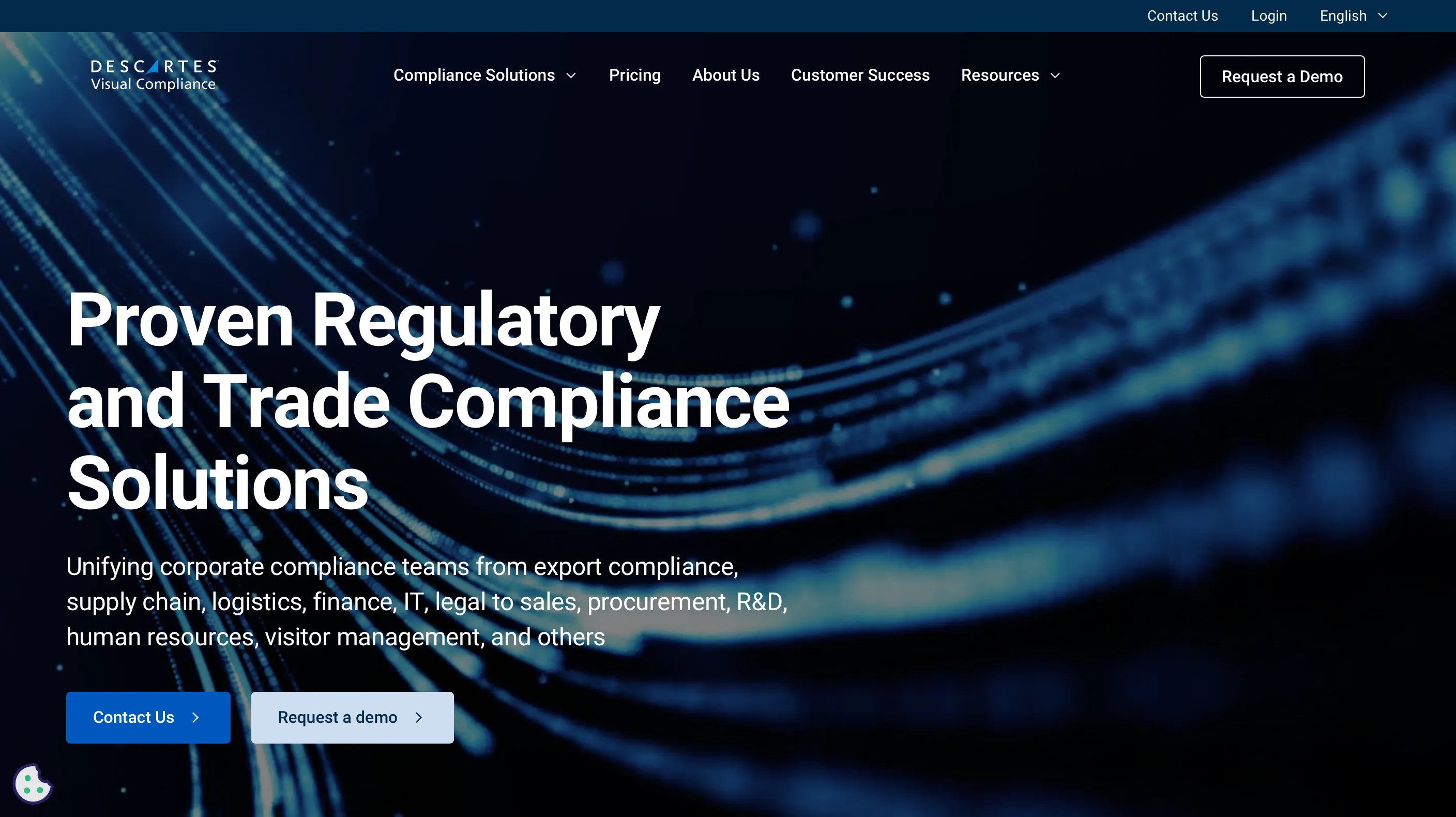
Descartes Visual Compliance automates the identification of restricted entities across 190+ global sanctions lists, watchlists, and denied party databases. It delivers real-time screening for customers, suppliers, and transactions with risk scoring, false-positive reduction, and automated workflows, and integrates with SAP, Oracle, NetSuite, Salesforce, and Dynamics.
Key features:
- Screening across 190+ sanctions and denied party lists
- Real-time and batch screening of customers, suppliers, and transactions
- Risk scoring and false-positive reduction
- Automated review and escalation workflows
- Pre-built connectors for major ERP and CRM systems
- API for homegrown and legacy systems
- OFAC 50% Rule support via enriched ownership data
- Recordkeeping and audit logs for regulatory reviews
Pricing:
Custom, based on screening volume and modules. Not published.
Pros:
- The most-reviewed dedicated screening tool, with deep list coverage
- Flexible integration across ERP and CRM platforms
Cons:
- Assistive by design, so matches route to analysts rather than triggering automatic holds
- Deepest ownership screening leans on paired Dow Jones data
What Users Say
- Love: Deep watchlist coverage that stays current. A procurement specialist writes that Descartes "screens hundreds of government and international watchlists" and that "false positives are reduced with the use of the AI feature... this platform is always in the know, so it's never behind," rating it 5/5 (source).
- Complain: Slower onboarding and enterprise pricing. The same reviewer notes "implementation and onboarding can be a bit slower than most businesses would want," and that "for smaller organizations, the pricing may not be as affordable as other platforms" (source). Descartes holds 4.8/5 across 213 G2 reviews.
Thomson Reuters ONESOURCE
Best for:
Fortune 1000 importers and exporters already on a Thomson Reuters tax and trade stack that want denied party screening with rich data behind each match.
Thomson Reuters ONESOURCE Denied Party Screening vets supply chain partners against 750+ global lists covering restricted persons, companies, and embargoed countries. Each record carries more than 30 data elements, such as name, date of birth, locations, and citizenships, to improve match accuracy and cut false positives.
Key features:
- Screening against 750+ global restricted party lists
- 30+ data elements per record to reduce false positives
- Real-time screening of partners and transactions
- Embargoed-country and restricted-person coverage
- Integration with the ONESOURCE global trade suite
- Case management and audit trails
- ERP integration, including SAP
- Regulatory content maintained by Thomson Reuters
Pricing:
Custom enterprise pricing, tied to the broader Thomson Reuters stack. Not published.
Pros:
- Rich data elements per record improve match accuracy
- Strong fit for organizations already on Thomson Reuters products
Cons:
- Assistive workflow, so matches still route to reviewers
- Pricing sits at the enterprise tier and is tied to the wider stack
What Users Say
- Love: Data depth that sharpens every match. ONESOURCE screens against 700+ lists tracking 300,000 entities across 240 countries, with 30+ data elements per record and multilingual matching to minimize false positives (source).
- Complain: Thin independent review signal. The denied party screening product carries little public G2 review volume, so day-to-day usability is validated through analyst positioning and references rather than aggregated ratings (source).
LexisNexis Bridger Insight
Best for:
Compliance programs that screen heavily for AML and KYC alongside trade, and want strong matching across a very large watchlist universe.
LexisNexis Bridger Insight XG scans against 1,000+ global watchlists, sanctions lists including OFAC, UN, and EU, and denied party databases in real-time or batch mode. It uses fuzzy logic, phonetic, and semantic matching to minimize false positives, with risk scoring and case management for compliance teams.
Key features:
- Screening across 1,000+ global watchlists and sanctions lists
- Fuzzy, phonetic, and semantic matching
- Real-time and batch screening modes
- Risk scoring to prioritize alerts
- Case management and alert resolution tools
- Entity resolution across parties
- OFAC, UN, and EU sanctions coverage
- ERP and CRM integration
Pricing:
Custom, based on volume and modules. Not published.
Pros:
- Very broad watchlist coverage with strong matching algorithms
- Mature case management for high alert volumes
Cons:
- Oriented toward AML and KYC workflows more than trade-compliance-native screening
- Tuning and setup can be involved for trade use cases
What Users Say
- Love: Easy API integration. A verified reviewer says "what I like best about LexisNexis BridgerInsight XG is how easy its API is to integrate into our existing systems," connecting screening into their workflows "without heavy development effort" (source).
- Complain: Heavy configuration. The same reviewer notes "the configuration process can feel quite heavy and complex at times," and that setup and adjustments "can slow down implementation and onboarding for new use cases" (source).
SAP Global Trade Services
Best for:
Large enterprises standardized on SAP that want sanctioned party list screening running natively inside the ERP.
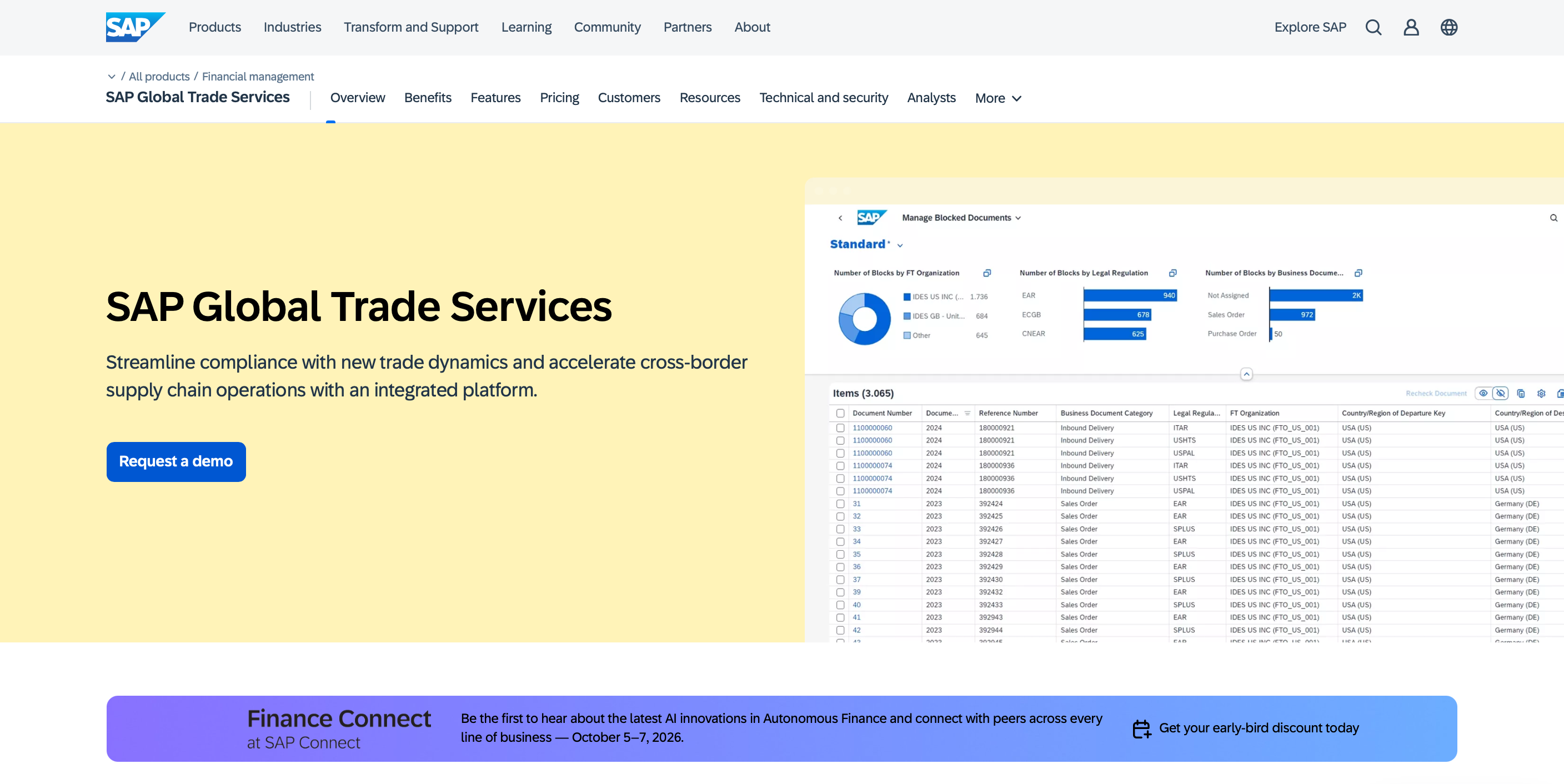
SAP Global Trade Services includes sanctioned party list screening that checks business partners, transactions, and shipments against global lists such as OFAC, EU, and UN in real time. Because it lives inside SAP, screening pulls partner and transaction data directly from S/4HANA and core logistics processes.
Key features:
- Sanctioned party list screening on partners and transactions
- Real-time screening inside SAP S/4HANA
- Embargoed-country and sanctions coverage
- Blocking of flagged transactions pending review
- Deep integration with SAP logistics and finance
- Classification and export control alongside screening
- Audit logging for compliance reviews
- Global regulatory content
Pricing:
Enterprise licensing, quoted through SAP or a partner. Not publicly disclosed.
Pros:
- Native SAP integration screens directly on ERP data
- Screening buyers trust for regulatory confidence
Cons:
- False positives require manual review, which slows throughput
- Long, resource-heavy implementation
What Users Say
- Love: Screening that builds regulatory confidence. A verified reviewer notes "the screening feature works very well, giving us confidence that we are not violating trade regulations," with automated flagging of embargoed countries and sanctions (source).
- Complain: False positives and a long setup. The same reviewer says "the compliance screenings sometimes result in false positives that need manual review, which slows things down," and setup "can take several months to a year" (source). SAP GTS holds 4.3/5 across 58 G2 reviews.
Oracle Global Trade Management
Best for:
Enterprises standardized on Oracle that want denied party screening inside Oracle Transportation Management, with clean reporting.
Oracle Global Trade Management Cloud automates denied party screening, tariff classification, licensing, and trade execution within OTM. It integrates cleanly with the Oracle stack, and reviewers highlight its clean interface and reporting, with cost the main caveat.
Key features:
- Denied and restricted party screening
- Real-time screening inside Oracle Transportation Management
- License determination and management
- Trade execution and documentation
- Reporting and analytics with configurable views
- Native Oracle Cloud ERP and OTM integration
- Global list coverage
- Audit and compliance records
Pricing:
Enterprise licensing, quoted through Oracle. Reviewers describe it as priced above competing platforms.
Pros:
- Clean, easy-to-use interface that shortens training time
- Native fit for Oracle-standardized enterprises
Cons:
- Priced above competing platforms
- Occasional slow dashboard load times on larger data sets
What Users Say
- Love: Clean and quick to learn. A mid-market reviewer describes it as a "clean and easy to use portal" where "the training time is reduced due to the entire portal's easy functionality" (source).
- Complain: Priced at the top of the market. The same reviewer notes "cost of the software is higher than the competitors" and wishes for "a more cost effective version" (source). Oracle GTM Cloud holds 4.2/5 across 16 G2 reviews.
Dow Jones Risk & Compliance
Best for:
Teams that want the deepest sanctions and adverse-media data behind their screening, with investigation and case-management workflows.
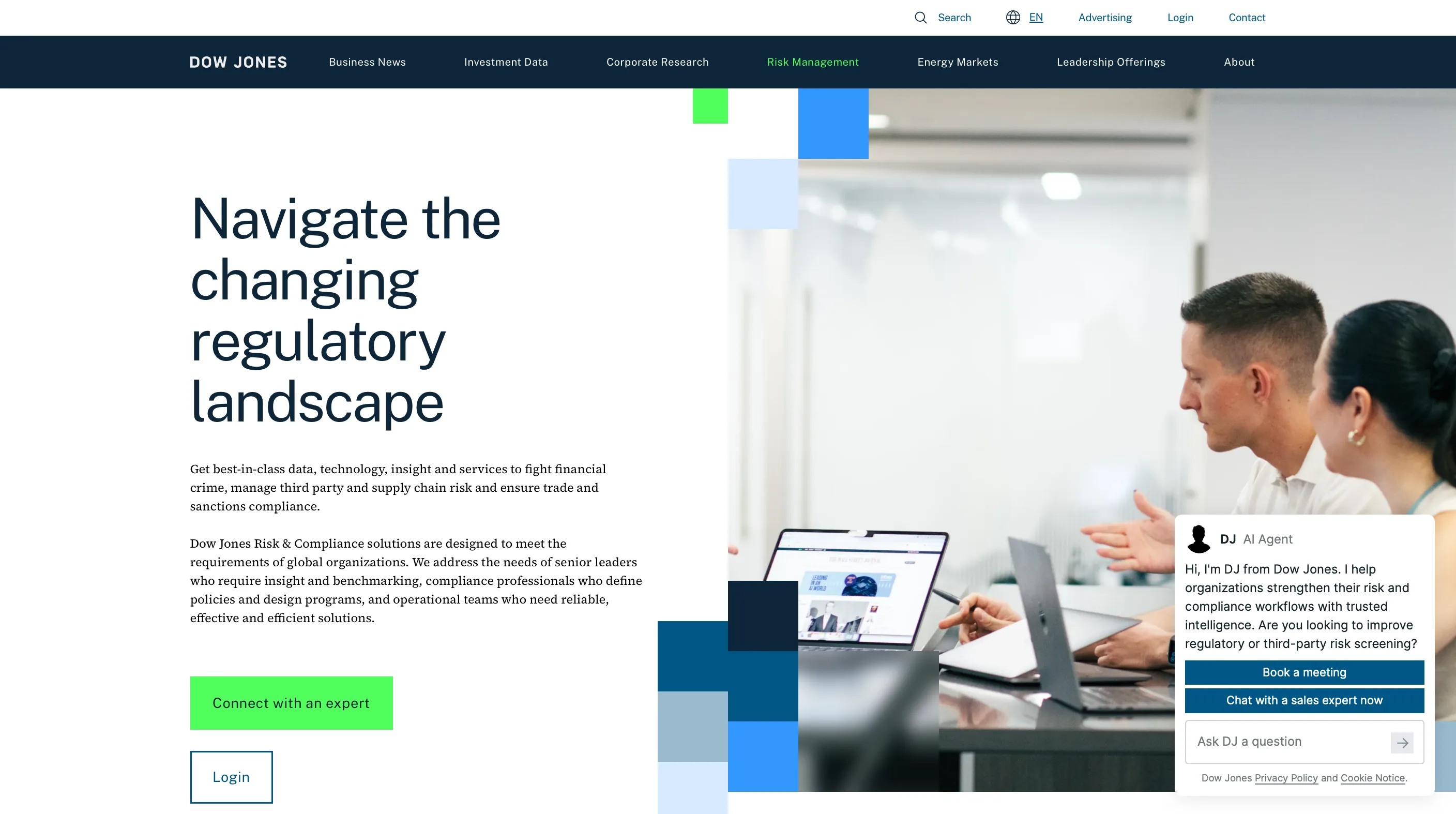
Dow Jones Risk & Compliance provides watchlist screening data covering sanctions, denied parties, and adverse media, with enriched global risk content. It emphasizes investigation and case-management workflows that route results to review teams, and it integrates directly into Descartes tools to strengthen OFAC 50% Rule compliance.
Key features:
- Sanctions, denied party, and adverse-media data
- Enriched global risk and ownership content
- OFAC 50% Rule ownership data
- Investigation and case-management workflows
- Standardized reviewer assignment
- Integration into third-party screening engines
- PEP and adverse-media coverage
- Global regulatory data maintenance
Pricing:
Custom, based on data and modules. Not published.
Pros:
- Deep sanctions and adverse-media data with strong ownership content
- Structured investigation and review workflows
Cons:
- Primarily a risk-data provider, so it needs a screening engine around it for trade execution
- Optimized for financial-crime use cases more than trade operations
What Users Say
- Love: Screen many parties in one query. A banking reviewer highlights "the ability to screen multiple entities and persons with one query," adding that "compared to its competitors, I find Dow Jones Risk & Compliance saves a significant amount of time spent doing compliance screening" (source).
- Complain: Report generation is clunky. The same reviewer notes "report generation is a bit more tricky and time-consuming," though bulk screening keeps the overall process quick (source). Dow Jones holds 4.3/5 across 13 G2 reviews.
AEB
Best for:
Enterprises with significant European trade operations that want continuous compliance screening inside an established trade compliance suite.
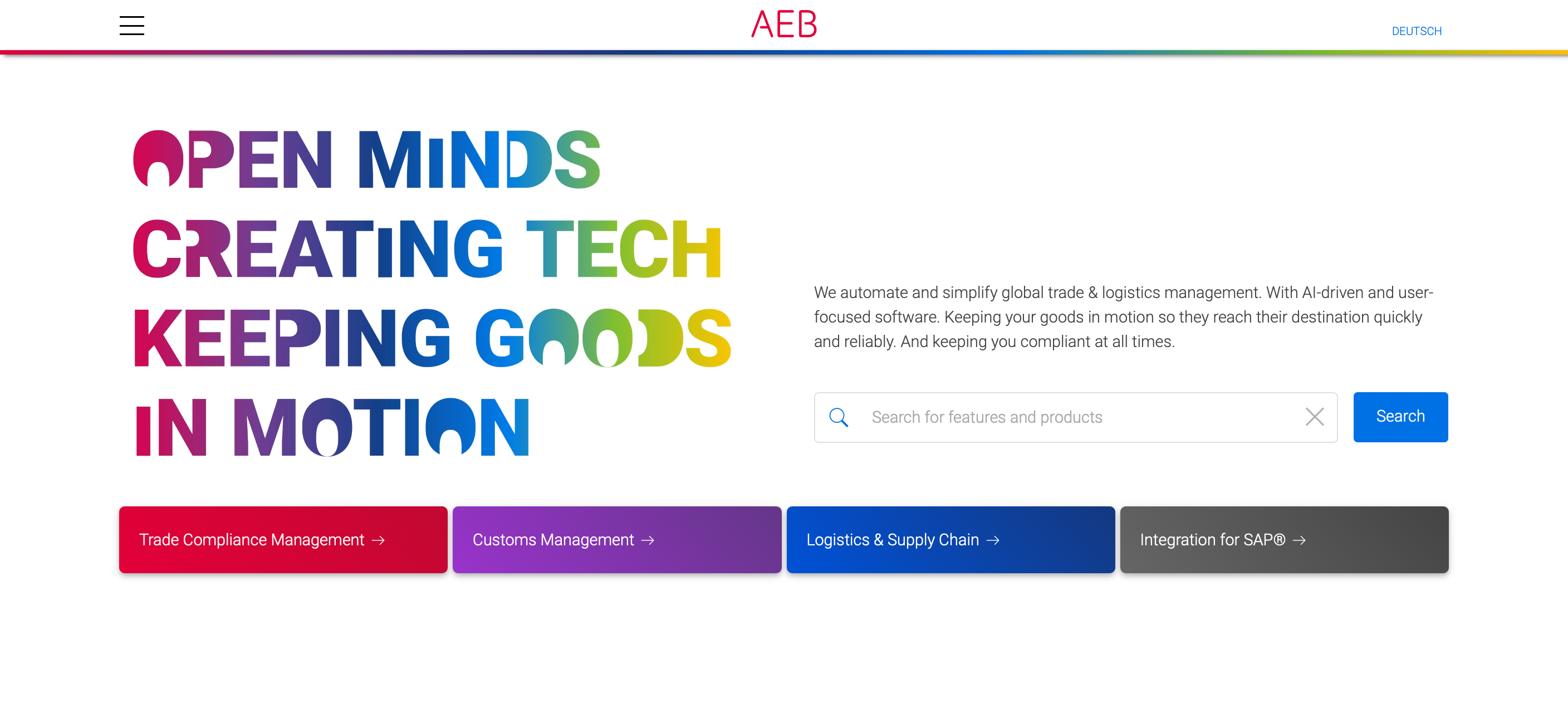
AEB is an established European trade compliance software vendor whose compliance screening checks business partners against sanctions and denied party lists continuously, integrated with ERP. It suits organizations centered in the EU and DACH region that want screening as part of a broader trade compliance suite.
Key features:
- Continuous compliance and denied party screening
- Sanctions and embargo list coverage
- ERP integration for partner and transaction data
- Batch and real-time screening
- Case management and documentation
- Broader trade compliance suite modules
- Strong European regulatory coverage
- Audit-ready recordkeeping
Pricing:
Custom, based on modules and volume. Not published.
Pros:
- Established European trade compliance vendor with continuous screening
- Screening sits inside a broader compliance suite
Cons:
- Strongest in the EU and DACH region, with a lighter US footprint
- Limited independent review presence to validate at scale
What Users Say
- Love: Continuous screening from a European specialist. Reviewers praise an "easy to use," modern browser interface that screens in real time in the background of transactions and integrates with SAP S/4HANA, Salesforce, and Dynamics (source).
- Complain: Regional footprint. Reviewers cite "no US-touch" and a proALPHA interface that is "not user-friendly," underscoring AEB's concentration in the EU and DACH region (source).
Other restricted party screening tools to know
These come up in evaluations but sit outside the core eight, either as data-heavy risk platforms or adjacent tools.
- Refinitiv World-Check (LSEG): an extensive database of 5M+ profiles spanning sanctions, PEPs, and adverse media, used widely for KYC and AML screening.
- ComplyAdvantage: an AI-driven sanctions and adverse-media screening platform popular with fintech and financial services.
- Kharon and Sayari: risk-intelligence platforms that map ownership networks and sanctions exposure for deep due diligence.
- Shipping Solutions: a lighter restricted party screening tool aimed at small and mid-market exporters.
Best denied party screening software alternatives: Descartes Visual Compliance
If Descartes fits your list-coverage needs but its assistive, flag-and-review model is the drawback, these alternatives approach screening differently.
Freehand
Choose Freehand if you want screening acted on automatically at the point of every transaction, with holds triggered without waiting for an analyst, inside a broader trade and compliance audit.
Thomson Reuters ONESOURCE
A deep-content alternative with 750+ lists and rich data elements, strongest for enterprises already on the Thomson Reuters stack.
LexisNexis Bridger Insight
A broad watchlist and matching alternative for teams whose screening leans heavily toward AML and KYC.
Best sanctions screening software alternatives: Thomson Reuters ONESOURCE
When ONESOURCE's content depth is attractive but its enterprise pricing or assistive workflow is not, consider these.
Freehand
Pairs continuous, autonomous screening with classification and duty audit, so screening is not a siloed check but part of one trade compliance system.
Descartes Visual Compliance
The most-reviewed dedicated screening tool, with 190+ lists and flexible ERP and CRM integration.
Dow Jones Risk & Compliance
A data-first alternative for teams that want the deepest sanctions and adverse-media content behind their screening.
{{brown-cta}}
How to choose the right restricted party screening software
The decision comes down to whether you want screening that acts or screening that alerts, how broad your list needs are, and where your operations sit.
If your priority is catching sanctioned parties between onboarding and transaction, the agentic approach matters most: Freehand screens every counterparty continuously and holds matches automatically. If list breadth and matching maturity lead your decision, Descartes Visual Compliance and Thomson Reuters ONESOURCE carry the deepest content, and LexisNexis Bridger Insight is strong where AML and KYC screening overlap with trade.
If you are standardized on an ERP, SAP Global Trade Services and Oracle Global Trade Management keep screening native to your stack. If you want the richest underlying risk data, Dow Jones supplies it. If your operations center on Europe, AEB is a strong regional fit. Match the platform to your risk model and your stack, then book the right demos.
Frequently asked questions
What is restricted party screening software?
Software that checks customers, suppliers, and partners against government sanctions and denied party lists, flags potential matches with risk scores, and maintains audit records for compliance.
What is the difference between restricted party screening and denied party screening?
None in practice. The terms are used interchangeably to describe checking business partners against restricted, denied, and sanctioned party lists before transacting.
How does restricted party screening work?
The software compares each partner name against sanctions lists using fuzzy and phonetic matching, scores similarity, flags matches at roughly 65% and above, and routes them for review.
How often should you run restricted party screening?
Best practice is continuous, not just at onboarding. Ownership, lists, and parties change, so leading tools rescreen at the point of every transaction.
What lists does restricted party screening software check?
Government and regulatory lists such as OFAC, BIS, EU, and UN, plus embargoed-country and watchlists. Enterprise tools cover anywhere from 190 to over 1,000 lists.
How do you reduce false positives in sanctions screening?
Fuzzy, phonetic, and semantic matching, risk scoring, and richer data elements per record, like date of birth and location, all help separate true matches from noise.
How much does restricted party screening software cost?
Most enterprise platforms use custom pricing based on screening volume and modules. Lightweight tools for smaller exporters are cheaper; enterprise suites are quoted.
Can restricted party screening be automated?
Yes. Agentic platforms screen every counterparty continuously and act on matches by holding the transaction automatically, rather than only flagging results for a reviewer.
The bottom line for 2026
If your priority is catching sanctioned parties in the moment a transaction happens, Freehand screens every counterparty continuously and acts on matches automatically. If list breadth and matching maturity lead, Descartes Visual Compliance and Thomson Reuters ONESOURCE carry the deepest content, and LexisNexis is strong for AML-heavy programs. If you are on SAP or Oracle, their native screening keeps it in your stack. Match the platform to your risk model, then book the right demos.
Want to see restricted party screening that acts at the point of every transaction? Book a Freehand demo.
Conflict of interest disclosure:
This guide is published by Freehand, a platform included in this comparison. We applied the same criteria to every platform, ranked Freehand first on autonomy and screening continuity while stating openly that dedicated specialists like Descartes and Thomson Reuters carry broader watchlist content and longer matching track records, and we invite you to score each vendor independently.
Compliance Screening and Freight Audit Are Different Problems, Both Worth Solving.
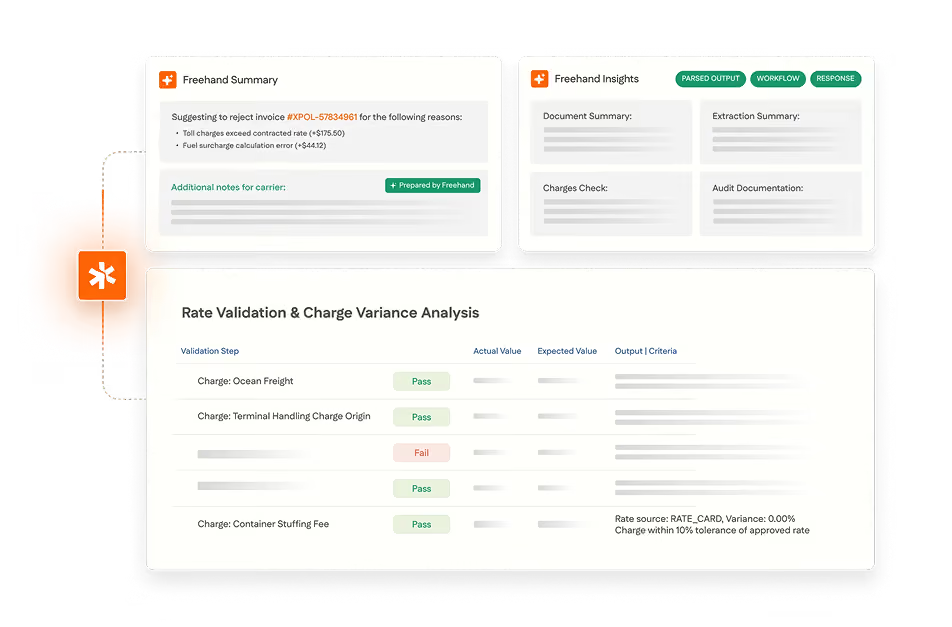
Freehand focuses specifically on freight invoice accuracy, checking every charge against contract terms after the shipment clears screening.
Screening Clears the Shipment. It Says Nothing About the Freight Bill.
Restricted party screening protects you from a compliance violation. It has no visibility into whether the carrier invoice matches the contracted rate.
Every warehouse. Every provider. Every mile.
Gartner's 2026 outlook on logistics outsourcing, and how AI Teams hold every contract to the terms you agreed.
- Where outsourced logistics quietly loses margin
- Why billed charges drift from the contract
- How AI Teams close the gap