

Carrier Sourcing: How Enterprise Shippers Evaluate and Build a Carrier Portfolio
.webp)
June 15, 2026
•
11
mins

The carrier that wins the bid is not always the carrier with the lowest total cost. An RFP that selects on lane rate alone optimizes for the contract rate. The spend line is different: it includes what the carrier actually billed, not just what the contract said they would bill. At 1.5 to 2.5% of freight spend in billing errors, the gap between contracted rate and invoiced rate represents hundreds of thousands of dollars annually at enterprise volumes, and it is almost entirely invisible in RFP scoring.
Key Takeaways
- Carrier sourcing is the process enterprise shippers use to identify, evaluate, and contract freight carriers, covering market assessment, RFP design, bid normalization, carrier qualification, and contract award.
- Most carrier RFP evaluations score on rate, service, and capacity but skip billing accuracy history, accessorial application frequency, and dispute responsiveness, the three factors that most reliably predict total carrier cost.
- Two carriers with identical contracted rates can carry materially different total cost once post-award billing behavior is applied to projected volume.
- Connecting carrier sourcing to invoice compliance is what separates projected savings from realized savings.
- U.S. business logistics costs reached $2.58 trillion in 2024, representing 8.8% of GDP. At that scale, how enterprises buy transportation is a financial strategy decision, not a procurement event.
What Is Carrier Sourcing in Freight Procurement?
Carrier sourcing is the process enterprise shippers use to identify, evaluate, and contract freight carriers, covering market assessment, RFP design, bid normalization, carrier qualification, and contract award.
For a freight broker, carrier sourcing means finding capacity for a specific load. For an enterprise shipper with $20M in annual freight spend across 150 lanes, it means something different: systematically assessing the carrier market against operational requirements, running a structured bid process across 20 or more carriers, and selecting a portfolio that balances rate, service, and risk across the full lane network.
Carrier Sourcing vs. Freight Procurement
Carrier sourcing is the front end of freight procurement. It produces the contracted rate and the carrier portfolio. Freight procurement covers the full lifecycle, including invoice compliance and payment, which determines whether the contracted rate holds.
| Category | Carrier Sourcing | Freight Procurement |
|---|---|---|
| Scope | Identify, evaluate, and contract carriers | Full lifecycle from sourcing through invoice payment |
| Output | Contracted lane rates and routing guide | Realized freight spend at the invoice level |
| Data input | Market benchmarks, carrier bids, qualification criteria | Contract rates, shipment records, invoice data |
| Failure mode | Wrong carrier selected; rate not competitive | Contracted rate not enforced at invoice level |
| When it ends | Contract signing | Every invoice cycle |
Enterprise carrier sourcing succeeds when the carrier portfolio delivers projected savings across the contract period. That requires the right evaluation criteria at the sourcing stage, not just the right rate on the contract.
How Does the Enterprise Carrier Sourcing Process Work?
The enterprise carrier sourcing process runs across three sequential phases: carrier market assessment and lane coverage analysis, RFP design and bid normalization, and carrier qualification and contract award. Each phase produces inputs the next requires, and shortcuts at any stage degrade the quality of the final carrier portfolio.
Phase 1: Carrier Market Assessment and Lane Coverage Analysis
The sourcing process begins with a lane-level analysis of the existing carrier portfolio. The questions that drive it:
- Which lanes have adequate capacity from contracted carriers?
- Where are service failures concentrated?
- Which carriers are consistently used as backup outside the routing guide?
- Which lane rate structures predate the current market by 18 months or more?
A sourcing scope built from actual shipment data, including departure frequencies, weight distribution, and seasonal patterns, generates a more defensible RFP than one built from prior-year spend reports alone. Market benchmarking from Xeneta (ocean), DAT and FreightWaves SONAR (truckload) establishes the rate range the market is clearing so the RFP enters negotiation with a reference point rather than a guess.
Phase 2: RFP Design and Bid Normalization
The RFP translates the lane analysis into a structured bid solicitation covering lane-level volume commitments, service level requirements, accessorial fee schedules, fuel surcharge formula specifications, and the contract period.
Bid normalization is what makes proposals comparable. A carrier quoting a lower base rate but excluding residential delivery from its accessorial schedule is not quoting the same thing as a carrier that includes both. Normalizing bids means adjusting each proposal to the same accessorial scope, the same surcharge formula, and the same volume baseline.
Without normalization, the carrier that appears cheapest in the raw bid may be the most expensive once the contract runs for six months. At enterprise scale (20 or more carriers, 200 or more lanes), manual bid normalization takes two to four weeks before any scenario modeling can run. With automated normalization, that step runs in hours.
Phase 3: Carrier Qualification and Contract Award
Qualification verifies carrier safety ratings and insurance coverage, carrier authority status, EDI capability, and operational footprint to service contracted lanes at committed volumes. A carrier that bids competitively but cannot demonstrate EDI 210 invoicing creates an AP processing cost that does not appear in the rate comparison.
Contract award assigns lanes based on the normalized bid comparison, qualification results, and portfolio risk considerations, typically spreading volume across primary and backup carriers to maintain service continuity.
What Do Most Carrier Sourcing Evaluations Miss?
Most carrier RFP evaluations score on rate, service, and capacity but skip three factors that most reliably predict total carrier cost: historical billing accuracy, accessorial application frequency, and dispute responsiveness. None of these appear in the base rate comparison. All three show up in total invoice cost after twelve months.
Billing Accuracy History
How often has a carrier billed above contracted rates, applied surcharges at incorrect tiers, or submitted accessorials without a contract basis?
A carrier with a 3% historical billing error rate on a $2M lane commitment costs $60,000 per year more than its contracted rate implies. Those overcharges arrive one invoice at a time, distributed across a billing cycle that makes the pattern easy to miss in manual review. They do not appear in the RFP scoring matrix at all.
Accessorial Application Frequency
Some carriers apply accessorials conservatively, charging residential fees only when genuinely warranted. Others apply them broadly, generating charges on 18 to 20% of parcel volume where 8 to 10% is the contract-justified rate for a typical B2C shipper.
Neither pattern shows up in the base rate comparison. Both show up in total invoice cost after twelve months.
Dispute Responsiveness
How quickly does the carrier acknowledge billing errors? How completely do they resolve disputes? What is their resolution rate?
A carrier that disputes slowly, resolves partially, and requires multiple follow-up cycles creates AP overhead that is real cost, just not cost that appears on the freight invoice. Including a dispute resolution SLA in carrier contracts and scoring carriers on historical responsiveness converts this hidden cost into a visible evaluation criterion.
How Do You Calculate Total Cost of Carrier Ownership?
Total cost of carrier ownership reflects how a carrier actually bills across the contract period, not just how they quoted on day one. Two carriers quoting identical base rates can carry materially different total cost once billing accuracy history and accessorial frequency are applied to projected volume.
| Component | What it captures |
|---|---|
| Base rate | Contracted lane rate times projected volume. Least predictive of actual spend. |
| Expected accessorial spend | Historical accessorial rate times projected volume. Reflects what is actually charged on a typical shipment mix. |
| Fuel surcharge cost | Contracted formula applied, not the carrier's published table, which diverges when carriers use their own index. |
| Dispute processing overhead | AP time to resolve billing errors. A 2% error rate on $3M spend generates $60K per year in dispute volume requiring resolution. |
| Audit coverage cost | Partial audit coverage inflates cost per recovered dollar beyond what recovery figures show. |
{{blue-cta}}
Worked example: two carriers, one lane, same quoted rate
Carrier A and Carrier B both quote $2,200 per load on a Chicago to Atlanta FTL lane with 400 annual loads.
Carrier A has a 0.8% historical billing error rate. Accessorial application rate is 9% of shipments. Dispute resolution rate is 94% within one billing cycle.
Carrier B has a 3.1% billing error rate. Accessorial application rate is 21% of shipments. Dispute resolution rate is 67% with average 2.3 billing cycles to close.
Same contracted rate: $880,000 per year in base volume.
Carrier A total cost of ownership: $880,000 base plus $7,040 in billing errors plus $15,840 in accessorials at contracted rate. Total: approximately $902,880.
Carrier B total cost of ownership: $880,000 base plus $27,280 in billing errors plus $36,960 in accessorials plus $8,400 in AP dispute overhead. Total: approximately $952,640.
The total cost of ownership difference on one lane: $49,760 per year, from two carriers quoting the same rate. Across a 150-lane network, that delta is the number the sourcing evaluation should optimize on.
What Are the Best Practices for Enterprise Carrier Sourcing?
H3: Use Multiple Bid Rounds for High-Value Lanes
One round of bidding captures a snapshot. Two or three rounds produce shortlisting, sharpened requirements, best-and-final numbers, and negotiation before award. FreightWaves research confirms that multi-round RFPs consistently produce better outcomes than single-round events. In spreadsheets, this is prohibitive. On a procurement platform, multiple rounds take less time than a single manual round used to.
Score on Total Cost, Not Base Rate
Weight billing accuracy history and accessorial frequency alongside rate in the carrier scoring model. A carrier scoring 8/10 on rate but 4/10 on billing accuracy and 5/10 on accessorial compliance carries a different expected total cost than its bid implies.
Segment Lanes Before Sourcing
Not every lane deserves the same sourcing intensity. High-volume, volatile lanes on major corridors warrant full multi-round RFPs with primary and backup awards. Stable low-volume lanes may be better served by annual rate benchmarking and bilateral renegotiation. Bundling all lanes together produces a suboptimal portfolio because high-volume and low-volume lanes have fundamentally different carrier negotiating dynamics.
Include Billing Compliance SLAs in Carrier Contracts
Dispute window lengths, billing error resolution timelines, and first-pass match rate commitments belong in the carrier contract alongside lane rates. A carrier that knows billing errors will be systematically identified and disputed bills more carefully than one that knows invoices clear AP without review.
Build the Post-Award Feedback Loop Before the Next RFP
The data generated during the contract period, carrier billing accuracy, accessorial application rates, dispute responsiveness, and lane cost variance, is the primary input for the next sourcing cycle. Without a structured process to capture and feed this data back into the RFP, every sourcing event starts from the same information baseline the last one did.
How Is AI Changing Carrier Sourcing for Enterprise Shippers?
AI compresses the RFP cycle by automating bid normalization, multi-scenario modeling, and carrier scoring. Post-award, spend intelligence surfaces carrier cost patterns that inform the next sourcing cycle.
Front-End Cycle Compression
Normalizing bids from 25 carriers across 200 lanes used to mean two to four weeks of spreadsheet work. Automated normalization completes that step in hours. Scenario analysis, what does the portfolio cost if volume allocation shifts between primary and backup carriers on a lane, becomes a real-time tool rather than a two-week project.
Negotiation Intelligence
When a carrier's bid on a lane is 12% above the current market clearing rate confirmed by live benchmarking data, the procurement team enters negotiation knowing that, not guessing at it. Real-time market benchmarking from platforms like DAT and Xeneta provides the data that converts negotiation from a bilateral information game into an anchored comparison.
Post-Award Feedback Loop
Spend analytics software tracks carrier billing patterns against contracted rates continuously and feeds that data back into the next sourcing cycle. A carrier whose billing accuracy degrades in months 7 to 10 should have renewal terms that reflect it. A carrier whose accessorial application rate has tracked 40% above the contracted norm since Q1 should carry a note into the next RFP.
That feedback loop is what most carrier sourcing strategies do not build. The data exists. The connection to the sourcing process usually does not.
How Do Enterprise Teams Measure Whether Carrier Sourcing Delivered?
Five KPIs connect the rate negotiated at contract award to the spend actually recorded. Together they answer the question that the RFP scorecard cannot: did the sourcing event produce realized savings, or did it produce projected savings that eroded in the billing cycle?
| KPI | What it tells you | Below-threshold signal |
|---|---|---|
| Savings realization rate | Actual spend reduction as a percentage of RFP-projected savings | Below 80%: post-award leakage through billing errors or accessorial creep |
| Contracted vs. billed rate variance | Gap between contracted and invoiced rate by carrier and lane | Any sustained variance flags compliance problems before the next RFP |
| Carrier contract compliance rate | Percentage of invoiced charges matching contracted rates | Below 95% on a high-volume carrier signals systematic billing deviation |
| Accessorial application rate vs. contracted schedule | Percentage of shipments billed an accessorial vs. what the contracted schedule implies | Sustained gaps above the contract-justified rate warrant renewal action |
| RFP-to-contract cycle time | Days from RFP launch to signed contract | A six to eight week manual cycle creates disadvantage in a moving market |
How Does Freehand Connect Carrier Sourcing to Invoice Compliance?
Your carriers quoted a rate. The question is whether they are billing it.
The gap between the rate your sourcing process negotiated and the rate appearing on invoices twelve months later is not a negotiation failure. It is a compliance gap. Fuel surcharge drift, accessorial creep, and rate misapplication accumulate after contract award, one invoice at a time, in ways that do not surface unless someone is systematically comparing what was contracted to what was billed.
At 1.5 to 2.5% of freight spend in annual billing errors, an enterprise with $25M in carrier spend loses $375,000 to $625,000 per year between contract signature and invoice payment, not because the sourcing team negotiated poorly but because the compliance infrastructure connecting the contract to the invoice does not exist.
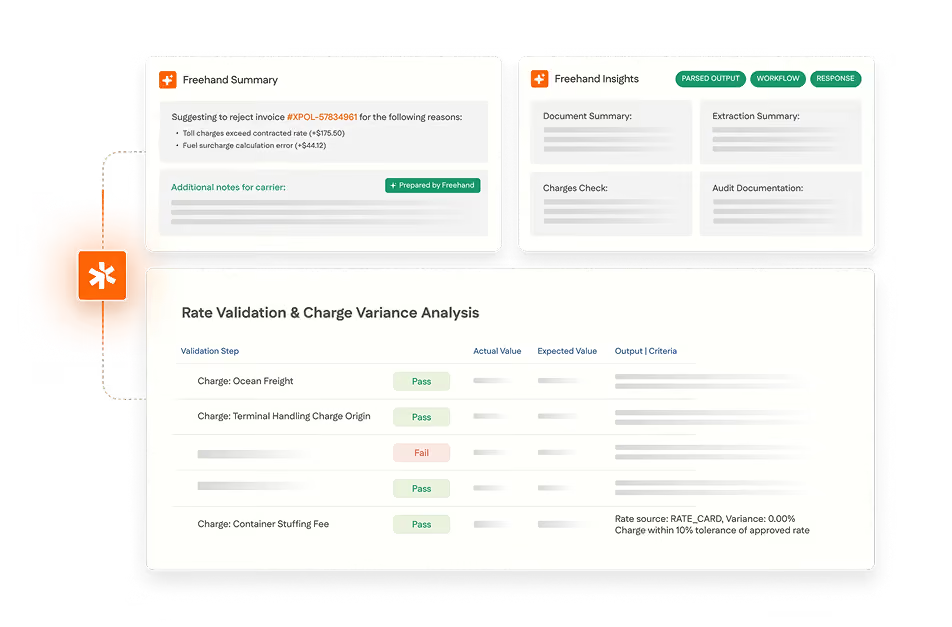
Freehand's logistics spend platform connects carrier sourcing data to post-award invoice compliance, tracking contracted rates against billed amounts across the full carrier portfolio, surfacing variance before it compounds, and feeding realized spend data back into the next sourcing cycle. Freehand is recognized in the 2026 Gartner Market Guide for Freight Audit and Payment Providers.
When you are ready to run structured events, our guide to the best freight procurement software compares the leading tools.
{{brown-cta}}
Frequently Asked Questions
What is carrier sourcing in freight procurement?
The process enterprise shippers use to identify, evaluate, and contract freight carriers, covering lane analysis, RFP design, bid normalization, carrier qualification, and contract award. It produces the carrier portfolio and rate structure governing freight spend for the contract period.
What is the difference between carrier sourcing and freight procurement?
Carrier sourcing is the front end of freight procurement: finding carriers, running bids, and awarding contracts. Freight procurement covers the full lifecycle through invoice compliance and payment. Carrier sourcing produces the contracted rate. Freight procurement determines whether that rate holds.
What is bid normalization in carrier sourcing?
Adjusting carrier proposals to a consistent set of assumptions, including the same accessorial scope, fuel surcharge formula, and volume baseline, so bids are comparable on equal terms. Without it, a carrier quoting a lower base rate but excluding key accessorials appears cheaper than it actually is.
What do most carrier sourcing evaluations miss?
Billing accuracy history, accessorial application frequency, and dispute responsiveness. A carrier with a 3% billing error rate on a $2M lane costs $60,000 more per year than its contracted rate implies. None of these show up in the base rate comparison.
How do you calculate total cost of carrier ownership?
Contracted base rate plus expected accessorial spend based on historical billing behavior, projected fuel surcharge cost, dispute processing overhead, and audit coverage cost. It reflects what a carrier actually bills across the contract period, not just what they quoted.
How do you measure whether carrier sourcing delivered?
Through savings realization rate, contracted versus billed rate variance by carrier, contract compliance rate, and accessorial application rate versus the contracted schedule. These connect the rate negotiated at award to the spend actually recorded.
What is carrier contract compliance rate?
The percentage of invoiced charges matching the contracted rate within tolerance. Below 95% on a high-volume carrier indicates systematic billing deviations: fuel surcharges at wrong tiers or accessorials applied without a contract basis.
How do enterprise shippers evaluate carriers in an RFP?
On contracted lane rate, service level, capacity, and operational fit. High-maturity evaluations also include historical billing accuracy, accessorial application frequency, and dispute responsiveness, the factors that determine total carrier cost, not just the rate on day one.
Freehand Gives You the Billing Accuracy Data Your RFP Doesn't Have.
Freehand's AI Teams track every carrier's invoice accuracy over time, so your next sourcing decision accounts for how a carrier actually bills, not just what it quotes.
The Lowest Bid Rate and the Lowest Actual Cost Are Different Numbers.
An RFP that scores on rate alone has no visibility into how a carrier actually bills once the contract is signed.
Every warehouse. Every provider. Every mile.
Gartner's 2026 outlook on logistics outsourcing, and how AI Teams hold every contract to the terms you agreed.
- Where outsourced logistics quietly loses margin
- Why billed charges drift from the contract
- How AI Teams close the gap