
What Are Freight Forwarder Invoices? Components, Errors, and How to Audit Them
.webp)
June 12, 2026
•
12
mins
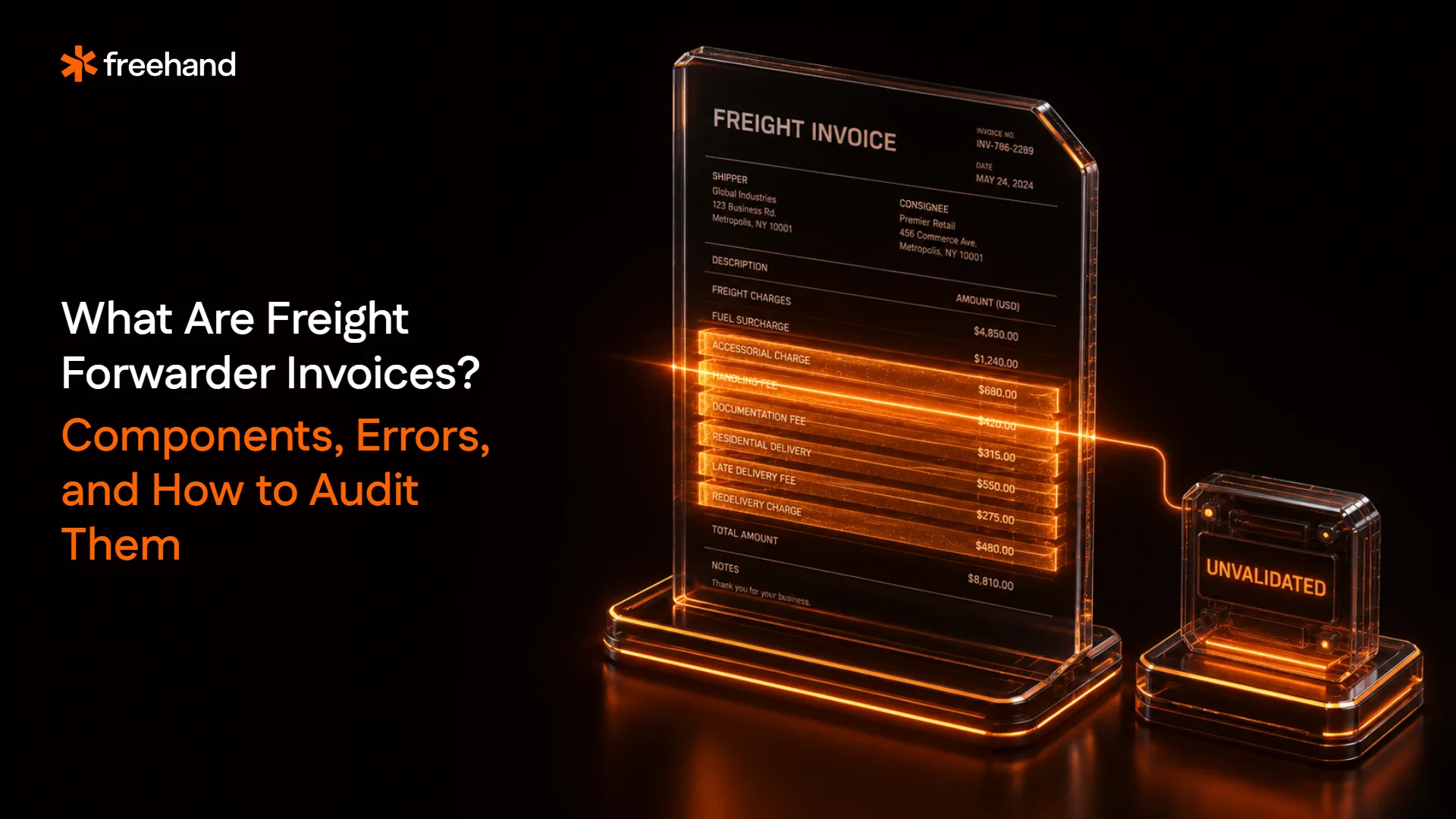
Your freight forwarder invoices on completion: origin handling, ocean freight, destination THC, customs clearance, documentation, and a handful of surcharges you didn't ask about but are paying anyway.
At two or three forwarders, a finance team can keep up. Once you're managing twelve across six trade lanes, the invoices arrive faster than anyone can validate them against contracts signed six months ago.
Key Takeaways
- A freight forwarder invoice is a multi-party billing document where one forwarder invoices for charges incurred across carriers, port agents, customs brokers, and handlers, making line-item validation harder than any single-service invoice.
- Fuel surcharges, destination THC, and documentation fees carry the highest error rates and receive the least AP scrutiny.
- Most enterprise AP teams run 2-way matching at best, catching rate mismatches on base freight but missing surcharge overcharges and fees billed without a contract basis.
- 100% freight forwarder invoice audit requires 4-way matching: forwarder contract, underlying carrier rate, shipment data, and confirmed service events.
- 80% of freight invoices contain some form of discrepancy, with overcharges averaging 8 to 10% above the correct amount.
What is a freight forwarder invoice?
A freight forwarder invoice is a consolidated billing document that covers all charges for moving a shipment from origin to destination: carrier costs, port fees, customs clearance, documentation, and the forwarder's own service margin, rolled into one bill.
Unlike a direct carrier invoice, which bills a single service against a single rate agreement, a freight forwarder invoice aggregates costs from multiple service providers. The forwarder pays carriers, port agents, customs brokers, and local handlers on your behalf, then invoices you for the total.
Some charges are passed through at cost. Some carry a markup. Some are forwarder-originated fees with no underlying third-party cost at all.
That structure is efficient for managing complex multi-leg shipments. It creates a specific audit problem: validating each line item requires knowing not just what you contracted with the forwarder, but what the underlying carrier or port agent actually charged.
At 10 invoices a month from two forwarders, that's manageable. At 500 invoices a month from twelve forwarders across multiple trade lanes, the bundled structure means most line items clear AP without anyone verifying the underlying rate.
How a Freight Forwarder Invoice Differs from a Commercial Invoice and a Bill of Lading
Three documents travel with every international shipment and are frequently confused with each other.
The freight forwarder invoice arrives weeks after shipment. The commercial invoice travels with the goods. The BOL is issued at time of loading. All three reference the same shipment but serve different functions. AP processes the freight forwarder invoice for payment. Customs uses the commercial invoice for duty assessment. Neither document is a substitute for the other.
What does a freight forwarder invoice include?
Freight forwarder invoices include origin charges, ocean or air freight, fuel surcharges, destination THC, customs and clearance fees, and documentation costs. The line items most prone to billing errors are fuel surcharges, destination THC, and documentation fees.
The components most AP teams validate (ocean freight, customs duties) tend to be the cleanest. The ones least likely to be checked are where overcharges accumulate most consistently.
How Does Freight Forwarder Invoice Processing Work?
The validation sequence determines whether what arrives in AP reflects contracted cost or billed cost. Most enterprises run the second.
The Five-Step Validation Sequence
Step 1: Invoice Arrives
The forwarder submits the invoice, typically 2 to 4 weeks after shipment. By the time it lands in the AP queue, goods are in the DC and customs is cleared. The practical pressure is to approve and pay.
Step 2: Contract Is Pulled
AP retrieves the forwarder contract to check the base ocean or air rate. For most teams, this is where validation stops.
Step 3: Line Items Are Matched
Fuel surcharges, destination THC, and documentation fees are cross-checked against the contract schedule. This step fails when the fuel index for the week of shipment is not accessible in AP, the port-published THC for the destination terminal is not on hand, or the forwarder's label for a charge does not match the contract terminology. "OHC" on the invoice does not automatically map to "origin handling" in the contract.
Step 4: Invoice Is Approved or Flagged
Lines that match clear to payment. Lines that cannot be validated because the data is not in one place typically clear to payment as well.
Step 5: Validated Amount Books to ERP
In a 4-way matching environment, only cleared invoice amounts enter the ERP. In a 2-way matching environment, billed amounts enter the ERP, overcharges included.
Why Standard AP Workflows Cannot Validate Forwarder Invoices Completely
Standard 3-way matching works for supplier invoices against purchase orders. Freight forwarder invoices have no PO. The contracted rate is dynamic: fuel surcharges reset weekly, accessorials are conditional on service events, and THC varies by port.
Without access to the fuel index, the destination terminal's published rate, and shipment delivery confirmation, steps 3 and 4 cannot run.
Why are freight forwarder invoices harder to audit than direct carrier invoices?
Freight forwarder invoices are harder to audit because they bundle charges from multiple sources into one document, the forwarder's margin isn't always disclosed, and validating individual line items requires access to underlying carrier rates that AP teams rarely have.
When you receive a direct carrier invoice, you're validating one bill against one contract. A freight forwarder invoice doesn't work that way. The forwarder has contracted with carriers, port agents, customs brokers, and local handlers, each with their own rate agreement, all rolled into one document.
Three structural features make validation difficult:
No disclosed carrier-level data
Unless the forwarder shares the actual carrier invoice, you're validating their invoice against your forwarder contract, not against the underlying cost. Most audit systems can't perform that second comparison because the data isn't there.
No standardized line-item format
One forwarder labels it "OHC," another calls it "origin handling," and a third bundles it into the freight charge. The same service billed three different ways makes automated matching unreliable without a normalization layer that maps terms across forwarder formats.
No single rate card to match against
A direct carrier invoice has one rate card. A forwarder invoice has rates from the forwarder contract, the carrier, the port agent, the customs broker, and the documentation provider, each maintained separately.
What Are the Most Common Freight Forwarder Invoice Errors?
Freight forwarder billing errors concentrate in fuel surcharges, destination THC, and documentation fees, the line items AP teams validate least often and where forwarders have the most billing discretion.
Fuel and Bunker Surcharge Mismatches
Ocean freight is priced in two parts: the base rate and the fuel component. The fuel component (BAF, EBS, or similar) is indexed to a price that changes weekly or monthly. Your forwarder contract specifies which fuel index applies and at what tier.
The most common error: the carrier's billing system applies a rate from a table that has not been updated to reflect the current week's EIA index or the current contract terms. Rate card staleness is the single most common root cause of systematic freight billing errors at enterprise scale. The charge passes a basic contract-match check because the rate exists somewhere in the audit system. It fails a current-week index validation because it reflects a prior period's tier.
At $40 to $120 per TEU per week depending on the lane, a systematic fuel surcharge mismatch across 200 monthly ocean shipments is a material number.
Destination THC Overbilling
Terminal handling charges (THC) are set by port terminals and collected by carriers. Your forwarder contract may specify a different rate, a cap, or a bundled rate that includes THC. When the carrier raises its published THC, forwarders sometimes pass through the increase even when the contracted rate was fixed.
The difference is $15 to $40 per container depending on the port. Across a high-volume importer clearing 3,000 import containers annually through a single destination port, that is $45,000 to $120,000 annually from one line item on one trade lane.
Documentation Fee Inflation
BL fees, telex release charges, certificate of origin fees, and surrender charges are small individually. The error modes that compound across a multi-forwarder portfolio:
- Fees billed on both master BL and house BL for the same shipment
- Telex release charged when the original BL was never requested
- Certificate of origin fees on lanes where the shipper handled documentation directly
- Documentation fees consistently billed 20 to 30% above the contracted schedule
A forwarder consistently overbilling documentation fees across 18 months shows as a portfolio-level pattern in freight spend analytics. That pattern does not surface from individual invoice review alone.
Demurrage and Detention Disputes
Demurrage and detention charges are among the most disputed line items in international freight. The error modes: incorrect start date for free time, charges applied to cargo that was released on time but not physically picked up due to a terminal delay, and containers charged on days when the terminal was closed.
Each dispute requires proof: the free time calculation from the BOL, the terminal's gate-in and gate-out timestamps, and the carrier's published free time schedule for the port and equipment type. Without that data connected to the validation workflow, most demurrage disputes are paid rather than contested.
How Does Freight Forwarder Overbilling Compound at Enterprise Scale?
At enterprise freight volumes, systematic overbilling on fuel surcharges, THC, and documentation fees represents 1.5 to 2.5% of total forwarder spend annually. Most AP teams never see it because the individual charges fall below the manual review threshold.
Per-invoice dollar amounts are misleading. A $40 THC overcharge on one shipment is not a priority. That same $40 applied to every container clearing through a specific port, across 12 months, across 3,000 import containers, is $120,000 from a single charge on a single trade lane, before fuel surcharges and documentation fees are added.
Worked example: three error types, one trade lane, one year
An enterprise importing 3,000 containers annually through a single European destination port runs the following systematic errors:
- Destination THC billed at carrier-published rate ($35) instead of contracted fixed rate ($22): $13 per container, $39,000 per year
- BAF fuel surcharge applied at prior week's tier rather than the week of departure: average $28 per container, $84,000 per year
- BL documentation fees billed on both master and house BL instead of house BL only: $65 per container, $195,000 per year
Total exposure from three line items on one trade lane: $318,000 per year. Each charge individually is below any manual review threshold. Combined across a full import portfolio, they represent the majority of recoverable overcharge exposure at most enterprise shippers.
The exposure is largest in import-heavy sectors such as food and beverage and life sciences and pharmaceutical.
Three dimensions compound the exposure:
Volume.
An enterprise importing 5,000 containers annually across eight freight forwarders has errors that accumulate faster than any sampling-based process can track. They are small and distributed across carriers, ports, and surcharge types, not concentrated in obvious exceptions.
Timing.
Freight forwarder invoices arrive 2 to 4 weeks after shipment. By the time the invoice lands in the AP queue, goods are in the DC and the carrier has been paid by the forwarder. There is no operational reason to hold payment.
Accrual accuracy.
When forwarder invoices arrive consistently late, finance teams book estimated freight costs at month-end based on quote amounts. When the final invoices arrive carrying overcharges, the variance enters a reconciliation queue that finance is still working through at the next close.
{{blue-cta}}
How do enterprise teams audit freight forwarder invoices without adding headcount?
Enterprise teams audit freight forwarder invoices at scale through automated 4-way matching that validates every invoice line against the forwarder contract, the underlying carrier rate or market benchmark, the purchase order, and confirmed shipment data simultaneously.
Manual audit doesn't fail because reviewers aren't thorough. It fails because the data needed for validation isn't in one place:
- The forwarder contract is in a contract management system
- The shipment data is in the TMS
- The carrier rate (when available) is in carrier-provided reports
- The purchase order is in the ERP
A reviewer working from the invoice alone has one of the four data points needed to validate any line item.
Where actual carrier rates aren't available, carrier benchmarks from industry data sources can flag when a forwarder's applied ocean or air rate falls outside the market range for the lane and week of shipment.
Are you auditing your freight forwarder invoices or just processing them?
Processing freight forwarder invoices means approving and paying them. Auditing them means validating every line item against the contracted rate, the actual service rendered, and confirmed shipment data before payment clears.
Most enterprise AP teams are doing the first.
The gap is structural. Your AP team has the invoice and the forwarder contract. They don't have:
- The carrier's actual charge
- The fuel index for the week of shipment
- The port-published THC for the destination terminal
- The container release record showing when the box was freed
Without all four, validation on fuel surcharges, THC, and documentation fees is practically impossible. So those line items get approved.
At 500 forwarder invoices per month across twelve forwarders and six trade lanes, that approval gap accumulates. The 1.5 to 2.5% of forwarder spend sitting in unchecked surcharges and fee inflation doesn't appear on a single invoice. It shows up in the gap between what you quoted at RFP and what you're actually paying each forwarder quarter over quarter.
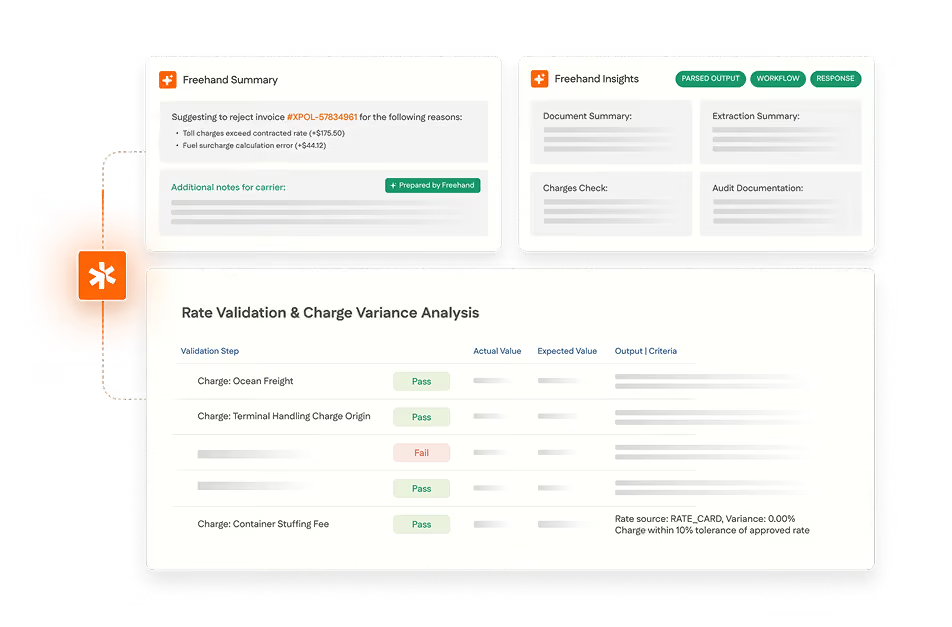
Freehand's freight audit platform runs 4-way matching across every freight forwarder invoice, ingesting from EDI, PDF, and email, benchmarking applied surcharge rates against carrier and market data, and surfacing exceptions before payment clears, without adding to your AP team's review queue.
What Are the Common Mistakes in Freight Forwarder Invoice Auditing?
Most freight forwarder invoice audit programs fail at the same points, and the failures are structural rather than execution failures.
Auditing Only the Ocean Freight Line
Ocean freight is the largest line item and the most visible. It is also the line item carriers and forwarders are most careful to bill correctly. Fuel surcharges, THC, and documentation fees receive less scrutiny on both sides and accumulate more errors. An audit program that validates base freight thoroughly but samples surcharges and documentation fees misses the majority of recoverable exposure.
Using 2-Way Matching for Logistics Invoices
2-way matching compares the invoice to the forwarder contract. It catches rate-level mismatches on base freight. It cannot verify whether the fuel surcharge tier applied matches the week of shipment, or whether THC was billed at the contracted rate versus the carrier's published rate. Those checks require operational data that 2-way matching does not pull.
Relying on Sampling
More than 60% of logistics teams continue to manually review invoices or use sampling for verification. A systematic forwarder billing error applied to every shipment on a lane will not surface in a 10% sample review. It surfaces when 100% of invoices are validated. The errors that generate the most recovery, small charges applied consistently across a high-volume lane, are exactly the ones sampling is least likely to catch.
Treating Contract Amendments as a Documentation Task
When a forwarder contract is renegotiated and the updated rate schedule is not reflected in the AP validation layer, every subsequent invoice validates against outdated terms. An amended rate in a PDF email attachment does not automatically update the rate reference the validation system uses. The lag between amendment agreement and system update is where negotiated savings disappear before they reach the P&L.
Auditing After Payment
Post-payment audits recover some overcharges. They do not recover charges where the dispute window has closed, and they do not prevent the accrual distortion that comes from incorrect amounts booking to the ERP at the time of payment. Freehand's freight audit and payment software runs validation pre-payment, before any amount clears AP.
What Are the Best Practices for Freight Forwarder Invoice Auditing?
The best practices for freight forwarder invoice auditing address the same failure modes: fragmented contract data, operational data not connected to the validation layer, sampling instead of full coverage, and amendment governance that does not reach the system of record.
Run 4-Way Matching, Not 2-Way
4-way matching validates every invoice line against four sources simultaneously:
- The forwarder contract (contracted rate for the service)
- The underlying carrier rate or market benchmark (what the carrier actually charged)
- Confirmed shipment data (weight, departure date, equipment type, service level)
- Service event records (delivery confirmation, free time consumption, accessorial trigger)
Manual review with the forwarder contract alone is 2-way matching. Everything above that requires data integration between the validation layer, the forwarder's rate schedule, the carrier's published indices, and TMS shipment records.
Structure Contracts as Queryable Rate References
A forwarder contract stored as a PDF cannot be compared against an invoice in real time. Rate schedules, fuel index references, THC caps, and accessorial schedules need to be structured so the validation layer can query them by lane, date, and charge type for each invoice line as it arrives.
Contract amendments must propagate to the validation system on the amendment effective date, not as a manual update that creates a lag window.
Normalize Line-Item Terminology Across Forwarders
One forwarder labels it "OHC," another calls it "origin handling," a third bundles it into the freight charge. Automated matching fails without a normalization layer that maps charge terminology across forwarder formats to a standard taxonomy. Without normalization, mismatched labels create false exceptions on correctly-billed charges and missed exceptions on incorrectly-billed ones.
Validate Against Live Fuel Index Data
Fuel surcharge validation requires the fuel index value for the week of shipment, not just the contract formula. This means integrating external fuel index feeds (Platts, IATA, carrier-published indexes) into the validation layer, not manually checking surcharge schedules invoice by invoice.
Build Dispute Workflows Before You Need Them
Every freight forwarder contract has a dispute window. Disputes filed after the window closes are typically rejected. A dispute workflow that auto-generates a dispute packet when a line item fails validation and routes it before payment clears is the difference between recovering overcharges and absorbing them.
Review Spend at Portfolio Level, Not Invoice Level
Individual invoice review catches individual errors. Portfolio-level spend analytics across all forwarders and trade lanes catches systematic patterns: a forwarder consistently billing documentation fees above schedule, a lane where fuel surcharge mismatches repeat every quarter, a port where THC overbilling tracks the carrier's published rate increases rather than the contracted cap.
How Does Freehand Audit Freight Forwarder Invoices?
Processing freight forwarder invoices means approving and paying them. Auditing them means validating every line item against the contracted rate, the actual service rendered, and confirmed shipment data before payment clears. Most enterprise AP teams are doing the first.
Freehand's freight audit and payment platform runs 4-way matching across every freight forwarder invoice, ingesting from EDI, PDF, and email, benchmarking applied surcharge rates against carrier and market data, and surfacing exceptions before payment clears, without adding to the AP team's review queue.
At 1.5 to 2.5% of forwarder spend in systematic billing errors, a $30M forwarder portfolio carries $450,000 to $750,000 per year in recoverable costs that clear AP undetected under standard 2-way matching.
The platform covers parcel through ocean, with validation logic tuned per mode, and posts validated amounts back to your ERP with a full audit trace on every reconciled line. Freehand is recognized in the 2026 Gartner Market Guide for Freight Audit and Payment Providers.
Request a demo to see how 4-way forwarder invoice matching works against your current forwarder portfolio.
When forwarder invoices outgrow manual checks, our ranking of the best freight invoice processing software shows which platforms scale.
{{brown-cta}}
Frequently Asked Questions
What is a freight forwarder invoice?
The payment request a freight forwarder issues after completing a shipment. It bundles charges from multiple third parties, including carriers, port agents, and customs brokers, into one document billed under the forwarder's name.
What is the difference between a freight forwarder invoice and a commercial invoice?
A freight forwarder invoice bills for transportation and logistics services. A commercial invoice bills for the goods themselves and is used by customs to assess duties and taxes. Both reference the same shipment but serve different functions and go to different parties.
What charges have the highest billing error rates on a freight forwarder invoice?
Fuel surcharges, destination THC, and documentation fees. These are the line items AP teams validate least often and where forwarders have the most billing discretion. Base ocean freight tends to be billed most accurately because it receives the most scrutiny.
What is the difference between 2-way and 4-way matching for freight forwarder invoices?
2-way matching compares the invoice to the forwarder contract. 4-way matching also validates against the underlying carrier rate or market benchmark and confirmed shipment data. Fuel surcharge and THC errors are only caught at the 4-way level.
How much does freight forwarder overbilling cost at enterprise scale?
At 1.5 to 2.5% of forwarder spend in systematic billing errors, a $30M forwarder portfolio carries $450,000 to $750,000 per year in recoverable costs that pass through standard AP workflows undetected.
What is the difference between a freight forwarder invoice and a bill of lading?
A freight forwarder invoice is a billing document requesting payment for transportation services. A bill of lading is a shipment document serving as a receipt, a contract of carriage, and a title document for the goods. The BOL is issued at loading. The freight forwarder invoice arrives weeks later.
What is demurrage on a freight forwarder invoice?
A charge billed when a container is held at a port terminal beyond the free time period specified in the carrier contract. Common billing errors include incorrect free time start dates and charges applied to containers that were released on time but not physically moved due to terminal delays.
How long does a freight forwarder have to issue an invoice?
Most forwarders invoice 2 to 4 weeks after shipment completion. Contracts typically specify payment terms of 30 days from invoice date. Waiting for invoices to arrive before validating them means goods are already in the DC and the carrier has been paid, creating payment pressure that works against thorough audit.
Freehand Validates Every Component of a Forwarder Invoice Separately.
Freehand's AI Teams check each charge type, ocean, THC, documentation, surcharges, against its own contract basis instead of approving the invoice as one bundle.
One Forwarder Invoice Bundles Charges From Six Different Parties.
Origin handling, ocean freight, destination THC, customs, and a handful of surcharges you didn't ask about, all on one line-item review.
Every warehouse. Every provider. Every mile.
Gartner's 2026 outlook on logistics outsourcing, and how AI Teams hold every contract to the terms you agreed.
- Where outsourced logistics quietly loses margin
- Why billed charges drift from the contract
- How AI Teams close the gap