

Freight Rate Management: Why Rate Card Accuracy Determines What AP Catches
.webp)
June 15, 2026
•
5
mins
A carrier contract covers hundreds of lanes, multiple surcharge matrices, and accessorial schedules that change with amendments negotiated mid-term. The AP team validating invoices against that contract depends on a rate card that is current, structured, and accessible.
In most enterprises, it is not. The contract is in a PDF on a shared drive, amendments are tracked in a spreadsheet, and the rate reference AP actually uses reflects the original contract terms, not the current ones.
The gap that creates is not visible in the exception report. It shows up in overcharges that clear as valid charges and valid charges that get flagged as exceptions.
Key Takeaways
- Freight rate management is the ongoing process of maintaining carrier rate cards as the current, authoritative rate reference for invoice validation, covering lane rate updates, surcharge schedule maintenance, accessorial amendments, and ensuring those changes propagate to the AP validation layer when contracts change.
- A stale rate card produces two failure types: false positives, where valid charges get flagged as errors, and false negatives, where overcharges pass because the old rate in the card is higher than the current contracted rate.
- A carrier rate card has three components requiring se
- parate maintenance: base lane rates, fuel surcharge schedules with indexed formulas, and accessorial schedules with conditional triggering logic. Each is amended independently.
- The amendment problem is where most rate management failures occur. Rates renegotiated mid-contract do not automatically update the rate reference AP uses for validation.
- Sourcing-to-contract sync solves the amendment problem by automating the handoff from RFP award or contract amendment to the audit engine, so new rates push directly to the invoice validation layer without a manual update step.
What Is Freight Rate Management?
Freight rate management is the ongoing process of maintaining carrier rate cards as the current, authoritative rate reference for invoice validation, covering lane rate updates, surcharge schedule maintenance, accessorial amendments, and propagating those changes to the AP validation layer when contracts change.
Most discussions of freight rate management focus on the TMS side: ensuring the routing engine has current contracted rates so it can assign the right carrier to each load. That is one half of rate management.
The other half, ensuring the AP validation layer has those same current rates so invoices can be validated correctly, gets far less attention and causes far more financial damage when it fails.
When the TMS rate card and the AP validation rate card diverge because an amendment was made and only one system was updated, the routing engine and the invoice validation layer are operating on different contract terms. The TMS may route correctly to the carrier whose amended rate is lower. AP may approve an overcharge because it is validating against the original, higher rate.
Freight Rate Management vs. TMS Rate Management
| Category | TMS Rate Management | AP Rate Management |
|---|---|---|
| Purpose | Ensures routing engine uses current rates for carrier selection | Ensures validation layer uses current rates to confirm billing accuracy |
| Failure mode | Wrong carrier selected; incorrect load tender | Overcharges pass validation; valid charges flagged as exceptions |
| Amendment impact | Routing decisions shift to the amended carrier | Invoice validation runs against old terms until manually updated |
| Who owns it | Transportation / logistics team | AP / procurement team |
| Visibility into failure | Routing guide exceptions visible in TMS | False positives and negatives invisible until retrospective audit |
An amendment that updates the TMS rate table may not update the AP validation layer. Both systems continue operating, producing outputs that look normal, until someone compares what was contracted to what was billed at the lane level.
What Does a Carrier Rate Card Actually Contain?
A carrier rate card contains three components requiring separate maintenance: base lane rates, a fuel surcharge schedule, and an accessorial schedule. Each is amended independently and each has a different failure mode when it goes stale.
Base Lane Rates
Base lane rates are the contracted freight charges for each origin-destination pair or zone, by mode, equipment type, and weight break. These are the rates the RFP produces.
Base rates are amended mid-contract when lanes are added to the network, rates on specific corridors are renegotiated outside the annual RFP cycle, or volume commitment thresholds that trigger discount tiers change. If the update is manual, there is a lag.
During that lag, every invoice on the renegotiated lane is validated against the old rate, either accepting overcharges if the old rate was higher, or flagging valid charges as exceptions if the new rate is lower.
Fuel Surcharge Schedules
Fuel surcharge schedules are the most frequently updated component of a carrier rate card. The schedule specifies the published fuel price index the surcharge is based on (typically the EIA weekly diesel price), what day of the week the surcharge tier resets, and the tier table that maps fuel price ranges to surcharge percentages.
The failure mode here is specific. A carrier may have two surcharge schedules in existence simultaneously: the one in the carrier contract and the one on the carrier's published general rate page.
If the AP validation layer is referencing the carrier's published surcharge rather than the contractually specified formula, it allows a surcharge tier the contract does not authorize. That discrepancy can run undetected for months because both rates look like legitimate surcharge amounts.
Accessorial Schedules
Accessorial schedules cover the conditional charges that apply when specific service events occur: residential delivery, address correction, DIM weight adjustments, liftgate service, extended area surcharges, and detention after the contracted free time.
Accessorial schedules are amended most frequently of the three rate card components. Carriers add new categories, adjust triggering thresholds, and revise rates, sometimes without formal contract amendment language.
When AP receives an invoice carrying an accessorial charge not in the current rate reference, the charge either clears because the validation layer does not flag charges it does not recognize, or triggers a manual exception because the charge type does not match anything in the rate card.
The first outcome lets invalid charges through. The second creates false exception volume that buries the AP team without necessarily catching the actual errors.
How Do Rate Card Gaps Create Invoice Validation Failures?
Rate card gaps create two types of invoice validation failure: false positives, where correctly billed charges fail validation because the rate card has not been updated, and false negatives, where overcharges pass validation because the stale rate in the card is higher than the current contracted rate.
False Positives: The Visible Failure
False positives are immediately visible. They inflate the AP exception queue with invoices that are actually correct. When a carrier invoices at the new contracted rate after a mid-cycle renegotiation and the AP validation layer still holds the original rate, the invoice fails validation even though the carrier billed correctly.
The AP team reviews the exception, cannot find a contract basis for the rejection, manually approves it, and moves on. The real cost is not the manual review. It is that the manual approval sets a precedent for clearing that exception type, which means future invoices at the same rate clear without review, whether they are correct or not.
False Negatives: The Invisible Failure
False negatives are invisible until someone looks for them. A fuel surcharge running on an expired rate matrix, invoiced at a tier two steps above what the current contracted formula would produce, passes AP validation because the old formula in the rate card happens to produce a higher surcharge than the current formula would. The invoice passes. The overcharge clears. It happens again on the next billing cycle and the one after.
Not because the AP team is not doing its job. Because the rate reference it is working from is wrong.
In enterprises managing 15 to 20 carrier relationships with quarterly amendments, the lag between when a contract changes and when the AP validation layer is updated is typically weeks to months. Every invoice processed during that lag is validated against the wrong rate.
Worked example: a fuel surcharge false negative
A carrier contract renegotiation in Q1 reduces the fuel surcharge formula by one index tier, effective March 1. The procurement team files the amendment. The AP validation layer is not updated until March 28.
During those 28 days, 340 invoices are processed on affected lanes. Each carries a fuel surcharge one tier above the new contracted formula. The average per-invoice surcharge overcharge is $47.
Total undetected overcharge in 28 days: $15,980. Annualized if the amendment propagation lag is endemic across quarterly renegotiations: $63,920 per year from fuel surcharge false negatives alone.
{{blue-cta}}
What Makes Freight Rate Management Harder in a Multi-Carrier Portfolio?
Managing freight rate cards across a 15 to 20 carrier portfolio means maintaining different rate structures, amendment histories, and surcharge formulas for each relationship, and ensuring every change propagates to the invoice validation layer before the next billing cycle.
Each carrier relationship has its own rate card structure. A parcel carrier rate card is built around zone tables, DIM weight factors, and surcharge stacks. An LTL carrier rate card is built around freight classes, distance-based tariff tables, and minimum charge floors. An ocean carrier rate card covers trade lanes, equipment types, port surcharges, and terminal handling charges.
The rate card maintenance burden for an enterprise with 10 active modes and 20 carriers is not 20 parallel tasks. It is 20 structurally different tasks requiring different domain knowledge.
Amendment frequency compounds the complexity:
- Ocean carrier surcharge schedules (BAF, EBS, CAF) can change monthly
- Truckload fuel surcharges reset weekly by index
- Parcel surcharge schedules are revised quarterly
- Accessorial additions happen at carrier discretion without always triggering a formal amendment notification
An enterprise managing that portfolio manually through a shared drive of PDFs and a tracking spreadsheet is running a process that falls behind within months of each RFP cycle. The invoices carrying the most billing errors are typically the ones on lanes where rate card maintenance has slipped furthest.
How Does Sourcing-to-Contract Sync Solve the Rate Card Maintenance Problem?
Sourcing-to-contract sync pushes new contracted rates from RFP award or contract amendment directly into the invoice audit engine, eliminating the manual rate card update step that creates the lag between the signed contract and the validation layer.
In a sourcing-to-contract sync architecture, the RFP process and the invoice audit process share the same rate data layer. When a new carrier is awarded a lane at a negotiated rate, that rate pushes to the audit engine automatically at contract signing.
When a mid-cycle amendment renegotiates a fuel surcharge formula, the formula update propagates to the validation layer as part of the amendment workflow, not as a separate manual step.
Manual Process vs. Sourcing-to-Contract Sync
| Category | Manual Rate Card Process | Sourcing-to-Contract Sync |
|---|---|---|
| Amendment propagation | Someone extracts new terms, updates rate card, verifies update | Rate pushes to audit engine at contract signing |
| Lag window | Days to weeks | Zero |
| Invoices during lag | Validated against old rate | Validated against current contracted rate |
| False negative risk | High: overcharges clear during lag | Eliminated |
| Effort per amendment | Hours of manual extraction and entry | Automated |
A manual process requires someone to extract new rate terms from the signed contract, update the rate card in the AP system, and verify the update happened correctly before invoices arrive. That takes days to weeks. During that window, invoices are validated against the old rate.
Sourcing-to-contract sync closes that window. The audit engine's rate reference is current with the signed contract as of the day of signing.
How Do Enterprise Teams Measure Freight Rate Management Effectiveness?
Four metrics track whether the AP validation layer is current with signed contracts and how much billing error is passing through as a result of rate card gaps.
| Metric | What it reveals | Below threshold |
|---|---|---|
| Rate card completeness | Percentage of carrier lanes with a current rate reference | Below 90%: remaining lanes approved on manual review or default pass |
| Amendment propagation lag | Days from contract amendment to live AP validation | Above 14 days: invoices validated against wrong rates for most of a billing cycle |
| Validation false-positive rate | Percentage of flagged exceptions that were correctly billed | High rate on a specific carrier signals an outdated rate card |
| Validation false-negative rate | Percentage of billing errors on approved invoices found on retrospective audit | The most financially significant metric. Any sustained rate is a structural problem. |
The false-negative rate is the metric that matters most and gets measured least. Most enterprises track exception volume (false positives) because exceptions are visible in the AP queue. False negatives only surface on retrospective audit, which most enterprises do not run systematically.
How Does Freehand Solve the Rate Card Management Problem?
Your contracts have the right rates. The question is whether the invoice validation layer knows that.
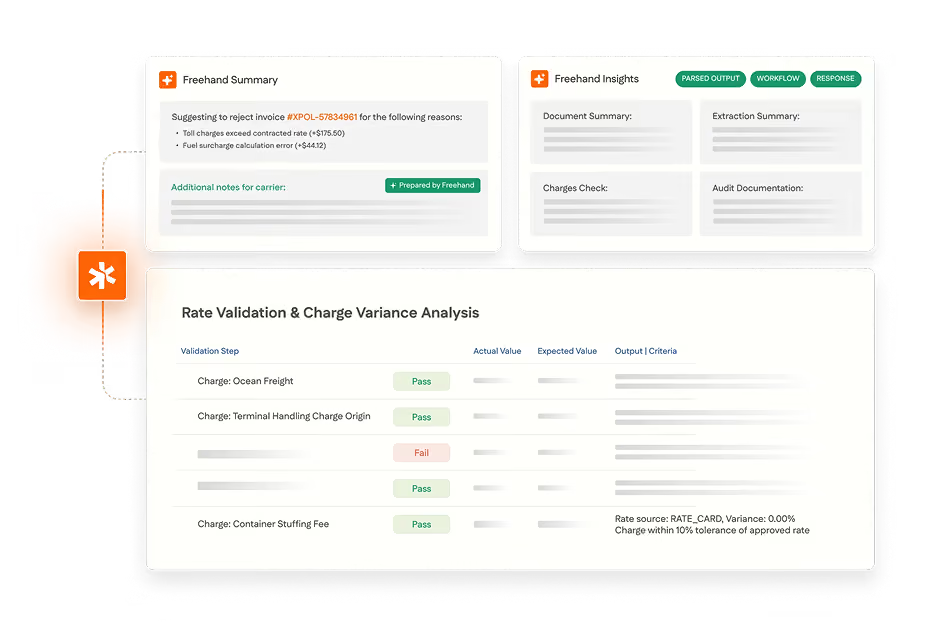
A carrier contract with accurate rates is only useful if the validation infrastructure enforces them. When the rate card in AP does not reflect the current contract, overcharges clear as correct and valid charges get flagged as exceptions. Neither error appears in the exception report as a rate card problem.
The procurement team that spent four weeks negotiating a 6% reduction on a high-volume lane assumes that reduction is showing up in every subsequent invoice. Whether it does depends entirely on whether the new rate made it from the signed contract into the AP validation layer before the first invoice arrived.
Freehand's freight audit and payment platform connects the procurement and invoice compliance layers through sourcing-to-contract sync, pushing awarded rates and amendments directly to the audit engine at contract signing. The rate the procurement team negotiated is the rate the AP team enforces from day one, not three weeks later.
The platform covers every mode with validation logic tuned per carrier type, and posts validated amounts back to your ERP with a full audit trace. Freehand is recognized in the 2026 Gartner Market Guide for Freight Audit and Payment Providers.
Request a demo to see how current rate enforcement works across your carrier portfolio.
{{brown-cta}}
Frequently Asked Questions
What is freight rate management?
The process of maintaining carrier rate cards as the current rate authority for invoice validation, covering lane rate updates, surcharge schedule maintenance, accessorial amendments, and propagating those changes to the AP validation layer when contracts change.
What does a freight rate card contain?
Base lane rates by origin-destination pair, a fuel surcharge schedule specifying the index formula and weekly tier table, and an accessorial schedule of conditional charges. Each component is amended independently and requires separate maintenance when contract terms change.
What are false positives and false negatives in freight invoice validation?
False positives: correctly billed charges fail validation because the rate card has not been updated, inflating the AP exception queue with valid invoices. False negatives: overcharges pass validation because the stale rate in the card is higher than the current contracted rate.
What is amendment propagation lag in freight rate management?
The time between when a contract amendment is signed and when the updated rate is live in the AP invoice validation layer. During that lag, invoices on amended lanes are validated against the old rate, producing false positives on valid charges and false negatives on overcharges.
What is sourcing-to-contract sync?
The automated handoff from RFP award or contract amendment to the invoice audit engine. New contracted rates push to the validation layer at contract signing rather than through a manual rate card update step, eliminating the propagation lag that causes rate card gaps.
How often should freight rate cards be updated?
Whenever a contract is signed or amended, which in a large carrier portfolio means continuously. Fuel surcharge formulas may update monthly, accessorial schedules quarterly, and lane rates annually or when renegotiated mid-cycle. The only sustainable approach at enterprise scale is automated propagation through sourcing-to-contract sync.
Why is freight rate management harder than maintaining a TMS rate table?
TMS rate management ensures the routing engine uses current rates for carrier selection. AP rate management ensures those same rates are used to confirm billing accuracy. An amendment updating the TMS rate table may not update the AP validation layer, causing both to operate on different contract terms with no visible indicator until a retrospective audit surfaces the discrepancy.
How do you measure freight rate management effectiveness?
Rate card completeness, amendment propagation lag, validation false-positive rate by carrier, and validation false-negative rate on approved invoices. Together these show whether the AP validation layer is current with signed contracts and how much billing error is passing through as a result of rate card gaps.
Freehand Keeps Your Rate Card Current.
Freehand's AI Teams maintain your contracted rate reference as amendments happen, so every invoice validates against the terms that are actually in effect.
Your Rate Card Reflects the Original Contract. Not the Current One.
Amendments tracked in a spreadsheet and a rate reference that never catches up both create overcharges that look like valid charges.
Every warehouse. Every provider. Every mile.
Gartner's 2026 outlook on logistics outsourcing, and how AI Teams hold every contract to the terms you agreed.
- Where outsourced logistics quietly loses margin
- Why billed charges drift from the contract
- How AI Teams close the gap