

Fuel Surcharge: What It Is and How to Verify It's Correct
A fuel surcharge adjusts freight rates for diesel price swings. Learn how it's calculated by mode, and how to check it's billed correctly on every invoice.
.webp)
August 21, 2026
•
13
mins

A fuel surcharge (FSC) is a variable charge added to a freight rate to account for diesel price changes since the contract was set, calculated from a published fuel index and recalculated on a fixed schedule, usually weekly. Because it resets that often and varies by mode, lane, and carrier, it's also one of the easiest line items to bill wrong and the hardest to catch by eye.
Key Takeaways
- A fuel surcharge is a variable add-on to a base freight rate, indexed to a published diesel price and recalculated weekly, so the "correct" surcharge changes even when nothing else about the shipment does.
- Truckload FSC is typically formula-based (current index price minus a base price, divided by average MPG); LTL and parcel FSC is typically a percentage tied to a published price band.
- The U.S. Energy Information Administration's weekly diesel price is the index most carrier contracts reference, but the base price, band table, and effective date are negotiated and vary by contract.
- FSC is usually locked to the fuel price on the ship or pickup date, not the delivery date, which means the invoice date and the index date rarely match, and that gap is where billing errors hide.
- Auditing FSC by hand at scale doesn't work: it requires pulling a diesel index for a specific week, checking a carrier's own surcharge table, and recalculating for every invoice, which is why most AP teams verify a sample instead of all of it.
What is a fuel surcharge?
A fuel surcharge is a separate, variable line item that carriers add to a freight invoice to pass through changes in fuel cost since the base rate was negotiated. It exists because a locked-in linehaul rate would otherwise force the carrier to absorb (or the shipper to underpay for) every swing in diesel prices over a multi-year contract.
The mechanism: a carrier publishes or negotiates a fuel index and a base price. Each week, the current index price is compared to that base, and the difference converts into a surcharge, either a dollar amount per mile or a percentage of the linehaul charge.
In business terms, FSC is the reason two invoices for the identical lane, same carrier, same week apart, can carry different total costs even though the base rate never changed. If your AP team isn't recalculating it, you're trusting the carrier's math on a number that moves every week.
Why does the reporting delay actually cost you money?
A fuel surcharge is recalculated on a fixed cycle, but the invoice you receive doesn't show its work. It shows a total. Verifying that total means independently pulling the same index the carrier used, for the same week, and running the same formula, then comparing.
Most AP teams don't do this on every invoice. They spot-check a sample, often when a total looks unusually high, and let the rest through on the assumption that fuel is a formula, so it must be right. That assumption is the gap: a stale index date, a wrong base price, or a rounding error in the band table produces a surcharge that looks entirely plausible on its face.
{{blue-cta}}
How is fuel surcharge calculated?
Truckload FSC is a per-mile formula based on the index-to-base spread and fuel economy; LTL and parcel FSC is a percentage pulled from a published band table. Mixing the two up is a common source of manual audit error.
Truckload: FSC is typically calculated as the current index price minus the base price, divided by the truck's average miles per gallon, then multiplied by loaded miles. A higher current-to-base spread or a lower MPG assumption both increase the surcharge.
Truckload Formula
FSC = ((Current Index Price − Base Price) ÷ MPG) × Loaded Miles
LTL and parcel: Carriers publish a surcharge table that maps a range of index prices ("bands," often in $0.05 or $0.10 increments) to a fixed surcharge percentage. When the index price falls inside a given band, that band's percentage applies to the base linehaul or transportation charge.
LTL / Parcel Formula
FSC = Band Percentage (from index price) × Base Linehaul Charge
Worked example
A carrier's LTL fuel table sets a 24% surcharge when the U.S. average diesel price is $3.90 to $3.99 per gallon, rising to 24.5% at $4.00 to $4.09. Your shipment ships on a day when the index printed at $3.98, so 24% should apply to a $1,200 base linehaul charge, a $288 surcharge.
If the carrier's system pulled the following week's index instead, printing at $4.02, the invoice shows 24.5%, or $294. That's a $6 miss on one invoice. At 15,000 LTL shipments a year, the same one-band error compounds into tens of thousands of dollars that never shows up as an obvious anomaly, because each individual invoice still looks reasonable.
What causes fuel surcharge billing errors?
Five error types account for most fuel surcharge billing mistakes, and all five look plausible on the invoice itself.
| Error type | What happens | Why it's easy to miss |
|---|---|---|
| Wrong index date | Carrier applies a later or earlier week's diesel price than the ship date requires | Invoice shows a total, not the index date used |
| Wrong base price | Base price used in the truckload formula doesn't match the contracted base | Base price is rarely printed on the invoice itself |
| Band misapplication (LTL/parcel) | Index price sits near a band boundary and the wrong band's percentage is used | A one-cent difference in the index can shift the entire percentage |
| Stale contract table | Carrier bills off an outdated surcharge table after a contract renewal changed it | Requires cross-checking the current signed contract, not the prior one |
| Mode mismatch | A percentage-based LTL logic applied to what should be a per-mile truckload calculation, or vice versa | Requires knowing which formula the specific mode and contract call for |
How do you verify a fuel surcharge is billed correctly?
Verification requires four pieces of information for every invoice: the ship or pickup date (not the invoice date), the index price for that date from the source named in the contract (usually the EIA weekly diesel average), the carrier's current base price or band table for that lane and contract, and the mode-appropriate formula. Recalculate, then compare to the billed amount.
This is straightforward for one invoice. It's a full-time job at freight AP volume, since a mid-size shipper processing thousands of LTL and truckload invoices a month would need the same four-step lookup repeated thousands of times, every week, against an index that changes every week.
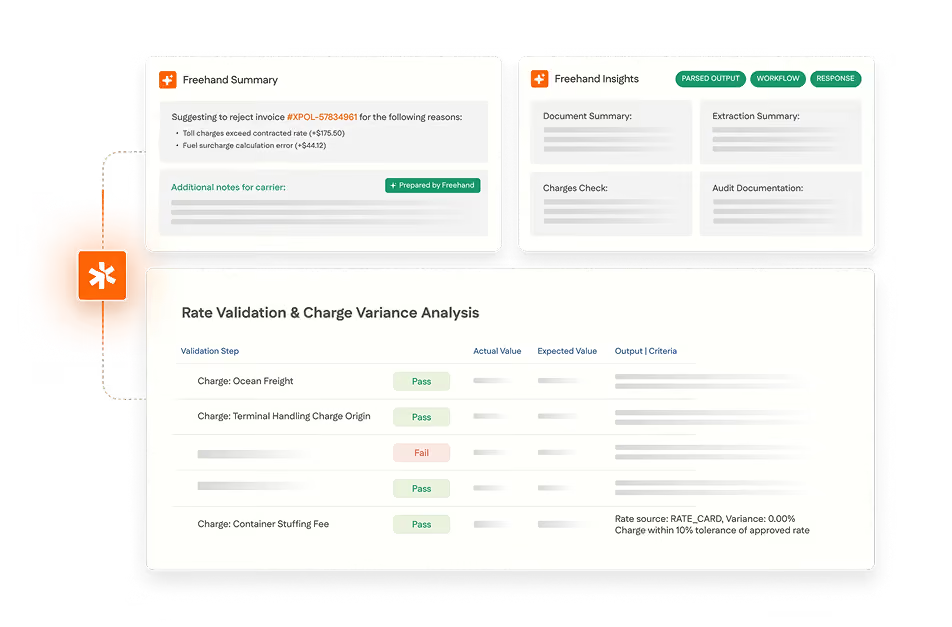
Freehand's invoice audit agent runs this recalculation automatically against every invoice, pulling the correct index for the ship date and comparing it to the contracted base price or band table before the invoice is approved for payment. That's the same logic used across accessorial charge validation generally, applied specifically to the one line item that changes weekly regardless of anything else on the shipment.
What are the benefits of a fuel surcharge?
A fuel surcharge exists to protect both sides of a carrier contract from fuel price volatility.
| For carriers | For shippers |
|---|---|
| A multi-year rate agreement doesn't require pricing in a worst-case fuel scenario upfront, since the surcharge absorbs the swing as it happens | A locked-in linehaul rate isn't inflated to cover fuel risk the carrier might never actually face |
| The rate stays viable even as fuel costs move | Pricing stays tied to the same public index everyone can check, at least in principle |
That transparency only pays off if someone on the shipper's side is actually recalculating the surcharge and comparing it to what's billed, which is the audit problem the rest of this article addresses.
Why is fuel surcharge auditing outsourced?
Fuel surcharge auditing gets outsourced, either to a freight audit BPO or handled through automated software, because verifying it in-house at scale doesn't fit into a standard AP workflow without dedicated tooling. It means pulling a weekly index, matching it to a carrier-specific band table, and recalculating for every invoice. Most in-house AP teams don't have a system built specifically to automate that recalculation, so the choice becomes doing it manually on a sample, or handing verification to a provider that has already built the process.
The tradeoff shippers weigh is coverage against control. A traditional BPO model can check fuel surcharge accuracy across more invoices than a manual sample, but usually on a batch cycle and with resolution timelines set by the provider. Freehand's agentic model checks the calculation on every invoice as it arrives, rather than in a periodic batch, without handing the process fully outside the company's own visibility.
What are the current fuel surcharge trends for shippers?
Three trends are shaping how shippers deal with fuel surcharges right now. First, contract language is getting more specific about which index, base price, and effective date apply, a direct response to disputes over exactly this ambiguity. Second, more shippers are pushing for shorter surcharge reset cycles negotiated in advance (weekly instead of monthly), which reduces lag but also increases how often the number needs checking. Third, surcharge verification is shifting from a periodic, sample-based audit toward continuous, invoice-level checking, since the volume and frequency of surcharge changes have made sampling a weaker control than it used to be.
What's the actual cost of not auditing fuel surcharges?
Fuel surcharges typically run 15 to 30% of a linehaul charge depending on mode and current diesel prices, so even a small, systematic error compounds fast at volume. The bigger risk isn't the surcharge itself moving with diesel prices, since that's expected and priced into freight budgets. It's the gap between what the formula says and what actually gets billed, the wrong-index-date and band-boundary errors covered earlier in this article, which show up as freight cost inflation that doesn't trace back to any obvious cause because each individual invoice still looks plausible.
At scale, that gap is a margin problem, not a rounding error. A shipper running thousands of LTL invoices a month absorbs the compounding effect of a one-band, one-week miss across every one of them. Because no single invoice looks wrong, the cumulative impact rarely gets flagged until someone recalculates the full year against the index it should have used.
Combined with the 1.5-2.5% of total freight spend that carrier billing errors represent across all charge types, an AP team processing $30M in annual freight spend without full fuel surcharge verification is plausibly leaving tens of thousands of dollars a year specifically inside this one line item, on top of everything else an audit process would catch.
How can shippers reduce fuel surcharge costs?
Three levers actually move the number: negotiating better contract terms, verifying every invoice against those terms, and monitoring the trends that affect future negotiations.
- Negotiate the base price and band table at signing: A lower base price or a wider, less aggressive band table reduces surcharge exposure for the life of the contract, and it's one of the few surcharge-related terms that's genuinely negotiable.
- Verify every invoice, not a sample: Since surcharge errors don't look anomalous individually, sampling misses most of them. Full-invoice verification is the only approach that catches a systematic one-band miss before it compounds.
- Track index trends to inform the next negotiation: A shipper that knows how often its lanes' diesel index crossed a band boundary over the past year has real leverage to negotiate a band table structured around its actual exposure, not a generic one.
The invoice-level verification step is where Freehand's invoice audit agent applies directly, recalculating the contracted formula against every invoice so the negotiation gains from the first lever don't quietly erode through billing errors the second lever was supposed to catch.
{{brown-cta}}
Fuel surcharges will keep changing every week for as long as diesel prices do. The question isn't whether your carriers are calculating it using a real formula, it's whether that formula, that week's index, and your contract terms actually line up on every invoice, not just the ones that look off. Freehand checks that math on 100% of invoices instead of a sample, catching the one-band, one-week errors that never look large enough on their own to trigger a manual review.
Frequently Asked Questions
What index do carriers use for fuel surcharges?
Most U.S. carrier contracts reference the Department of Energy's Energy Information Administration (EIA) weekly average diesel price, but the base price and surcharge table are negotiated per contract, so the index alone doesn't tell you the correct surcharge.
Is fuel surcharge based on pickup date or delivery date?
Pickup or ship date, in almost all contracts. This matters because a shipment that picks up on a Friday and delivers the following Tuesday could span two different weekly index prints, and the invoice needs to reference the correct one.
Does fuel surcharge apply to accessorial charges too?
Typically no. Fuel surcharge is calculated against the base linehaul or transportation charge, not against accessorials like detention or liftgate, though carrier practices vary and this should be confirmed against your specific contract language.
Can fuel surcharge be negotiated?
Yes. The base price, band table, and MPG assumption behind the formula are all negotiable contract terms, not fixed inputs.
The Index Recalculated on Every Invoice, Not a Sample.
Freehand's invoice audit agent pulls the correct index for the ship date and checks it against your contracted base price or band table before the invoice is approved.
The Invoice Shows a Total. It Doesn't Show Its Work.
Verifying a fuel surcharge means pulling the same index the carrier used, for the same week, and running the same formula, something most AP teams do on a sample, not every invoice.
Every warehouse. Every provider. Every mile.
Gartner's 2026 outlook on logistics outsourcing, and how AI Teams hold every contract to the terms you agreed.
- Where outsourced logistics quietly loses margin
- Why billed charges drift from the contract
- How AI Teams close the gap