
How to Recover Freight Overcharges and Prevent Errors
Learn how to recover freight overcharges: file a winning carrier dispute, track claim deadlines, and prevent the billing errors from happening again and again.
.webp)
August 4, 2026
•
16
mins
Recovering a freight overcharge means disputing the line item with your carrier in writing. Back it with the rate confirmation and shipment documents, then track the claim to a deadline. Preventing the next one means fixing the upstream process that let the error happen. Together, the two close a loop that a one-time audit alone does not.
Key Takeaways
- A freight overcharge dispute is a formal written claim to a carrier. It names a specific billing error, cites the contract term that was broken, and asks for a credit or refund.
- Billing errors almost always favor the carrier. Industry patterns put 3 to 8% of freight spend at risk of overcharge before a recovery program catches it.
- Carrier disputes run on a clock. Miss a carrier's short deadline, or the longer statutory window, and the claim is gone for good.
- Rate misapplication, missing discounts, and duplicate invoices are recoverable after the fact. Weight, dimension, and accessorial errors are usually preventable before the invoice is even cut.
- Freehand's Claims Recovery Agent files the claim, tracks the deadline, and confirms the credit actually lands. Manual audit programs handle this on a person-by-person escalation ladder instead.
Why do freight billing errors happen, and why do they favor the carrier?
Freight billing errors happen because rate structures are complex and freight data lives across systems that do not talk to each other. They favor the carrier because the carrier controls the invoice, and an error nobody catches simply gets paid.
Three things drive most of the volume:
- Rate complexity. Contracts carry lane-specific pricing, tiered discounts, and fuel surcharge formulas that shift monthly, and a manual reviewer cannot hold all of it in their head across thousands of invoices.
- Fragmented systems. The contract lives in one system, the shipment record in a TMS, and the invoice in a third. Nothing forces the three to reconcile automatically.
- Manual review limits. A team checking invoices by hand can review a sample, not the volume an enterprise shipper actually generates. Everything outside that sample gets paid on trust.
For an enterprise shipper running $50M in freight across parcel, LTL, and truckload, an unrecovered overcharge rate of 3 to 8% is $1.5M to $4M a year, money that already left the building as an approved payment. That number compounds every year the recovery program does not exist. The pattern also looks different by mode: parcel errors cluster in dimensional weight and address-correction fees, while LTL and truckload errors cluster in reweighs, reclasses, and accessorials.
A complete program addresses both. Auditing alone only catches the first family.
The rest of this guide covers both halves: how to win the dispute on an error that already happened, and how to stop the same error from recurring.
How do you recover a freight overcharge?
You recover a freight overcharge by building a documented claim, filing it inside the carrier's deadline, and escalating on a fixed schedule if they go quiet. Recovery is not just about invoices you catch going forward. A post-audit of invoices already paid, over the last several months, often turns up the same overcharge pattern across carriers, sitting there until someone looks. The steps below are the sequence that gets disputes resolved instead of ignored.
Step 1: Confirm the error and calculate the exact amount
Identify the specific line item in dispute and calculate the correct charge against your contracted rate, not an estimate. A dispute for "this seems too high" gets deprioritized. A dispute for "$412.18 over the contracted rate on invoice 88214" gets processed.
Step 2: Assemble the documentation
Pull the rate confirmation or contract page that governs the charge, the bill of lading, proof of delivery, and the disputed invoice itself. Accessorial disputes additionally need delivery receipts or driver notes showing whether the service actually occurred.
Step 3: Submit the dispute in writing with a response deadline
Send the claim through the carrier's dispute portal if they run one, or to their billing department in writing if not, with the invoice number, the line item, the contracted term, the dollar amount, and your supporting documents attached. Set a clear response deadline, typically 5 business days, so the clock starts on your terms, not theirs.
Step 4: Escalate on a fixed schedule if there is no response
If the carrier does not respond, follow up referencing the original dispute and copy the billing supervisor or account manager. If that also goes unanswered, call directly and offer to walk through the documentation. Each step should have a hard date attached, not an open-ended wait.
Step 5: Short-pay the disputed amount if needed
Pay the undisputed portion of the invoice on time and withhold only the disputed amount, with a written explanation attached. This keeps the carrier relationship current on the parts that are not in question while the dispute resolves.
Step 6: Track the claim to resolution and log the outcome
Record the invoice, the dispute date, the amount, the carrier's response, and the final recovery in one place. That log is what turns individual disputes into a pattern you can act on, and it is the record you need if a claim has to escalate further.
{{blue-cta}}
What documentation do you need to win a freight billing dispute?
You need documentation that proves the correct charge, not just documentation that the shipment happened. The table below maps the dispute type to what actually wins it.
A dispute missing any of this usually gets denied on the first pass. The claim itself may well be correct, but the carrier has no obligation to investigate an unsupported assertion.
How long do you have to dispute a freight bill?
You generally have a short window set by the carrier's own policy. Often 90 to 180 days, depending on the carrier and mode. A much longer statutory window sits behind it. Under U.S. interstate freight rules, shippers and carriers typically get around 18 months from delivery to file an overcharge claim. But the deadline that actually matters day to day is the carrier's shorter one.
Miss the carrier's short window, and recovery gets harder and slower, though the claim can sometimes still move forward. Miss the statutory window, and it is dead. Either way, the lesson is the same: track every dispute against a date, and file inside the shortest deadline that applies.
How do you prevent freight billing errors before they happen?
You prevent freight billing errors by fixing where the error starts, not just catching it later on the invoice. Recovery gets your money back after the fact. Prevention stops that same error from becoming next month's dispute.
Manual dispute management vs automated recovery: which prevents more errors?
Manual dispute management catches the errors a person has time to chase, and stops there. Freehand's AI Teams work every flagged variance the same way, build and file the dispute packet, track it to the deadline, and feed the pattern back into prevention automatically, which is the step that actually reduces next month's error volume.
The gap that matters most is the last row. A $40 detention overcharge is not worth a person's time to dispute by hand. Freehand resolves that exception the same way it resolves a $4,000 one, and a thousand $40 errors is real money.
What does good overcharge recovery and error prevention look like?
Good recovery and prevention mean a shrinking error rate, not just a bigger recovery total. If your recovered dollars stay flat while errors also stay flat, you are catching the same mistakes every month instead of fixing them. Track these four metrics to see the difference.
A leading home appliance manufacturer ran 131,000 freight loads a year. Detention charges sat entirely outside its audit flow, matched by hand against yard timestamp data. Invoices under a set dollar threshold got auto-approved with no line-item review at all. Carriers billed accordingly. The company then moved to consistent, line-item auditing across every invoice, no matter the dollar size. It recovered $6M in annual freight spend, and brought detention charges across all of its carriers into one consistently audited flow.
Stop writing off the disputes too small to chase
Every overcharge you do not dispute becomes the carrier's new baseline for next month's invoice. Manual dispute management catches the large claims a person has time for, and writes off the rest. The errors behind those small claims never get fixed at the source.
Freehand's AI Teams file every dispute, track every deadline against the carrier's window and the statutory one, and feed the error pattern back into the controls that stop it from happening again. You recover the claims too small to chase by hand, and close the loop that turns recovery into fewer disputes next quarter. It is working-capital recovery finance leaders can see reflected directly in freight spend.
{{brown-cta}}
Frequently Asked Questions
How do you recover a freight overcharge?
File a written dispute with the carrier's billing team. Name the line item, the contracted rate, and the dollar amount, backed by the rate confirmation and shipment documents. Set a response deadline, escalate on a fixed schedule if unanswered, and short-pay the disputed amount if the invoice is due first.
What is the most common freight billing error?
Rate misapplication, billing above the contracted rate, is the most common error, and usually the biggest one in dollars. Unauthorized accessorial charges come close behind, and they are the easiest to win with delivery documentation.
How long do you have to dispute a freight bill?
Carriers usually set their own deadline, often 90 to 180 days depending on the carrier and mode. A longer statutory window, around 18 months, sits behind that. File inside the carrier's shorter deadline whenever you can. That is the one that decides how easily the claim gets resolved.
Can you dispute a freight charge after you already paid it?
Yes. Post-payment disputes move slower and tie up cash longer than a pre-payment hold, but the claim is still valid inside the deadline. Short-paying before payment is faster when the invoice has not gone out yet.
How do you prevent freight billing errors instead of just catching them?
Fix the source: calibrate scales, require signed proof for accessorials, verify freight class before tender, and check contract rates against billed rates on a set schedule. Auditing every invoice catches what slips through. Prevention shrinks the error rate over time.
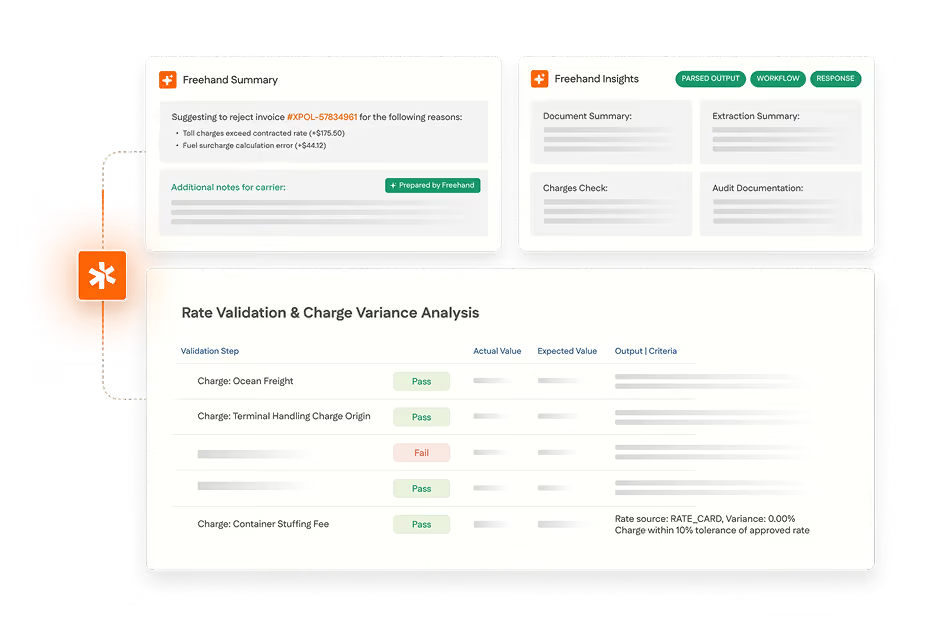
Every Invoice Checked. Every Charge Verified.
Freehand reads each carrier invoice against your contracted rates and flags the variance before you pay it. No sampling, no backlog.
You're Auditing a Sample. The Errors Live in the Rest.
Most teams spot-check 15 to 30% of freight invoices. Overcharges hide in the 70% no one opens.
Every warehouse. Every provider. Every mile.
Gartner's 2026 outlook on logistics outsourcing, and how AI Teams hold every contract to the terms you agreed.
- Where outsourced logistics quietly loses margin
- Why billed charges drift from the contract
- How AI Teams close the gap