

How to Dispute a Freight Overcharge: Full Guide
Learn how to dispute a freight overcharge: what the dispute needs to say, the escalation ladder, and when to go legal if the carrier stalls or stays silent.
.webp)
August 6, 2026
•
10
mins

Disputing a freight overcharge means sending the carrier a specific, evidence-backed claim, not a general complaint. Name the invoice, the line item, and the correct amount. Attach proof. Then follow a fixed schedule instead of waiting on a reply that may never come. This guide covers the dispute itself. For the broader process of catching the overcharge in the first place, see that guide instead.
Key Takeaways
- A freight overcharge dispute names the invoice number, the exact line item, and the amount your contract actually supports. It comes with documentation attached, not a vague objection.
- You have 180 days under federal law (49 U.S.C. § 13710) to formally contest a freight bill. Miss that window, and the right to dispute it can disappear.
- A carrier that disagrees needs a different response than one that goes silent. Treat them the same, and you weaken your position on one of the two.
- If a carrier still will not resolve a valid claim, you have options: a demand letter, a bond claim against a broker's authority, small claims court, or arbitration if your contract requires it.
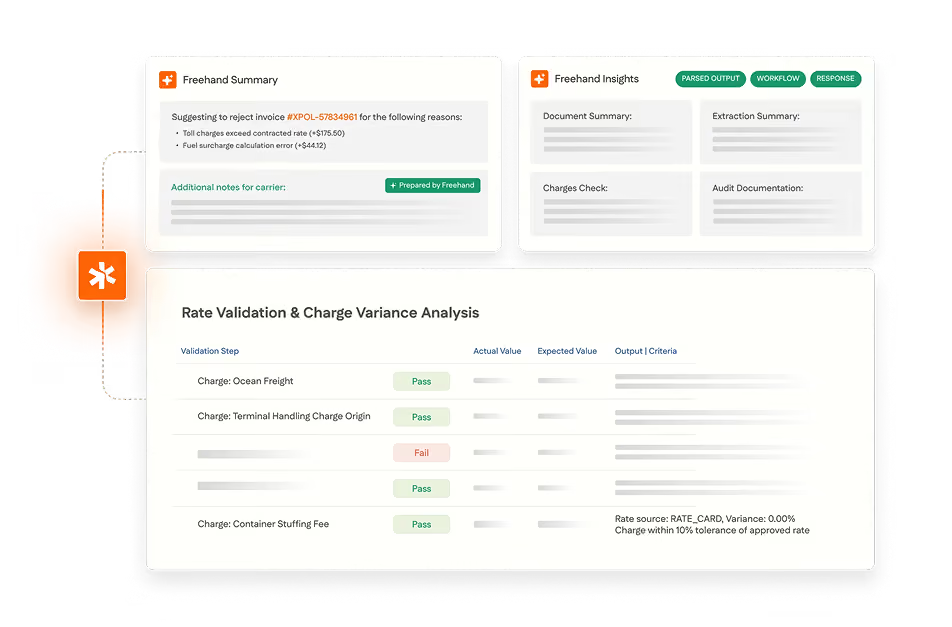
- Freehand's Dispute Management Agent builds and files this packet automatically. A Fortune 15 pharmaceutical distributor caught and resolved $600K a month in discrepancies before they ever reached AP, cutting dispute resolution time from months to weeks.
What do you actually put in a freight overcharge dispute?
A dispute needs four things: the invoice number, the specific line item, the amount your contract or rate confirmation supports, and the documents that prove it. Anything vaguer than that reads as a complaint, not a claim.
Name the exact charge type: a detention fee, a fuel surcharge, an accessorial billed at the wrong rate, a rate that does not match the contract. State the dollar difference between what was billed and what should have been billed. Attach the rate confirmation, the bill of lading, and the proof of delivery, whichever apply to that specific charge.
A dispute this specific gets processed. A general "this invoice looks high" does not, because the carrier has nothing to check it against.
How long do you have to dispute a freight overcharge?
You generally have 180 days from the invoice date to formally contest a freight bill under federal law, specifically 49 U.S.C. § 13710. That is shorter than the broader statute of limitations for filing a lawsuit over the same charge, which can run close to 18 months.
Treat the 180-day window as the deadline that actually matters day to day. It is the one that determines whether your dispute gets a hearing at all, regardless of how strong your evidence is. Internally, aim to flag any discrepancy within 3 to 5 business days of receiving the invoice, so you are never racing that federal clock.
{{blue-cta}}What does the escalation ladder look like when a carrier goes silent?
The escalation ladder is a fixed schedule of contact, not an open-ended wait. Each stage has a deadline attached, so the dispute keeps moving even if the carrier does not respond.
Step 1: Send the dispute with a 5-business-day response deadline
Send the claim to the carrier's billing department with the invoice number, the line item, the amount, and your evidence attached. State a specific date by which you expect a response.
Step 2: Follow up in writing if day 5 passes with no response
Reference the original dispute and resend it, copying the carrier's billing supervisor or account manager if you have one. Silence at this stage is common and does not mean the claim is weak.
Step 3: Call directly by day 10 to 15
Reference the emails, the dollar amount, and the invoice number, and offer to walk through the documentation on the phone. A live conversation often moves a stalled dispute faster than another email.
Step 4: Short-pay the disputed amount by day 16 if there is still no response
Pay the undisputed portion of the invoice on time, and withhold only the disputed line with a written explanation attached. This keeps the relationship current on everything that is not in question.
What do you do when the carrier disagrees instead of going silent?
A carrier that disagrees is telling you something. It thinks your evidence does not back your claim. The escalation ladder will not fix that. Read their response first.
Say their counter-evidence is real: a signed delivery receipt showing a service you thought was never requested. Reassess the dispute instead of pushing it forward out of principle. Say their counter is weak or has no proof behind it. Point out that exact gap and hold your ground. Escalating a claim you never actually reassessed just burns the same 180-day window you are trying to protect.
When do you take a freight dispute past the carrier and go legal?
You go legal when a valid, well-documented claim has gone through the full escalation ladder with no result, and the dollar amount justifies the next step. Four paths exist beyond the carrier relationship itself.
- Attorney demand letter. A letter from a lawyer carries more weight than a routine email, especially when it names the specific legal remedy you are entitled to.
- Bond claim. This works against a broker specifically, filed against the broker's operating authority under FMCSA rules. It can succeed even when the broker itself stays silent.
- Small claims court. A real option for disputes under roughly $20,000 in many states, and far cheaper than full litigation.
- Arbitration. This applies only if your contract has a mandatory arbitration clause. When it does, arbitration usually replaces a lawsuit rather than running alongside one.
How do you dispute an overcharge without wrecking the carrier relationship?
You protect the relationship by disputing the charge, not the carrier's competence. Keep every message specific and factual. A dispute is a normal part of freight billing. It is not an accusation.
Route every dispute through the same contact each time. That builds a relationship instead of resetting one with each new claim. Keep the language plain: name the discrepancy, state the amount, attach the proof. A carrier that sees a consistent, well-documented process treats your account differently than one that sends vague complaints and hopes for a discount.
A dispute is only as strong as its deadline
A well-documented claim that misses the 180-day window is no longer a dispute. It is a write-off. The evidence stops mattering the moment the clock runs out.
Freehand's AI Teams build the dispute packet, file it, and track every deadline the moment an overcharge is confirmed, not after someone gets around to it. The escalation ladder runs on schedule, every time, across every carrier, so the claims that used to stall in an inbox get resolved instead.
{{brown-cta}}
Frequently Asked Questions
How do you dispute a freight overcharge?
Send the carrier the invoice number, the specific line item, the correct amount, and your supporting documents. Set a response deadline, follow a fixed escalation schedule if there is no reply, and short-pay the disputed line while the rest of the invoice moves on schedule.
How long do you have to dispute a freight bill?
You have 180 days from the invoice date to formally contest it under 49 U.S.C. § 13710. A broader statute of limitations for a lawsuit can run closer to 18 months, but the 180-day window is the one that determines whether your dispute even gets heard.
What do you do if the carrier ignores your dispute completely?
Follow the escalation ladder: a written follow-up by day 5 to 10, a phone call by day 10 to 15, and a short-pay of the disputed line by day 16 if there is still no response. Silence does not mean your claim is invalid.
Can you take a freight dispute to small claims court?
Yes, for disputes under roughly $20,000 in many states, small claims court is a real option without the cost of full litigation. Larger disputes or ones involving a broker specifically may call for a bond claim or an attorney demand letter instead.
What is the difference between disputing a broker and disputing a carrier?
A dispute with a broker can include a bond claim against the broker's operating authority under FMCSA rules, which does not apply to a direct carrier relationship. Otherwise the dispute mechanics, evidence, and escalation ladder are the same for both.
The Packet Built and Filed the Moment an Overcharge Is Confirmed.
Freehand's AI Teams build the dispute, track every deadline, and run the escalation ladder on schedule, across every carrier.
A Vague Dispute Reads Like a Complaint. Only a Specific One Gets Processed.
The invoice number, the line item, the amount your contract supports: miss one and the carrier has nothing to check it against.
Every warehouse. Every provider. Every mile.
Gartner's 2026 outlook on logistics outsourcing, and how AI Teams hold every contract to the terms you agreed.
- Where outsourced logistics quietly loses margin
- Why billed charges drift from the contract
- How AI Teams close the gap