
Invoice Reconciliation: What It Is, and What Freight Adds
Invoice reconciliation checks a bill against what was ordered and received. See how it works, and the extra layer freight invoices require.
.webp)
August 28, 2026
•
11
mins

Invoice reconciliation is the process of checking that an invoice matches the records it should agree with, typically a purchase order and a receipt of goods, before it's approved for payment. Standard reconciliation checks the invoice against what was ordered and received. Freight invoices need a fourth check: whether the billed rate matches what the carrier actually contracted to charge.
Key Takeaways
- Invoice reconciliation is the process of verifying an invoice matches the records it should agree with before it's approved for payment.
- The standard version is two-way matching (invoice against PO) or three-way matching (invoice against PO and goods receipt), depending on what the business tracks.
- Reconciliation exists to catch discrepancies before money moves: wrong quantities, wrong prices, duplicate invoices, or charges that were never authorized.
- Freight invoices carry no PO in the way supplier invoices do, so standard reconciliation logic has nothing reliable to check them against.
- Freight invoice reconciliation needs a fourth layer, the contracted rate for that lane, mode, and billing date, which is what Freehand adds to the process.
What is invoice reconciliation?
Invoice reconciliation is the process of comparing an invoice against the records it should agree with, confirming the charges are accurate before the invoice is approved for payment.
For a standard vendor invoice, that means checking it against the purchase order, and often the goods receipt note, for matching quantities, prices, and terms.
The mechanism is a comparison, not a calculation: the invoice states what the vendor is charging; the PO and receipt state what was agreed and what actually arrived. Reconciliation confirms those three documents tell the same story before payment clears.
In business terms, reconciliation exists to answer one question before money leaves the company: does this invoice reflect a real, authorized, correctly-priced transaction. Skipping it means paying whatever an invoice says, whether or not it's accurate.
How does invoice reconciliation actually work?
Reconciliation runs as invoice matching: line items on the invoice are checked against the corresponding line items on the PO and, if applicable, the goods receipt.
Quantities have to match. Unit prices have to match, or fall within a configured tolerance. Terms (payment timing, discounts) have to align with what was contracted.
Anything that matches clears automatically or with minimal review. Anything that doesn't, a quantity mismatch, a price variance outside tolerance, a duplicate invoice number, gets flagged as an exception and routed for manual investigation before it can be approved.
Worked example
A supplier invoice bills for 500 units at $12 each, totaling $6,000. The PO authorized 500 units at $12 each. The goods receipt confirms 500 units were delivered. All three documents agree, so the invoice reconciles cleanly and clears for payment. If the goods receipt had instead logged only 480 units delivered, the quantity mismatch would flag the invoice as an exception, holding payment until the discrepancy is resolved, either a corrected invoice or confirmation the missing 20 units are still in transit.
{{blue-cta}}What are the types of invoice reconciliation?
Reconciliation typically runs as two-way or three-way matching, depending on how much of the transaction the business tracks.
| Type | What it checks | Best fit |
|---|---|---|
| Two-way matching | Invoice against the purchase order only | Services or goods where a separate receipt record isn't practical |
| Three-way matching | Invoice against the PO and the goods receipt note | Physical goods, where confirming actual delivery matters |
| Four-way matching (freight-specific) | Invoice against the PO or contract, the receipt or shipment record, and the contracted rate | Freight and carrier invoices, where standard PO matching alone can't validate what should have been billed |
The mechanics of setting up matching for freight invoices specifically are covered in more depth in our guide to 4-way matching for freight invoices.
Why does reconciliation matter for a business?
Reconciliation is the control that catches billing errors before they become cash that's already left the company.
Once an invoice is paid, recovering an error means disputing a completed transaction, a slower and less certain process than catching it before payment. Reconciliation is what stands between an invoice arriving and money actually moving.
It also produces a byproduct most businesses underuse: a documented record of what was actually billed versus what was actually agreed, across every vendor and every transaction. That record is what a spend analysis or an audit trail is built from later.
What are the common challenges in invoice reconciliation?
Most reconciliation problems trace back to missing or late documents, not to the matching logic itself.
- Missing or delayed purchase orders. An invoice with no PO on file has nothing to reconcile against, regardless of how accurate the invoice actually is.
- Late goods receipts. If the receiving team logs deliveries in batches rather than at the point of delivery, invoices queue waiting for a receipt record that hasn't been entered yet.
- Inconsistent vendor invoice formats. Invoices that don't extract cleanly into structured data slow down the comparison step, whether that step is manual or automated.
- Duplicate invoices. The same invoice submitted twice, under a different number or date, can clear reconciliation if the duplicate check isn't matching on enough fields.
- Tolerance thresholds set incorrectly. Too tight, and routine, immaterial variances flood the exception queue. Too loose, and real errors clear without being caught.
Why can't freight invoices be reconciled the standard way?
Freight invoices don't carry a purchase order the way supplier invoices do, so two-way or three-way matching has nothing reliable to check them against. A supplier invoice traces back to a requisition and a PO with a fixed price. A carrier invoice traces back to a shipment and a rate agreement, base rate, fuel surcharge, accessorials, a structurally different document chain that standard reconciliation logic isn't built to read.
Even when a freight invoice is pushed through a reconciliation system built for PO matching, it typically fails to match cleanly, not because anything is wrong with the invoice, but because there's no PO for it to check against. The invoice routes to manual review by default, every time.
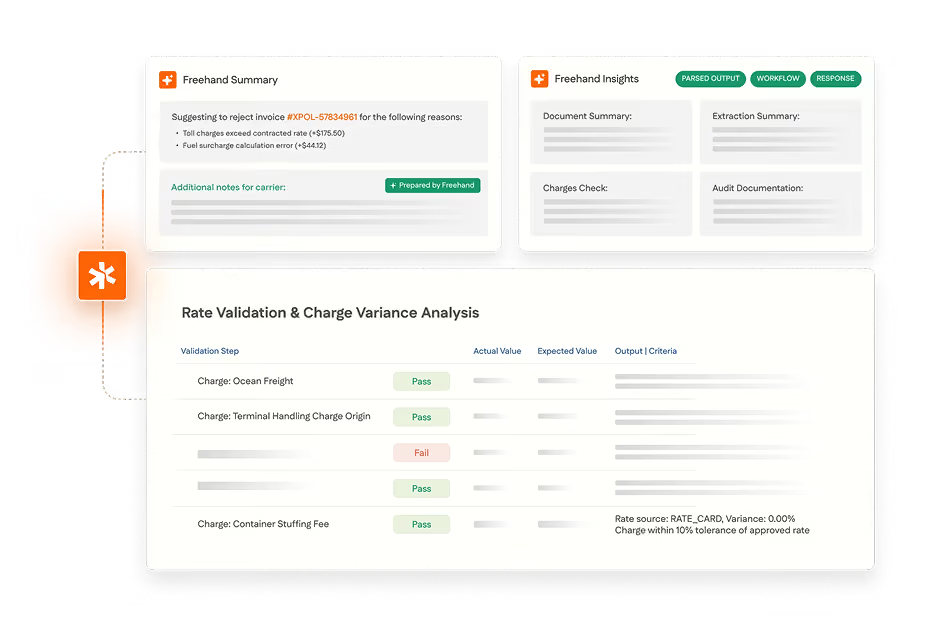
Freehand's invoice audit agent replaces the PO check with the actual authorization chain freight invoices run on: the carrier contract for the rate, the fuel index for the surcharge, and shipment data confirming whether an accessorial charge's trigger, like a detention delay, actually occurred. That gives freight invoices a real match to reconcile against, instead of routing to manual review for lack of one.
What's the 5-step invoice reconciliation process?
A typical reconciliation process runs in five steps: gather the documents, compare line items, flag discrepancies, resolve exceptions, and approve for payment.
Step 1: Gather the invoice and supporting documents
Pull the invoice alongside the PO, contract, or agreement it should match, and the goods receipt or shipment record if one applies.
Step 2: Compare line items
Check quantities, prices, and terms on the invoice against the corresponding figures on the supporting documents.
Step 3: Flag discrepancies
Anything outside configured tolerance, a price variance, a quantity mismatch, a duplicate invoice number, gets flagged as an exception rather than cleared automatically.
Step 4: Resolve exceptions
Investigate each flagged item: contact the vendor or carrier, confirm the correct figure, and correct the invoice or document the resolution before proceeding.
Step 5: Approve for payment and record it
Once every line item matches or every exception is resolved, the invoice clears for payment. The general ledger updates to reflect the transaction, so the payment and the underlying accounting record move together instead of one lagging the other.
How do you improve your invoice reconciliation process?
Most improvements come from fixing the process upstream of reconciliation, not from reconciliation itself.
- Enforce PO creation before purchasing, not after. An invoice with a PO already on file reconciles immediately. One without it starts every reconciliation cycle behind.
- Require goods receipts at the point of delivery, not in a weekly batch. A receipt logged the day goods arrive is available the moment the invoice needs it; one logged a week later blocks matching for that entire week.
- Set tolerance thresholds by transaction size, not one flat number. A $50 variance on a $500 invoice and a $50 variance on a $50,000 invoice aren't the same signal, and treating them the same either over-flags small invoices or under-flags large ones.
- Automate the matching step for invoice categories with a reliable PO to check against. Manual reconciliation doesn't scale past a sample at real invoice volume; automation does, as long as the underlying data is structured enough to compare.
- Extend the same discipline to invoice categories without a PO, like freight, using contract data instead. A process that automates supplier invoices but still reconciles freight by hand has only solved part of the problem.
Invoice reconciliation only works if there's something reliable to check the invoice against. For most vendor invoices, that's a purchase order. For freight, it's the contract, and most reconciliation processes were never built to read one. Freehand reconciles every freight invoice against the contracted rate, the fuel index, and the shipment record, so freight gets the same reliable match a PO gives a standard invoice.
{{brown-cta}}
Frequently Asked Questions
What is the purpose of invoice reconciliation?
To confirm an invoice reflects a real, authorized, correctly-priced transaction before payment is made. It's the control that catches billing errors while they're still preventable, rather than after money has already moved.
What's the difference between invoice reconciliation and bank reconciliation?
Invoice reconciliation checks a vendor's bill against what was ordered and received. Bank reconciliation checks a company's own bank statement against its internal accounting records. Both confirm records agree, but they compare entirely different documents.
How is freight invoice reconciliation different from standard invoice reconciliation?
Standard reconciliation checks an invoice against a purchase order. Freight invoices generally have no PO to check against, so freight reconciliation instead validates the invoice against the carrier contract, the fuel index, and shipment data, a fourth layer standard reconciliation doesn't require.
Can invoice reconciliation be automated?
Yes, for invoices with a PO to match against. Two-way and three-way matching automate well against structured purchase data. Freight invoices need reconciliation logic built specifically for contract-based validation instead of PO matching to automate the same way.
The Fourth Layer Standard Reconciliation Never Checks.
Freehand reconciles every freight invoice against the contracted rate, not just the shipment record.
A Clean Match Against the PO Doesn't Mean the Rate Was Right.
Freight has no PO to check. Standard reconciliation clears it anyway.
Every warehouse. Every provider. Every mile.
Gartner's 2026 outlook on logistics outsourcing, and how AI Teams hold every contract to the terms you agreed.
- Where outsourced logistics quietly loses margin
- Why billed charges drift from the contract
- How AI Teams close the gap