

Logistics Accounts Receivable: Managing Short-Pays, Disputes, and DSO
.webp)
June 12, 2026
•
15
mins

Logistics billing is the only AR category where a customer's first response to an invoice is often a deduction, not a payment.
A shipper that disputes a weight charge or disagrees with an accessorial doesn't file a formal notice. They pay what they think they owe and note the difference. That pattern compounds across hundreds of accounts and thousands of monthly invoices into a collections workload that standard AR processes weren't designed to absorb.
Key Takeways:
- Logistics AR carries higher dispute and short-pay rates than standard AR because billing is service-contingent. Every invoice line can be contested on whether the service occurred, at what weight, and under what conditions, and resolving each dispute requires operational evidence that isn't in the AR system by default.
- Short-pay is the default resolution mechanism in logistics billing. Customers deduct what they believe they owe without filing a formal notice, creating a classification and contestation workload that arrives as underpayments rather than dispute notifications.
- Pre-send invoice validation catches billing errors before the invoice leaves your system, eliminating disputes at the source. Every error caught pre-send is one fewer short-pay, one fewer collections delay, and one fewer DSO impact downstream.
- Cost-to-serve by customer changes which disputes are worth pursuing. A short-paying customer on a low-margin lane is a different collections priority than the same balance on a high-margin relationship.
What is logistics accounts receivable?
Logistics accounts receivable is revenue owed to a logistics provider (a 3PL, carrier, freight broker, or fulfillment operator) for transportation, warehousing, and related services rendered.
It differs from standard AR in three ways:
- Billing is service-contingent
- Disputes are endemic rather than exceptional
- The evidence required to collect is operational data that rarely lives in the AR system
In standard AR, the invoice references a product the customer agreed to buy at a price set at PO creation. The customer's basis for dispute is narrow: wrong goods, missing quantity, non-delivery.
Logistics AR doesn't work that way. The amount billed depends on facts that are frequently contested:
- The actual shipment weight
- Whether a residential delivery fee was warranted
- Whether the fuel surcharge was calculated at the correct index tier
- Whether the delivery timestamp qualifies for a service failure credit
Each of those facts is verifiable, but the proof is in the TMS, the carrier EDI system, or the warehouse management system, not the AR platform. When those systems aren't connected, disputed invoices age. Aged disputes recover at a fraction of the rate of disputes addressed within 30 days.
What is the freight billing process from invoice to payment?
The freight billing cycle starts at delivery and ends at payment. Invoice generation speed, BOL accuracy, and payment terms each determine how long that cycle runs and how much AR ages in the process.
From shipment completion to invoice generation
The billing cycle begins when a shipment is delivered and the carrier or 3PL has all necessary documentation:
- Signed Proof of Delivery (POD)
- Bill of Lading (BOL)
- Accessorial documentation (detention logs, liftgate confirmation)
- The rate confirmation or contract rate reference
Invoice generation delays are a primary cause of AR aging. Providers that generate invoices within 24 to 48 hours of delivery achieve faster payment cycles. Digital POD capture that feeds directly to billing reduces the document collection step from 2 to 5 days to near-instantaneous.
The difference between a freight bill and a Bill of Lading
The BOL is the contract of carriage: it describes the freight, the parties, the terms, and the agreed service. It is not an invoice.
The freight bill (or carrier invoice) is the payment request, calculated from the BOL terms applied to the contracted rate.
BOL discrepancies are a major source of freight billing disputes. When the freight delivered differs from what the BOL describes, the carrier bills for the actual service, and the customer disputes the difference. A clean BOL, accurate in weight, class, dimensions, commodity description, and delivery requirements, is the single most effective upstream control for reducing AR disputes.
Payment terms and the 30/60/90-day cycle
Standard payment terms in logistics range from net-15 (common in parcel and small carriers) to net-30 (industry standard) to net-45 or net-60 (common for large enterprise customers).
The 30/60/90-day AR aging report tracks outstanding invoices by age bucket:
- 31 to 60 days: typically require a collection touchpoint
- 61 to 90 days: require formal collection action
- Beyond 90 days: significantly higher write-off probability, require escalation to collections or factoring
What is DSO and what are logistics industry benchmarks?
Days Sales Outstanding (DSO) measures the average number of days between invoice date and payment receipt. The formula is: (Accounts Receivable divided by Total Credit Sales) multiplied by Number of Days. Logistics industry DSO benchmarks range from 35 to 55 days.
DSO ranges vary across logistics provider categories:
Key DSO drivers in logistics: invoice accuracy, billing cycle frequency, dispute resolution speed, and customer mix.
Logistics providers that implement automated invoice generation tied to digital POD capture and real-time rate confirmation have reported DSO reductions of 30 to 40% compared to manual billing workflows.
What is freight factoring and how does it affect logistics AR?
Freight factoring converts outstanding invoices to immediate cash by selling them to a third-party factor at a discount. It addresses working capital constraints but not the billing accuracy problems that generate disputes on those same invoices.
The logistics provider receives 85 to 95% of the invoice face value immediately. The factor collects the full invoice amount from the shipper and retains the factoring fee, typically 1 to 5% of invoice value.
Two factoring types:
Recourse factoring
The provider must buy back invoices the factor cannot collect
Non-recourse factoring
The factor absorbs the loss on uncollectible invoices, but at a higher fee
When factoring makes sense
When the cost of capital (the factoring fee) is lower than the cost of the working capital gap it bridges.
When it doesn't
Factoring does not address the underlying billing accuracy problem. Disputes on factored invoices create chargebacks that the carrier must cover from the holdback or from operating cash. A logistics provider with a high invoice dispute rate that factors their receivables will experience higher chargeback rates and reduced factoring advance rates over time.
How do logistics providers manage credit risk in AR?
Logistics credit management starts before the first load moves: evaluating customer creditworthiness, establishing credit limits, and building escalation triggers into the AR process.
Credit evaluation:
They run D&B or credit report checks, review payment history through carrier references, and establish initial credit limits with a 90-day review.
Credit holds
The AR aging report should trigger automatic credit holds at defined thresholds, commonly no new loads tendered to customers with invoices over 45 days past due.
Customer concentration risk
When a single customer represents more than 15 to 20% of total AR, the provider's working capital is exposed to that customer's payment behavior. Factors apply lower advance rates to high-concentration portfolios.
Credit controls that are not enforced before freight moves cannot be enforced after the carrier has already absorbed the cost.
Why does logistics AR carry a higher dispute rate than standard AR?
Logistics AR dispute rates run structurally higher than standard AR because billing is service-contingent, short-pay is the industry's default dispute mechanism, and rate complexity creates legitimate disagreement on nearly every invoice.
Service-contingent billing and proof of delivery requirements
Every logistics invoice line is tied to a service event. Whether each charge is valid depends on whether the underlying event happened as billed, and proof requires operational records that most AR systems don't hold.
Proof of delivery is the clearest example. A shipper disputing a delivery charge wants:
- The delivery scan
- The recipient signature
- The timestamp
If the POD isn't accessible in the AR system, the dispute routes to a research queue, waits for someone to pull the TMS record, and ages while the customer's payment clock runs.
DIM weight and reweigh disputes follow the same pattern. A carrier billing on a corrected weight needs the original weight record, the reweigh documentation, and the contract clause authorizing reweigh billing, three data sources from two or three systems, before the dispute can be contested or credited.
Short-pay culture in logistics billing
In most industries, a customer who disagrees with an invoice opens a formal dispute and pays the undisputed amount while the dispute is pending. In logistics, the dominant pattern is different. Customers pay what they believe they owe and note the deduction, often without any communication beyond the payment amount itself.
Short-pays don't generate automatic alerts in most AR systems. They arrive as underpayments that need to be:
- Identified against open invoices
- Matched to the specific shipment or billing event
- Classified as valid or invalid
- If invalid, contested with evidence before the customer relationship suffers
The dollar distribution compounds the problem. A significant share of short-pay incidents are under $200 each, individually below any reasonable manual review threshold, collectively material. A logistics provider with 500 short-pay incidents per month averaging $150 each is looking at $75,000 per month in contested revenue, most of it invisible in the AR aging report until someone goes looking.
Rate and contract disputes from billing complexity
Logistics pricing structures are complex: zone-based rates, DIM weight calculations, fuel surcharge tiers indexed to weekly publications, accessorial schedules with conditional triggering. Each creates a surface for legitimate disagreement.
A rate dispute requires the same multi-source validation as freight audit: the carrier contract, the applicable rate for the lane and date, the fuel surcharge schedule for the shipment week, and the operational record confirming what actually happened. When the AR team doesn't have all three in one place, disputes stay open while someone tracks down the relevant contract version, rate card, and supporting shipment record.
{{blue-cta}}
What is short-pay management in logistics accounts receivable?
Short-pay management in logistics AR is the process of identifying underpayments against open invoices, classifying each as a valid billing error or an unjustified deduction, and either crediting valid claims quickly or contesting unjustified deductions with evidence before they age into uncollectable write-offs.
Two scenarios, two very different responses:
- Valid claim: A short-pay on a shipment where the billing system applied the wrong DIM weight should be credited quickly, and the billing error should trigger a review of whether the same error exists on other invoices in the same billing run.
- Unjustified deduction: A short-pay where the customer applied their own rate interpretation to a lane contracted at a higher tier requires a contestation packet: the signed contract, the applicable rate for the lane and date, and documentation that the service was delivered as contracted.
The time variable matters significantly. Short-pays classified and responded to within 30 days recover at substantially higher rates than those that age past 60 days. The systems that flag, route, and auto-compile evidence for short-pays are what keep recovery rates above write-off thresholds, not the size of the collections team.
What does pre-send invoice validation catch in logistics billing?
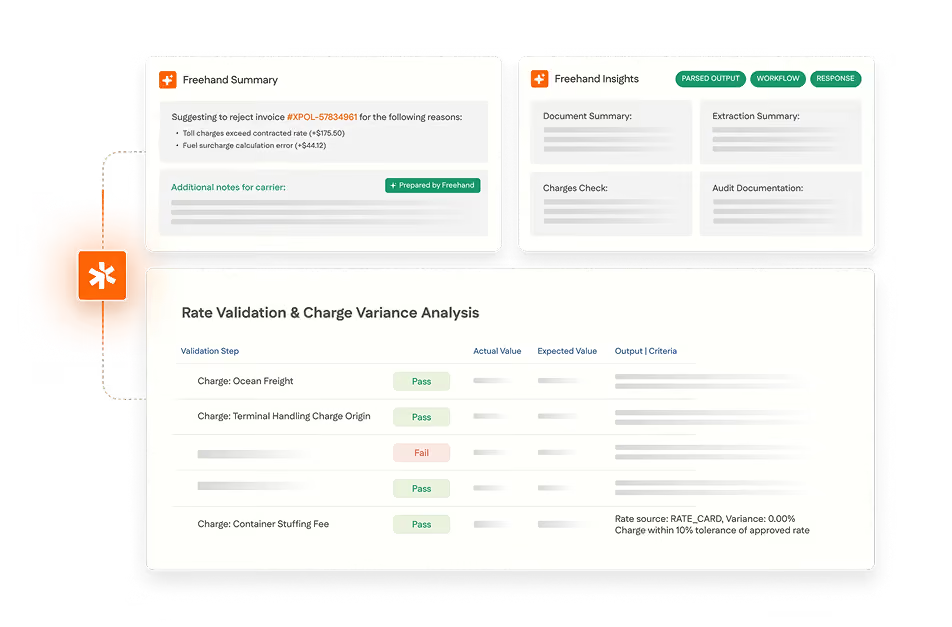
Pre-send invoice validation checks each invoice line against contracted rates and shipment records before it goes to the customer, catching billing errors at the source rather than resolving them as disputes downstream.
Every error caught pre-send eliminates:
- One potential short-pay
- One collections delay
- One DSO impact
The billing errors that generate the most disputes in logistics aren't random. They follow predictable patterns:
- The same fuel surcharge matrix applied one tier too high
- DIM weight calculations that don't account for the customer's contracted billable weight threshold
- Accessorial charges triggered on a shipment type the contract excludes
Pre-send validation compares each invoice line against the contracted rate, the applicable surcharge schedule, and the shipment record before dispatch. Lines that fail the check don't go to the customer until they're corrected.
The metric this drives is clean invoice rate: the percentage of invoices dispatched that come back without a dispute or short-pay.
For a logistics provider at 60% clean invoice rate on 4,000 monthly invoices, moving to 85% through pre-send validation eliminates roughly 1,000 monthly dispute incidents, along with the resolution labor, collections delays, and write-off risk each of those carries.
How does cost-to-serve data change AR prioritization?
Cost-to-serve by customer and lane changes AR prioritization from a balance-and-aging model to a profitability model.
Standard AR prioritization runs on two variables: balance size and aging. That logic makes sense when customers are roughly equally profitable. In logistics, they aren't.
- A shipper moving high-density freight on dense corridors at contracted rates may generate 15 to 18% operating margin
- A shipper moving irregular freight with frequent accessorial disputes and service failure credits on the same lanes may generate 2 to 3%
When a low-margin customer short-pays a $3,000 invoice, aggressive collections may cost more in relationship friction than the amount recovered. When a high-margin customer short-pays the same amount, the same effort has a very different return. Cost-to-serve data is what makes that distinction visible before the collections call.
Cost-to-serve decomposition also identifies customers whose dispute behavior is systematically eroding profitability: customers who short-pay on a significant percentage of invoices, whose claim rates exceed the norm for their lane type, or whose billing complexity generates resolution costs that compress the margin on the relationship.
How do enterprise logistics teams measure AR performance?
Five metrics connect billing quality to collections outcomes.
Your invoices went out. How much is actually coming back?
The gap between invoiced revenue and collected revenue in logistics AR isn't primarily a collections problem. It's a billing quality problem, a data access problem, and a dispute resolution speed problem. All three are upstream of where most AR processes start.
A logistics provider that dispatches invoices without pre-send validation sends disputes along with them. A collections team that can't access POD, rate confirmations, and shipment records when a short-pay arrives can't resolve disputes fast enough to hold recovery rates. A finance team prioritizing collections by balance size rather than customer profitability is working the wrong list.
At typical logistics billing volumes, each of those gaps compounds:
- The clean invoice rate stays below 70%
- The short-pay recovery rate underperforms
- The write-off line grows by the amount that ages past the resolution window
None of it appears as a specific line item in the P&L. It shows as lower-than-billed revenue against a volume that looks fine from the outside.
Freehand's logistics spend platform provides pre-send invoice validation, short-pay classification and contestation, dispute resolution with auto-compiled evidence, and cost-to-serve intelligence by customer and lane, connecting the billing, collections, and commercial data that logistics AR needs to operate as a financial control rather than a perpetual catch-up.
{{brown-cta}}
Frequently Asked Questions
What is logistics accounts receivable?
Revenue owed to a logistics provider for freight, warehousing, and fulfillment services. It differs from standard AR through service-contingent billing, high short-pay rates, and dispute cycles that require operational evidence (proof of delivery, weight records, rate confirmations) to resolve.
Why does logistics AR have a higher dispute rate than standard AR?
Logistics billing is tied to service events customers can contest: delivery weight, accessorial triggers, fuel surcharge tiers, service conditions. Each disputed fact requires operational records to verify, and those records aren't in the AR system by default, lengthening resolution cycles.
What is a short-pay in logistics billing?
A partial payment where the customer pays less than the invoiced amount without filing a formal dispute. In logistics, short-pay is the default mechanism for billing disagreements. Customers deduct what they believe they owe, creating a contestation workload that arrives as underpayments rather than formal dispute notifications.
What is pre-send invoice validation in logistics AR?
Checking each invoice line against contracted rates and shipment records before dispatch. It catches billing errors at the source before they become disputes, short-pays, and DSO impacts. Every error caught pre-send is one fewer collections incident downstream.
What is clean invoice rate in logistics billing?
The percentage of invoices dispatched that are paid in full without dispute or short-pay. The leading indicator for logistics AR performance, measuring billing quality before disputes occur rather than after.
What is DSO in logistics accounts receivable?
Days Sales Outstanding: the average days between invoice date and payment receipt. Logistics DSO benchmarks range from 35 to 55 days. Invoice accuracy and dispute volume are the primary drivers of variance.
What is freight factoring?
The sale of outstanding invoices to a third-party factor at a discount for immediate cash. The provider receives 85 to 95% of invoice value upfront. Factoring solves working capital gaps but doesn't reduce dispute rates or chargeback exposure from inaccurate invoices.
What is an AR aging report in logistics?
Groups outstanding invoices by age: current, 1 to 30 days, 31 to 60 days, 61 to 90 days, and 90-plus days. Drives collection prioritization and credit hold decisions. Invoices beyond 90 days have significantly higher write-off probability.
How does cost-to-serve affect AR prioritization?
Cost-to-serve by customer and lane shows which relationships generate margin. A short-paying customer on a low-margin lane is a different collections priority than the same balance on a high-margin relationship. Prioritizing by profitability ensures collections effort goes where recovery generates the most return.
Full Coverage Starts With Getting the Invoice Right the First Time.
Freehand's AI Teams validate every outbound freight charge against contract and service data, the same rigor AP audit runs on the way in.
A Short-Pay Is Still Just an Unverified Claim.
Every deduction sits in a queue until someone confirms whether the service actually happened as billed.
Every warehouse. Every provider. Every mile.
Gartner's 2026 outlook on logistics outsourcing, and how AI Teams hold every contract to the terms you agreed.
- Where outsourced logistics quietly loses margin
- Why billed charges drift from the contract
- How AI Teams close the gap