
Multimodal Bill of Lading: Why It's Harder to Audit
A multimodal bill of lading covers a shipment across two or more transport modes under one document. Learn how it works and why auditing it is harder.
.webp)
August 24, 2026
•
12
mins

A multimodal bill of lading is a single transport document covering a shipment that moves across two or more modes, ocean, rail, and truck, for example, under one contract of carriage and one responsible party. It simplifies documentation for the shipment itself, but it complicates invoice reconciliation, since the charges and liability behind that one document can still be split across several legs and carriers.
Key Takeaways
- A multimodal bill of lading is a single document covering carriage across two or more transport modes, issued by one multimodal transport operator (MTO) who holds end-to-end liability for the full journey.
- It's distinct from a through bill of lading, which typically covers a single mode (usually ocean) across multiple carriers, with liability passed from one carrier to the next at each handoff.
- Multimodal BOLs operate under a network liability system: the liability rules for whichever mode a loss occurred on apply to that segment, even though one MTO is contractually accountable for the whole shipment.
- Because one document can represent charges across ocean, rail, and drayage legs, verifying that an invoice matches the BOL requires matching each leg's charges separately, not just checking the total.
- A commodity or weight discrepancy on a multimodal BOL is harder to trace to the specific leg it originated on, which is exactly where reconciliation errors hide.
What is a multimodal bill of lading?
A multimodal bill of lading is a transport document issued when a shipment moves under a single contract across at least two different modes of transport, most commonly some combination of ocean, rail, and truck.
One multimodal transport operator (MTO) issues the document and takes contractual responsibility for the entire door-to-door movement, even though the actual carriage is likely performed by several different carriers across different legs.
The mechanism behind it is the network liability system. Rather than one uniform liability rule covering the whole journey, the specific mandatory liability rules for whichever mode the loss or damage occurred on apply to that segment. Ocean-leg damage falls under maritime liability conventions; a truck-leg loss falls under domestic trucking liability rules, even though the shipper's single point of contact and single document is the MTO throughout.
In practical terms, a multimodal BOL exists to simplify documentation and give the shipper one party to hold accountable, without simplifying the underlying liability or billing structure behind it.
What are practical examples of multimodal bill of lading use?
Multimodal BOLs show up wherever a shipment needs more than one mode to get door to door. A cross-border e-commerce shipment moving by ocean from an Asian factory, then by rail and truck to a U.S. distribution center, is a common case. Automotive parts moving by rail from an inland plant to a port, then by ocean to an overseas assembly line, is another. Heavy machinery and project cargo, too large or specialized for a single mode's standard equipment, frequently move under one multimodal BOL across ship, rail, and heavy-haul truck legs.
In each case, the shipper deals with one MTO and one document, regardless of how many actual carriers and equipment types the cargo passes through.
{{blue-cta}}What are the functions of a multimodal bill of lading?
A multimodal bill of lading does three jobs at once, and each one matters for a different reason.
- Receipt: it confirms the MTO actually received the goods described, in the condition described, before the journey started.
- Contract evidence: it's the written record of the carriage agreement, including which liability rules apply if something goes wrong on a given leg.
- Document of title: in many trade-finance transactions, the BOL functions as a negotiable document, meaning whoever holds it controls the right to claim the goods, which is why banks and letters of credit reference it directly.
That third function is why the document-content requirements in the next section aren't optional formatting. A BOL that's missing a required field can fail as a title document even if the shipment itself moves without issue.
What are the stages of a multimodal shipment under one bill of lading?
A multimodal shipment moves through six stages, and the same BOL carries through all of them.
- Booking and BOL issuance: the MTO issues the document once the contract of carriage is agreed, before the goods move.
- Receipt at origin: the MTO or its agent takes physical custody of the cargo and confirms its condition against the BOL description.
- First-mode carriage: the goods move on the first leg, ocean, rail, or truck, to the first interchange point.
- Transshipment or interchange: cargo transfers from one mode to the next, often the point where weight or count discrepancies first get introduced.
- Subsequent-mode carriage: the goods move on the remaining leg or legs to their final destination.
- Delivery and BOL surrender: the consignee takes delivery, and for a negotiable BOL, surrenders a properly endorsed original in exchange for the goods.
Each interchange point in stages 3 through 5 is a place where the underlying charges (and the underlying risk of a discrepancy) attach to a specific leg, even though the BOL itself doesn't change hands until stage 6.
What information must a multimodal bill of lading include?
A valid multimodal transport document has to identify the carrier, confirm the goods were received for shipment, and state where the journey starts and ends. Under the trade-finance rules most letters of credit reference (UCP 600), that means naming the carrier and carrying a signature from the carrier, the master, or a named agent acting for either. It also has to indicate that the goods were dispatched, taken in charge, or shipped on board at a stated place, and name both the place of dispatch and the final destination.
These requirements exist independently of anything an AP team checks. A document can satisfy every trade-finance requirement above and still create the reconciliation problem this article is about, since none of those fields say anything about how charges split across legs.
What conditions determine whether a multimodal bill of lading is valid or negotiable?
Beyond the required fields, three conditions determine how a multimodal BOL can actually be used. A BOL issued "to order" (or to the order of a named consignee) is negotiable, meaning it functions as a transferable document of title. A "straight" BOL naming a fixed consignee is not negotiable, and is typically used once payment terms are already settled and the priority is releasing the goods quickly rather than transferring title.
If the BOL is negotiable, an original, properly endorsed copy has to be surrendered before the goods are released, which is what makes it usable as trade-finance collateral in the first place. Negotiable BOLs also commonly carry a validity period after issuance, often defined in the carrier's own terms, after which the document no longer functions as a document of title even though the underlying carriage obligations may still apply.
What are the advantages and disadvantages of a multimodal bill of lading?
The advantages are real and mostly operational; the disadvantages sit on the AP and claims side.
| Advantages | Disadvantages |
|---|---|
| One document instead of several | Identifying which carrier is actually liable can take real investigation when damage occurs |
| One point of contact instead of coordinating with each leg's carrier separately | Liability depends on which leg the loss happened on, not just which document covers the shipment |
| The MTO bears full responsibility for the journey, regardless of which underlying carrier is actually moving the freight | Underlying carriers' own terms can conflict, and incorporation clauses need a careful read before assuming any one carrier's liability limits apply |
How is a multimodal bill of lading different from a through bill of lading?
The two are often used interchangeably, and they shouldn't be. A through bill of lading typically covers a single mode, most often ocean, moved by multiple carriers in sequence, with liability handed off from one carrier to the next at each interchange point. A multimodal bill of lading specifically requires at least two different modes and keeps one party, the MTO, liable for the full journey regardless of how many carriers actually touch the freight.
The practical difference for AP purposes: a through BOL's liability and billing questions usually point back to whichever carrier held the freight when something went wrong. A multimodal BOL's billing can span multiple invoices from different legs, all technically covered by one master document, which is what makes reconciliation more complex.
Why is auditing an invoice against a multimodal BOL harder?
A single-mode shipment produces one BOL and, usually, one invoice to check it against: same weight, same piece count, same origin and destination on both documents, as covered in our guide to reconciling carrier invoices against a BOL. A multimodal shipment can produce charges from an ocean carrier, a rail carrier, and a drayage provider, all traceable back to one multimodal BOL but billed separately, sometimes by different entities and on different schedules.
Worked example
An MTO issues a multimodal BOL for a shipment moving from an Asian port by ocean, transferring to rail at a U.S. port, then completing final delivery by truck. The ocean leg invoice reflects the full container weight, the rail invoice reflects a partial reweigh at transfer, and the drayage invoice references a different weight still. If the shipment was correctly billed, all three should reconcile against the same underlying cargo description on the multimodal BOL, adjusted only for documented loss or partial delivery. A discrepancy on any one leg is easy to miss if each invoice is checked against the master BOL in isolation instead of against each other.
| Reconciliation step | Single-mode BOL | Multimodal BOL |
|---|---|---|
| Number of invoices to match | Usually one | Often multiple, one per leg or carrier |
| Weight/count consistency check | One comparison: invoice vs. BOL | Multiple comparisons: each leg's invoice vs. BOL, and legs vs. each other |
| Liability regime if a discrepancy is found | One rule set applies | Depends which leg the discrepancy traces to |
| Documentation needed to resolve a dispute | BOL and one invoice | BOL plus every leg's invoice and handoff documentation |
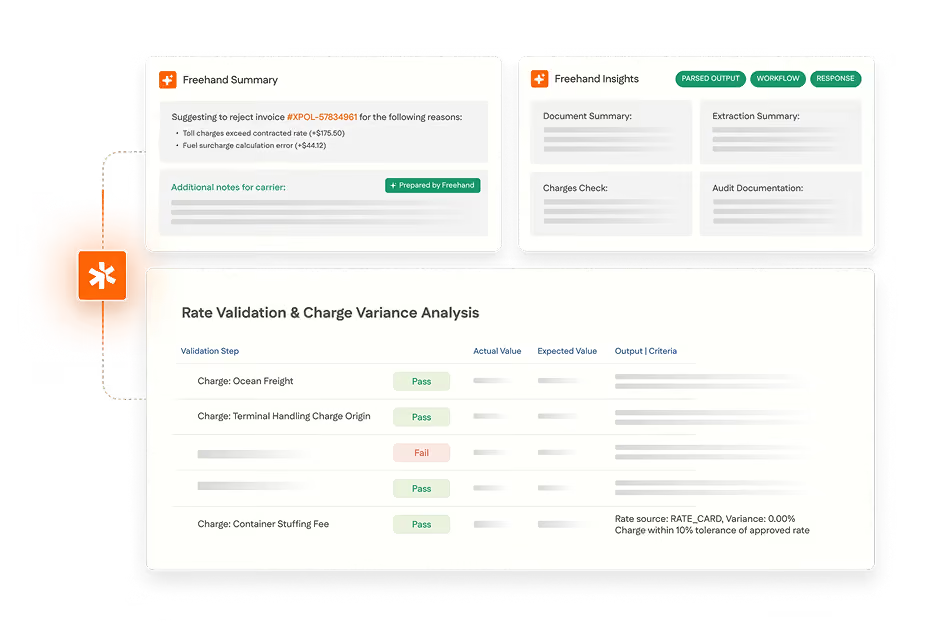
Freehand's invoice audit agent checks each leg's invoice against the multimodal BOL and against the other legs' documentation, so a discrepancy that only shows up when comparing legs against each other doesn't get missed by checking each invoice against the master document alone.
What happens when a discrepancy isn't caught across legs?
When a multimodal shipment's leg-level discrepancy goes unreconciled, the cost shows up in one of two places: an overpayment on whichever leg's invoice was wrong, or an unresolved liability dispute if damage or loss occurred and no one can confirm which leg it happened on. Both outcomes get more expensive the longer they go undetected, since documentation from an earlier leg (weight tickets, handoff records) gets harder to retrieve the further the shipment has moved past that point.
{{brown-cta}}
A multimodal bill of lading simplifies who you're contractually dealing with. It doesn't simplify how many invoices you need to check, or how many places a billing error can hide across legs. Freehand reconciles every leg's invoice against the master BOL and against each other, catching the discrepancies that only appear when the full multimodal picture is checked at once.
Frequently Asked Questions
Does a multimodal bill of lading need to name every carrier involved?
Not necessarily on the face of the document. The MTO is the contracting party of record, though supporting documentation for each leg typically identifies the actual performing carrier.
Who is liable if goods are damaged on a multimodal shipment?
Liability follows the network system: whichever mode's liability rules apply to the leg where the damage occurred govern that claim, even though the MTO remains the shipper's primary point of contact throughout.
Is a multimodal bill of lading required for every shipment using more than one mode?
Not always. Some shippers still use separate, mode-specific bills of lading for each leg rather than a single multimodal document, though a multimodal BOL simplifies documentation when the same MTO arranges the full journey.
Can a multimodal bill of lading cover domestic-only shipments?
Yes, in principle, if the shipment genuinely uses two or more distinct modes, though the term is most commonly associated with international, cross-border movements involving an ocean leg.
Every Leg Audited Against Its Own Contract, Not Just the Total.
Freehand matches each carrier's invoice on a multimodal shipment against its own rate and terms, so a discrepancy on one leg doesn't hide inside the total.
One Bill of Lading. Three Carriers Who Never Compare Notes.
A multimodal BOL covers the whole move, but each leg's invoice still needs matching against its own contract, on its own terms.
Every warehouse. Every provider. Every mile.
Gartner's 2026 outlook on logistics outsourcing, and how AI Teams hold every contract to the terms you agreed.
- Where outsourced logistics quietly loses margin
- Why billed charges drift from the contract
- How AI Teams close the gap