

Supply Chain Spend Management: Reporting vs. Financial Control
.webp)
June 11, 2026
•
10
mins
.webp)
Most enterprises know what their freight spend was last quarter. The number is in the ERP. What is harder to answer is whether any of it should have been lower: whether the carrier billed at the contracted rate, whether the 3PL charged for storage that WMS records would not support, whether the fuel surcharge tier matched the EIA index for that departure week.
That gap between what cleared AP and what the contracts required is not a reporting problem. It is a validation problem. At 1.5 to 2.5% in billing errors, a $40M logistics portfolio carries $600K to $1M per year in costs that appear legitimate on every spend report because no one compared them to the contract before they booked.
Key Takeaways
- Supply chain spend management is the systematic process of tracking, validating, and optimizing total supply chain costs by comparing invoiced amounts against contracted rates, across freight, 3PL, and trade, to recover overbilled amounts and maintain logistics cost control.
- Logistics categories carry the highest billing error rates of any spend category and the thinnest validation infrastructure to catch them. Freight invoices carry no PO reference. 3PL billing requires WMS data AP does not hold. Trade costs arrive as lump-sum entries with no line-item classification detail.
- At 1.5 to 2.5% in billing errors, a $40M logistics portfolio carries $600K to $1M per year in recoverable costs appearing as legitimate freight expense on every spend report.
- Top-performing organizations achieve 80 to 90% spend under management. Most enterprises manage 40 to 60%, with logistics routinely below 50%.
- Freight audit must run before validated spend data enters the ERP. Spend intelligence built on unvalidated AP data amplifies errors rather than reflecting contracted cost.
What Is Supply Chain Spend Management?
Supply chain spend management is the upstream control layer that sits between the invoice and the ERP, checking whether what was billed matches what was contracted before any amount books to the financial record.
In the broad procurement sense, it covers the full source-to-pay cycle: strategic sourcing, supplier management, contract management, purchasing workflows, and invoice validation across every spend category. That is how the major procurement platforms define it, as an enterprise-wide discipline managing all supplier relationships and company purchasing to maximize the value of every dollar spent.
For enterprises with significant logistics spend, that broad definition understates where the financial exposure concentrates. The categories where standard procurement tools fall shortest are:
- Freight invoices that reference no PO and carry rate complexity ERP matching cannot validate
- 3PL billing tied to operational activity that AP cannot verify without WMS data
- Import duties that depend on tariff classification decisions made months before the invoice arrives
These are the categories with the highest billing complexity, the weakest validation coverage, and the largest gap between contracted cost and actual cost. A spend report built on data from these categories shows what cleared AP. Supply chain spend management determines whether what cleared was correct.
What Does Unmanaged Logistics Spend Actually Cost?
At 1.5 to 2.5% of freight spend in billing errors, a $40M logistics portfolio carries $600K to $1M per year in costs that appear on every spend report as legitimate freight expense. None of it requires renegotiating a contract to capture. It requires enforcing the contracts that already exist.
Worked Example: A $40M Freight Portfolio
A North American industrial manufacturer runs $40M per year in freight across FTL, LTL, and parcel. At the industry-average billing error rate, that portfolio carries $600K to $1M in annual overbilling. No line in the ERP marks those amounts as errors. They appear as freight cost.
In the first month after a pre-payment freight audit goes live, the team identifies $87K in fuel surcharge overcharges and accessorials billed without a contract basis, and files disputes before payment runs. Over 12 months, $740K is recovered without renegotiating a single carrier contract.
The recovery concentrates in a predictable set of error types: fuel surcharge tier mismatches, accessorials without a contract basis, and expired rate card application. These errors are systematic. Once the validation layer runs, they surface consistently.
What Are the Types of Supply Chain Spend?
Supply chain spend breaks into three primary categories, each carrying a different billing error profile and requiring a different management structure.
What Is Maverick Spend?
Maverick spend is procurement outside approved supplier agreements. It bypasses negotiated rates and approval workflows, producing higher unit costs and reducing spend visibility. In logistics, this occurs when business units book carriers or 3PL services outside the contracted network, typically during capacity shortfalls.
What Is Tail Spend?
Tail spend is high-volume, low-value procurement. The Pareto principle applies: 80% of supplier relationships typically account for 20% of spend. These transactions are left unmanaged because the per-transaction value does not justify manual oversight. AI classification now makes tail spend management economically viable at scale.
What Is Spend Under Management?
Spend under management (SUM) is the share of total enterprise spend governed through formal procurement and invoice validation. Top-performing organizations reach 80 to 90% SUM. Average enterprises manage 40 to 60%. Logistics spend sits below 50% at most enterprises without a dedicated freight audit and payment layer running before booking.
How Does Supply Chain Spend Management Work?
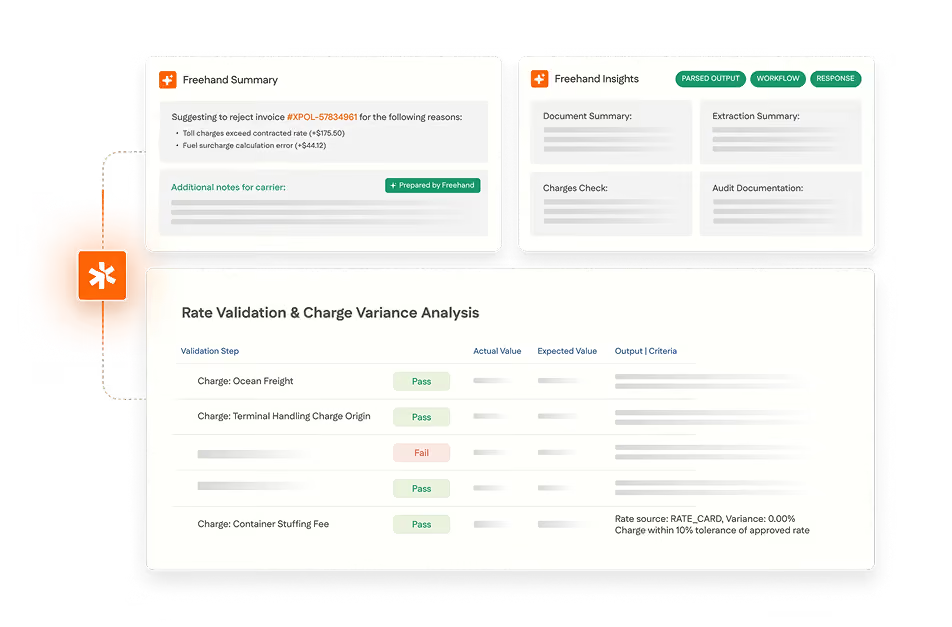
Supply chain spend management runs as a five-step validation sequence: contract data and operational data are checked against the invoice before any amount books to the ERP. Most enterprises skip this sequence. Invoices arrive, AP processes them, amounts book. No step in that workflow checks whether what was paid matched the contracted rate.
The Five-Step Validation Sequence
Step 1: Invoice Arrives
The carrier, 3PL, or trade service provider submits an invoice containing line items: base rate, fuel surcharge, accessorials, and additional fees.
Step 2: Contract Data Is Queried
The validation layer pulls the contracted rate for that lane, date, weight, and service type. The fuel surcharge tier is checked against the departure date. Accessorials are checked for a contract basis.
Step 3: Operational Data Is Matched
TMS shipment records confirm the move happened as described. WMS records confirm pallet counts for 3PL storage fees. Delivery conditions are checked against the accessorials claimed.
Step 4: Variance Is Flagged or Cleared
Lines that match contract and operational data are cleared for payment. Lines that deviate are flagged for dispute before payment runs.
Step 5: Validated Amounts Book to the ERP
Only cleared invoice amounts enter the ERP. Recovered overcharges appear as a separate recoverable line item, not embedded in the freight total.
Why Most ERP Reporting Skips Steps 2 and 3
Standard AP workflows match invoices to purchase orders. Freight invoices have no PO. 3PL billing references operational activity that AP cannot access. Trade costs arrive as lump-sum entries with no classification detail.
Without a dedicated validation layer connecting to TMS, WMS, and contract repositories, steps 2 and 3 do not run. The spend report shows what was paid, and billing errors travel with it into every downstream analysis built on that data.
What Is the Difference Between Spend Reporting and Spend Management?
Spend reporting shows what cleared AP. Spend management validates whether what cleared matched contracted rates and drives corrective action where it does not. The difference is data access: spend reporting connects to the ERP; spend management connects contract and operational data to validate the invoice before it books.
The structural gap compounds over time. A spend report built on unvalidated AP data does not just show what was paid. It sets that figure as the benchmark for sourcing decisions, freight accruals, and network analysis. Billing errors travel into every model built on that data.
What Are the Challenges of Supply Chain Spend Management?
The core challenge is structural: logistics spend validation requires three data sources, and most enterprises have reliable access to only one. The ERP holds financial data. Carrier contract data and WMS operational data live elsewhere. Without both, the comparison between contracted cost and actual cost is impossible.
Freight and Carrier Spend
22% of all invoices contain exceptions requiring manual intervention, per Ardent Partners' 2025 State of ePayables report. In freight, that rate is higher, and errors are harder to detect without contract data connected to the validation layer at the line-item level.
Common errors that pass through undetected:
- Fuel surcharges billed one tier above the contracted formula
- Accessorials applied without a contract basis
- Rate misapplication where an expired rate card drives the invoice
This is particularly acute for retail, FMCG, and food and beverage enterprises running high parcel volumes, where 100% invoice coverage is structurally impossible to achieve manually.
{{blue-cta}}
3PL and Warehousing Spend
3PL billing carries the same structural complexity as carrier billing, with less rigorous validation infrastructure at most enterprises. Specific failure modes include storage fees billed against pallet positions only the 3PL's WMS records can confirm, pick-and-pack charges dependent on order-level pick counts the AP team cannot access, and inbound receiving charges referencing pallet counts from events that happened 30 days prior in a facility the AP team does not manage.
3PL and 4PL audit software structures contract amendments as live rate references so validation always runs against current terms, not outdated ones. Contract amendments add a second failure mode that compounds the first: a renegotiated storage tier or revised accessorial rate, if not updated in the validation layer, means every invoice in the affected period validates against outdated terms.
Trade and Duty Costs
Import duties are frequently booked as lump-sum ERP entries: total duty paid per shipment, with no line-item detail by tariff classification. That structure makes it impossible to identify whether the HS classification was correct, whether a lower-duty classification was available, or whether an FTA qualification would have reduced the rate.
Duty overpayments from HS misclassification appear as duty cost in spend reports, not as errors. The formal protest window is 180 days after liquidation in the U.S. After that, the overpayment is unrecoverable. A trade compliance audit layer identifies misclassification before the protest window closes. This is most consequential for life sciences and pharmaceutical enterprises with complex cross-border material flows.
What Are the Benefits of Supply Chain Spend Management?
Supply chain spend management produces four measurable outcomes: recoverable cost, accurate procurement baselines, reliable freight accruals, and AP workload reduction at scale.
Recoverable Cost That Does Not Appear on Any Report
A global healthcare company reduced invoice cycle time by 80% and achieved 6% combined savings across primary and secondary freight after implementing Freehand's freight audit platform across multimodal pharmaceutical and MedTech operations. The recovery came from enforcing existing contracts, not renegotiating new ones. (Freehand platform data)
Procurement Baselines That Reflect Contracted Cost
A global pharma company achieved its first unified freight spend view across 14 countries, 6 modes, and 3 cold chain providers within 45 days. Freehand's Spend Intelligence Agent surfaced $4.2M in addressable spend that had been misclassified or invisible in prior analysis. (Freehand platform data)
When spend data is validated before it enters the ERP, every procurement decision is built on what the enterprise was contracted to pay, not on baselines inflated by billing errors that distort every RFP savings projection.
Accurate Freight Accruals at Financial Close
Real-time validated freight accruals, including accessorials, give finance teams accurate freight liability at any point in the month. Estimating freight costs from unvalidated AP data at month-end produces accrual gaps that flow directly into P&L accuracy and financial planning.
AP Workload Reduction at Scale
A major US retailer achieved 100% invoice audit coverage across $54M in freight spend, a 60 to 70% reduction in manual workload, and a 93% first-time match rate improvement after implementation. (Freehand platform data)
What Does Good Spend Management Look Like?
Why Does Supply Chain Spend Management Matter Across the Enterprise?
Unvalidated logistics spend data affects procurement baselines, financial close accuracy, and systems integration decisions across the enterprise, not just AP processing. The problem is not contained to one function or one team.
ERP sophistication does not close this gap on its own. An enterprise running SAP with a mature procurement function still carries the logistics spend problem if freight invoices are not validated against carrier contracts at the line-item level before booking.
Gartner forecasts that SCM software with agentic AI capabilities will grow from under $2B in 2025 to $53B by 2030. That growth reflects enterprise investment moving toward execution-layer automation that validates spend before it books, not just reports on what already has.
How Is AI Changing Supply Chain Spend Management?
AI is automating the three most labor-intensive supply chain spend management tasks and expanding the scope of what a lean team can actively manage.
Spend Classification at Tail Spend Scale
AI models classify spend by category, supplier type, and compliance status at volumes no manual process can match. Tail spend categories that were previously unclassified and unmanaged come into view for the first time, making it possible to bring them under formal governance without adding headcount.
Full-Coverage Contract Compliance
AI-assisted invoice validation checks each invoice line against contract terms without the manual lookup that made full-coverage validation impractical at scale. For logistics, this enables 100% audit at carrier portfolio scale. BPO-based audit programs cannot achieve this through sampling alone.
Real-Time Market Benchmarking
AI systems continuously compare contracted supplier prices against current market rates, surfacing renegotiation opportunities between RFP cycles. Procurement teams see which carrier lanes are overpriced relative to current market before the next renewal, not after it passes.
One constraint that does not go away: AI spend tools are only as accurate as the contract data and invoice data they operate on. Fragmented contract repositories, PDF rate cards, and unstructured invoice data remain the primary bottlenecks. Enterprises that resolve the data integration problem first extract the most value from the AI layer built on top of it.
How Does Freehand Close the Supply Chain Spend Management Gap?
Most logistics teams face the same situation: the spend report shows what was paid, but there is no systematic way to know whether it matched what was contracted.
Freehand's spend analytics platform runs the validation layer that most ERP workflows skip: auditing freight invoices, 3PL billing, and trade costs against contracted rates, surfacing variance in real time, and feeding validated actuals into the spend intelligence layer so every downstream decision is built on contracted cost, not AP data that cleared unreviewed.
That $600K to $1M in recoverable costs does not require a contract renegotiation to capture. It requires enforcing the contracts that already exist. Freehand's freight audit and payment software closes the validation gap at the invoice line level, before payment clears.
Freehand was recognized in the 2026 Gartner Market Guide for Freight Audit and Payment. The platform serves industrial manufacturers, FMCG enterprises, retailers, food and beverage operators, healthcare and life sciences companies, oil and gas enterprises, and logistics service providers managing complex multi-carrier, multi-mode freight portfolios.
Request a demo to see how validated supply chain spend management works against your current logistics portfolio.
{{brown-cta}}
Frequently Asked Questions
What is supply chain spend management?
The process of tracking, validating, and optimizing total supply chain costs by comparing invoiced amounts against contracted rates, across freight, 3PL, and trade, to recover overbilling and control logistics cost.
What is the difference between spend reporting and spend management?
Spend reporting shows what cleared AP. Spend management validates what cleared against contracted rates and operational records, then drives corrective action where variance exists. The difference is data access: one connects to the ERP, the other connects to contracts and operations.
What is spend under management?
The share of total enterprise spend governed through formal procurement and invoice validation. Top performers reach 80 to 90%. Most enterprises manage 40 to 60%, with logistics routinely below 50% without a dedicated freight audit layer.
What is maverick spend in supply chain?
Procurement outside approved supplier agreements. In logistics, it appears as spot freight booked outside the contracted carrier network or 3PL charges not covered by a master service agreement. It produces higher unit costs and reduces spend visibility.
How much does unmanaged logistics spend cost?
At 1.5 to 2.5% in billing errors, a $40M freight portfolio carries $600K to $1M per year in recoverable costs before 3PL billing discrepancies and duty overpayments are added. None of it requires contract renegotiation to capture.
What data does logistics spend validation require?
Three layers: operational data from TMS and WMS confirming what happened, contract data establishing what should have been billed, and financial data recording what was paid. Most analytics tools connect only to the financial layer, making the contract comparison structurally impossible.
Why does logistics spend have the highest billing error rate?
Freight invoices carry no PO reference, arrive in multiple formats, and contain charges that require TMS and WMS data to validate. Standard AP matching confirms invoices against purchase orders. Freight and 3PL billing has no PO, so the anchor for comparison does not exist without a dedicated validation layer.
Freehand Validates Spend Before It Becomes a Report.
Freehand's AI Teams check every freight and logistics invoice against contracted rates first, so your supply chain spend numbers reflect reality, not just what cleared.
Your Spend Report Shows What Was Paid. Not What Should Have Been.
A charge that never got compared to the contract still looks completely legitimate on every spend report that includes it.
Every warehouse. Every provider. Every mile.
Gartner's 2026 outlook on logistics outsourcing, and how AI Teams hold every contract to the terms you agreed.
- Where outsourced logistics quietly loses margin
- Why billed charges drift from the contract
- How AI Teams close the gap