
$455 Million in Freight Fraud Last Year. All of It Passed the Audit.

March 18, 2026
•
6
mins

The fraud problem in logistics is not a scale problem. It is an architecture problem.
Truckstop's 2024 Freight Fraud Report puts industry losses above $455 million for the year. CargoNet tracked a 71.6% jump in freight theft incidents in Q4 2023 alone. The Transportation Intermediaries Association found that average gross fraud losses per respondent exceeded $400,000, with some respondents reporting over $1 million. These are the numbers that make it into the press coverage.
What the press coverage consistently underreports is the more important statistic: the proportion of that $455 million that passed through an audit process before the fraud was eventually discovered. The answer, in the documented cases, is close to all of it.
What the documented cases share
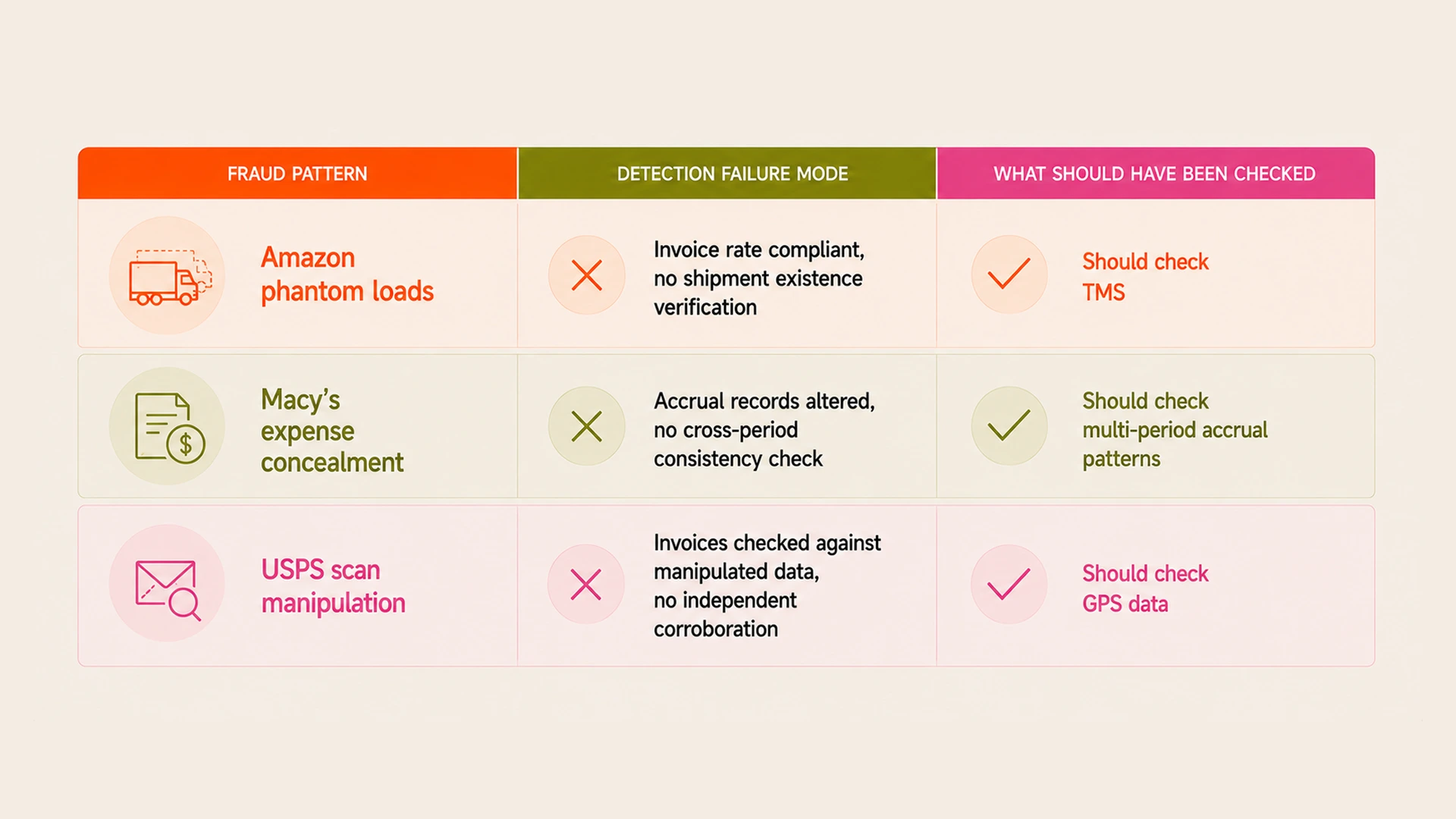
The Amazon case: a Connecticut carrier operator set up multiple trucking companies, billed Amazon for trailer moves that never happened, and collected more than $3.5 million over multiple years. The invoices were plausible. They followed the rate structure. They were billed from carrier entities that existed in Amazon's system. They passed the audit that was supposed to catch billing anomalies.
The Macy's case: an employee concealed $154 million in delivery expenses over nearly three years by manipulating accrual records. The exposure ran through the company's internal financial controls and external audit without detection. It was not discovered by the audit process. It was discovered when someone noticed an inconsistency in financial reporting.
The USPS case: Air Cargo Carriers manipulated electronic scan data to avoid late-delivery penalties. The manipulation affected the performance data used to calculate carrier compensation. The invoices that followed were correct relative to the manipulated performance data. The audit checked the invoices against the performance data. Both were wrong in the same direction.
Why standard audit is structurally blind to these patterns
The architectural reason standard freight audit misses fraud is that it was designed to validate documents against other documents. Invoice against rate card. Invoice against PO. Invoice against shipment reference. Document validation is a necessary condition for accurate billing. It is not sufficient for fraud detection.
Fraud in freight billing operates at the level above document validity. The documents themselves are often correct. The phantom load has a correct invoice. The manipulated scan data produces a correct performance record. The concealed expense passes through because the accrual records were altered at the source. Detecting these patterns requires reading across documents and asking whether the combination makes sense given what the operational data says actually happened.
“Fraud does not fail invoice matching. It fails cross-system coherence checks. Most audit systems do not run coherence checks.”
The cross-system coherence check
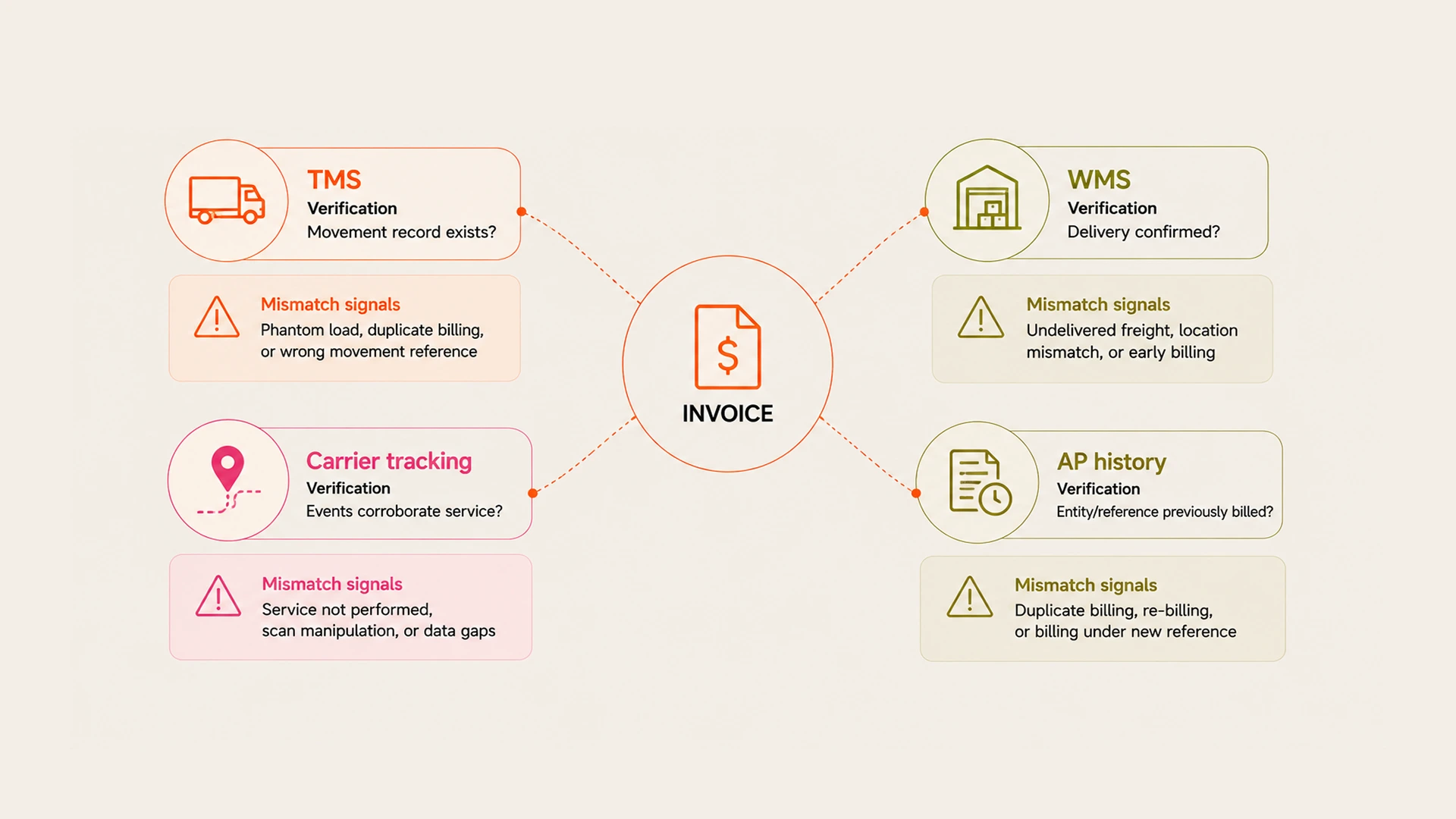
Cross-system coherence checking means asking, for each invoice, whether the event being billed can be verified against an independent operational record. A trailer move should appear in the TMS as a dispatched and completed movement. A delivery should appear in the WMS as a received shipment. A performance penalty should be based on scan data that can be independently verified against GPS or carrier portal records.
This requires connecting the audit system to operational data sources that are not typically in scope for freight audit: the TMS, the WMS, the carrier tracking system. The integration work is non-trivial. But the alternative, running an audit that validates billing documents against billing documents and misses the category of fraud that operates at the operational record level, is demonstrably insufficient.
The $455 million in documented fraud is the reported number. The structural gap that allows it is present in every enterprise that runs audit against documents rather than against the operational record. The question is not whether the gap exists. It is how long it remains acceptable.