
Agentic AI Adoption Is at 35%. The Advantage Window Is Closing.

April 20, 2026
•
7
mins

Early mover advantage in technology is not about being first. It is about being first to get the infrastructure right.
MIT Sloan Management Review's 2025 AI survey put enterprise agentic AI adoption at 35%, with 44% of organizations planning deployment within the next 12 months. McKinsey found that 62% of companies are experimenting with AI in supply chain operations. These numbers are past the early adopter phase and into the early majority. The advantage window for organizations that build the right infrastructure now is real but not permanent.
Early mover advantage in enterprise technology works differently from how it is often described. It is not primarily about having the technology before competitors. It is about accumulating the data assets, the institutional learning, and the decision trace infrastructure that makes AI more capable over time. An organization that has been running autonomous freight audit for two years has two years of decision patterns, exception resolution history, and carrier billing data that trains the model continuously. An organization that starts the same deployment today starts from zero.
What the 35% actually represents
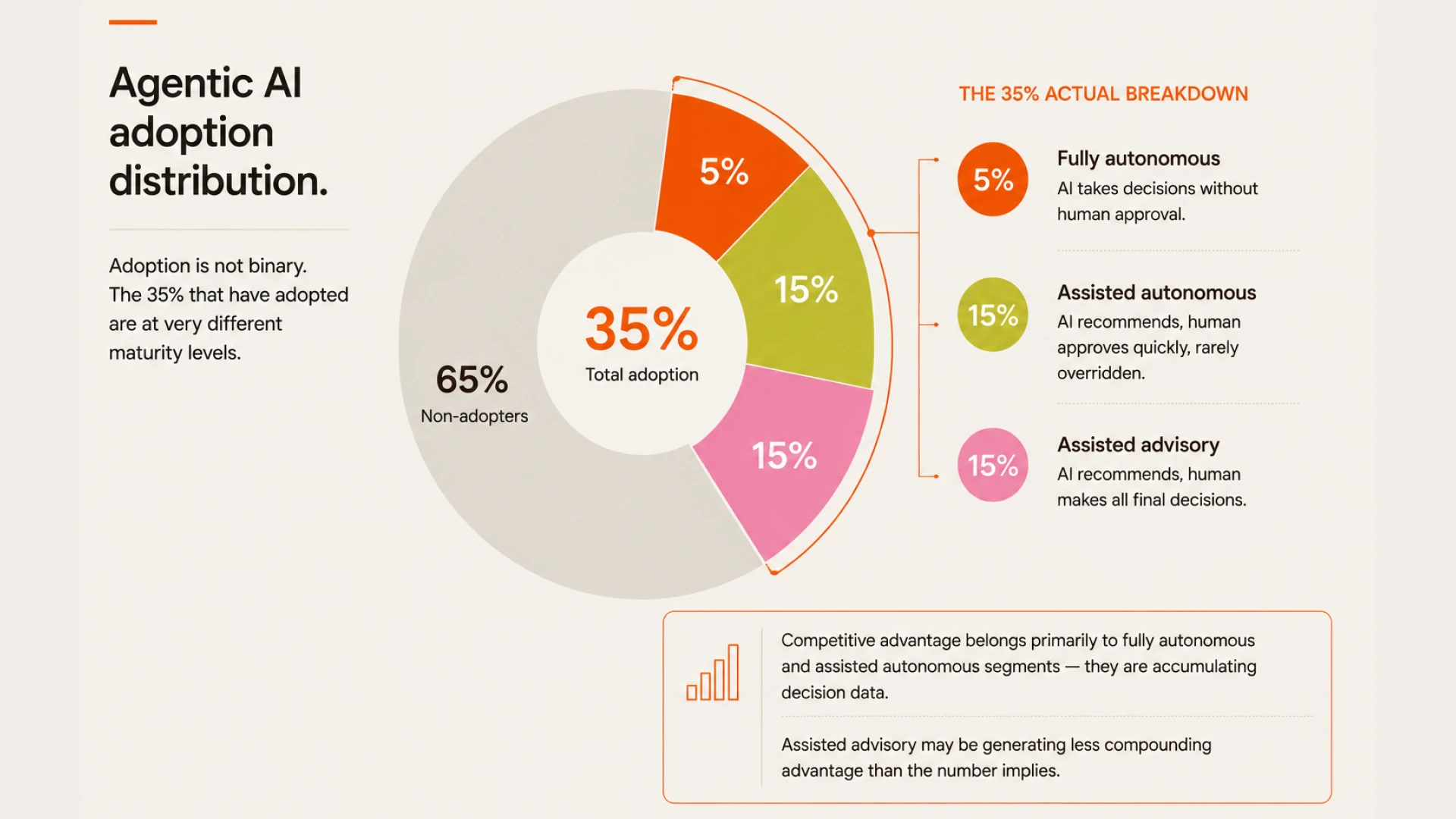
The MIT Sloan number requires precision to be useful. Agentic AI adoption at 35% does not mean that 35% of enterprises have AI agents taking end-to-end decisions autonomously. It means that 35% have deployed some form of AI agent in some part of their operations — including, in many cases, agents that surface recommendations for human review rather than taking independent action. The distribution within that 35% is significant: a small proportion have AI that is genuinely autonomous at scale, and a larger proportion have AI that is operating in an assisted mode that still requires human approval on most decisions.
The 65% that have not deployed any agentic AI are not necessarily behind in a way that will be permanent. The technology is available. The implementation path is established. What they are behind on is the data accumulation and institutional learning that make the AI more effective over time. That gap widens every month that the early movers are running in production.
The compounding effect of production data
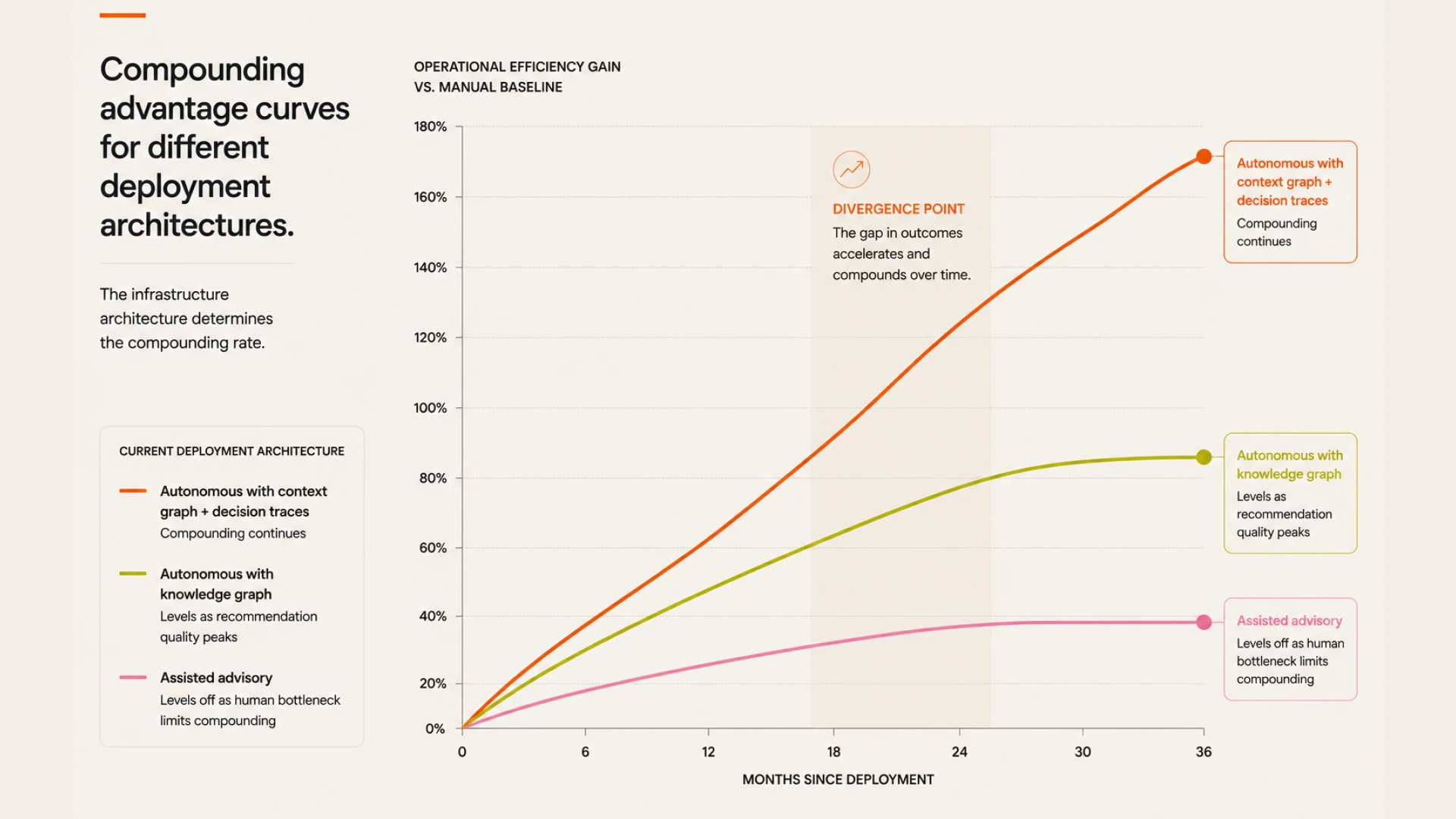
In AI systems that improve through deployment, the competitive advantage is not linear. It compounds. An organization that has run 18 months of production freight audit has a model that has seen carrier billing patterns across seasonal cycles, rate volatility periods, and carrier configuration changes. It has exception resolution history that has trained the autonomous categorization logic on the specific exception types that appear in that organization's carrier base. It has carrier behavior baselines that inform pattern detection across the invoice population.
An organization starting the same deployment today will reach the same point eventually — the model learns at a similar rate regardless of when it starts. But the compounding means that the gap is largest at the point when it matters most: the first 18 to 24 months after widespread adoption normalizes the technology. The organizations that started two years ago are operating with two years of compounded learning. The organizations that start today will spend two years catching up while the early movers accumulate further advantage.
“The advantage window in enterprise AI is not about being first to deploy. It is about accumulating two years of production data before the rest of the market catches up.”
What 'getting the infrastructure right' means
The organizations that will have lasting advantage from early agentic AI deployment are not the ones that deployed first. They are the ones that deployed with the right architecture — context graphs rather than knowledge graphs, decision traces captured from the beginning, autonomous resolution rather than assisted recommendation. An organization that deployed AI-assisted advisory 18 months ago has 18 months of recommendations and human approvals. An organization that deployed autonomous resolution 18 months ago has 18 months of decision traces, carrier feedback loops, and compounded exception suppression.
The infrastructure decision made at deployment determines what compounds. Getting the infrastructure right matters more than getting the timing right.