
Cold Chain Billing Has No Audit Standard. That's a Problem.

February 13, 2026
•
6
mins
In pharma and life sciences, the charges that vary most are the ones validated least.
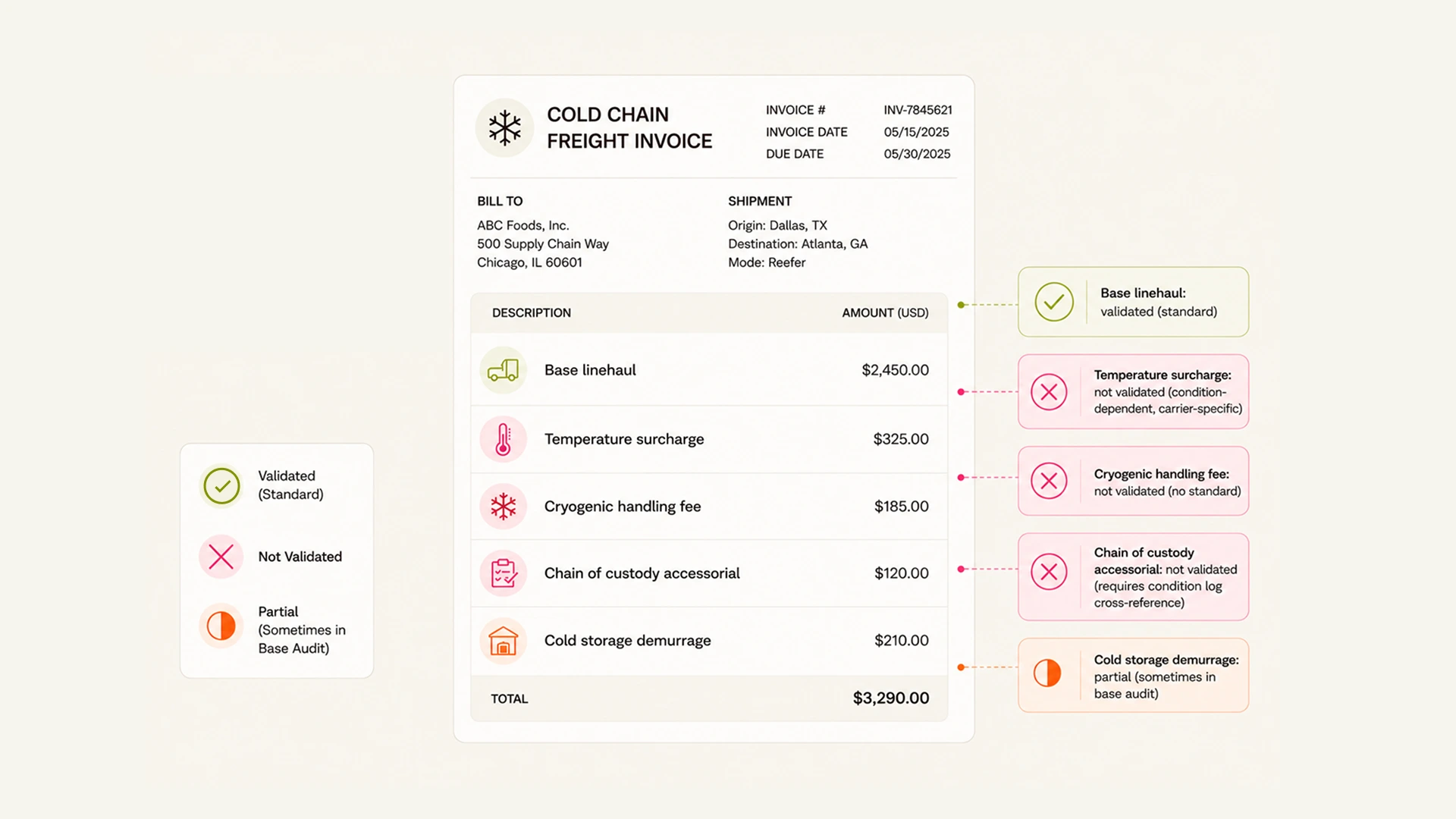
Walk into the logistics finance function of most large pharmaceutical companies and ask what percentage of cold chain accessorial charges get independently validated before payment. The answer, if you can get one, is uncomfortable. Temperature-control surcharges, cryogenic handling fees, chain-of-custody accessorials, and cold storage demurrage charges are billed by carriers based on internal cost models that shippers have limited visibility into and audit systems were never configured to check.
This is not an oversight that someone forgot to fix. It is the accumulated result of a decade of procurement decisions that outsourced the audit function to third-party providers whose systems were designed for standard freight modes and standard accessorial logic. Cold chain billing is neither of those things.
What makes cold chain billing structurally harder
Standard accessorial auditing already requires matching invoice charges against carrier-specific rules that vary by contract. Cold chain adds two additional layers of complexity.
The first is condition-dependent billing. A temperature-excursion handling fee may apply only when the shipment records a temperature deviation above a specified threshold during transit. Whether the fee is valid depends on whether the carrier's temperature log recorded a deviation, whether that deviation meets the contractual threshold, and whether the excursion occurred during carrier custody or shipper loading. Those three conditions require data from three different systems, none of which are typically connected to the audit platform.
The second is lane-specific rate variation. Cold chain carriers frequently negotiate lane-by-lane pricing for temperature-controlled capacity, particularly for cryogenic and ultra-low-temperature shipments. A single pharmaceutical company might have 20 different temperature-controlled carrier agreements, each with distinct surcharge structures for different lane types, service levels, and product classifications. Validating a cold chain invoice against the correct rate requires knowing which agreement applies to this shipment on this lane on this date.
The 20-year BPO problem
The longer a pharmaceutical company has been with the same audit provider, the more entrenched the audit gaps become. Long-term BPO relationships in freight audit tend to calcify around the capabilities the provider had when the contract was signed. Cold chain surcharge validation was not a standard capability in 2005 or 2010. Companies that have been with the same provider since then are carrying audit gaps that were built into the original implementation and have never been closed.
The provider relationship also creates a visibility problem. When audit outcomes are reported as summary statistics rather than line-item records, the company has no way to know whether a 98 percent audit pass rate means 98 percent accuracy or 98 percent of invoices falling below the threshold that triggers review. These are very different things.
“A 98% audit pass rate means different things depending on what the other 2% contains. In cold chain freight, the 2% can be structurally invisible.”
What independent audit changes
Independent audit of cold chain freight requires, at minimum, three things that most legacy audit models do not provide. First, direct access to carrier temperature logs and shipment event data, not through the carrier's self-reported invoice but through the operational tracking system. Second, contract knowledge at the lane and product class level, not just the master agreement. Third, validation logic for condition-dependent charges that runs the actual shipment conditions against the contractual trigger criteria.
Enterprises that have moved to independent cold chain audit consistently find cost recovery opportunities in the 4 to 6 percent range on temperature-sensitive freight. For a company with $85 billion in revenue and a global cold chain operation across 400 facilities, the scale of that opportunity is significant. The more important finding is the control improvement: finance finally has an accurate picture of what cold chain freight actually costs, rather than a number that has been passing through unvalidated for years.