
EDI 210 Is 40 Years Old. Your Audit System Was Built Around It.

February 18, 2026
•
6
mins

The data standard that shaped freight audit has a structural blind spot. Most platforms inherited it.
EDI 210, the electronic data interchange standard for freight invoices, was published in 1985. It was designed for a world in which carriers were large, formats were standardized, and freight billing complexity was manageable by a rules-based system running on batch processing. The standard specified a fixed set of transaction segments: rates, charges, shipment references, carrier identification, billing party.
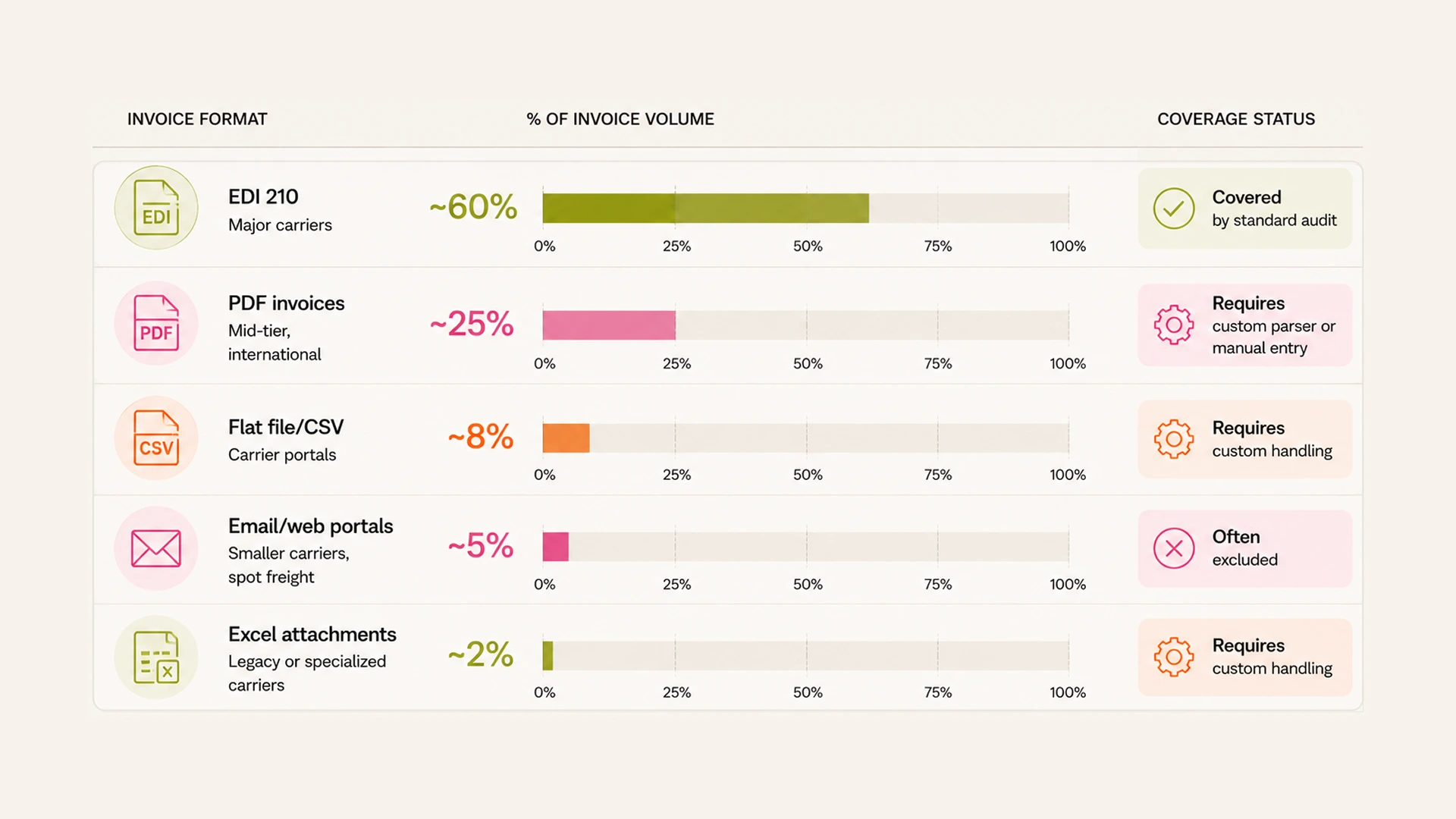
Forty years later, EDI 210 is still the primary data format for freight invoices between large carriers and large shippers. Most freight audit platforms were built around the assumption that invoices arrive in this format. That assumption has a structural blind spot: a significant and growing portion of freight invoices do not arrive in EDI 210. They arrive as PDF documents, flat files, Excel attachments, or email bodies. The platform built for EDI handles none of these natively.
~40% of freight invoices at enterprise shippers arrive outside EDI — as PDF, flat file, or email
What happens to the non-EDI invoice
The fate of the non-EDI invoice in a platform built for EDI depends on what the platform's implementation team built to handle exceptions. The common approaches: manual data entry by a clerk, a custom parser written for that specific carrier's PDF format, or exclusion from the audit entirely with manual approval.
None of these approaches scale. Manual data entry is error-prone and expensive. Custom parsers break when the carrier changes their PDF template, which happens with some regularity. Exclusion from audit means the invoice goes through without the validation that the rest of the population receives. The cost is not just the billing errors that pass undetected on the excluded invoices. It is the systematic blind spot that forms around certain carriers or invoice types because the platform cannot handle them.
The carrier onboarding friction this creates
The practical consequence of EDI-centric audit architecture is that adding a new carrier to the audit program requires an onboarding project. The carrier's invoice format has to be mapped to the platform's data model. Custom extraction logic has to be written, tested, and validated. The carrier has to be engaged on data format requirements. For platforms where each carrier onboarding is a manual implementation task, the result is an audit program that perpetually lags the carrier base. New carriers, spot carriers, and international carriers operate outside the audit program until someone gets around to building the connector.
The delay is not just operational inconvenience. New carriers, spot lanes, and international legs are precisely the freight types where billing error rates are highest, because the rates are negotiated quickly, the contracts are less standardized, and the exception handling is less mature. The carriers most likely to have billing discrepancies are the ones least likely to be in the audit program.
“Spot carriers and new lanes have the highest billing error rates. They are also the last ones onboarded to audit platforms built around EDI.”
Adaptive ingestion as the architectural alternative
An audit platform built on adaptive ingestion rather than EDI-centric parsing approaches the invoice format problem differently. Instead of requiring invoices to conform to a standard before they can be processed, it normalizes any input format into a standard internal representation. OCR for PDF documents. Structured extraction for flat files and Excel attachments. Parsing logic for email bodies.
The key requirement is that the normalization has to be intelligent, not just mechanical. A PDF invoice from a carrier who uses proprietary column headers and embedded tables requires more than a fixed field extraction. It requires understanding the document structure, identifying the relevant data regardless of layout, and handling edge cases like multi-page invoices with summary tables that reference detail on earlier pages.
When this works correctly, the carrier onboarding process changes character. Instead of a multi-week integration project per carrier, the onboarding becomes a validation exercise: ingest a sample of the carrier's invoices, confirm that the extraction is accurate, and add them to the audit program. The platform does not know or care what format the invoice arrived in. It knows what the invoice says.