
Electronics Logistics: 7 Handoffs, 150 Carriers, One Audit Window You're Missing

March 13, 2026
•
6
mins

The freight audit challenge in consumer electronics is not just volume. It is the compounding complexity of multi-leg, multi-currency, multi-carrier billing.
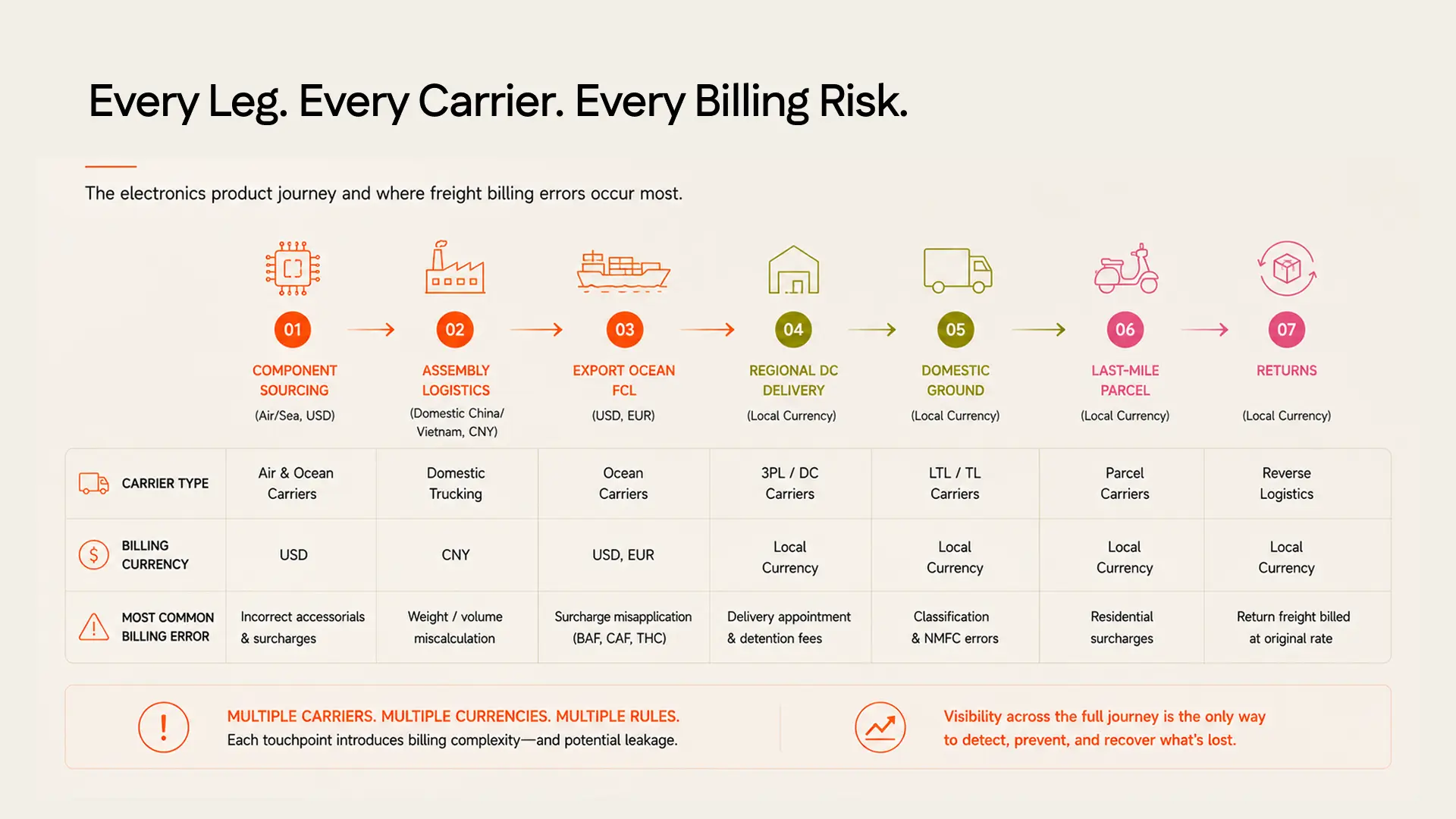
A consumer electronics product moves from component sourcing in Taiwan through assembly in Vietnam or China, ocean freight to regional distribution, air freight for high-value or expedited SKUs, last-mile parcel in major markets. The product touches seven to eight freight legs before it reaches a customer. Each leg involves a different carrier, often a different currency, and a different contract structure. Billing error probability at each leg compounds across the total product journey.
The scale problem is distinct from other verticals. A major electronics manufacturer processes 1.6 million parcel invoices annually before accounting for ocean, air, and ground. Each parcel invoice carries dimensional weight calculations, zone determinations, service-level charges, and accessorial fees. At 150-plus carriers across multiple geographies, the rule set governing what is valid on each invoice is not one rule set. It is 150 overlapping rule sets, each with carrier-specific variations.
The dimensional weight problem at 1.6 million invoices
Dimensional weight billing in parcel is straightforward in principle: divide the package volume in cubic inches by a divisor to get a calculated weight, then bill against whichever is higher, actual or calculated. The complexity in practice comes from two sources. First, the divisor varies by carrier and service type: FedEx Ground uses 139, FedEx Express uses 139, but the applied divisor in the carrier's billing system may differ from the divisor in the contract if the account was set up incorrectly or the contract was amended without updating the billing configuration.
Second, dimensional data requires a source. The invoice shows the DIM weight. Validating whether that DIM weight is correct requires the actual dimensions of the package: length, width, height. For a manufacturer who measures packages at the point of shipment and records those dimensions in their WMS, this data exists. Connecting it to the audit system is a data integration requirement that most legacy audit implementations have not prioritized, because it requires an additional data source join that was not in the original scope.
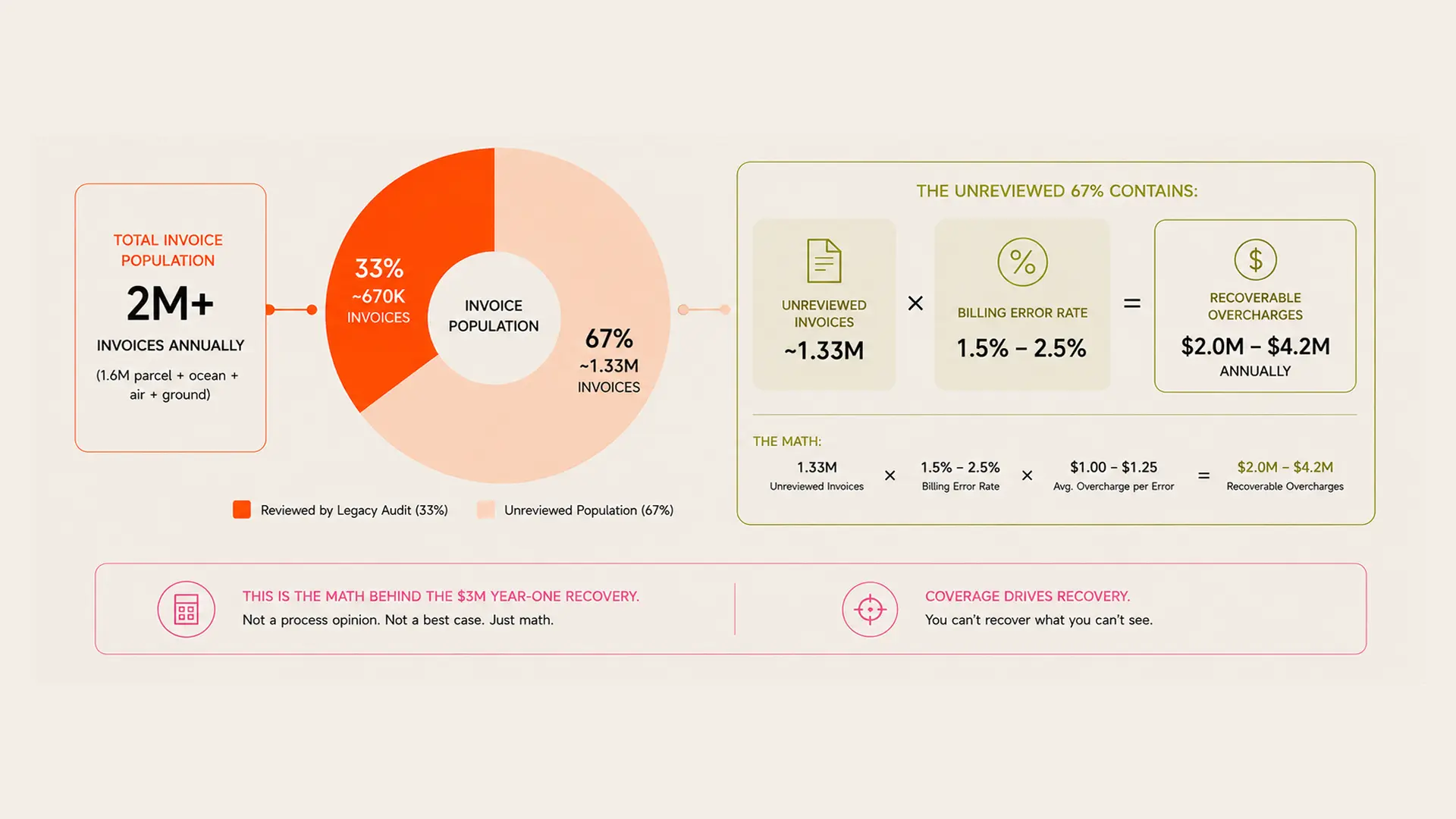
$3M+ recovered in year one at one global electronics leader by moving from 33% to 100% audit coverage
Multi-currency billing complexity
A single shipment from Asia that moves on an ocean carrier under a USD-denominated contract, transits through a port with EUR-denominated handling fees, and is delivered by a domestic carrier under a local-currency agreement produces an invoice trail that crosses three currencies before the shipment reaches its destination. The freight audit system needs to apply the correct currency conversion, at the correct rate, against the correct contract currency, for each leg.
Currency conversion in freight audit is frequently done at a rate that lags the actual transaction date, because audit systems typically apply a monthly or quarterly exchange rate rather than the spot rate on the invoice date. In a period of significant FX volatility, the difference between the applied rate and the actual rate can produce billing variances that look like discrepancies but are actually currency conversion artifacts, and genuine discrepancies that look clean because the currency variance is masking them.
“At 1.6 million parcel invoices annually, a DIM weight divisor error of one unit in the denominator compounds into a multi-million dollar billing discrepancy before anyone notices the formula is wrong.”
The 33% to 100% coverage shift
The $3 million recovery that one global electronics leader attributed to moving from 33% to 100% audit coverage did not come from discovering new types of billing errors. It came from applying the same validation logic to the full invoice population that previously only applied to a third of it. The errors that were present in the 67% that went unaudited were the same types that the audit program was already finding in the 33% it reviewed. They were just numerically larger because the population was three times bigger.
The operational constraint that made 100% coverage previously unachievable was not rules complexity. It was throughput. Manual review of 1.6 million parcel invoices is not feasible at any cost structure that makes commercial sense. AI-native audit removes the throughput constraint by processing every invoice through the same validation logic at the speed of data ingestion rather than at the speed of human review.