
Freight Fraud Doesn't Look Like Fraud. It Looks Like Normal Billing

February 25, 2026
•
6
mins
The cases that define the category share one architectural feature: they were invisible to the audit systems designed to catch them.
In 2024, a man in Connecticut admitted to defrauding Amazon of more than $3.5 million by setting up multiple trucking companies and billing for trailer moves that never happened. The fraud ran for years. A Macy's employee concealed $154 million in delivery expenses over nearly three years. Air Cargo Carriers manipulated electronic scan data on USPS mail routes to avoid late-delivery penalties. The Transportation Intermediaries Association puts total freight fraud losses above $455 million for 2024.
What connects all of these cases, and what the headlines consistently miss, is the architectural reason they were not caught earlier. It is not that the companies lacked audit processes. It is that the audit processes were asking the wrong question.
The wrong question
Standard freight audit asks: does this invoice match the rate card? The question is legitimate. It catches rate miscalculations, accessorial misapplications, and contract compliance failures. What it does not catch is billing that matches the rate card perfectly while being fraudulent.
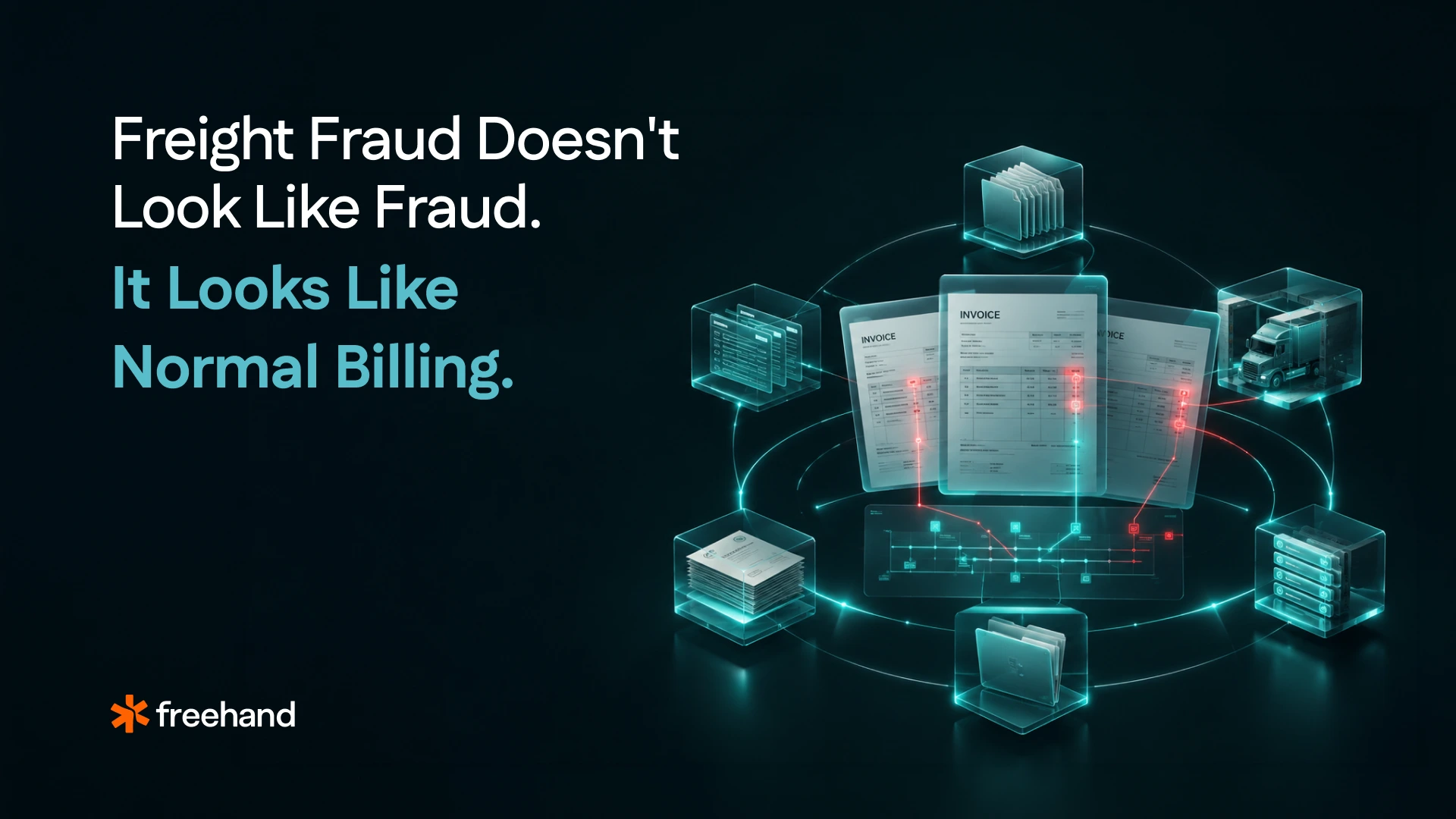
The Amazon case involved invoices for services that were never performed. The invoices were compliant with the rate structure. They looked exactly like legitimate bills for trailer moves. A 2-way match between the invoice and the rate card would pass every one of them. The question that would catch them is different: do the invoices correspond to movements that can be verified against operational records? That is a 3-way match, and it requires access to shipment execution data, not just rate card data.
$455M+ in freight fraud losses in 2024 — most of it invisible to standard audit models

The pattern question
Billing manipulation that is more sophisticated than phantom loads does not appear in a single invoice. It appears across hundreds or thousands of invoices as a systematic deviation from what the pattern of legitimate billing should look like. The same carrier, the same lane, a consistently misapplied accessorial charge, week after week, each instance individually small enough to fall below the dispute threshold.
An invoice processing system that reads each invoice in isolation cannot detect this. It requires reading across the invoice population and asking: given the history of how this carrier has billed on this lane, does this invoice make sense? That is a different computational problem. It requires holding the entire invoice history in context, not just the current document, and applying statistical reasoning about what normal looks like.
“Fraud in freight billing does not announce itself. It arrives in invoices that pass every individual check but fail the pattern test that nobody was running.”
The entity verification gap
There is a third category of billing manipulation that sits between outright fraud and billing error: invoices billed to the wrong legal entity. In large enterprises with multiple brand names and corporate entities, carrier billing systems often default to whichever entity name populates first in their system. Invoices end up coded to the wrong entity, which does not produce an obvious error in a 2-way match because the rate is correct and the shipper name is a known name in the system. It simply goes to the wrong cost center and sits there.
At one Fortune 500 company, invoices were being billed to the wrong legal entity because two subsidiary names were similar enough that carriers defaulted to whichever one populated first. The invoices passed audit for months. When 3-way matching with entity verification was applied against the shipment data, the pattern was identified on day one. The recovery from that single detection pattern was in the $800,000 to $1.3 million range annually.
The Deloitte analysis of supply chain fraud frames the underlying vulnerability correctly: it is the absence of cross-system visibility in payment workflows, not the sophistication of the fraudster, that creates the opportunity. The cases that make headlines are the extreme instances of a structural gap that produces smaller losses continuously, in every billing cycle, at every enterprise with a freight audit model built around document matching rather than pattern recognition.