
Freight Inflation Didn't Create the Billing Error Problem. It Made It Impossible to Ignore.

March 11, 2026
•
8
mins
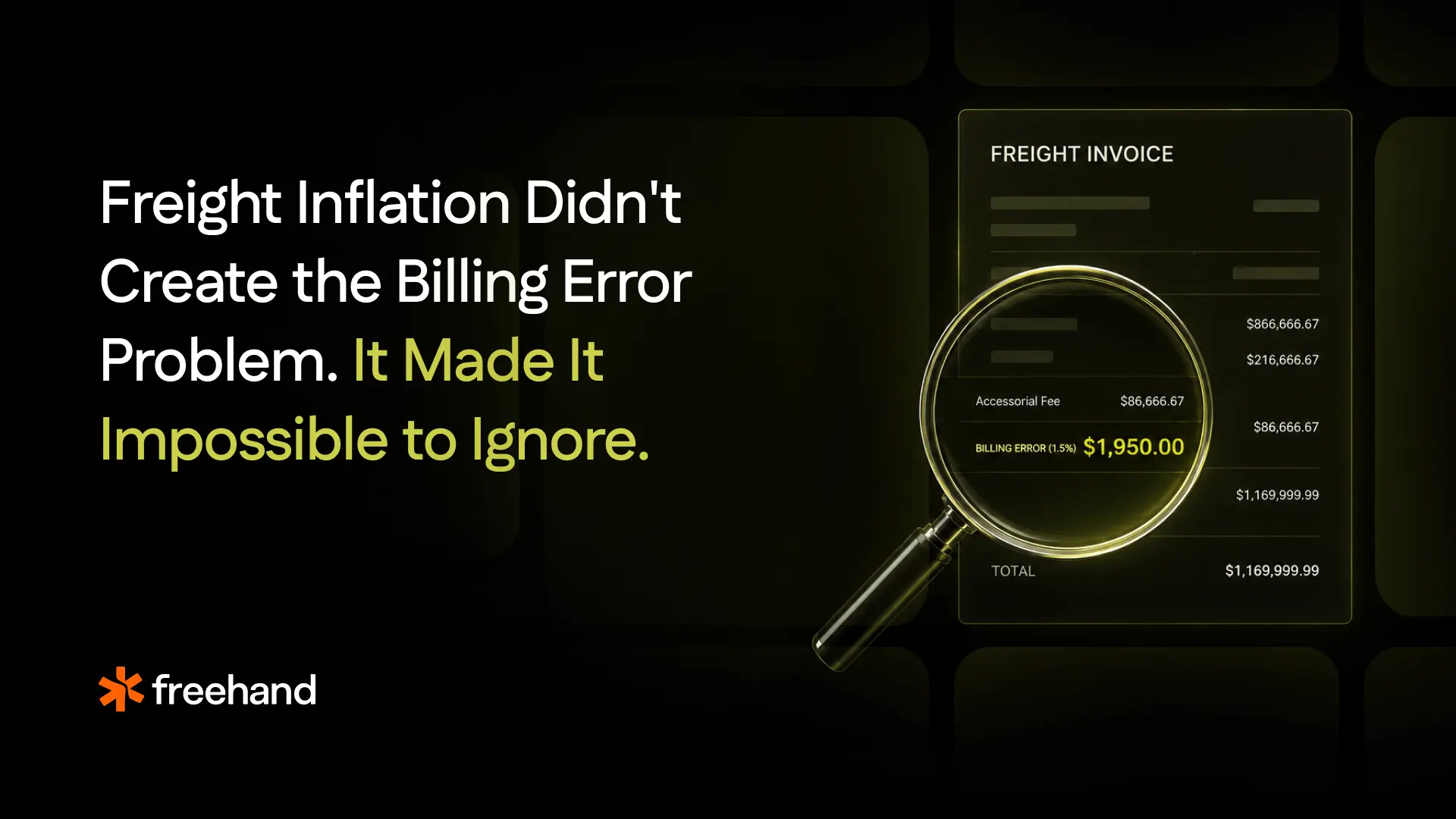
When freight rates were stable, a 1.5% billing error was a rounding consideration. When spot rates spike 50%, it is a board-level number.
Freight billing errors have existed as long as freight billing has. The 1.5 to 2.5 percent error rate that shows up consistently in industry data is not new. What is new is the financial materiality of those errors in an environment where the base freight spend they are calculated against has risen sharply.
Bloomberg reported spot container rates from Asia to the U.S. West Coast surging 50% in early 2025. UNCTAD warned that rising freight rates could push consumer prices up 0.6%. By Q3 2025, CPI was running at 3% annually, with core goods inflation at 1.5%, its highest outside the pandemic period. Deloitte's 2026 retail outlook found 61% of executives expecting significant cost increases from trade policy.
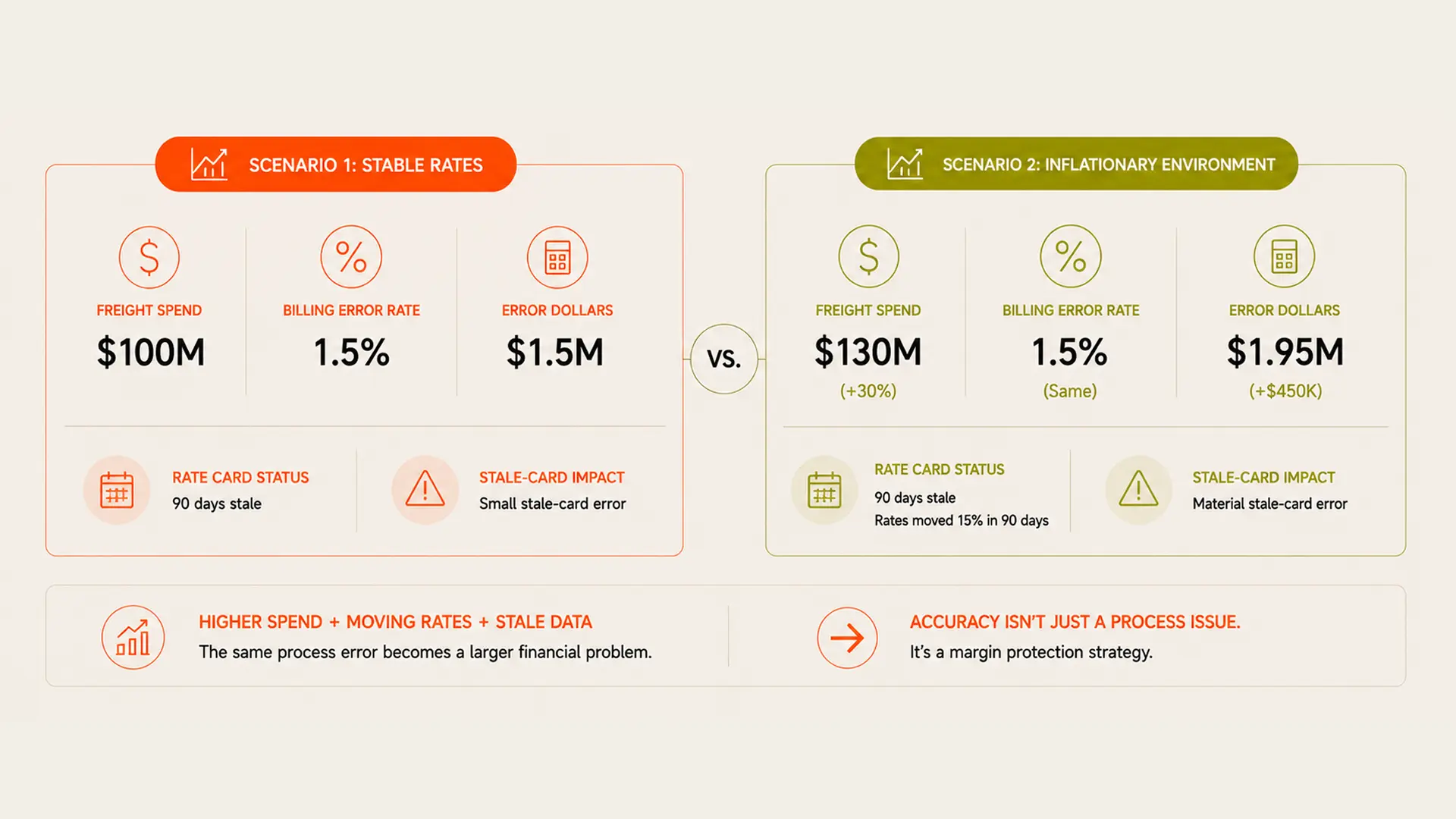
In this environment, the 1.5% billing error is not a rounding consideration. On a $100 million freight spend, it is $1.5 to $2.5 million. For a company whose freight spend has risen 30% over two years due to rate inflation, the absolute dollar value of the billing error has risen 30% alongside it, with no corresponding increase in audit capability or recovery capacity.
50% increase in Asia-to-US West Coast spot container rates in early 2025 — the same billing error rate costs proportionally more
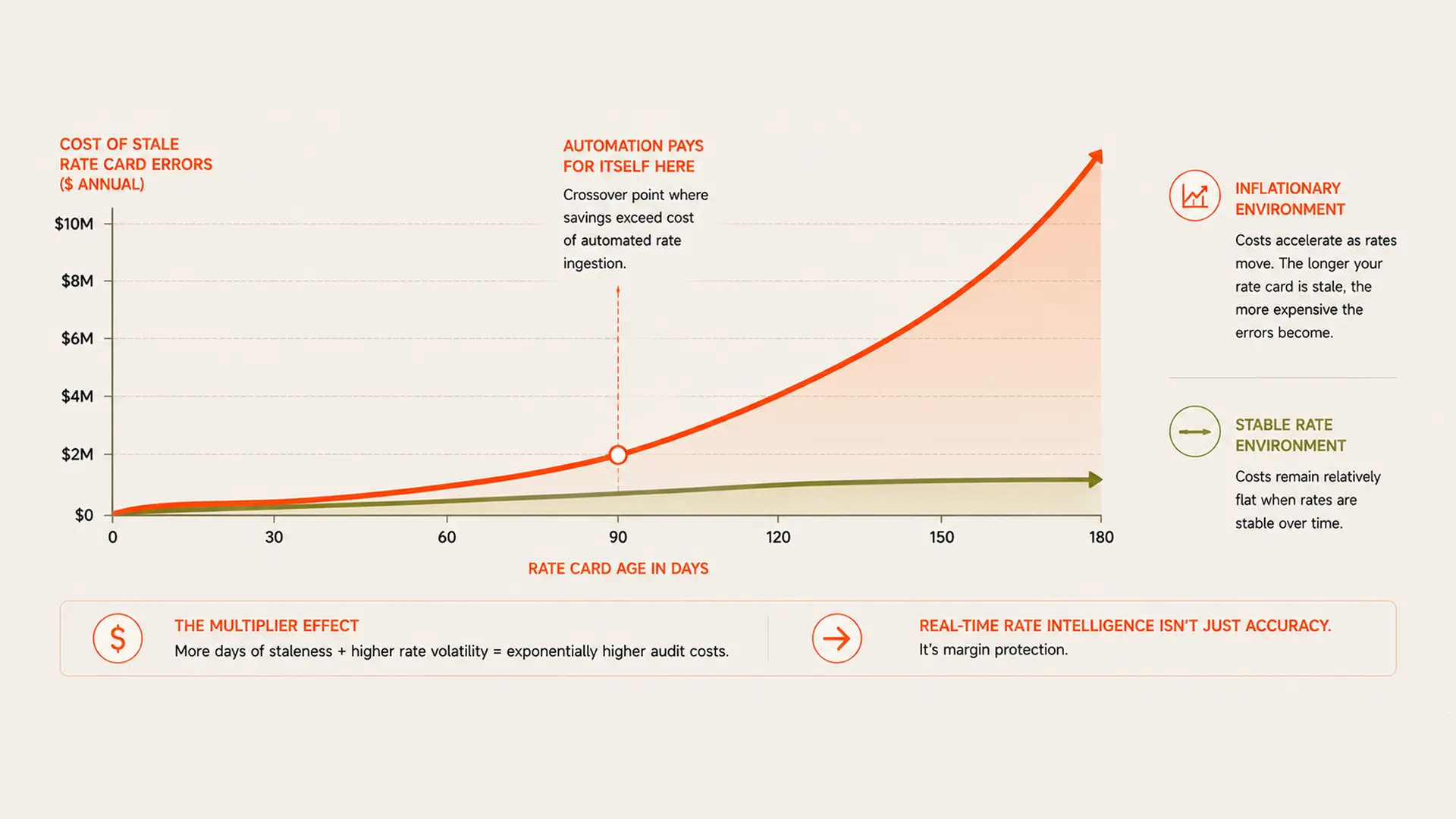
The stale rate card problem compounds in an inflationary environment
Carrier rate cards move mid-contract now in a way they did not reliably do in a stable rate environment. Fuel surcharges reprice weekly. Carriers apply emergency surcharges for capacity constraints or driver shortages. Accessorials get updated when costs change. The rate card that the audit system was configured against at contract signing is frequently not the rate card that applies to the invoice being audited.
In a stable rate environment, the error introduced by a stale rate card was small in absolute terms and self-correcting over time. In an inflationary environment, the error is larger in absolute terms and compounds in the same direction: the carrier's rates are going up, and if the audit system is checking against last year's rate card, it is approving charges that exceed what the current contract allows without flagging them.
The BPO response time problem
Legacy freight audit BPOs were designed for a rate environment that changed once a year during the annual contract cycle. Their audit logic was configured to the contracted rates, updated at renewal, and operated against that configuration for the next 12 months. When fuel surcharge tables update weekly and carrier accessorial schedules change monthly, a BPO that reconfigures its audit logic quarterly or annually is systematically approving charges that exceed what current contracts allow.
The audit error in this scenario is not the provider's incompetence. It is the structural limitation of a manual update process in an environment that requires continuous rate monitoring. The BPO cannot update its rate configurations in real time because real-time rate card maintenance requires automated ingestion from carrier systems, which most legacy audit platforms were not architected to support.
“A 10-to-21-day audit cycle in an environment where rates move weekly is not a slow audit. It is an audit that runs against rates that no longer exist.”
What the operational response looks like
The operational response to rate inflation in the audit context has two components. First, automated rate card ingestion: carrier rate updates should flow into the audit configuration as they are published, not as a quarterly manual update. This requires a technical integration between the carrier rate notification system and the audit platform's rate configuration, something that most legacy platforms do not offer.
Second, variance analysis calibrated to current rate levels rather than historical baselines. An alert threshold set at 5% above contracted rate that was appropriate when freight costs were stable may be too permissive in an environment where carriers are regularly testing the edges of contractual tolerances. The audit configuration needs to account for the rate environment it is operating in.
Freight inflation did not create the billing error problem. It created the conditions under which ignoring that problem costs more than fixing it. That is a different kind of motivation, but it is producing the same result: enterprises that have been comfortable with 33% sampling coverage and batch reconciliation are reconsidering the architecture of their audit program in ways they were not willing to six months ago.