
Grocery Retail Runs 20,000 Shipments a Week. The Audit Cycle Runs Monthly.

April 15, 2026
•
8
mins
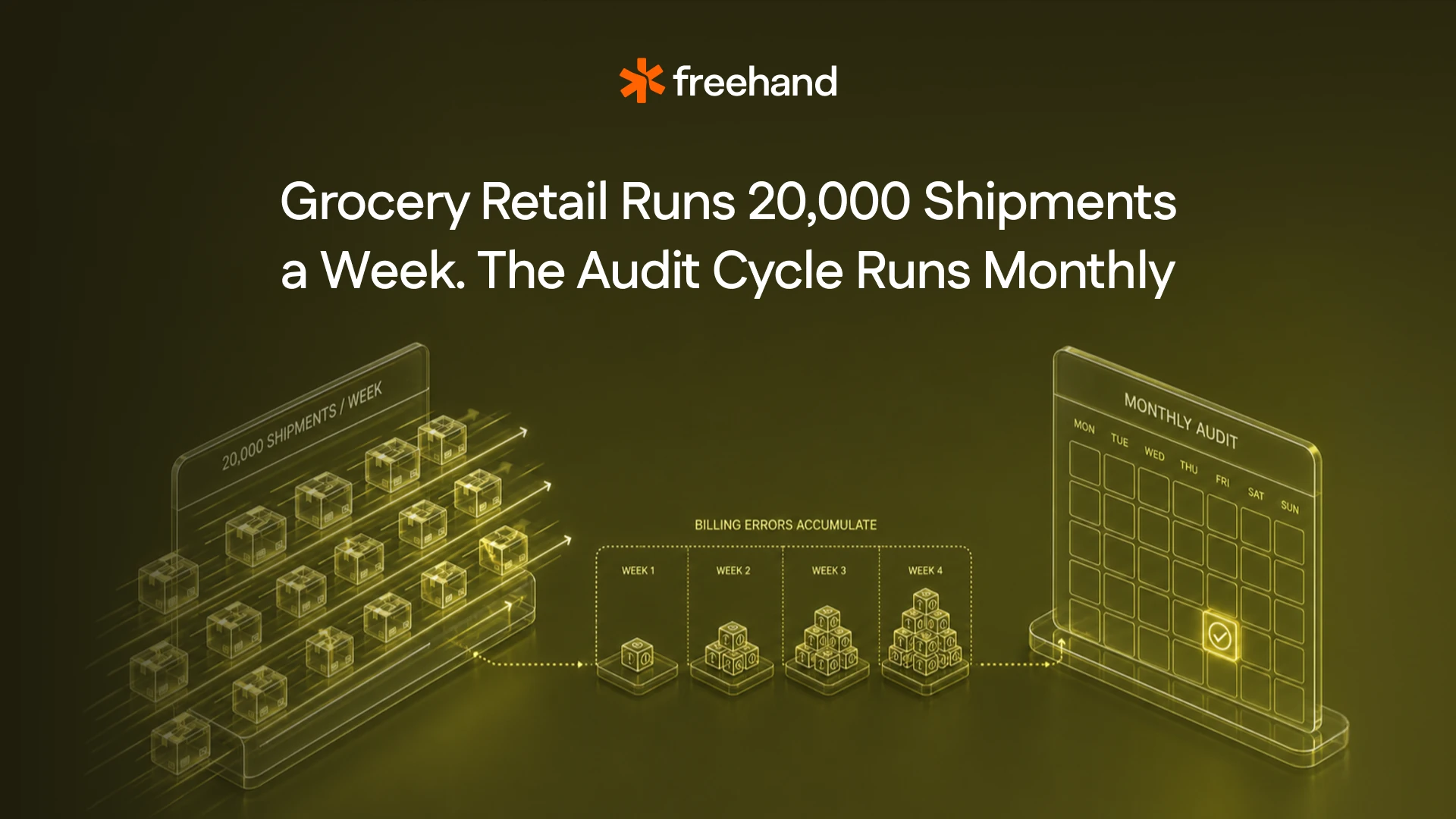
The gap between shipment cadence and audit cadence is where billing errors accumulate into structural leakage.
A major European grocery retailer processes more than 20,000 shipments weekly. Each shipment generates an invoice. The invoices arrive on varying schedules from 50-plus carriers across seven modes. The audit cycle runs monthly. The mathematics of that temporal gap are straightforward: at 20,000 shipments per week over a four-week cycle, the audit system is examining 80,000 invoices when it finally runs. The billing errors that accumulated in weeks one through three are not caught until week four. By then, most of the payments have already cleared.
This is the structural reality of monthly audit at grocery-scale freight volume. It is not a failure of the audit team. It is the design of a batch reconciliation system in an environment where the volume makes real-time processing seem impractical. The question is whether impractical still means impossible.
What accumulates in the interval
The month-end audit does not just delay the catch. It changes what is catchable. An invoice that is audited at 28 days rather than 1 day has almost certainly been paid already — the payment cycle at most grocery operators runs faster than the audit cycle. Catching an error after payment means opening a dispute, generating documentation, contacting the carrier, tracking the response, receiving a credit memo, and applying it to a future payment. The dispute resolution process for a recovered billing error runs 30 to 90 days. The net result is that an invoice processed in week one does not produce its recovery until month three at the earliest.
Carriers who have billing errors in their configuration — misconfigured DIM weight divisors, fuel surcharge tables referencing the wrong index, accessorial triggers applied outside their contractual conditions — run those errors through every invoice in the audit window before the pattern is identified. At 20,000 shipments per week, a systematic error from one carrier processing 800 weekly shipments runs 3,200 invoices before month-end audit identifies it.

The root cause identification problem at monthly cadence
Monthly audit also delays the root cause identification that prevents future errors. When a billing discrepancy is identified at month-end, the first question is whether it is a one-time error or a systematic one. Answering that question requires reviewing the prior month's invoices from the same carrier to see if the pattern exists there too. That review takes time. The root cause communication to the carrier takes more time. The carrier's correction of their billing system configuration takes more time.
In aggregate, the time from a systematic billing error first appearing to the carrier correcting the underlying configuration runs three to five months in a monthly audit model. In a real-time audit model, that window compresses to days. Every week of delay between error appearance and root cause correction represents another week of accumulating invoices being processed with the error.
“The interval between when a billing error first appears and when the audit catches it is not just a cost delay. It is the window in which the error is compounding across every invoice the carrier submits.”
What real-time audit looks like at 20,000 shipments per week
Real-time audit at grocery scale requires processing each invoice as it arrives rather than batching it for period-end reconciliation. This is not a manual processing problem — no team of auditors can review 20,000 invoices per week individually. It is an architectural question: can the audit system ingest, validate, and process invoices at the rate they arrive?
The grocery retailer that moved from monthly batch audit to real-time processing at 20,000 weekly shipments replaced a 15-day audit cycle with a 5-day guaranteed payment cycle. The compressed payment cycle was made possible by the audit running in real time — clean invoices approved immediately, exceptions flagged at ingestion, carriers notified of discrepancies before the payment window rather than after it. The working capital benefit to the carrier, which showed up as improved rate negotiation at the next renewal, was the downstream financial outcome of an operational change that started with audit timing.