
How Decision Memory Makes AI Accountable, Not Just Accurate

April 22, 2026
•
7
mins

Accuracy is a quality metric. Accountability is an auditability metric. They are not the same requirement.
When a freight audit AI approves an invoice for $340,000, the finance team has two legitimate requirements. The first is accuracy: the approval should be correct. The invoice should match the contracted rates, the charges should be supported by shipment execution data, and the approval should reflect the organization's established exception tolerances. The second requirement is accountability: the approval should be traceable. When someone asks why that invoice was approved, there should be a complete, structured answer — not 'the AI decided' but the specific facts, logic, and precedent that produced the approval.
Most AI deployments in freight audit are designed to meet the first requirement. Accuracy is measured, tested, and optimized. Accountability is treated as a reporting layer that can be added after the fact. This sequencing is wrong, and it becomes wrong in ways that surface during audits, SOX reviews, and carrier disputes where the organization needs to reconstruct the reasoning behind a payment decision.
What a decision trace contains
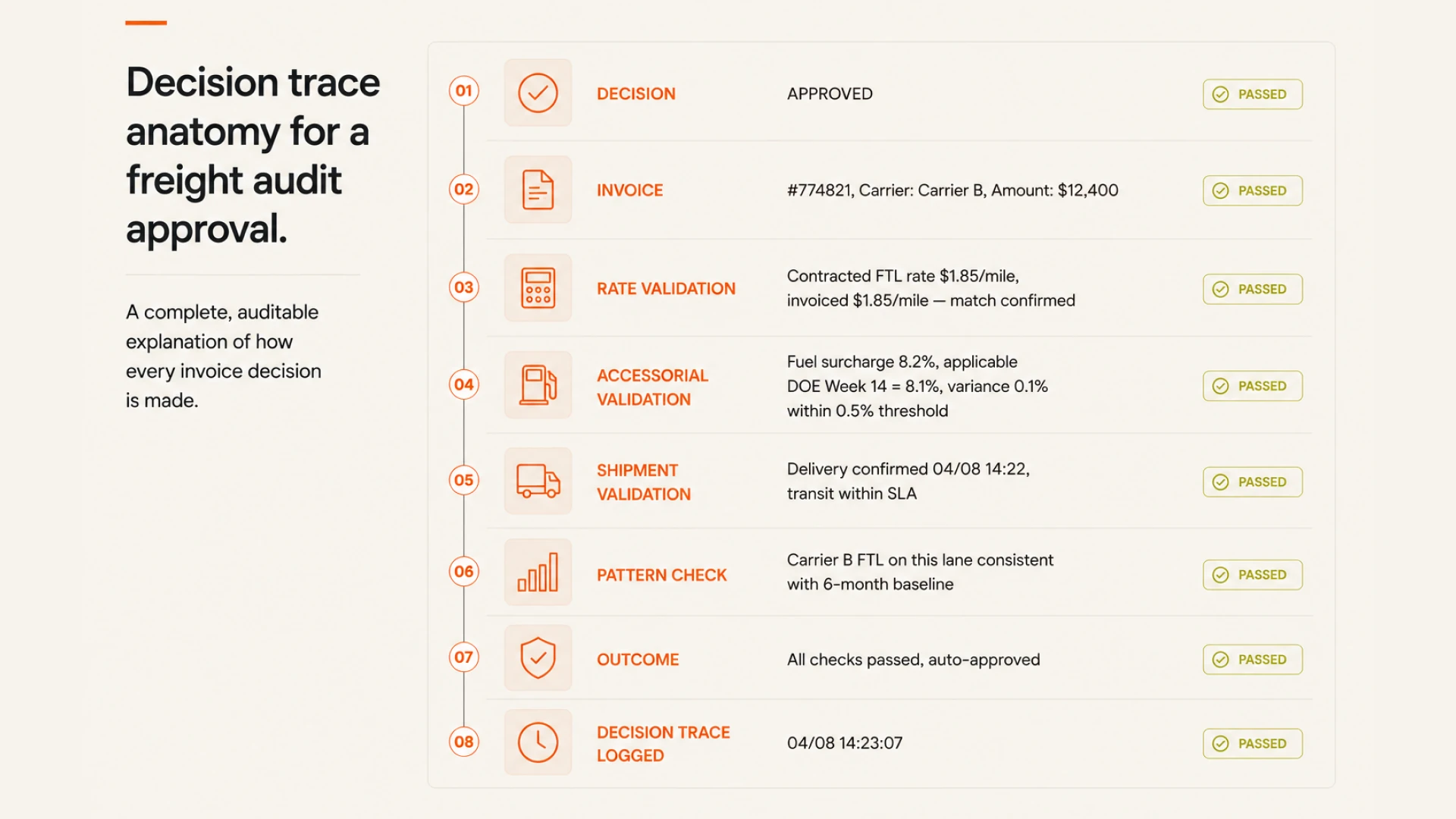
A decision trace is not an audit log. An audit log records what happened: invoice received, invoice approved, payment processed. A decision trace records how the decision was made: what facts were retrieved and from where, what logic was applied to those facts, what threshold or precedent determined the outcome, and what the AI would have done differently if any one of those inputs had been different.
For a freight audit decision, a decision trace captures: the specific contracted rate retrieved from the knowledge graph for this carrier on this lane, the shipment execution data that was used to validate the charge conditions, the historical exception pattern that informed whether a variance was within established tolerance, and the explicit reasoning step that produced the approve or dispute decision. This trace is stored alongside the payment record, queryable by invoice number, and accessible to finance, legal, and operations without requiring a separate data extraction.
Why accountability matters in a regulated finance environment
Freight audit sits inside financial controls. In a SOX-compliant environment, the controls around accounts payable need to be documented, tested, and demonstrably effective. When those controls are executed by an AI system, the documentation requirement does not diminish — it becomes more specific. The AI is now the control. Its decision logic needs to be auditable to the same standard as the human judgment it replaced.
External auditors who review freight audit as a financial control need to be able to answer: what was the AI checking? How does it decide what to approve and what to dispute? How would someone know if the AI was wrong? In a system without decision traces, these questions are answered with model descriptions and accuracy statistics. In a system with decision traces, they are answered with evidence: here is the trace for the disputed invoice, here is the fact that was retrieved, here is the threshold that was applied, here is where the AI would have flagged differently.
“When an auditor asks why the AI approved that invoice, 'the model had 98.5% accuracy' is not an answer. A decision trace is an answer.”
The carrier dispute use case
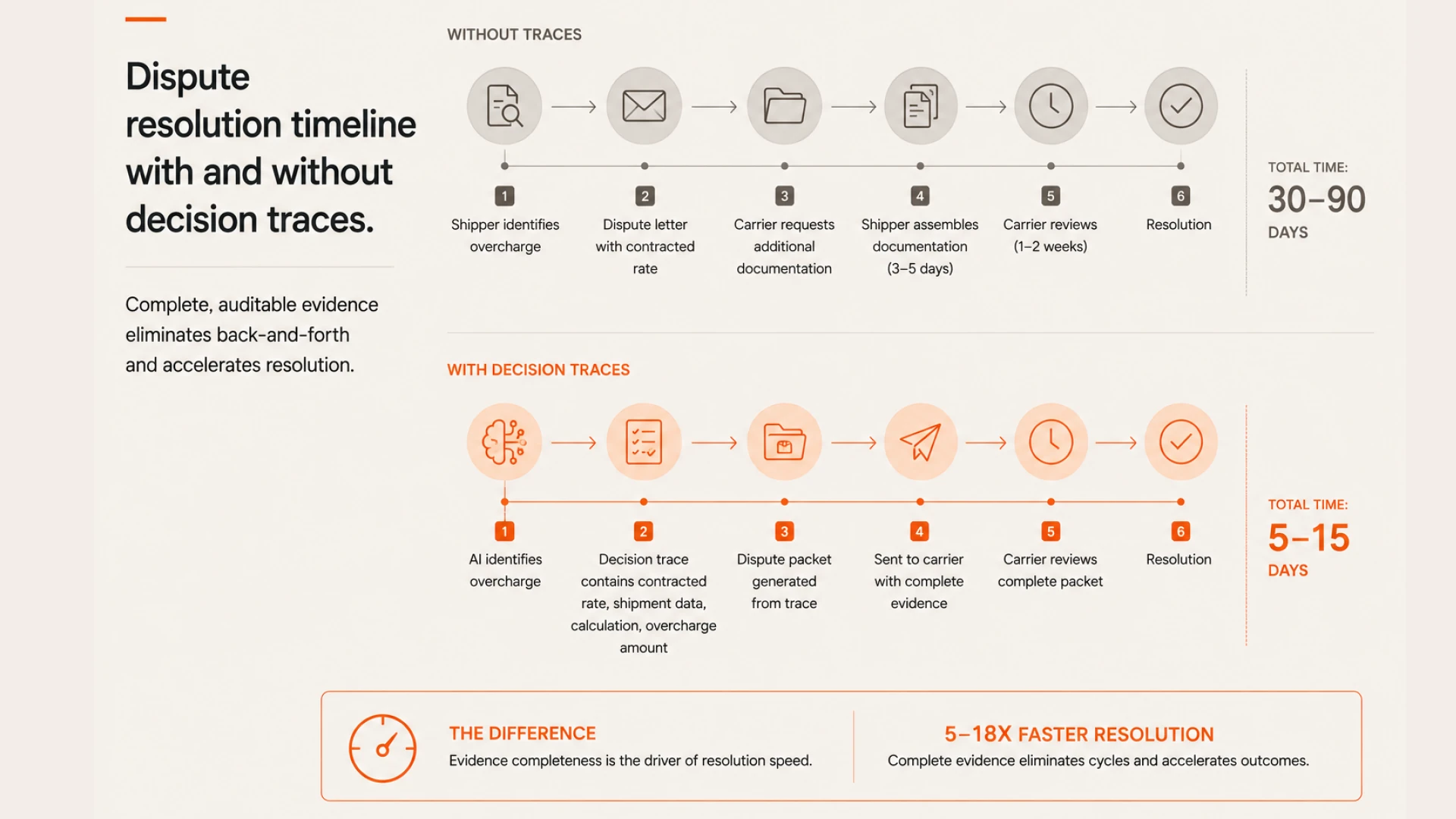
Decision traces have a practical value beyond regulatory compliance: they make carrier disputes faster and more recoverable. When Freehand generates a dispute packet for an incorrect charge, the supporting evidence in that packet is drawn from the decision trace — the specific contracted rate, the shipment data that contradicts the billed condition, the calculation that shows the overcharge. The carrier receives a dispute with complete documentation. Resolution times decrease because the carrier cannot contest the evidence — it comes from their own shipment data cross-referenced against their own contracted rates.
A dispute generated from a decision trace typically resolves in days rather than weeks because there is no back-and-forth about what the shipper's position is or what evidence supports it. The position is in the trace. The evidence is in the trace. The dispute is complete on first submission.