
How Freehand's Agents Normalize Data Across ERPs Without a Custom Integration

March 16, 2026
•
7
mins
Fragmented ERP environments are the primary reason freight audit stays incomplete. Agentic ingestion changes the architecture of the problem.
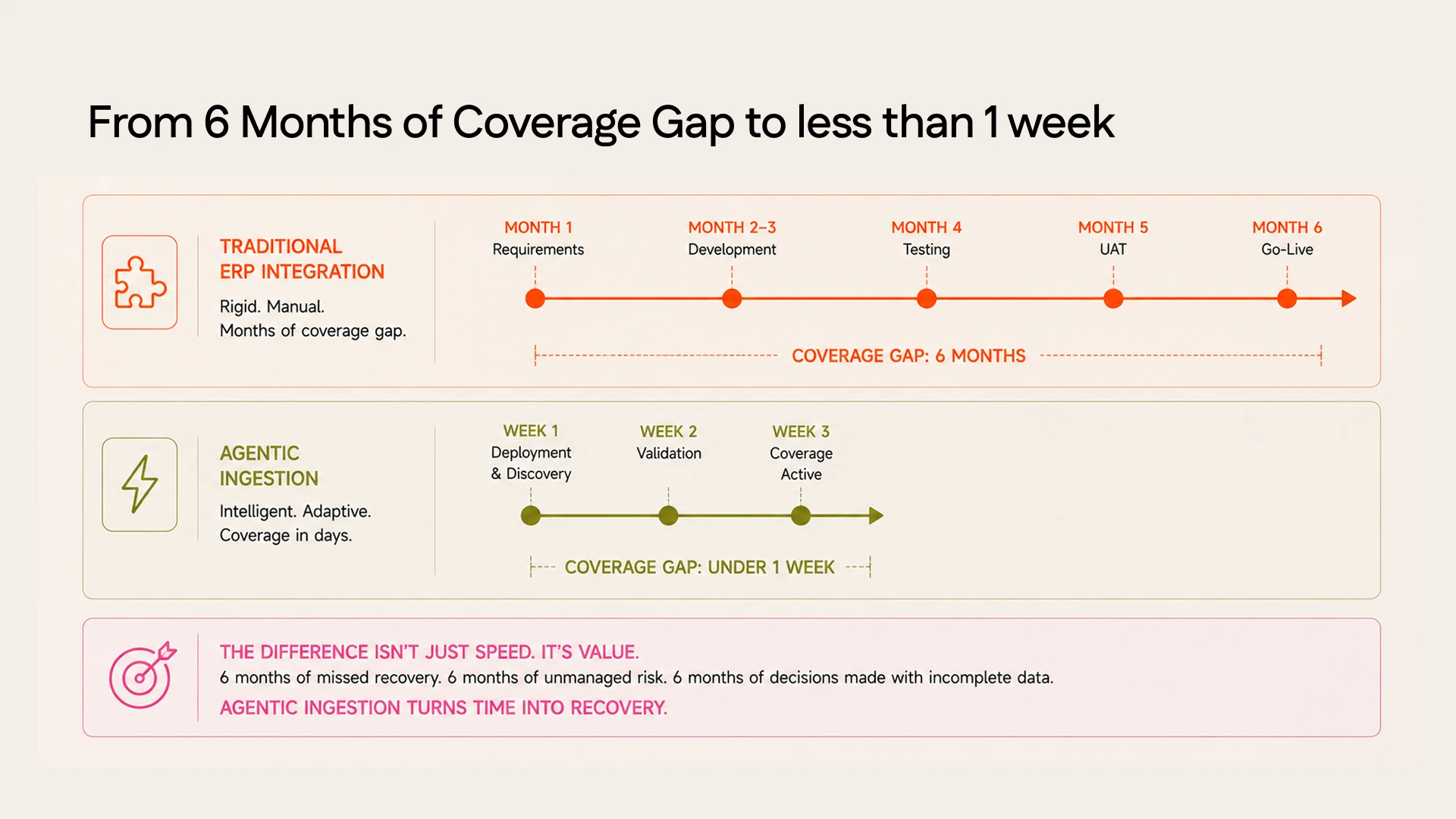
The conventional approach to integrating freight audit with enterprise ERP systems is a project: requirements gathering, API development, data mapping, testing, validation, go-live, followed by maintenance as the ERP vendor releases updates that break the integration. For a company running SAP in North America, Oracle in Europe, and Infor in Asia Pacific, this is not one integration project. It is three, each with different data models, different field names for the same concepts, and different latency characteristics for data extraction.
The integration project approach is why large enterprises with multiple ERP environments routinely have freight audit programs that cover their primary ERP instance but have coverage gaps in the other systems. The secondary systems are on the roadmap. The roadmap never completes because each integration project is a resource-intensive engagement that competes with other IT priorities.
What agentic ingestion changes
Agentic data ingestion approaches the ERP connectivity problem from a different architectural direction. Rather than building a fixed integration that maps ERP data fields to a predetermined schema, an agentic ingestion system deploys agents that explore each connected system's data model, identify the relevant entities, extract the data using whatever access method is available (API, database query, file export, or portal scraping), and normalize it into a unified internal representation.
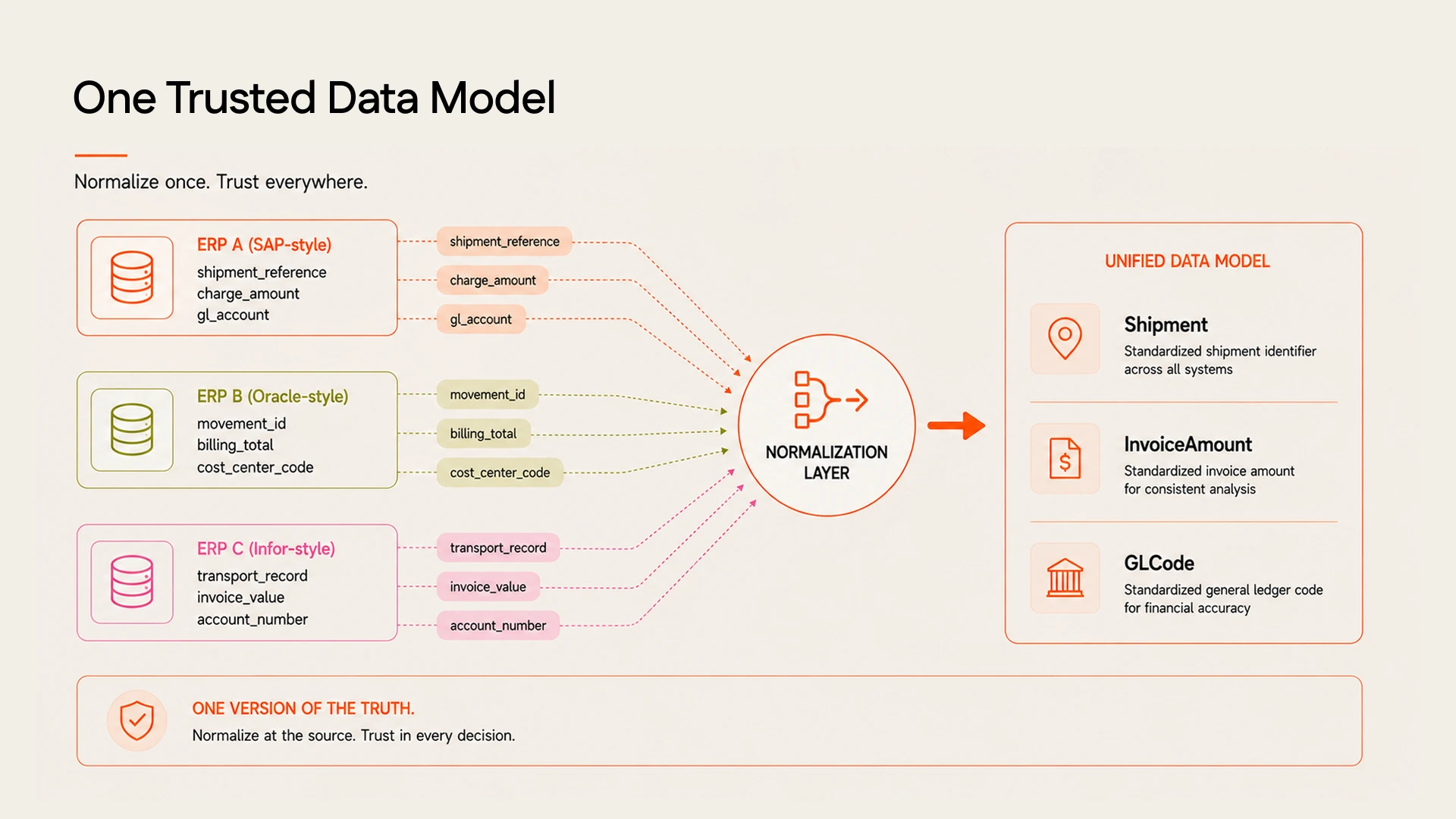
The normalization step is where the semantic work happens. 'Shipment reference' in SAP, 'movement ID' in Oracle, and 'transport record' in Infor all refer to the same conceptual entity. An agentic ingestion system that understands logistics domain semantics can recognize these as equivalent and normalize them into a single 'shipment' entity in the freight audit data model, without requiring a human to map each field manually for each system.
Handling schema evolution without breaking integrations
A persistent problem with traditional ERP integrations is schema evolution: when the ERP vendor releases an update that changes field names, data types, or table structures, the integration breaks until it is updated. For a freight audit program that is running continuously, an integration break means a coverage gap until engineering gets to the fix.
Agentic ingestion handles schema evolution differently. Because the agents are discovering the data model dynamically rather than relying on a static mapping, a schema change in the ERP triggers a re-discovery process rather than a breakage. The agent identifies that the field it was previously reading no longer exists in its expected location, searches for the conceptually equivalent field in the updated schema, and updates its extraction logic accordingly. The process is not instantaneous, but it is self-correcting rather than requiring a manual engineering intervention.
“A traditional ERP integration breaks silently when the schema changes. An agentic ingestion system detects the change and adapts. The difference is whether the coverage gap announces itself or accumulates unnoticed.”
The no-code configuration benefit
Beyond the technical architecture benefit, agentic ingestion changes the operational profile of adding a new data source to the freight audit program. A traditional integration requires an engineering team, a project timeline, and a budget allocation. Agentic ingestion reduces this to a configuration exercise: connect the new system, run the agent discovery process, validate the extracted data against known samples, and add the system to the audit program.
For a company that acquires a business with a different ERP stack, or expands into a market where a different system is in use, this matters operationally. The new system is in scope for freight audit within days rather than quarters. The coverage gap that previously persisted for the duration of the integration project does not have time to accumulate material leakage.