
How Freehand's Logistics Language Model Handles Carrier-Specific Billing Logic

May 1, 2026
•
7
mins
A model that understands freight in the abstract gets the right answer on textbook invoices. Real invoices are not textbooks.
There is a category of AI capability that looks similar from the outside but produces meaningfully different results in production: understanding a domain versus understanding a domain's operational exceptions. A general-purpose language model understands freight. It knows what an accessorial charge is. It knows how fuel surcharges work in principle. It knows the structure of an LTL invoice and the difference between a class-based rate and a density-based rate. This is genuine understanding. It is not sufficient for accurate invoice audit on real carrier billing.
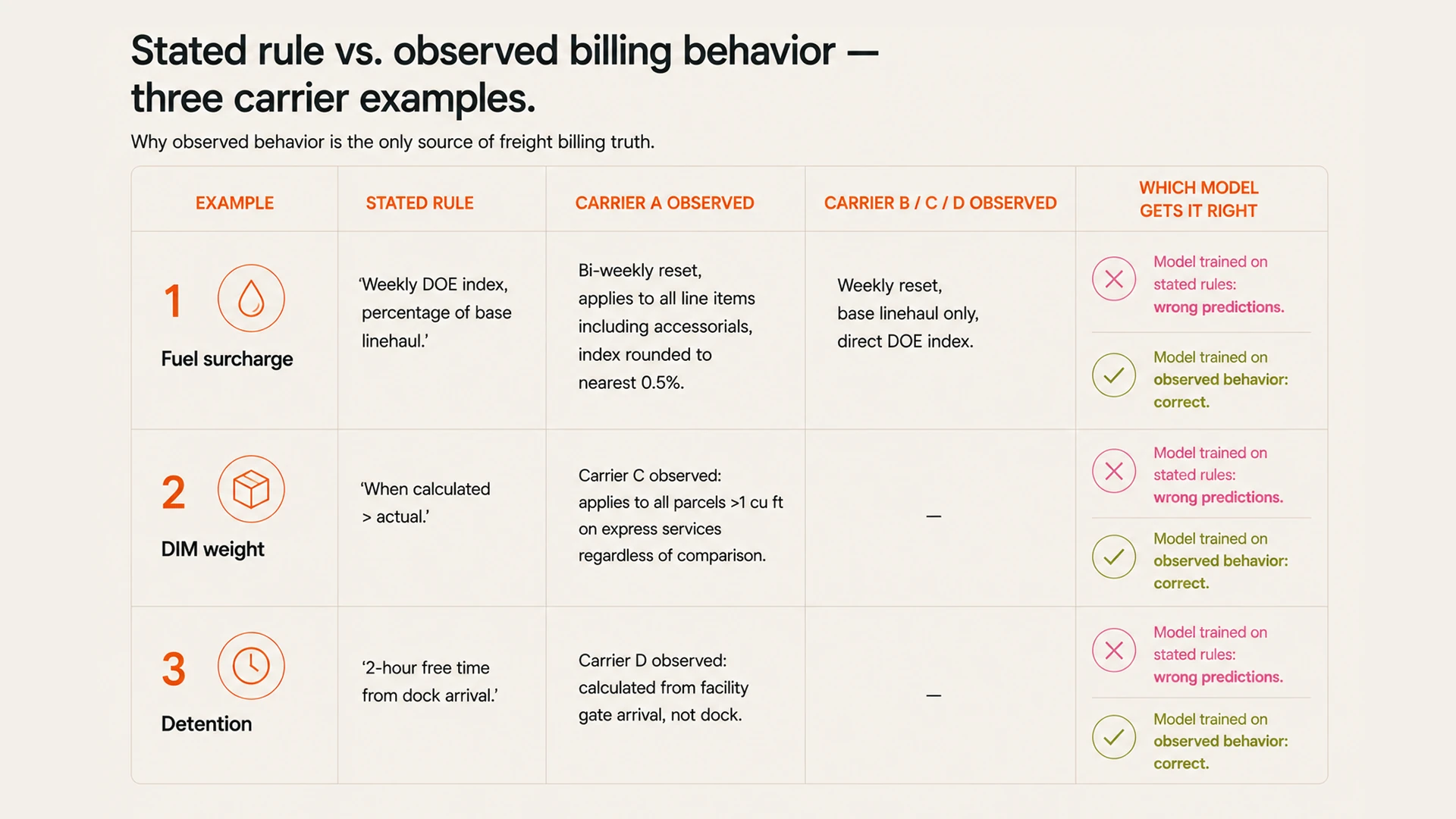
Real carrier billing has carrier-specific exceptions to everything the general framework says is true. The fuel surcharge calculation uses an index — which index, how often it resets, what the cap is, and whether it applies to base freight only or to accessorials as well — differs by carrier and by contract vintage within the same carrier. A model that applies the general fuel surcharge framework to an invoice from a carrier whose contract specifies a non-standard calculation will produce a plausible-looking result that is wrong.
What logistics-specific pre-training means in practice
The Logistics Language Model in Freehand is pre-trained on the actual billing patterns from millions of freight invoices across thousands of carriers. Not the stated rules from carrier tariff documents — the actual billing behavior observed in invoices processed in production. These two things are different in ways that matter.
A carrier's tariff document says that dimensional weight applies when the calculated weight exceeds actual weight. The actual billing behavior observed in invoices from that carrier shows that the DIM weight is applied to all parcel shipments above 1 cubic foot, regardless of the actual versus calculated comparison, on specific service types. The tariff is technically consistent with this — the carrier interprets 'exceeds' to include equality — but the standard interpretation of the rule would not predict the billing behavior. A model trained on the tariff produces wrong predictions. A model trained on the observed billing behavior produces correct ones.
NMFC classification as an example of carrier-specific complexity
National Motor Freight Classification codes govern how LTL freight is priced — each freight class from 50 to 500 has a different base rate, and carriers check the classification on each invoice against their records for the shipper and the freight description. NMFC classification disputes are among the most common exception types in LTL freight audit.
The complexity in practice is that NMFC classifications are both shipper-specific (the same product can be classified differently depending on the shipper's historical agreement with the carrier) and update regularly (the NMFC committee issues classification changes quarterly). A model that knows the general NMFC framework cannot predict how a specific carrier will classify a specific product for a specific shipper on a specific invoice. A model trained on the observed classification behavior for that shipper-carrier pair can.
This specificity is what produces the high first-pass accuracy rates in production. The model is not applying general freight knowledge. It is applying the learned billing behavior of each carrier, adjusted for the specific contract terms and historical patterns of each shipper. The accuracy comes from the specificity of the training data, not from the sophistication of the underlying model architecture.
“A general model knows how freight billing works. The Logistics Language Model knows how your carriers actually bill. The difference shows up on every invoice.”
Continuous learning from production data
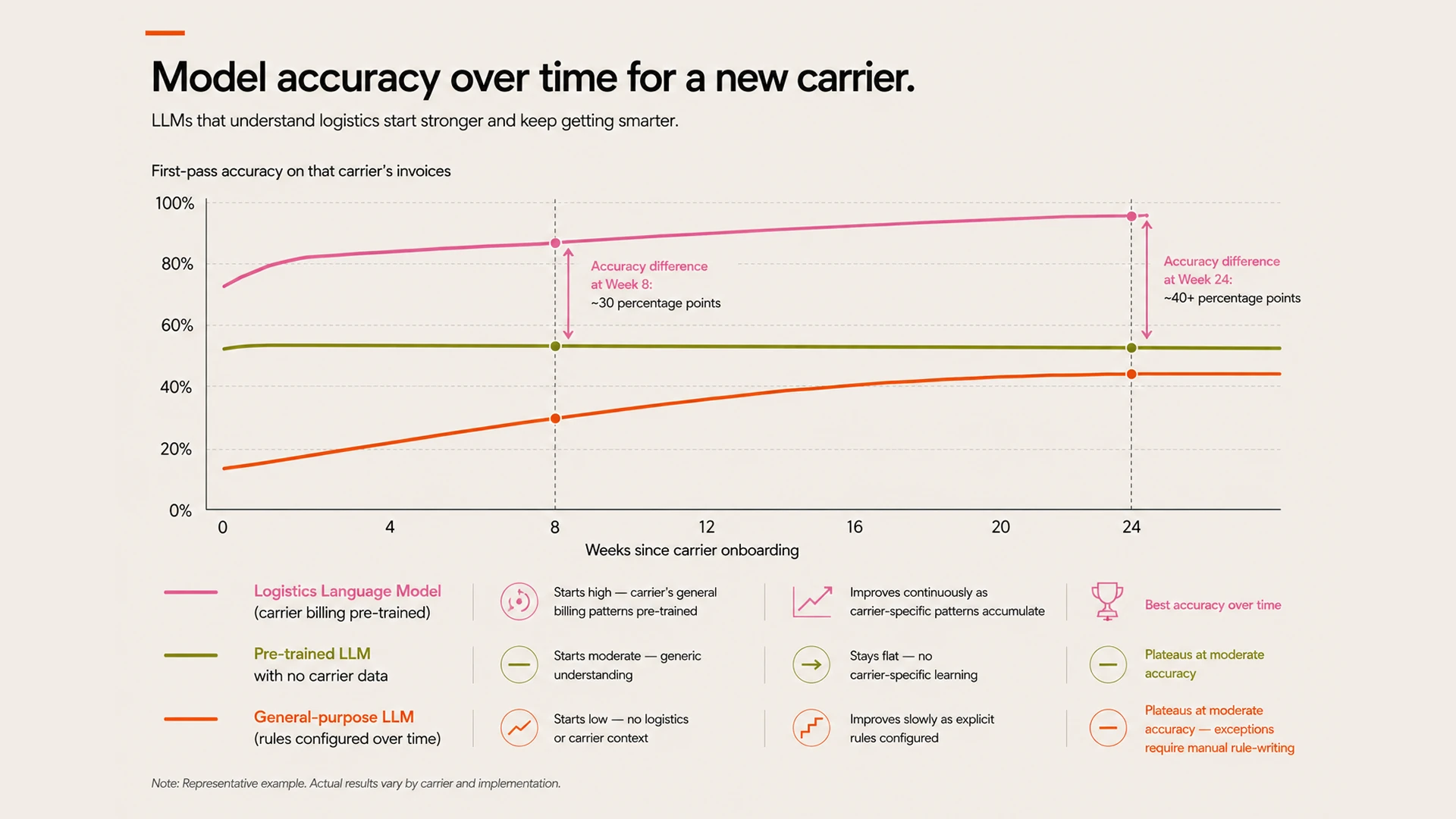
The model's carrier-specific knowledge is not static. It updates as new invoices are processed — when a carrier changes their billing behavior, the model detects the pattern change and updates its predictions accordingly. When a new carrier joins the customer's network, the model begins with the pre-trained baseline for that carrier's general billing patterns and refines it as invoices accumulate. The accuracy on a new carrier's invoices is high from day one (because the general patterns are pre-trained) and improves continuously (because the carrier-specific patterns are learned in production).
This continuous learning is also how the model handles carrier billing system errors — when a carrier's billing system is misconfigured after an update, producing invoices that deviate from their established pattern, the model detects the anomaly in the first billing cycle and flags it for investigation. The detection is not rule-based. It is pattern-based — the model knows what normal looks like for this carrier and surfaces deviation from it.