
How Multi-Way Matching Catches What Rate-vs-Invoice Matching Leaves Behind

April 8, 2026
•
8
mins

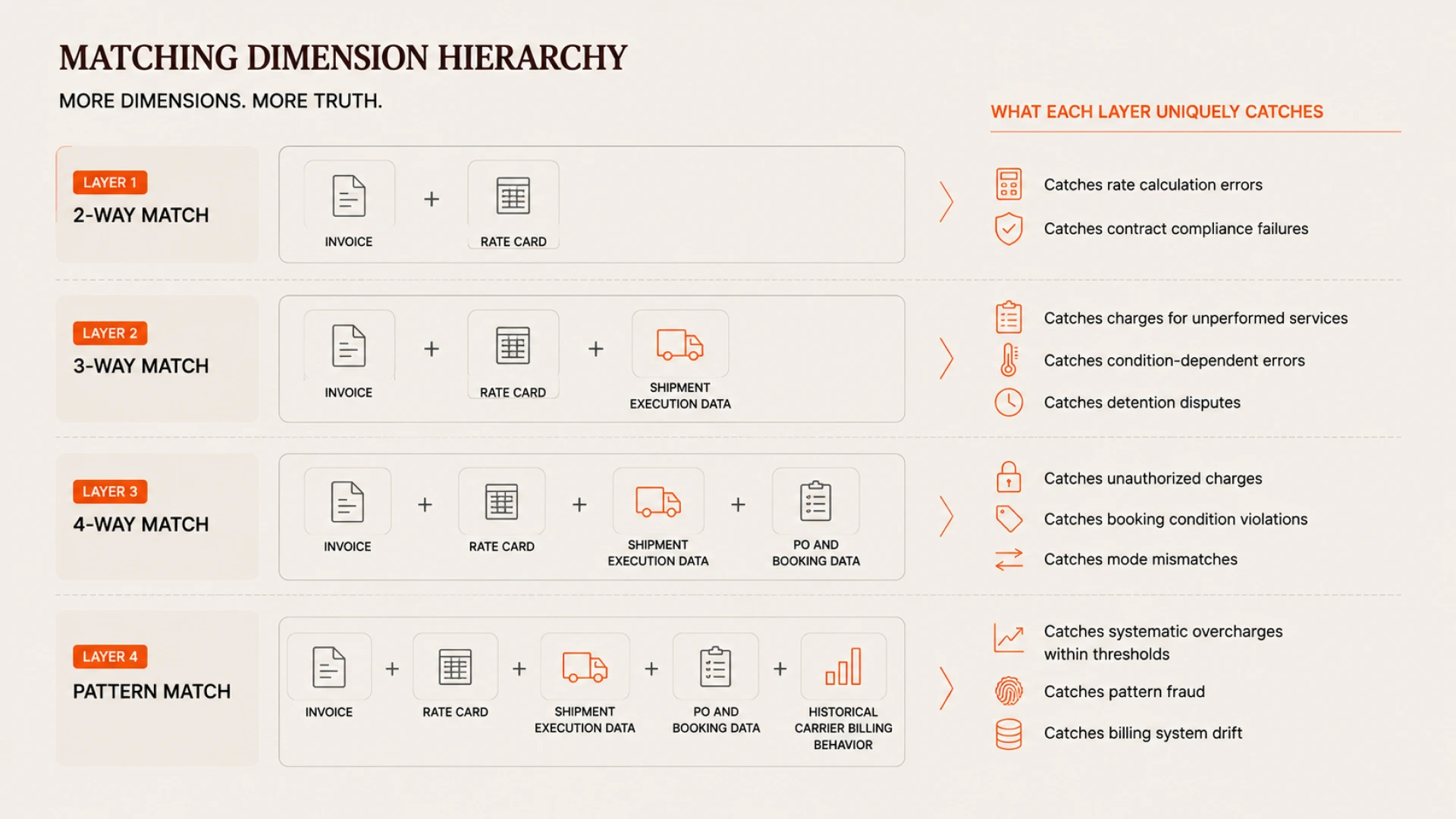
A 2-way match tells you if the rate is right. A 4-way match tells you if the charge is justified.
Two-way matching in freight audit is straightforward: compare the invoiced rate to the contracted rate. If the rate on the invoice matches the rate on the contract, the invoice passes. If it does not, it flags. This catches rate miscalculations and contract compliance failures. It does not catch a larger category of billing errors where the rate is correct but the charge is not.
A carrier that applies the correct contracted fuel surcharge rate to a fuel surcharge that was not triggered — because the shipment moved within the fuel surcharge exemption window in the contract — produces an invoice where the rate is right and the charge is wrong. A 2-way match passes it. A charge-level match against shipment execution data catches it.
What each additional matching dimension catches
The value of moving from 2-way to 3-way to 4-way matching is not incremental. Each additional dimension catches a qualitatively different category of billing error that the previous dimensions cannot see.
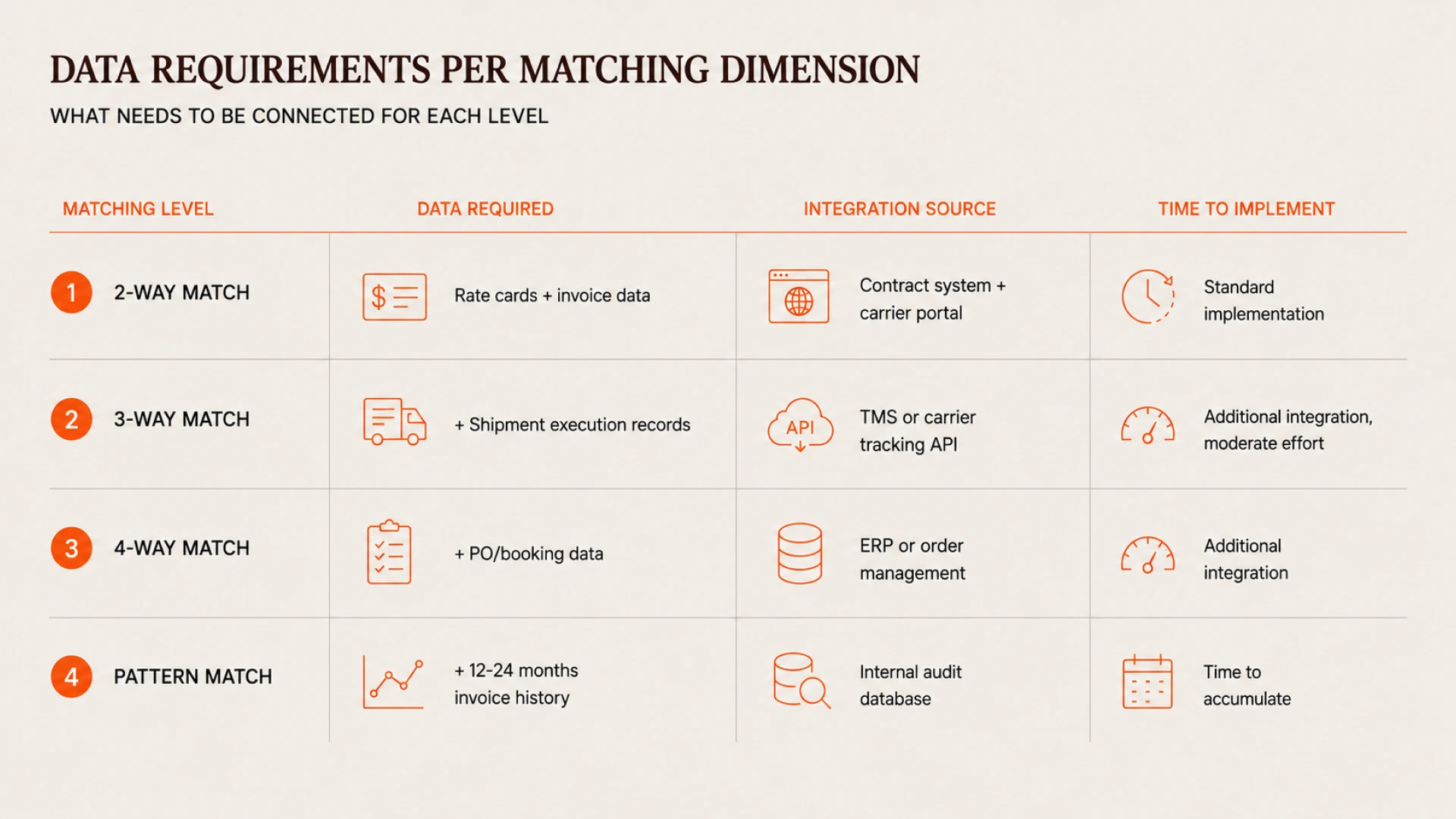
3-way matching adds the shipment execution record to the invoice and rate card comparison. This catches charges for services that were billed but not performed — detention charges where the carrier's own tracking data shows the driver was released within the free-time window, delivery attempts billed for addresses where the tracking record shows a successful delivery, accessorials triggered by shipment conditions that the execution data does not support.
The fourth dimension: historical carrier behavior
The fourth matching dimension is the one that separates systematic error detection from individual invoice validation. Historical carrier billing behavior — the record of how this carrier has billed on this lane for this service type over the past 12 to 24 months — provides a baseline against which current invoices can be compared. A charge that is individually within threshold but systematically 3% above the carrier's own historical billing pattern on this lane is a pattern anomaly that warrants investigation.
This is the dimension that catches the carrier whose fuel surcharge calculation drifted after an internal billing system update — not by a threshold-triggering amount on any individual invoice, but by a consistent small amount across every invoice processed since the update. Each invoice passes all the other matching tests. The pattern test catches the systematic deviation.
“A 2-way match answers: is this rate correct? A 4-way match with pattern analysis answers: is this charge justified, and does it make sense given everything we know about how this carrier bills?”
The data requirements for each dimension
Each matching dimension requires a data source that not all audit implementations have connected. 3-way matching requires shipment execution data — pickup timestamps, delivery timestamps, exception events, driver detention records — from the carrier's tracking system or the shipper's TMS. This is often the connection that implementations skip because it requires an additional integration that adds time to the project scope.
4-way matching with historical pattern analysis requires a persistent invoice history that spans enough billing cycles to establish statistical baselines — typically 12 to 24 months of invoices from each carrier at sufficient transaction volume to produce reliable patterns. An implementation that has been running for six months does not have the history required for robust pattern analysis. One that has been running for two years does. This is one of the reasons that pattern-based detection improves continuously over time rather than being static at deployment.