
Tariffs Rewrote the Sourcing Calendar. The RFQ Didn't Get the Memo.

March 2, 2026
•
7
mins
The 12-month sourcing cycle was built for a stable world. That world ended around 2025.
The standard enterprise freight sourcing model has not changed materially in 20 years. Procurement runs an RFQ in Q3 or Q4. Carriers respond. Rates are negotiated. Contracts are signed. The business operates against those rates for the next 12 months. The cycle repeats.
This model was built for an environment in which landed cost was relatively stable between sourcing cycles. It is not that environment anymore. The Supreme Court's ruling on Trump-era tariffs moved average U.S. tariff rates from 16.9% to 9.1% overnight, per Yale Budget Lab estimates. A company that locked its sourcing strategy in Q4 2025 woke up the next morning with rate cards that did not reflect the tariff structure they had been modeled against. The Q4 RFQ assumption: wrong the next morning.
98% of supply chain leaders are redesigning their sourcing strategy because of tariff changes (Gartner, 2025)
The 12-month cycle compounds the exposure
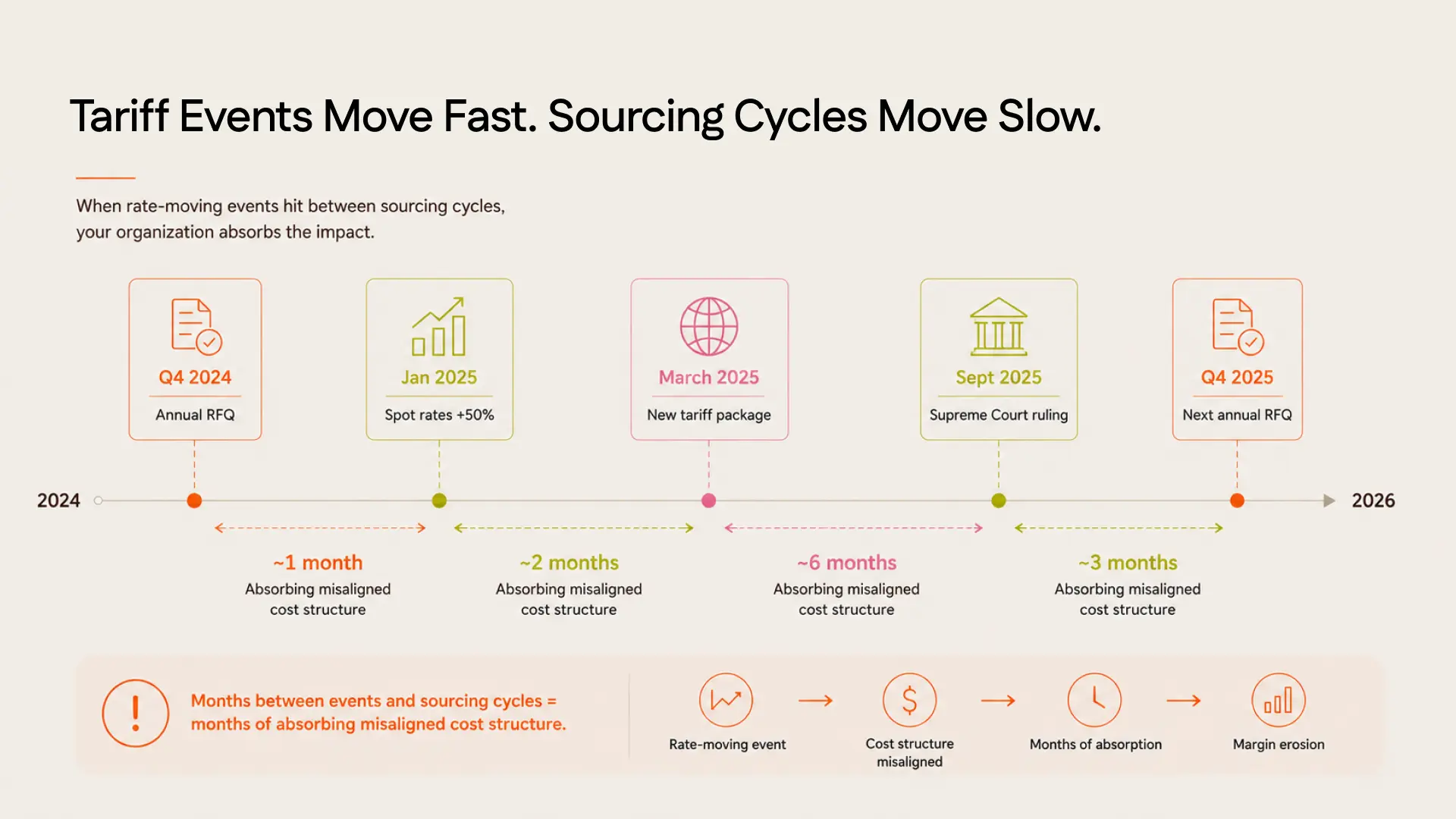
The 12-month sourcing cycle does not just create a one-time misalignment when conditions change. It compounds the exposure for the duration of the contract. A shipper who locked ocean rates in Q4 2024 at $4,500 per TEU on Asia-to-West-Coast lanes was operating against those rates while spot rates spiked 50% in early 2025. The contract insulated them partially, but their capacity allocation decisions, their carrier mix strategy, and their mode choices were all made against a cost basis that no longer reflected market reality.
The CNBC-ASCM survey puts this in operational terms: 65% of supply chain managers are absorbing at least 10 to 15% cost increases right now. Layoffs in the sector doubled to 32%. These are companies trying to manage a cost structure that their sourcing model was not designed to adapt to in real time.
What continuous sourcing actually requires
The response to this environment is not to run more frequent RFQs manually. A mid-cycle RFQ is a six-week analyst project under the current model: identify the affected lanes, build the bid templates, engage the carriers, negotiate, evaluate, award, and communicate. By the time the process completes, the market has moved again.
Continuous sourcing, in the sense that matters for 2026, requires operational plumbing that can compress the sourcing cycle from six weeks to days. That means three capabilities working together. First, a live rate intelligence feed connected to market benchmarks, so procurement knows when contracted rates are materially out of line with the market before waiting for a renewal cycle. Second, bid automation that can generate and send carrier RFQs against specific lane sets without the manual preparation that current RFQ processes require. Third, award logic that can evaluate responses and recommend reallocation based on cost and performance criteria without the multi-week evaluation project.
“When a tariff shift moves landed cost 15% overnight, waiting until Q4 to re-source means absorbing the spread for months. The companies holding margin are running sourcing on a different clock.”
The connected problem
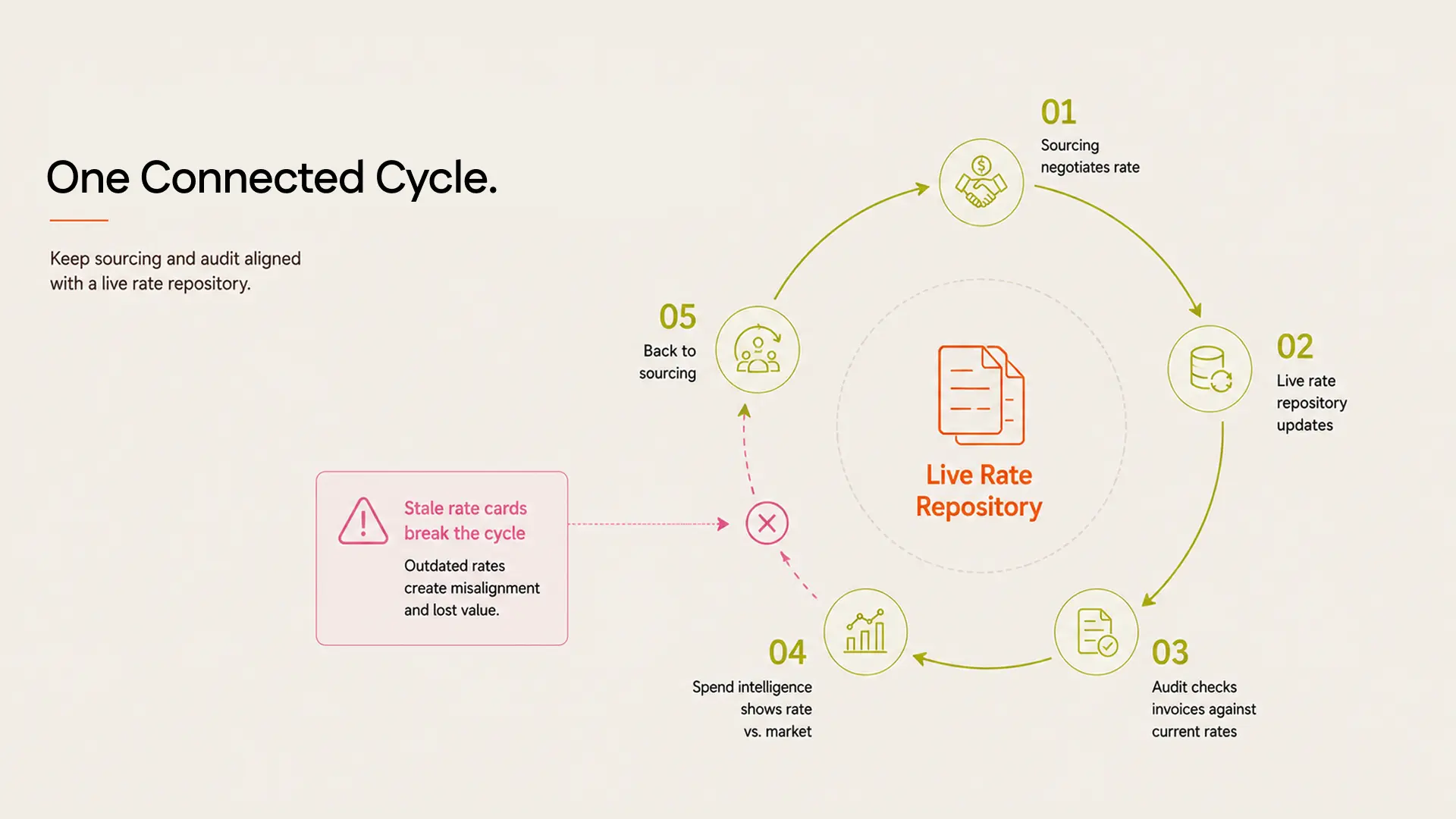
Continuous sourcing is not just a procurement process change. It creates a downstream audit problem that most enterprises have not thought through yet. When freight rates are changing mid-cycle, the contracted rate that the audit system checks invoices against needs to stay current. An audit system that checks invoices against a rate card locked in Q4 2024 will either flag legitimate charges as discrepancies or miss actual overcharges, depending on which direction the market moved. The sourcing cycle and the audit cycle need to share the same live rate repository, or the efficiency gains from faster sourcing are partially offset by the audit errors that stale rate cards produce.
This is the infrastructure problem that tariff volatility has surfaced. It was always present. Annual sourcing cycles made it manageable by minimizing the frequency of rate changes. Permanent tariff volatility makes it urgent.