
The Institutional Knowledge Problem in Freight Procurement

February 16, 2026
•
5
mins
When the person who held the context leaves, AI inherits an amnesiac system.
Freight procurement has a knowledge problem that predates AI and will outlast any particular AI deployment. It is the problem of institutional memory: the carrier exception approved after last year's service disruption, the accessorial rate that was verbally agreed to by an operations director who is no longer with the company, the lane preference that was negotiated into the contract three years ago and never made it into the TMS configuration.
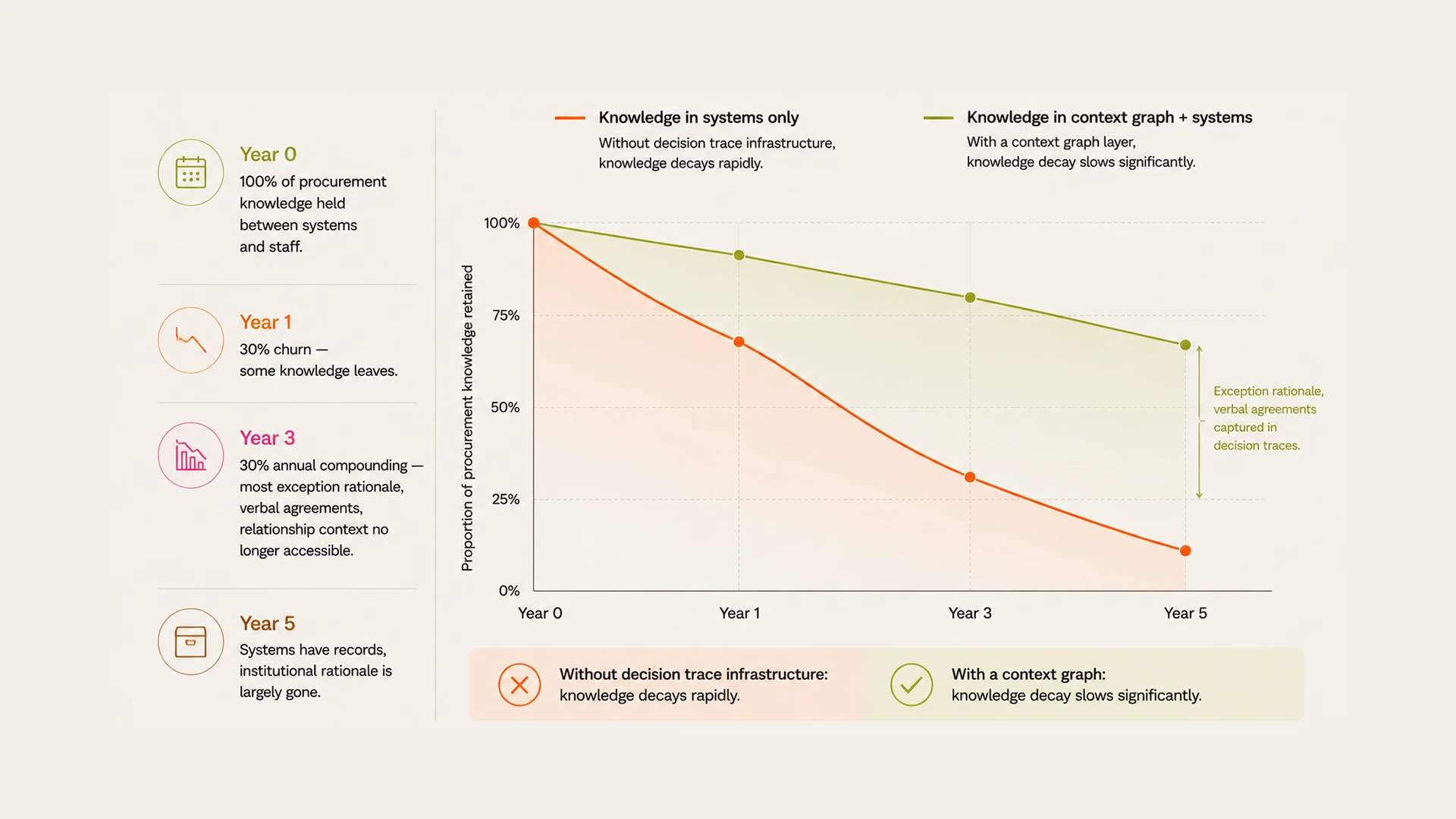
This knowledge is not in any system. It is in the heads of the people who negotiated those arrangements, managed those relationships, and handled those exceptions. When those people leave, and in freight procurement they leave at a rate of roughly 30 percent per year, the knowledge goes with them. The new person who inherits the account inherits the record without the rationale.
30% annual churn rate in freight procurement roles — institutional knowledge walks out annually
The record without the rationale
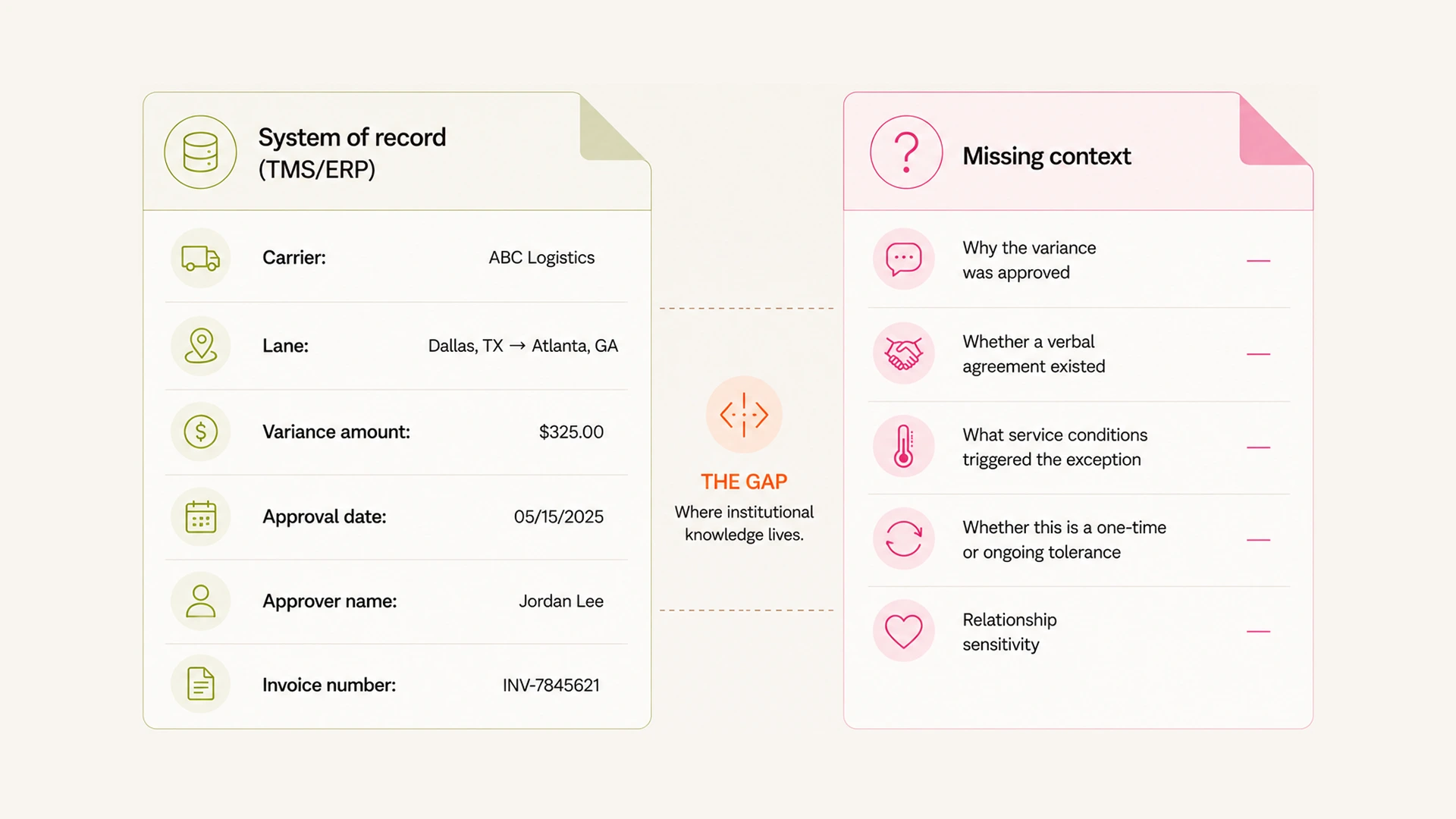
Enterprise procurement systems are excellent at recording transactions. A TMS records the shipment. The ERP records the invoice and payment. The carrier agreement records the contracted rates. What none of these systems record is the context in which decisions were made: why procurement accepted a 14 percent variance on that carrier's invoices for three consecutive months, whether it was because the carrier was providing exceptional service during a capacity crunch or because someone misconfigured the approval threshold and nobody caught it.
For an AI system trying to validate that same variance today, these two scenarios require different responses. In the first case, the variance may be within an informal tolerance that the operations team considers acceptable given the carrier's performance record. In the second case, it is a systematic billing error that should be disputed. Without access to the rationale behind the original decision, an AI cannot distinguish between them. It either approves everything that looks similar to past approvals, or it flags everything that deviates from contract, generating noise that operators learn to ignore.
Why this matters more than it used to
Institutional knowledge loss is not a new problem. It has existed as long as companies have had experienced employees who eventually leave. What has changed is that the cost of losing that knowledge has risen significantly as enterprises attempt to deploy AI in procurement operations.
An AI system that is supposed to take autonomous decisions on freight disputes needs to operate from a stable understanding of what the organization's established tolerances and preferences are. If that understanding is based only on transaction records, stripped of the rationale and context behind them, the AI will make decisions that are technically defensible but operationally wrong. It will dispute charges that the operations team has an unspoken agreement to absorb. It will approve charges that a knowledgeable analyst would flag as anomalous given a piece of context buried in a three-year-old email thread.
“Thirty years of institutional knowledge does not retire gracefully. It disappears overnight. AI built on transaction records inherits an amnesiac system.”
The capture problem and its solution
Solving this problem requires building infrastructure that captures decision rationale as decisions are made, not after the fact. That means connecting to the communication channels where decisions actually happen: email threads where exceptions are approved, Teams and Slack messages where quick calls are made, meeting notes where verbal agreements are recorded. It means building a system that reads those channels with enough semantic understanding to identify decision-relevant signals and link them to the procurement entities they concern.
This is not a data lake problem. Data lakes store everything without organizing it around the questions that matter. It is a context graph problem: building a queryable record of how your organization makes procurement decisions, so that when an AI agent needs to know whether a particular variance is within accepted tolerance, it can look that up rather than guess.
The 30 percent annual churn in freight procurement is not going to change. What can change is whether the institutional knowledge those people carry walks out with them or stays in the system.