
What a Live Rate Repository Changes About How Audit and Sourcing Interact

April 27, 2026
•
7
mins
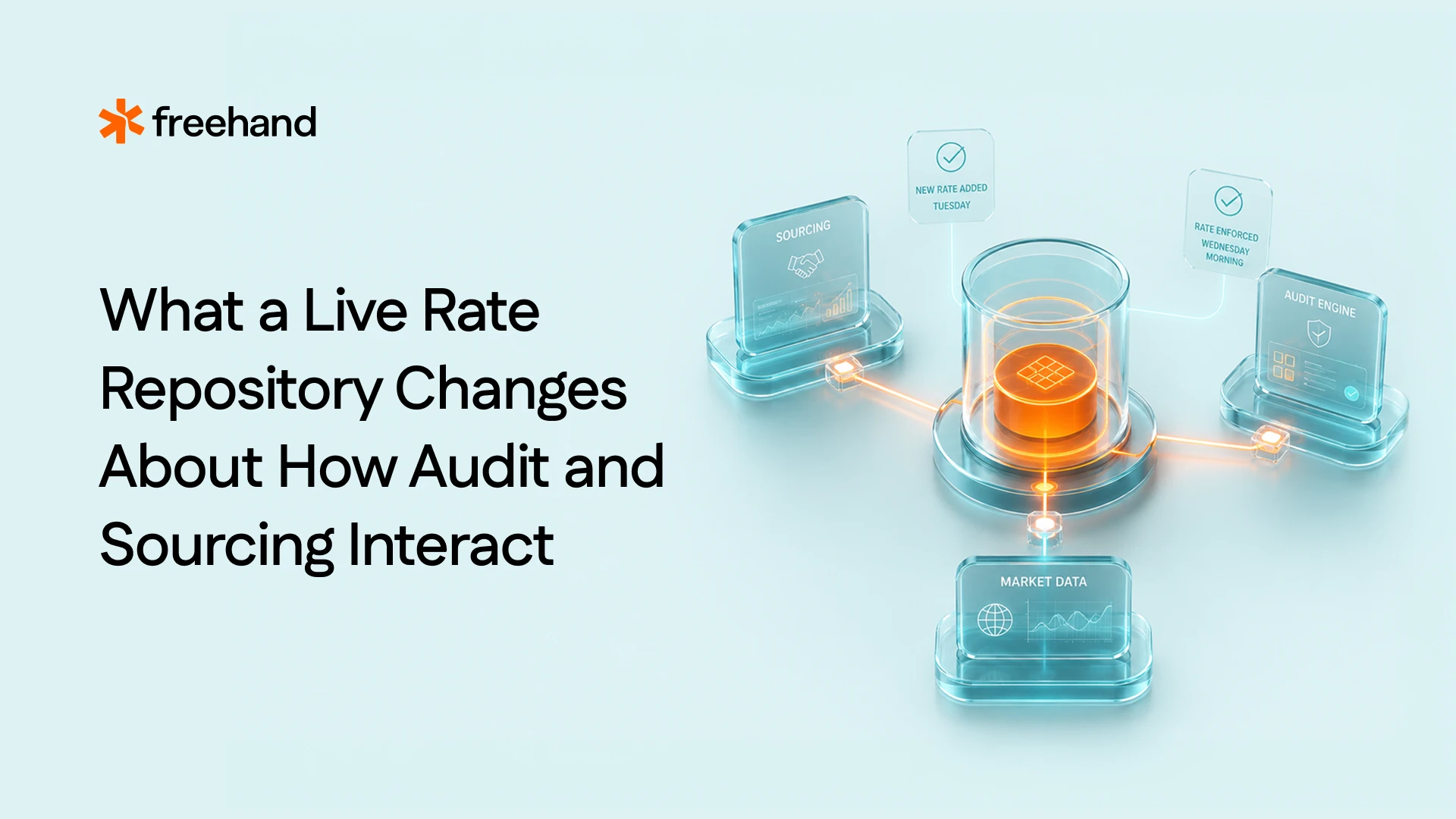
When sourcing and audit share one rate data source, the savings that procurement negotiates are immediately enforceable.
Freight procurement and freight audit are supposed to work in sequence: procurement negotiates the rate, audit enforces it. In most enterprises, this sequence has a gap. The rate that procurement negotiated lives in the contract management system. The rate that audit enforces lives in the audit platform's configuration. Between the two sits a manual update process — someone has to take the rate from the contract and put it in the audit system. Until that happens, the audit is enforcing the old rate.
The duration of that gap varies by organization. In best-case implementations with good process discipline, it is two to four weeks. In typical implementations where the rate configuration update competes with other implementation priorities, it is four to eight weeks. During that window, the procurement savings that the sourcing event produced are not being enforced. Invoices at the new rate might get flagged as discrepancies. Invoices at the old rate might pass clean when they should not.
The anatomy of a rate configuration lag
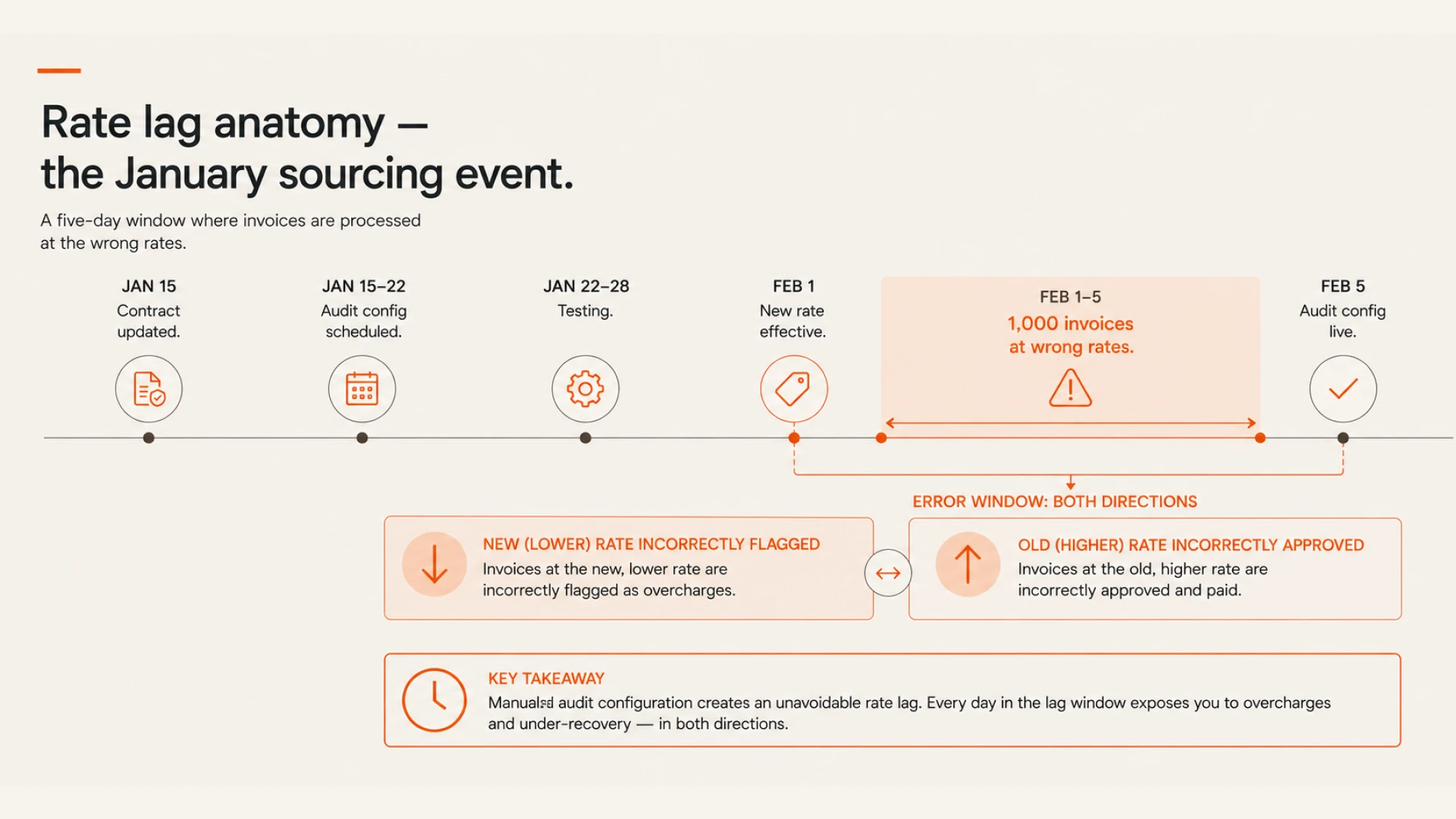
A sourcing event that completes in the second week of January produces a new rate card effective February 1. The procurement team updates the contract management system on January 15. The implementation team schedules the audit configuration update for the third week of January. An audit configuration update typically requires testing and validation before going live — running a sample of invoices against the new configuration to confirm it is producing correct results. Testing adds a week. The audit configuration goes live on February 5.
In the five days between February 1 and February 5, any invoices submitted under the new contract are checked against the old configuration. For a carrier processing 200 invoices per day, that is 1,000 invoices checked against wrong rates. Some will flag incorrectly. Some will pass when they should not. The procurement team does not know this is happening because the configuration update feels like a routine task that should have been handled by now.
What a shared live repository eliminates
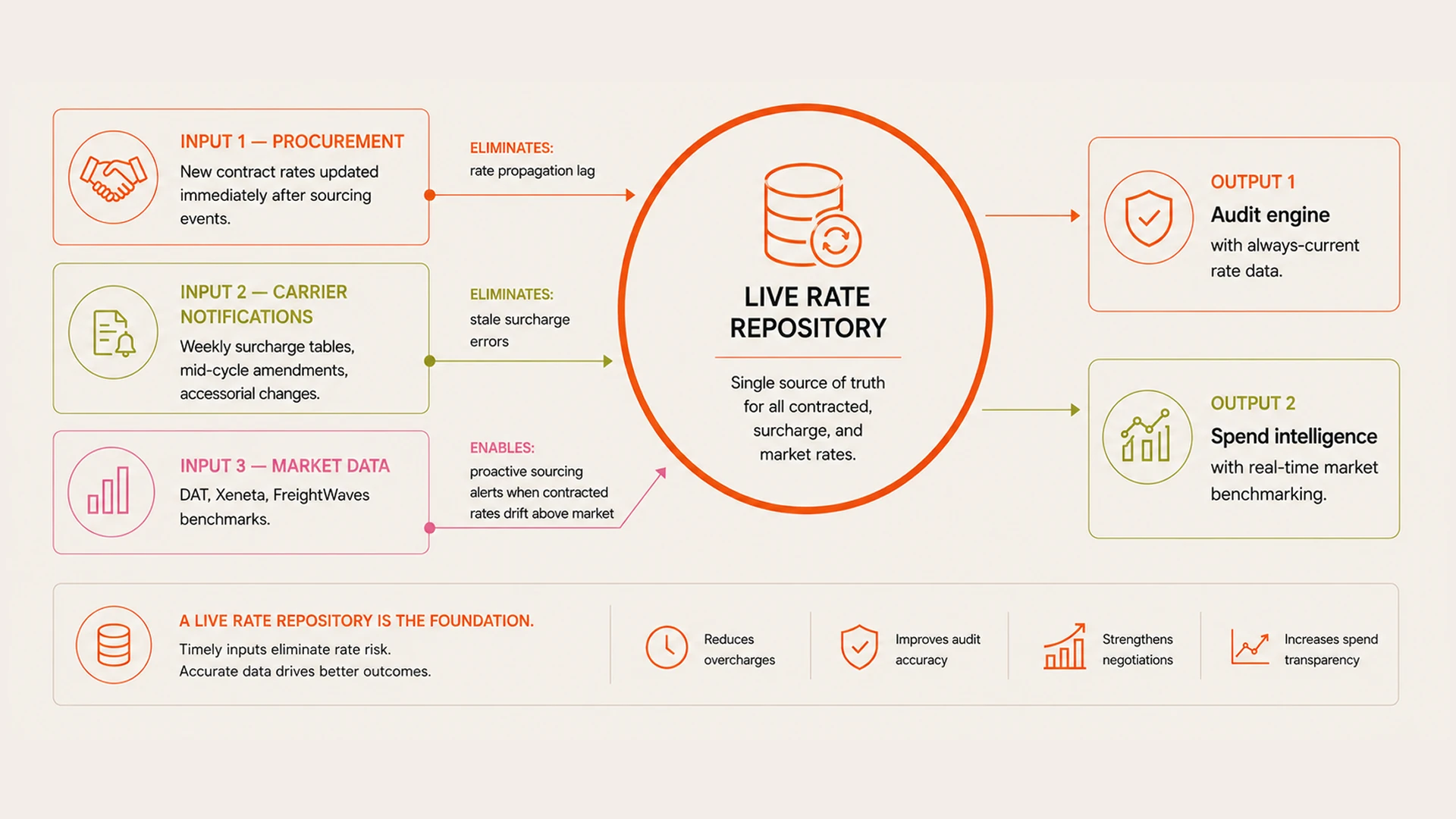
A live rate repository used by both sourcing and audit eliminates the handoff entirely. When procurement completes a rate negotiation and updates the repository, the audit engine reads from the same repository. The update is instantaneous from the audit system's perspective — not because the audit system is notified, but because it reads the rate from the repository at the time of invoice processing rather than from a pre-loaded configuration.
This architectural change has a second benefit that is less obvious: it makes real-time rate benchmarking possible within the audit workflow. An audit system that reads from a live repository that also contains market rate data from DAT, Xeneta, or FreightWaves can benchmark every invoice not just against the contracted rate but against current market rates. A contracted rate that was competitive when negotiated six months ago may now be above market on certain lanes. The audit system surfaces this as spend intelligence rather than waiting for the next sourcing cycle to discover it.
“The sourcing savings are hypothetical until audit enforces them. A live rate repository is what makes enforcement instantaneous.”
Carrier rate change notifications as a third input
A live rate repository that also ingests carrier rate change notifications — the weekly fuel surcharge updates, the mid-cycle accessorial amendments, the seasonal rate adjustments — gives the audit system a third input that eliminates a different class of error. Carriers who update their billing logic mid-contract, with or without explicit shipper notification, will have those changes reflected in the audit configuration within hours rather than weeks. Invoices billed under the updated billing logic are checked against the updated audit configuration automatically.
The combined effect — procurement rates updated immediately, market benchmarks current, carrier rate changes ingested in near-real-time — produces an audit system that is always operating against accurate rate data rather than against a configuration that reflects the state of rates at some point in the past. The improvement in audit accuracy compounds over time as the number of stale-rate-card false positives and missed overcharges declines.