
What It Means to Anchor LLM Outputs to a Verified Graph

April 13, 2026
•
7
mins
A general-purpose LLM produces plausible-sounding freight audit logic. Plausible is not the same as correct.
The most common failure mode in enterprise AI deployments is not hallucination in the dramatic sense — an AI confidently stating something completely fabricated. It is plausible incorrectness: an AI producing reasoning that sounds authoritative, applies the right general principles, and arrives at a conclusion that is wrong in ways that require domain expertise to detect.
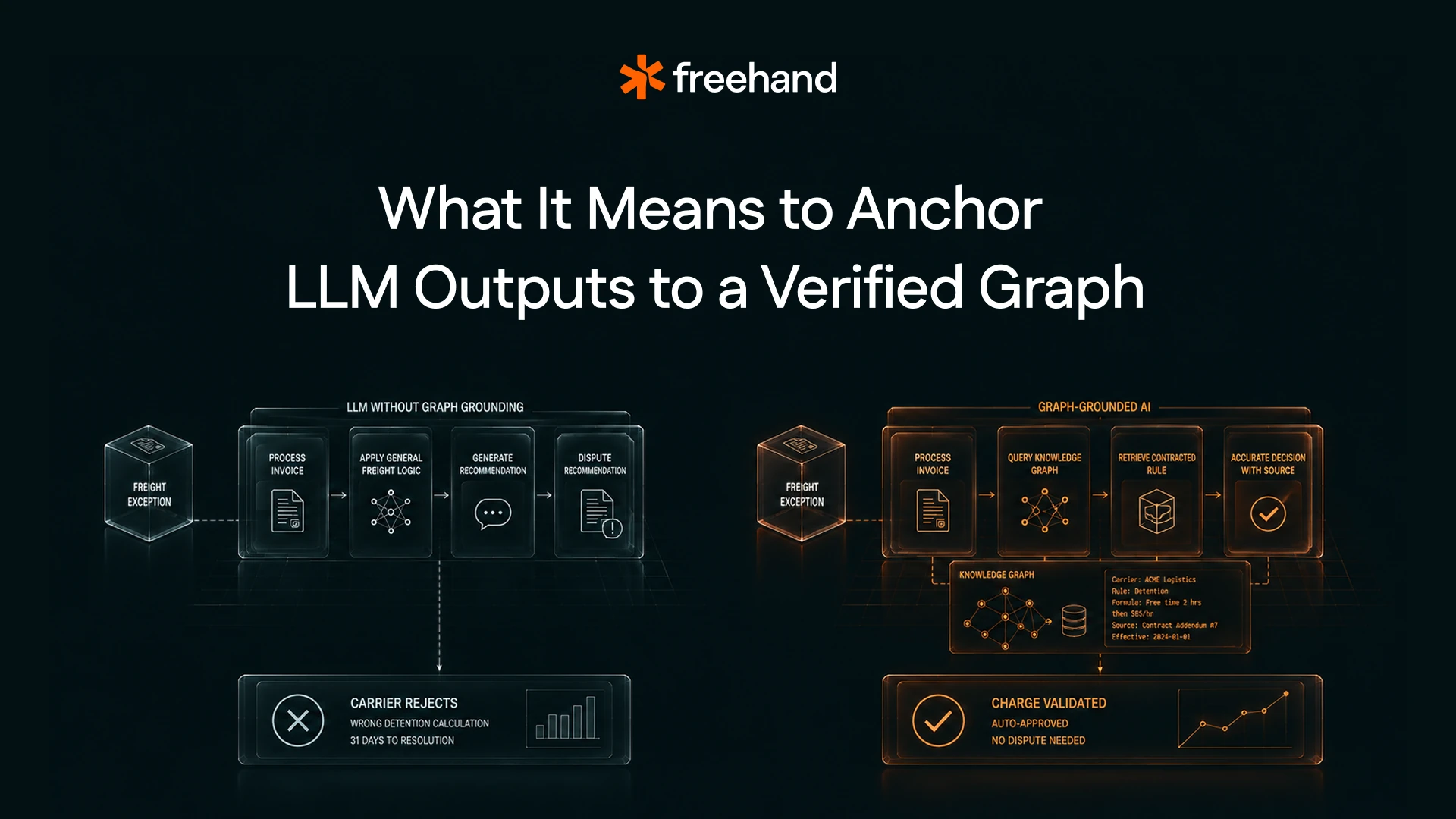
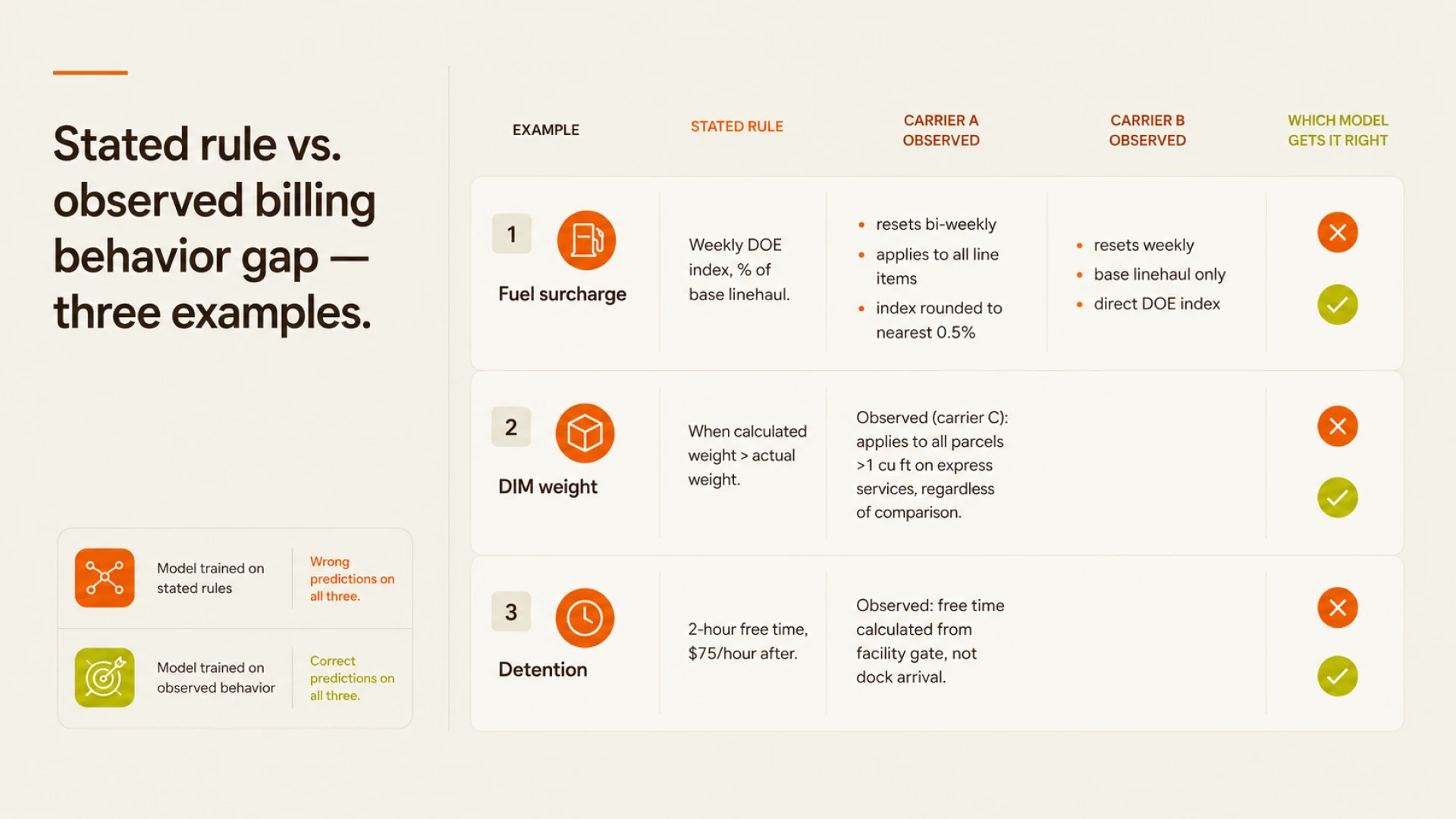
In freight audit, plausible incorrectness is operationally dangerous because the decisions being made are financially material and time-sensitive. An AI that confidently categorizes a detention exception using the wrong carrier-specific detention rules will produce a dispute packet that the carrier rejects on contact, wasting the time that autonomous exception management was supposed to save. An AI that approves a dimensional weight charge because the DIM weight calculation looks reasonable in principle — but uses the wrong divisor for this carrier's service type — produces an overpayment that passes without detection.
Why general-purpose LLMs get freight wrong
A general-purpose LLM has been trained on a large corpus of text that includes logistics documentation, carrier agreements, freight industry publications, and regulatory filings. It has a genuine understanding of freight concepts — what detention is, how fuel surcharges work, what NMFC classifications are. This understanding is real and it enables the LLM to produce freight-adjacent reasoning that reads as authoritative.
What the general-purpose LLM does not have is the current, carrier-specific, contract-specific ground truth required to apply that reasoning correctly to a real invoice. The NMFC classification the LLM knows is the general one. The applicable classification is the one in this shipper's specific carrier contract, which may differ from the standard. The fuel surcharge calculation the LLM applies is the common formula. The applicable calculation is the one specified in this carrier's current rate card, indexed to the specific fuel table that this contract references.
What grounding to a verified graph changes
Grounding LLM outputs to a verified knowledge graph changes the computational architecture of the AI's reasoning. Instead of drawing on training data to produce a response, the LLM queries the knowledge graph for the specific, verified facts relevant to this decision, and generates its response based on those retrieved facts rather than on its training priors.
For a freight audit agent, this means the detention calculation is not the LLM's understanding of how detention is generally calculated. It is the specific formula retrieved from the knowledge graph for this carrier on this lane on this contract vintage. The fuel surcharge table is not the standard formula — it is the current table for this carrier, retrieved from the rate card the knowledge graph has ingested and verified. The dispute logic is not general principles of freight dispute — it is the pattern of how this type of exception has been successfully disputed with this carrier based on historical resolution records.
“A general-purpose LLM knows how freight audit works. A graph-grounded AI knows how your freight audit works. The difference is the precision required to be right on a real invoice.”
SOX compliance and the accountability requirement
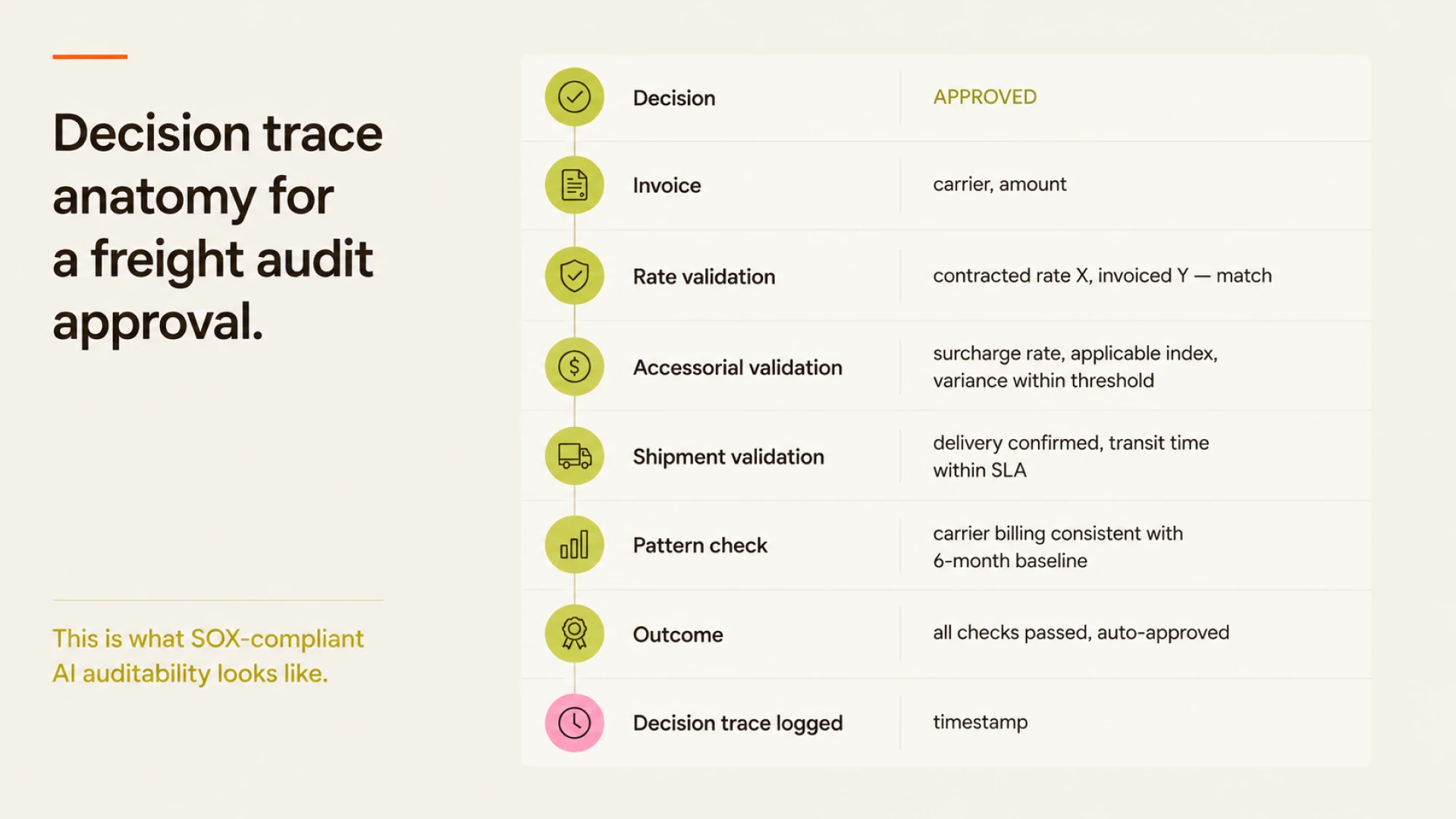
In a regulated finance environment, the accuracy requirement is necessary but not sufficient. The AI also needs to be accountable — every decision needs to be traceable to the specific facts and logic that produced it. When an auditor asks why a particular invoice was approved, the answer cannot be 'the AI decided.' It needs to be: this invoice was approved because the contracted rate was $X, the shipment data confirmed condition Y, and the historical pattern on this carrier supports the conclusion that the charge was within contracted tolerance.
Graph-grounded AI produces this traceability as a natural output of the reasoning architecture. The facts retrieved from the knowledge graph are logged alongside the decision. The reasoning steps that connected the facts to the conclusion are structured and stored. The audit trail is not a separate reporting layer added on top of the decision — it is the record of how the decision was made.