
Why Pattern Detection Catches What Invoice Matching Misses

February 27, 2026
•
6
mins
The unit of analysis in freight audit is not the invoice. It is the carrier's billing behavior across invoices.
Invoice matching has a well-defined scope. It compares a submitted invoice against a known standard: the contracted rate, the shipment record, the purchase order. When the invoice conforms to all three, it passes. When it deviates, it flags. The logic is sound. The limitation is in what the matching model treats as its unit of analysis: the individual invoice.
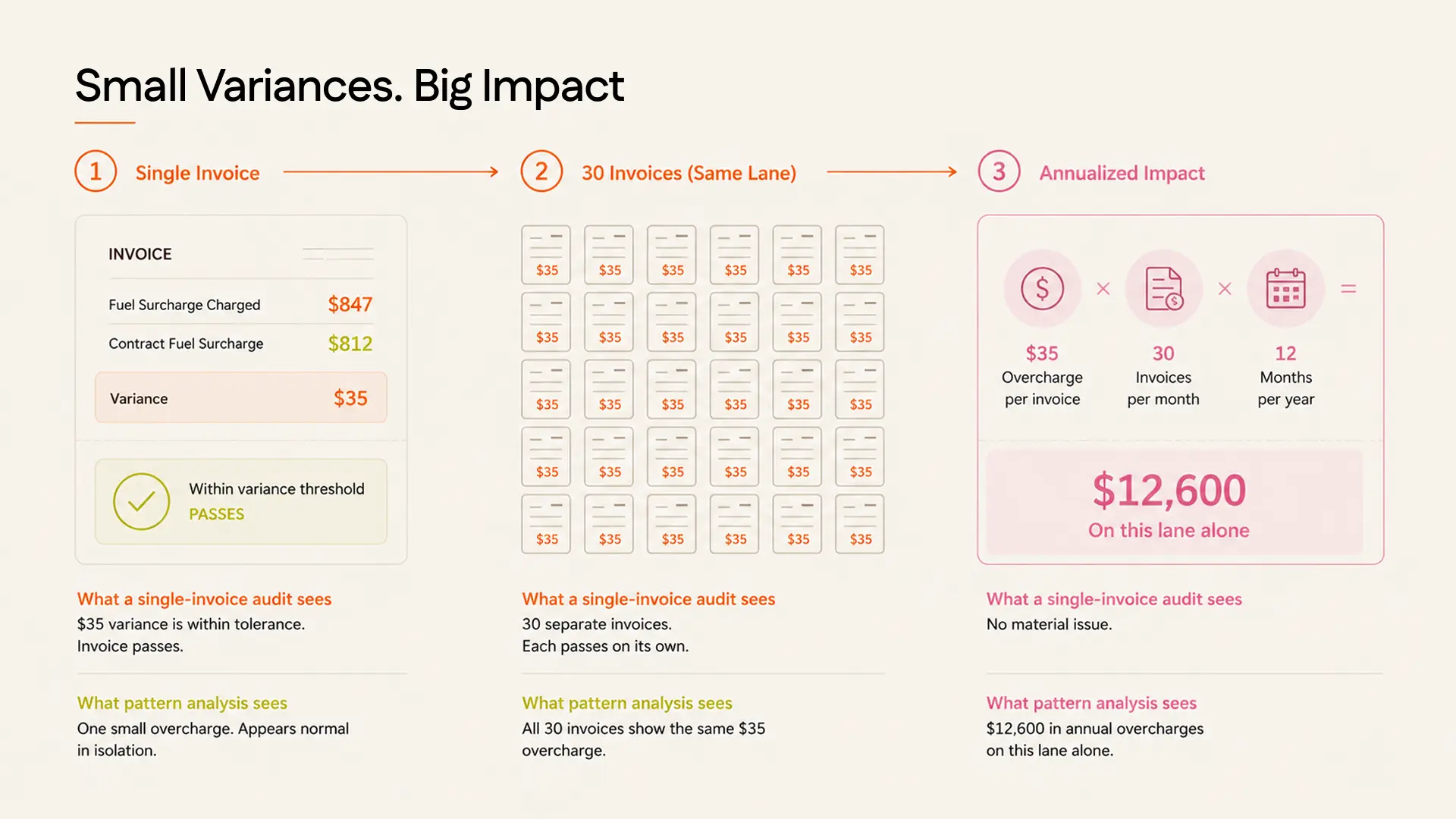
The individual invoice is the wrong unit for a significant category of billing errors. Not because the matching is wrong on the individual document, but because the pattern of errors across the invoice population encodes information that no single invoice contains. An invoice with a correctly calculated fuel surcharge is a clean invoice. Five hundred invoices with the same correctly calculated fuel surcharge, from a carrier whose contract specifies a different calculation method than the one being applied, is a systematic overcharge. No individual invoice flags. The pattern does.
What pattern detection requires
Detecting billing patterns at scale requires three things that are architecturally distinct from invoice matching.
First, a persistent invoice history that spans the relationship, not just the current billing cycle. Pattern detection compares current invoices against the historical distribution of charges for this carrier on this lane in this service type. That requires a data store that holds the full billing history, not just the current batch.
Second, a statistical model of what normal billing looks like for each carrier-lane-service combination. Normal is not just the contracted rate. It is the distribution of actual charges, including the accessorial variance that is legitimately carrier-specific and the variance that represents systematic deviation from what the contract allows.
Third, anomaly detection logic that runs across the invoice population continuously rather than on each invoice as it arrives. An invoice that is individually unremarkable may be anomalous relative to the baseline. Detecting that requires reading across the population in context.
The carrier behavior model
The most useful mental model for pattern-based freight audit is not 'what does this invoice say' but 'what does this carrier's billing behavior look like.' Carriers, like any billing entity, have consistent patterns. A carrier that systematically applies a higher DIM weight divisor than the contract specifies will do so across all affected shipments, not just some. A carrier that mis-categories LTL freight in a way that upgrades it to a higher-cost NMFC class will do so whenever that freight type appears in their system.
These patterns persist until they are surfaced and disputed. The dispute does not happen unless someone is reading the invoice population as a whole, not just validating individual documents. Manual audit cannot do this at enterprise invoice volumes. A human reviewing 200 invoices per day has no working memory that spans 50,000 invoices. The carrier's billing behavior over six months is not visible to them.
“A carrier's billing system doesn't make random errors. It makes systematic ones. The patterns are readable if you are looking at the right unit of analysis.”
Recurring exception suppression as the operational output
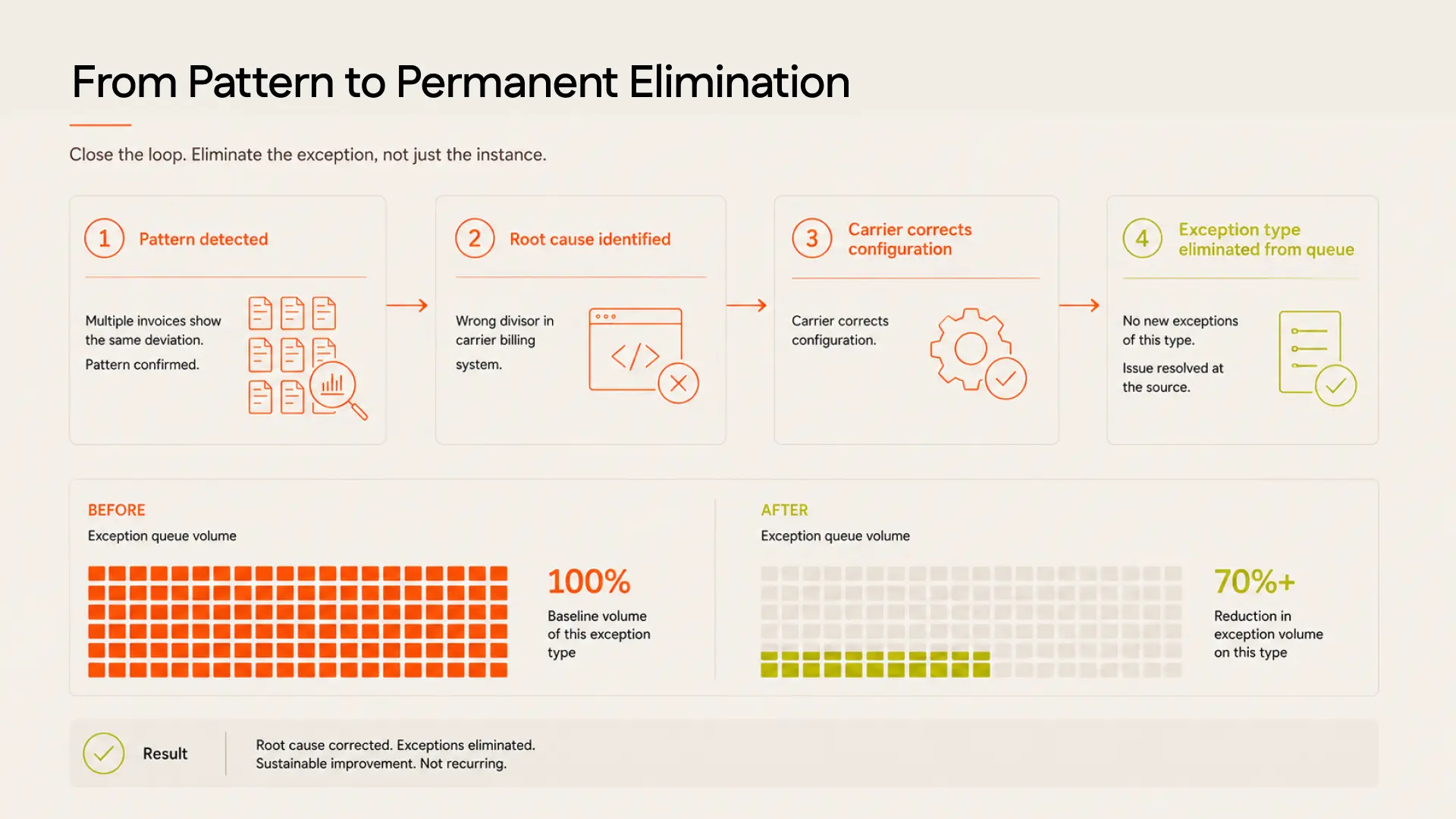
When pattern detection identifies a systematic billing behavior, the appropriate response depends on whether the behavior is a billing error or a misunderstanding. In most cases, it is a configuration issue in the carrier's billing system: a divisor that was set incorrectly when the account was set up, a surcharge table that was never updated to reflect the current contract, an NMFC classification that defaults to the wrong category for certain shipment types.
Once the pattern is identified and the carrier corrects the underlying configuration, the exception stops recurring. The operational value of this is significant: rather than reviewing the same exception type every billing cycle, the audit program eliminates it. The 70 percent reduction in recurring exceptions within 90 days that comprehensive AI audit produces is not primarily from catching more errors on existing invoices. It is from identifying the systematic patterns, surfacing them to carriers, and having them correct the root cause.