
Why the Global Trade Compliance Gap Is Bigger Than Most Supply Chain Teams Realize

April 10, 2026
•
8
mins
HS code misclassification and missed FTA qualification are not compliance risks. They are cost recovery opportunities that are currently silent.
Twenty-three percent of supply chain buyers identified global trade management as their top software investment priority for 2026, according to Gartner's Supply Chain Technology User Wants and Needs Survey. Ninety-eight percent of supply chain organizations are redesigning their sourcing strategy because of tariff changes. These are large numbers. The reason they are large is that the compliance gap has become expensive enough to force attention that previously was not there.
The compliance gap itself is not new. HS code misclassification has always produced customs duty overpayments. Free trade agreement qualification has always required documentation that many companies assembled imperfectly or not at all. The gap was present and the cost was real. What changed is that tariff volatility made the cost visible in a way it was not before — when duties move from 9% to 25% on a product category, the cost of misclassifying that product category is no longer a rounding consideration.
What the gap actually costs
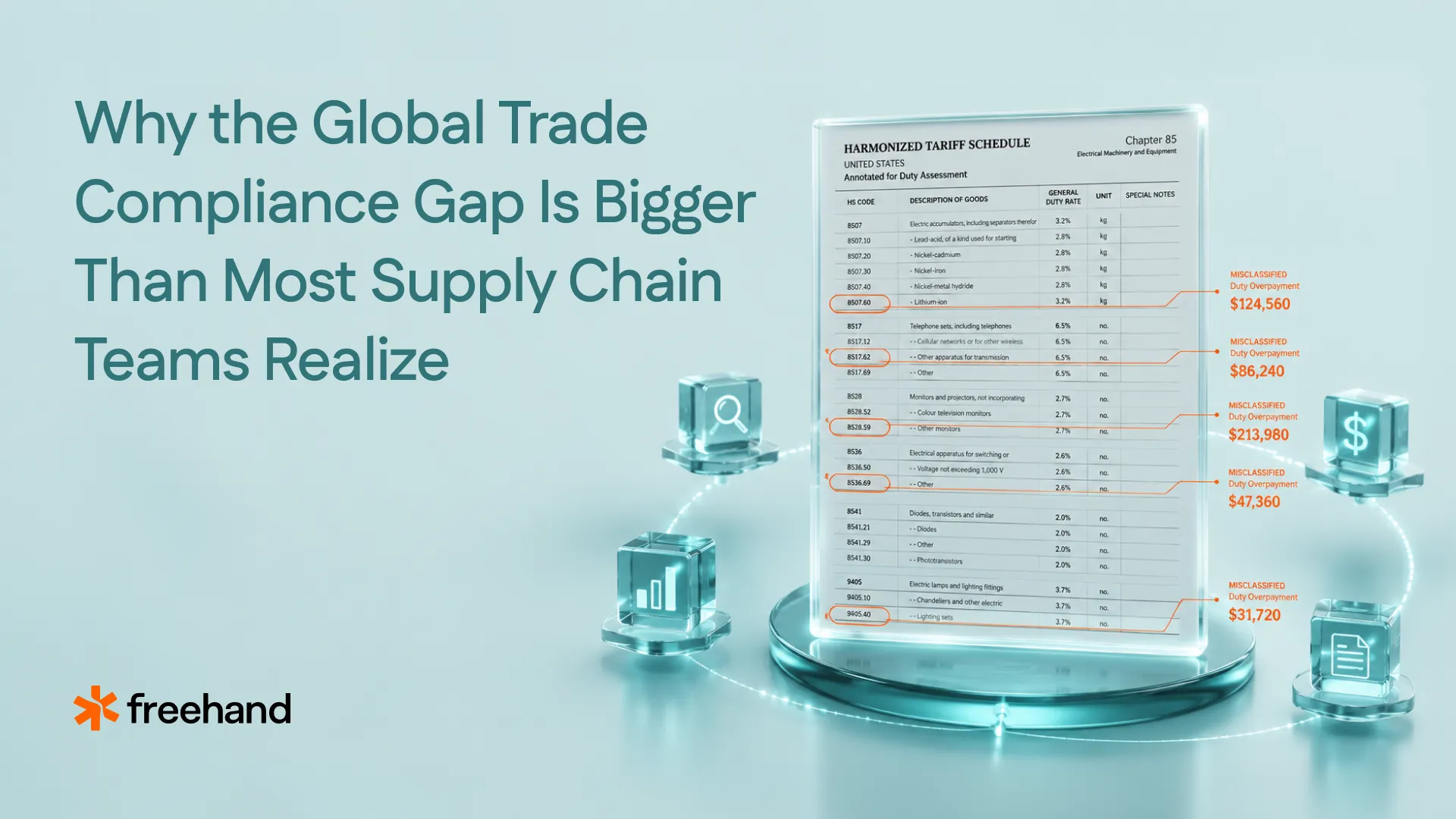
HS code misclassification produces two categories of cost. The first is overpayment: goods classified in a higher-duty code than the correct code result in customs duty payments above what is owed. In a period of high tariff rates, this overpayment scales proportionally. The second is underpayment risk: goods classified in a lower-duty code than the correct code create regulatory exposure — penalties, additional assessments, and in repeat-violation scenarios, potential import restrictions.
FTA qualification failure is the inverse: goods that are eligible for preferential duty treatment under a free trade agreement but are not properly documented for qualification pay full duties they do not owe. For a company with significant trade flows between the United States and Canada, the USMCA preferential rate versus the MFN tariff rate can represent the difference between paying 0% and paying 25% on affected product categories. The qualification documentation is a form-filling exercise. The cost of not completing it correctly is material.
![HS code misclassification and missed FTA qualification are not compliance risks. They are cost recovery opportunities that are currently silent. Twenty-three percent of supply chain buyers identified global trade management as their top software investment priority for 2026, according to Gartner's Supply Chain Technology User Wants and Needs Survey. Ninety-eight percent of supply chain organizations are redesigning their sourcing strategy because of tariff changes. These are large numbers. The reason they are large is that the compliance gap has become expensive enough to force attention that previously was not there. The compliance gap itself is not new. HS code misclassification has always produced customs duty overpayments. Free trade agreement qualification has always required documentation that many companies assembled imperfectly or not at all. The gap was present and the cost was real. What changed is that tariff volatility made the cost visible in a way it was not before — when duties move from 9% to 25% on a product category, the cost of misclassifying that product category is no longer a rounding consideration. What the gap actually costs HS code misclassification produces two categories of cost. The first is overpayment: goods classified in a higher-duty code than the correct code result in customs duty payments above what is owed. In a period of high tariff rates, this overpayment scales proportionally. The second is underpayment risk: goods classified in a lower-duty code than the correct code create regulatory exposure — penalties, additional assessments, and in repeat-violation scenarios, potential import restrictions. FTA qualification failure is the inverse: goods that are eligible for preferential duty treatment under a free trade agreement but are not properly documented for qualification pay full duties they do not owe. For a company with significant trade flows between the United States and Canada, the USMCA preferential rate versus the MFN tariff rate can represent the difference between paying 0% and paying 25% on affected product categories. The qualification documentation is a form-filling exercise. The cost of not completing it correctly is material. [INFOGRAPHIC 1] Visual: Three categories of GTM compliance cost. Category 1: HS code misclassification (overpayment). Show product category, correct HS code (lower duty rate), misclassified HS code (higher duty rate), duty overpayment per unit, annualized at realistic import volume. Category 2: FTA qualification failure (missed preferential rate). Show product eligible for USMCA, MFN tariff rate (25%), USMCA preferential rate (0%), duty paid unnecessarily per unit, annualized. Category 3: Underpayment risk (regulatory exposure). Show potential penalty range as a multiple of the underpayment. Use anonymized representative numbers. Total: the compliance gap is a recovery opportunity and a risk simultaneously. Why the gap persists despite the cost Trade compliance has historically been treated as a cost center and a regulatory obligation rather than a value recovery function. The team responsible for it is typically small, specialized, and measured on compliance outcomes — whether shipments clear customs, whether the documentation is complete — rather than on cost optimization outcomes such as duty recovery and FTA utilization rates. HS code classification at scale is genuinely difficult. A large importer with thousands of SKUs across multiple product categories faces a classification problem that requires both deep regulatory knowledge and the ability to apply it consistently at transaction volume. Manual classification by a trade compliance team cannot keep pace with the SKU count and the frequency of tariff schedule updates. The result is classification decisions made once per SKU and maintained until someone notices they are wrong — which typically happens when a customs audit surfaces the discrepancy. “Most HS code classification errors are not discovered in customs audits. They are discovered by companies that start running systematic review for the first time and find years of accumulated overpayment.” What AI-driven classification changes AI-driven HS code classification applies consistent classification logic across every SKU at every transaction, rather than once per SKU per year. When tariff schedules update — which happens with some regularity during periods of active trade policy — the classification logic updates across the affected SKU population rather than waiting for a human to identify which SKUs need review. FTA qualification documentation is assembled automatically based on the origin and value content of each shipment rather than relying on a static template that may not reflect current product composition. The 16.7% CAGR forecast for the global trade management software market through 2029 reflects the recognition that this problem is both real and addressable. The companies building the classification and qualification infrastructure now are the ones who will have the visibility to recover overpayments from the current tariff environment and the systematic compliance posture to manage the next one.](https://cdn.prod.website-files.com/69a9744c90c7ff7e8784c3c9/6a34c9be4340b50bc70fa57d_6a33851053c9088b186b5666_Infographic_01_Why.webp)
Why the gap persists despite the cost
Trade compliance has historically been treated as a cost center and a regulatory obligation rather than a value recovery function. The team responsible for it is typically small, specialized, and measured on compliance outcomes — whether shipments clear customs, whether the documentation is complete — rather than on cost optimization outcomes such as duty recovery and FTA utilization rates.
HS code classification at scale is genuinely difficult. A large importer with thousands of SKUs across multiple product categories faces a classification problem that requires both deep regulatory knowledge and the ability to apply it consistently at transaction volume. Manual classification by a trade compliance team cannot keep pace with the SKU count and the frequency of tariff schedule updates. The result is classification decisions made once per SKU and maintained until someone notices they are wrong — which typically happens when a customs audit surfaces the discrepancy.
“Most HS code classification errors are not discovered in customs audits. They are discovered by companies that start running systematic review for the first time and find years of accumulated overpayment.”
What AI-driven classification changes
AI-driven HS code classification applies consistent classification logic across every SKU at every transaction, rather than once per SKU per year. When tariff schedules update — which happens with some regularity during periods of active trade policy — the classification logic updates across the affected SKU population rather than waiting for a human to identify which SKUs need review. FTA qualification documentation is assembled automatically based on the origin and value content of each shipment rather than relying on a static template that may not reflect current product composition.
The 16.7% CAGR forecast for the global trade management software market through 2029 reflects the recognition that this problem is both real and addressable. The companies building the classification and qualification infrastructure now are the ones who will have the visibility to recover overpayments from the current tariff environment and the systematic compliance posture to manage the next one.
![HS code misclassification and missed FTA qualification are not compliance risks. They are cost recovery opportunities that are currently silent. Twenty-three percent of supply chain buyers identified global trade management as their top software investment priority for 2026, according to Gartner's Supply Chain Technology User Wants and Needs Survey. Ninety-eight percent of supply chain organizations are redesigning their sourcing strategy because of tariff changes. These are large numbers. The reason they are large is that the compliance gap has become expensive enough to force attention that previously was not there. The compliance gap itself is not new. HS code misclassification has always produced customs duty overpayments. Free trade agreement qualification has always required documentation that many companies assembled imperfectly or not at all. The gap was present and the cost was real. What changed is that tariff volatility made the cost visible in a way it was not before — when duties move from 9% to 25% on a product category, the cost of misclassifying that product category is no longer a rounding consideration. What the gap actually costs HS code misclassification produces two categories of cost. The first is overpayment: goods classified in a higher-duty code than the correct code result in customs duty payments above what is owed. In a period of high tariff rates, this overpayment scales proportionally. The second is underpayment risk: goods classified in a lower-duty code than the correct code create regulatory exposure — penalties, additional assessments, and in repeat-violation scenarios, potential import restrictions. FTA qualification failure is the inverse: goods that are eligible for preferential duty treatment under a free trade agreement but are not properly documented for qualification pay full duties they do not owe. For a company with significant trade flows between the United States and Canada, the USMCA preferential rate versus the MFN tariff rate can represent the difference between paying 0% and paying 25% on affected product categories. The qualification documentation is a form-filling exercise. The cost of not completing it correctly is material. [INFOGRAPHIC 1] Visual: Three categories of GTM compliance cost. Category 1: HS code misclassification (overpayment). Show product category, correct HS code (lower duty rate), misclassified HS code (higher duty rate), duty overpayment per unit, annualized at realistic import volume. Category 2: FTA qualification failure (missed preferential rate). Show product eligible for USMCA, MFN tariff rate (25%), USMCA preferential rate (0%), duty paid unnecessarily per unit, annualized. Category 3: Underpayment risk (regulatory exposure). Show potential penalty range as a multiple of the underpayment. Use anonymized representative numbers. Total: the compliance gap is a recovery opportunity and a risk simultaneously. Why the gap persists despite the cost Trade compliance has historically been treated as a cost center and a regulatory obligation rather than a value recovery function. The team responsible for it is typically small, specialized, and measured on compliance outcomes — whether shipments clear customs, whether the documentation is complete — rather than on cost optimization outcomes such as duty recovery and FTA utilization rates. HS code classification at scale is genuinely difficult. A large importer with thousands of SKUs across multiple product categories faces a classification problem that requires both deep regulatory knowledge and the ability to apply it consistently at transaction volume. Manual classification by a trade compliance team cannot keep pace with the SKU count and the frequency of tariff schedule updates. The result is classification decisions made once per SKU and maintained until someone notices they are wrong — which typically happens when a customs audit surfaces the discrepancy. “Most HS code classification errors are not discovered in customs audits. They are discovered by companies that start running systematic review for the first time and find years of accumulated overpayment.” What AI-driven classification changes AI-driven HS code classification applies consistent classification logic across every SKU at every transaction, rather than once per SKU per year. When tariff schedules update — which happens with some regularity during periods of active trade policy — the classification logic updates across the affected SKU population rather than waiting for a human to identify which SKUs need review. FTA qualification documentation is assembled automatically based on the origin and value content of each shipment rather than relying on a static template that may not reflect current product composition. The 16.7% CAGR forecast for the global trade management software market through 2029 reflects the recognition that this problem is both real and addressable. The companies building the classification and qualification infrastructure now are the ones who will have the visibility to recover overpayments from the current tariff environment and the systematic compliance posture to manage the next one.](https://cdn.prod.website-files.com/69a9744c90c7ff7e8784c3c9/6a34c9be4340b50bc70fa580_6a33851053c9088b186b5667_Infographic_02_Why.webp)